If you live on a farm in the Karoo, run a lodge in the bushveld, or simply suffer through endless load shedding with a dead local fiber cabinet, high-speed satellite internet isn’t a luxury—it’s survival.
Let’s cut right through the marketing hype. As a South African network engineer, I see the same confusion every week: Can you actually run Starlink here legally? What does it truly cost once you clear SARS customs? Why did my neighbor’s dish stop working after two months?
This comprehensive guide breaks down every single Rand, regulatory obstacle, and hardware trick you need to know.
1. The Regulatory Elephant in the Room: ICASA & B-BBEE
Before spending a single Rand, you must understand the current legal status.
Why Isn’t Starlink Officially in South Africa Yet?
SpaceX has not officially launched Starlink directly in South Africa because of licensing requirements overseen by the Independent Communications Authority of South Africa (ICASA). Under current regulations, any electronic communications network operator must hold both an I-ECNS (Individual Electronic Communications Network Service) and an I-ECS license. A core requirement for these licenses is maintaining a minimum 30% ownership by Historically Disadvantaged Groups (HDG) or local black economic empowerment compliance.
While recent policy developments surrounding Equity Equivalent Investment Programs (EEIPs) offer a potential pathway for foreign tech giants, ICASA’s regulatory process remains ongoing.
The Regional “Gray Market” Workaround
To get around the lack of direct domestic ordering, tens of thousands of South Africans purchase equipment imported from neighboring countries where Starlink is fully licensed (such as Mozambique, Eswatini, Botswana, or Zimbabwe) and operate using Roam (Mobile) plans.
Critical Warning (The Roam Crackdown): SpaceX has aggressively tightened its international roaming enforcement. Standard regional roaming plans are strictly subject to geo-fencing and temporary usage limits (such as a 30-day to 60-day out-of-country cap or strict 7-day limits in unlicensed territories) unless continuously managed or moved across borders. Running a gray-market dish as a permanent, static home connection comes with the active risk of account pauses or mandatory account transfers.
2. Hardware Kit Costs: Standard vs. Starlink Mini
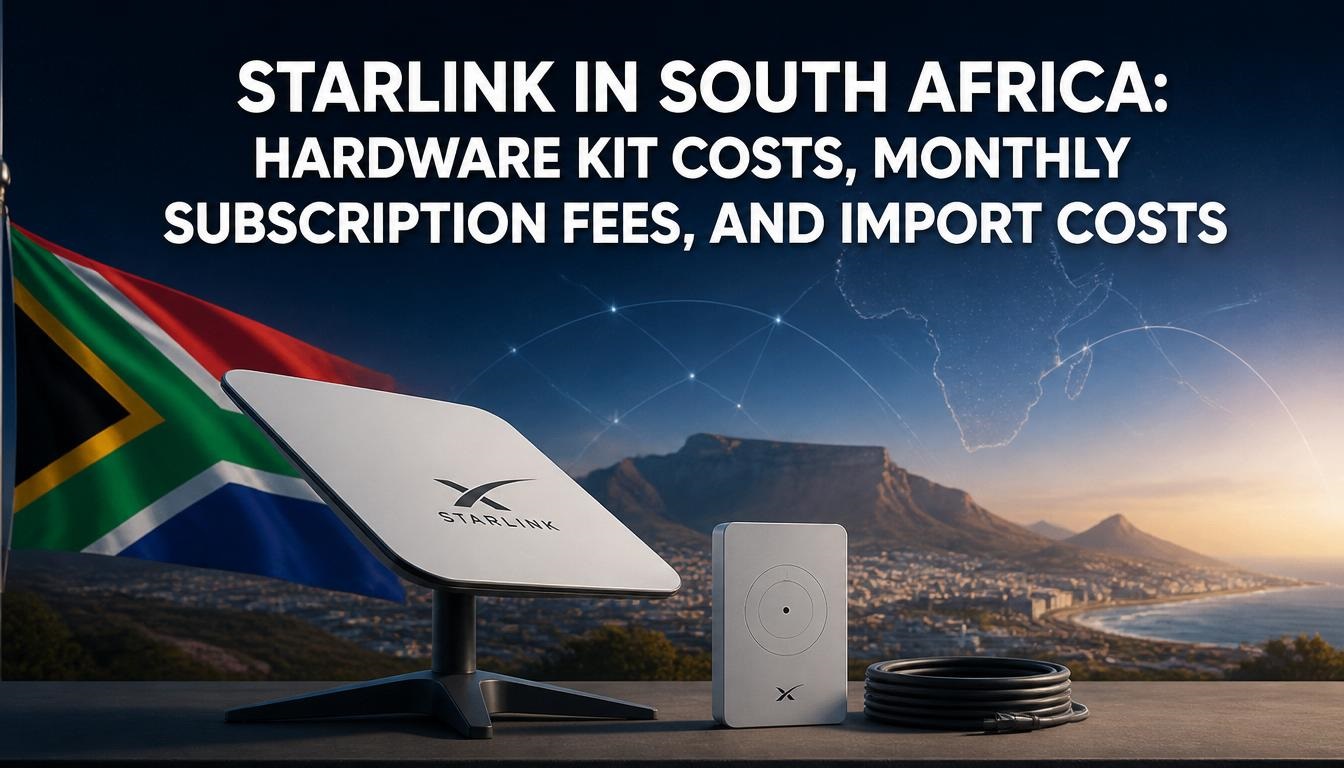
If you decide to acquire a setup, you have two primary dish options: the Starlink Standard Gen 3 Kit and the Starlink Mini Kit.
Official Retail MSRP vs. South African Reseller Prices
Because you cannot buy directly from Starlink’s South African portal, you will pay a markup for third-party import logistics, clearance, and courier delivery.
| Hardware Model | Direct Regional Price (Approx. ZAR Equivalent) | Local Reseller / Imported Price in SA | Ideal Use Case |
| Starlink Standard (Gen 3) | ~R6,800 – R7,500 | R9,500 – R12,500 | Permanent home installation, high bandwidth, heavy multi-device householding. |
| Starlink Mini | ~R4,260 – R5,600 | R7,500 – R9,500 | Camping, mobile rigs, light remote work, backup during severe load shedding. |
Hardware Specs & Field Experience
-
Gen 3 Standard Dish: Drops the motor from older V2 dishes. You manually align it using the Starlink smartphone app’s built-in compass/gyro sensor. It includes a Wi-Fi 6 router, capable of handling 100 to 300+ Mbps downloads in clear line-of-sight conditions.
-
Starlink Mini: A compact dish with a Wi-Fi router integrated directly into the back of the panel. It can run on a USB-C Power Delivery bank (capable of 100W/20V 5A), making it a favorite for off-grid 12V solar setups.
3. Real Import Costs, Custom Duties, and SARS Taxes
If you buy a dish yourself from an overseas vendor or use an import agency, beware of hidden costs at border control.
-
Customs Clearance & HS Codes: Satellite hardware imported into South Africa falls under specific ICT radio equipment codes.
-
Value Added Tax (VAT): SARS levies 15% VAT on the customs value of the dish.
-
Import Duties: Depending on how the freight forwarder classifies the kit (telecommunications apparatus vs. computing peripheral), import duties typically range between 0% and 15%.
-
Third-Party Logistics Fees: Services that handle the registration in a neighboring country and courier the box straight to your door in Gauteng, Western Cape, or KZN generally charge an all-in concierge fee of R2,500 to R4,500 above the dish cost.
4. Monthly Subscription Fees: Breaking Down the Plans
To keep your dish connected, you pay a monthly service fee billed in the foreign currency of the registration country (e.g., Mozambican Metical MZN or USD $). Below is what those costs translate to in South African Rand (ZAR) based on standard conversion rates.
| Package Tier | Overseas Billing Rate | Estimated Monthly Cost in ZAR | Data Cap / Performance Features |
| Regional Roam (Unlimited) | ~3,100 MZN | ~R900 – R1,260 / month | Uncapped mobile data across the region; subject to congestion deprioritization during peak hours. |
| Regional Roam (100GB Cap) | Varied regional pricing | ~R540 – R900 / month | High-speed priority for the first 100GB, throttled speed after reaching cap. |
| Residential (Local Address) | N/A (Requires official SA launch) | Estimated target: R800 – R1,100 / month | Fixed location, highest network priority, lower latency. |
Note: Foreign bank transactions incur card conversion surcharges (typically 2% to 3.5% depending on your South African bank).
5. Performance Reality Check: Latency, Load Shedding, and Real Speeds
How does Starlink perform on South African soil?
Speed & Gaming Latency
-
Download Speeds: Typically vary between 80 Mbps and 220 Mbps depending on atmospheric conditions and satellite density overhead.
-
Upload Speeds: Usually fluctuate between 10 Mbps and 25 Mbps.
-
Ping / Latency: Since your traffic bounces from your dish to a Low Earth Orbit (LEO) satellite and down to the nearest ground station (gateway earth station in neighboring regions), ping ranges between 45ms and 90ms to local servers. For competitive gaming (e.g., CS:GO or Valorant on Johannesburg servers), local fiber/5G remains superior. For streaming 4K video, Zoom calls, and heavy software downloads, Starlink excels.
Load Shedding & Weather Resilience
Unlike local cell towers whose battery backups drain during extended Stage 4+ load shedding, satellite links stay online as long as your dish and router have power.
Rain fade is minimal during light showers, but heavy Highveld thunderstorms will cause brief packet drops.
Interactive Discussion: What’s Your Off-Grid Setup?
Are you currently running a Starlink dish imported from a neighboring country, or are you holding out for official ICASA approval and direct South African sales?
Drop a comment below with your experience:
-
What average download/upload speeds are you seeing in your area?
-
Which hardware rig (Gen 3 Standard vs. Mini) are you running on your backup battery system?
Let’s trade setup tips and help other South Africans get the most out of their satellite connectivity!

Joseph Mathebula is a consumer analyst and market researcher at Prices in South Africa. He specializes in tracking local service costs, retail pricing, and travel budgets, helping everyday shoppers navigate the market to secure the best value.