There is a distinct moment in every South African homeowner’s life when you realize that sweeping fine Karoo dust off tiled floors or wrestling pet hair out of a living room carpet is a losing battle. Load shedding schedules, unpredictable weather, and open windows bringing in local grit mean our floors work overtime. When I first plugged in my automated cleaner, I expected a novelty gadget. Instead, it fundamentally changed how I managed weekly maintenance. But stepping into the South African smart home market reveals a massive crossroad: do you buy the high-tech, feature-packed ecosystem of Xiaomi, or do you invest in the legacy cleaning power and rubber-extractor heritage of iRobot’s Roomba?
Navigating local retail pricing, import taxes, and real-world performance requires looking past international marketing fluff. This guide cuts through the noise, offering an in-depth, hands-on comparison tailored explicitly to South African homes, power grids, and budgets.
Understanding the South African Robotic Vacuum Landscape
Buying smart home tech in South Africa comes with unique hurdles. Our power supply can fluctuate, parts availability varies wildly outside major metros like Johannesburg, Cape Town, and Durban, and local housing styles range from compact sectional-title apartments in Green Point to sprawling suburban freestanding homes in Pretoria.
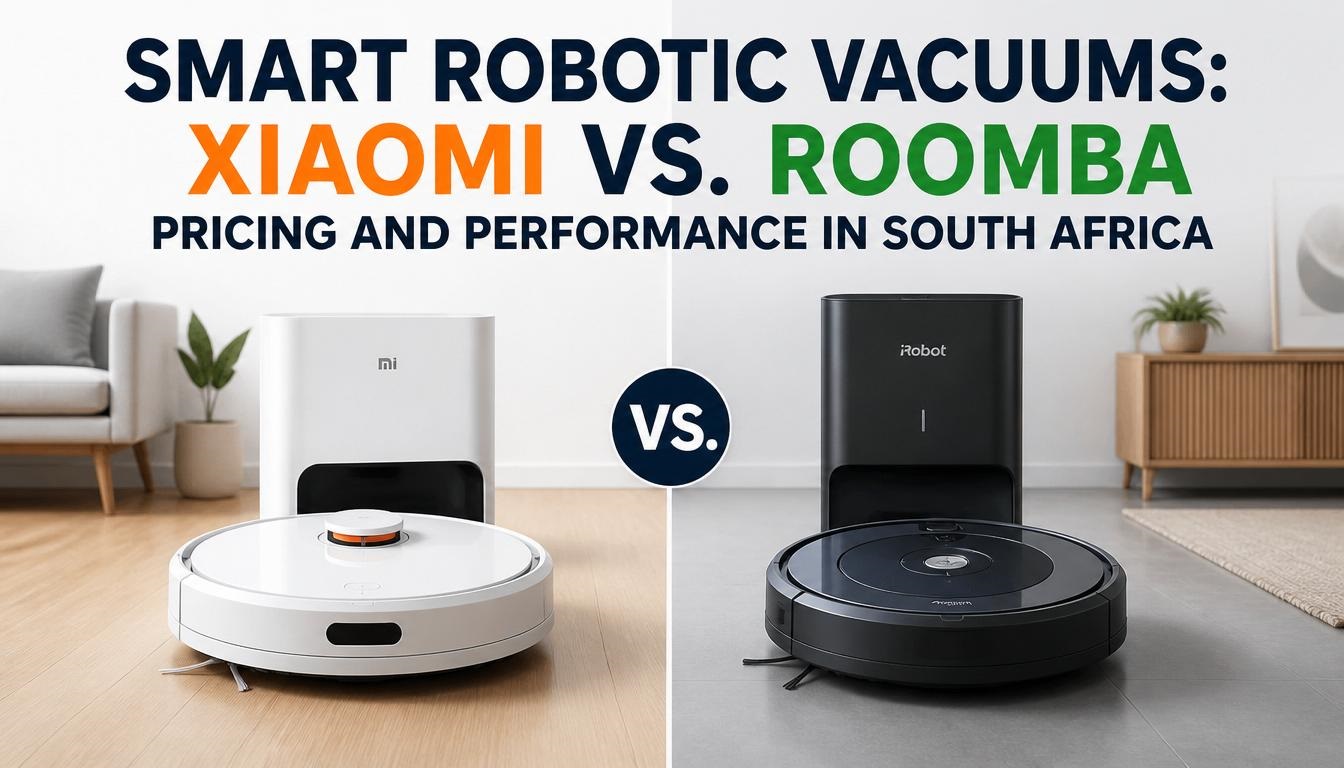
When choosing between Xiaomi and Roomba, you are looking at two entirely different philosophies of home automation:
-
Xiaomi: Focuses on aggressive value-for-money, high suction metrics, advanced LIDAR navigation, and fully integrated mopping systems packed into all-in-one docking stations.
-
Roomba (iRobot): Prioritizes mechanical longevity, patented anti-tangle dual rubber brushes, straightforward app ecosystems, and robust carpet agitation over flashy multi-function docks.
Lineup Overview: Current Models and Pricing in South Africa
Price dictates everything in our current economic climate. Local pricing reflects shipping, customs, and local retail margins across major outlets like Takealot, Hirsch’s, and Computer Mania.
Xiaomi Local Lineup and Pricing
Xiaomi has captured massive market share in South Africa by offering bleeding-edge specs at mid-range price points.
-
Xiaomi Robot Vacuum E5: RRP around R2,499 — An entry-level, slimline unit designed for smaller apartments or hard floors.
-
Xiaomi Robot Vacuum S20: RRP around R4,699 — Introduces proper laser navigation and competent suction for mid-sized spaces.
-
Xiaomi Robot Vacuum S20+: RRP around R7,299 — Steps up with dual rotating mop pads and stronger suction.
-
Xiaomi Robot Vacuum X20+: RRP around R10,999 to R11,999 — A crowd favorite featuring a self-emptying and washing dock.
-
Xiaomi Robot Vacuum 5 Pro: RRP around R15,499 to R18,999 — The flagship tier featuring advanced AI obstacle avoidance and high-end automated maintenance docks.
Roomba Local Lineup and Pricing
iRobot’s Roomba series maintains a premium footprint in South Africa. While older models like the Roomba i7 trade around R11,779 when available through liquidators or online platforms, newer imported multi-functional variants push well past the upper tier of the market, often mirroring or exceeding Xiaomi’s flagship pricing without always bundling the advanced dual-mopping docks standard in competing Asian imports.
| Feature / Model Category | Xiaomi Entry to Mid-Range (E5 / S20 Series) | Xiaomi Flagship (X20+ / 5 Pro) | Roomba Mid-to-High Tier (i7 / Combo Series) |
| Approximate SA Price | R2,499 – R7,299 | R10,999 – R18,999 | R11,779 – R19,999+ |
| Navigation Technology | Gyroscopic / Entry LDS to Precise LDS LiDAR | AI Binocular 3D + LiDAR | vSLAM Camera or Precision LiDAR |
| Primary Floor Focus | Hard floors & low pile carpets | Multi-surface deep clean & active mopping | Deep carpet agitation & hair pickup |
| Docking Station | Standard charging base | Auto-Empty & Self-Washing Clean Stations | Auto-Empty options available on select units |
Performance Showdown: Real-World Testing in Local Conditions
If you live in a home with children or pets, random-bounce vacuums are useless.
-
Xiaomi’s Approach: Xiaomi relies heavily on laser direct structuring (LDS) LiDAR and, on higher-end models like the 5 Pro, AI-powered binocular vision. In testing, Xiaomi units map a standard three-bedroom suburban home in under ten minutes. They systematically clean in neat rows and brilliantly avoid stray charging cables, socks, and pet toys.
-
Roomba’s Approach: Traditional Roombas use vSLAM camera navigation or structured light. While older models occasionally bump gently into furniture legs to map boundaries, they are remarkably reliable. However, in pitch-dark rooms during load shedding, camera-based Roombas can occasionally lose tracking, whereas Xiaomi’s LiDAR units navigate seamlessly regardless of ambient light.
2. Suction Power and Dust Extraction
South African soils are heavy, and fine dust settles deep into carpet fibers.
-
Xiaomi: Boasts impressive raw metrics on paper—ranging from 4,000Pa up to a staggering 15,000Pa on elite configurations. In practice, this high suction pulls microscopic dust out of grouting on tiled and laminate floors with incredible efficiency.
-
Roomba: iRobot rarely publishes raw Pascal (Pa) suction ratings, focusing instead on airflow dynamics and its legendary dual multi-surface rubber brushes. These rubber extractors flex to maintain continuous contact with wood, tile, and carpet, physically beating dirt loose rather than just relying on raw suction. For households with heavy shedders (like Golden Retrievers or Boerboels), Roomba’s brush design resists hair wrap far better than traditional bristled rollers.
3. Mopping Capabilities: The Ultimate Decider
For most South African buyers, a “robot vacuum” must also mop because daily foot traffic leaves stubborn prints on kitchen tiles.
-
Xiaomi: Out of the box, Xiaomi dominates the budget-to-mid mopping segment. Models like the S20+ and X20+ feature dual rotating, pressure-applying mop pads that spin at high RPMs. Combined with self-cleaning docks that wash and dry the pads with hot air, Xiaomi acts as a true autonomous floor scrubber.
-
Roomba: Historically, Roomba was a dry-vacuum specialist. While newer Roomba Combo iterations have closed the gap by introducing mechanical lift-up mop mechanisms and automated washing docks, they remain structurally optimized for vacuuming first, with mopping functioning as a secondary feature unless you invest heavily in their top-tier global flagships, which are often scarce or exceptionally pricey through local channels.
Software, Smart Home Ecosystems, and Load Shedding Resilience
Smart appliances are only as good as their software.
-
Xiaomi Home App: Exceptionally feature-rich. You can draw virtual walls, set no-go zones for specific rugs, schedule multi-floor mapping, and integrate the vacuum directly into Google Home or Amazon Alexa. The trade-off? Because it relies heavily on cloud servers, a severed internet connection during sudden broadband drops or network failures can temporarily disable remote scheduling, though local button-press cleaning always works.
-
iRobot Home App: Clean, intuitive, and highly reliable. It excels at routine automation, prompting you when maintenance is needed and tracking filter health accurately.
The Load Shedding Factor: South African power outages take a toll on lithium-ion batteries. Both brands handle power cuts well, automatically pausing jobs and returning to base if power drops. However, Xiaomi’s charging docks tend to draw sensitive power regulation components; using a surge-protected plug adapter is non-negotiable for protecting your investment against Eskom surges.
Maintenance, Consumables, and Long-Term Value
Owning a robotic vacuum means budgeting for replacement consumables: HEPA filters, side brushes, main rollers, and mop pads.
-
Xiaomi Consumables: Readily available online via Takealot or specialized local tech importers. Because Xiaomi shares parts across many sub-brands, finding affordable third-party replacement packs (often containing months of filters and brushes for a few hundred Rand) is easy.
-
Roomba Consumables: Official iRobot replacement parts are expensive and tightly controlled. While genuine parts ensure optimal performance, the ongoing cost of ownership over a 3-to-5-year lifespan is notably higher than Xiaomi.
Final Verdict: Which One Should You Buy?
Choosing between the two depends entirely on your flooring mix and feature priorities:
-
Buy the Xiaomi if: You want maximum value for money, excellent hard-floor vacuuming coupled with true rotating dual-pad active mopping, and hands-free convenience via a self-emptying/washing dock without spending a fortune. It is the undisputed king of feature-to-price ratio in South Africa.
-
Buy the Roomba if: Your home is predominantly carpeted, you own heavy-shedding pets, and you prioritize rugged mechanical durability and legendary anti-tangle rubber rollers over advanced mopping features.
Join the Discussion
Which side of the fence are you on when it comes to automated home cleaning in South Africa? Have you experimented with budget imports, or do you swear by premium legacy brands? Drop a comment below sharing your floor type, your pet situation, and any questions about how these vacuums handle local dust—let’s talk real-world performance!

Joseph Mathebula is a consumer tech analyst and market researcher at Prices in South Africa. He specializes in tracking smartphone prices and consumer electronics, helping everyday shoppers navigate the market to secure the best value.