If you’ve spent any time living in South Africa over the last few years, you know the sound: that sharp clack of the main trip switch flipping back on after a load shedding slot ends, followed immediately by the collective holding of breath across the house.
Will the fridge compressor kick on? Did the fiber router survive the spike? Is the TV going to turn on with a black screen?
Grid switching, load shedding transients, and Highveld lightning strikes wipe out millions of Rands worth of home electronics across South Africa every year. Most homeowners head straight to the nearest hardware store, buy a R199 red surge plug, plug their R20,000 OLED TV into it, and assume they are fully covered.
That assumption usually turns into an expensive lesson.
Point-of-use plug adaptors have a specific role, but relying on them as your sole line of defense against severe grid spikes or lightning-induced surges is like using an umbrella to stop a high-pressure fire hose. To build real protection, you need to understand how Type 2 Distribution Board (DB) surge arresters work alongside Type 3 plug-in protectors, what both actually cost in SA, and how to stay compliant with South African National Standards (SANS 10142-1).
The South African Grid Problem: Why Voltage Spikes are Worse Here
Voltage surges come in two distinct flavors: fast high-voltage transients (like a lightning strike hitting a nearby line) and sustained over-voltage/under-voltage events (which happen when power is restored to a neighborhood after stage 4 or stage 6 load shedding).
When the municipality re-energizes a feeder line, thousands of inductive loads—geysers, air conditioners, pool pumps, and fridge compressors—try to draw power simultaneously. This creates a massive, instantaneous voltage swell that can push supply well past the standard 230V rating, often peaking at 300V to 400V for a fraction of a second, or causing a prolonged brownout.
-
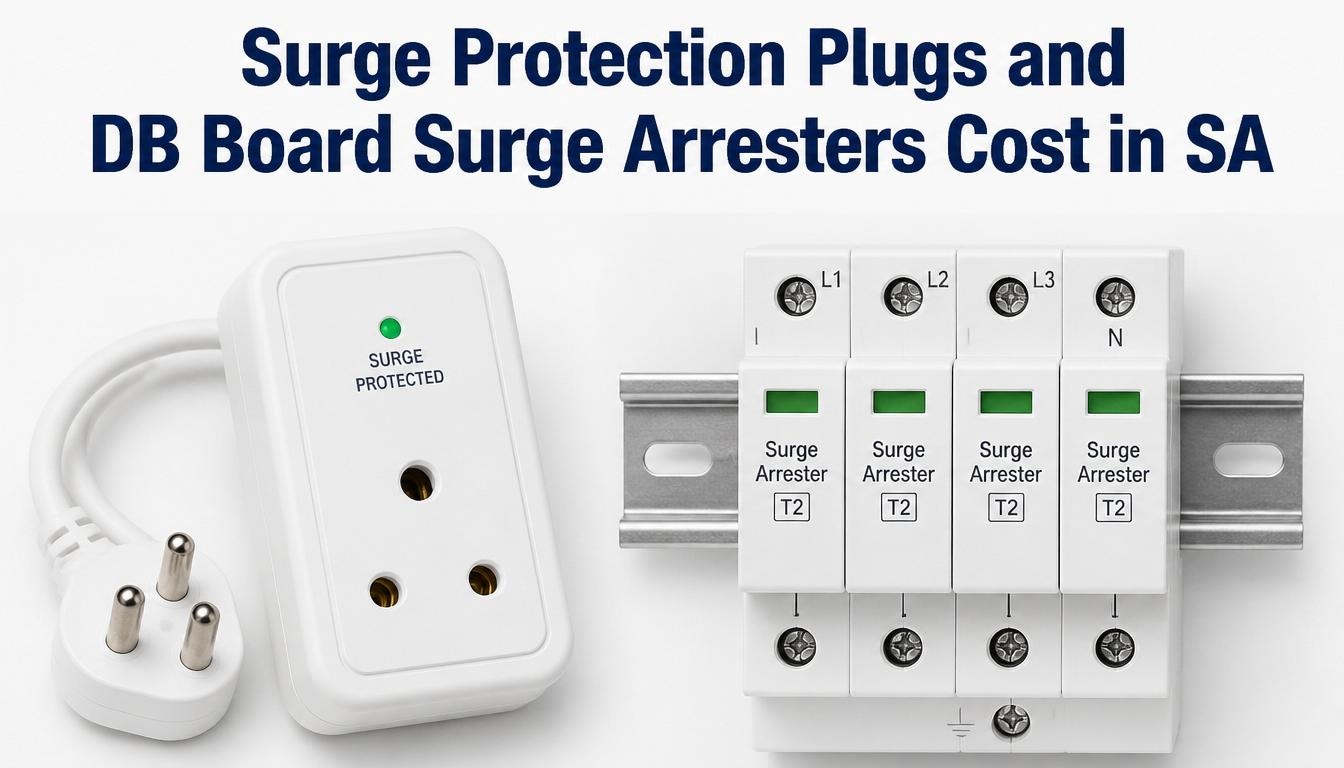
Standard Plug Adaptor (Type 3): Protects single localized outlets. Diverts small voltage spikes (under 1,000 Joules). Ideal for laptops, TVs, and small routers.
-
DB Board Surge Arrester (Type 2): Protects the entire electrical panel and all downstream circuits. Diverts massive surge currents (10kA to 40kA). Ideal for inverters, fridges, built-in appliances, and house-wide defense.
While a plug adaptor uses a small component called a Metal Oxide Varistor (MOV) to absorb minor electrical noise, a heavy voltage kick from a substation switch will instantly fry that component, leaving your connected appliances completely exposed to the remainder of the surge.
1. Point-of-Use Surge Protection Plugs (Type 3)
Type 3 surge protectors are the most common defense mechanism. They clamp low-level voltage spikes right at the wall socket. However, not all surge plugs are built the same, and picking the wrong one for a specific appliance can leave you unprotected.
Popular Surge Plug Categories in South Africa
-
Standard Multi-Plug Surge Strips: Feature multiple 3-pin and 2-pin sockets with an internal thermal-fuse MOV. These are rated in Joules (energy absorption capacity).
-
Voltage-Monitoring / Delay Plugs (Fridge/TV Safes): Instead of just clamping high voltage, these actively disconnect the power if the voltage drops too low (brownout) or spikes too high. When grid power returns, they enforce a 3-to-5-minute delay before restoring power, allowing the local transformer and gas pressures in compressor motors to stabilize.
-
High-Surge Dedicated Adaptors: Compact single or double-outlet red plugs rated for higher clamping currents (often 6kA to 10kA).
Current Market Pricing for Surge Plugs in South Africa
Below is an overview of what you can expect to pay across South African retailers for reliable, brand-name point-of-use surge protection:
| Plug Type / Model | Target Appliances | Average Price Range (ZAR) | Key Protection Feature |
| Basic 3-Way / 4-Way Surge Adaptor (PowerWorx / Ellies) | Laptops, lamps, small phone chargers | R110 – R250 | Basic MOV clamping against minor line noise. |
| Fridge/Appliance Protection Plug (Electricmate / Clearline) | Refrigerators, freezers, ice makers | R250 – R680 | Voltage monitoring + 3 to 5-minute startup delay mechanism. |
| Media / TV Surge Strip (8 to 12 Way with USB) | OLED/LED TVs, soundbars, gaming consoles | R350 – R850 | Higher Joule rating (1000J+), overload circuit breaker reset. |
| Telecom / Network Line Protector (Clearline / Voltex) | Fiber ONTs, ADSL/Ethernet routers, CCTV | R450 – R900 | Shields both 230V power and RJ45/RJ11 copper data lines. |
Real-World Experience Tip: If you are buying a surge plug for a double-door fridge or chest freezer, do not buy a standard surge plug. Buy an active voltage protection plug with a delayed reconnect timer. Refrigeration compressors lock up if power flickers on and off in rapid succession, generating massive internal heat that burns out the motor windings long before a standard surge plug ever triggers.
2. DB Board Surge Arresters (Type 2)
A Distribution Board (DB) surge arrester—also called a Surge Protective Device (SPD)—is installed directly inside your main electrical panel right after the main isolator switch.
Instead of waiting for a high-voltage spike to travel down your home’s copper wiring into your living room, a DB surge arrester catches the spike at the entry point of your property and safely dumps thousands of amperes of excess current directly into the earth spike outside.
Flow of Power and Protection in a DB Board
Grid Power / Eskom Supply feeds directly into the Main DB Isolator. From there, it splits into two paths:
-
The DB Surge Arrester: Dumps high-voltage surges safely straight down to the external Earth Spike.
-
The Earth Leakage Switch: Supplies clean power down to individual home circuits (Lighting, Plugs, Geyser).
Types of DB Board Surge Protection
-
Class 1 / Type 1 (Lightning Arresters): Designed for direct lightning strikes. Usually required on rural farms with overhead power cables or structures fitted with external lightning masts.
-
Class 2 / Type 2 (Surge Arresters): The standard requirement for urban homes, residential complexes, and businesses. Protects against indirect lightning strikes and grid switching transients.
-
Single-Phase vs. Three-Phase: Single-phase DBs require a 1-Pole + Neutral (1P+N or 2-pole) unit, while three-phase DBs require a 3-Pole + Neutral (3P+N or 4-pole) unit.
Hardware Costs for DB Board Surge Arresters
Hardware prices vary based on the maximum discharge current, measured in kiloamperes (kA), and brand reputation:
| Unit Type & Brand | Capacity | Average Hardware Cost (Excl. VAT) | Mounting Type |
| CBI 1P / 2P Surge Protector | 10kA – 20kA | R320 – R600 | Dual Mount (CBI Mini-Rail & Standard DIN Rail) |
| Schneider Easy9 1P+N Surge Arrester | 20kA | R450 – R900 | Standard 35mm DIN Rail |
| ABB / Dehn OVR Type 2 SPD | 20kA – 40kA | R1,200 – R2,500 | Standard 35mm DIN Rail |
| CBI 3P+N Three-Phase SPD | 20kA | R1,250 – R2,400 | Dual Mount / DIN Rail |
| DC Surge Arrester (For Solar Inverters) | 20kA – 40kA DC | R550 – R1,000 | DIN Rail (PV Array DB Boxes) |
Installation and Labor Costs in SA
Installing a DB arrester is not a DIY job. Under SANS 10142-1 regulations, modifying your distribution board must be executed or supervised by a registered Department of Employment and Labour electrical contractor who can issue or update a Certificate of Compliance (CoC).
Here is a breakdown of average professional installation charges across major metropolitan areas (Gauteng, Western Cape, KZN):
| Expense Item | Estimated Cost Range (ZAR) |
| Type 2 Single-Phase SPD Unit (Standard 20kA) | R400 – R850 |
| Labor (Electrician call-out + 1–2 hours work) | R750 – R1,500 |
| Auxiliary Materials (Wiring, dedicated MCB/fuse protection if required) | R150 – R350 |
| CoC Revision / Issuance Fee (If required by home insurance) | R850 – R1,800 |
| Total Professional Turnkey Cost | R2,150 – R4,500 |
Side-by-Side Comparison: Plugs vs. DB Board Arresters
To decide how to allocate your budget effectively, consider how these two protective measures compare across key performance categories:
| Protection Factor | Point-of-Use Plug Adaptors | DB Board Surge Arresters |
| Scope of Coverage | Only devices plugged directly into the unit. | The entire installation (all plug points, lights, built-in appliances). |
| Surge Capacity | Low to Moderate (typically 1,000J to 3,000J / 3kA to 6kA). | High to Extreme (20kA to 40kA+ discharge current). |
| Response Time | Extremely fast (less than 1 nanosecond), close to appliance. | Very fast (less than 25 nanoseconds), clamps before entering home circuit. |
| Visual Status Indicator | Simple LED light (On = Protected, Off = Blown). | Color indicator flag (Green = OK, Red = Faulty) or status window. |
| Protects Hardwired Items? | No. (Geysers, stoves, aircons, gate motors are bypassed). | Yes. Covers all fixed electrical installations. |
| Installation Requirement | Plug and Play (No tools required). | Professional installation by a registered electrician required. |
| Price Point | Low upfront cost per device (R150 – R600). | Moderate system investment (R2,000 – R4,500 installed). |
Building a Two-Tier Protection Strategy
Neither solution is completely sufficient on its own. Electrical engineers recommend a tiered surge defense strategy to achieve optimal protection:
-
Tier 1 (Heavy Diverter): DB Board Class 2 Arrester installed at the main panel. Dumps up to 90% of spike current into the main earth spike outside.
-
Tier 2 (Fine Clamper): Point-of-Use Surge Plug or Fridge Safe at the wall socket. Cleans up remaining residual low-voltage ringing before it enters sensitive digital circuitry.
Why You Need Both
-
The DB Arrester (Tier 1) handles the heavy lifting. When a massive 20,000-Amp transient enters from the municipal pole, the DB arrester dumps 80% to 90% of that energy into your main earth electrode before it reaches your living room wiring.
-
The Plug Adaptor (Tier 2) cleans up the leftover voltage (called the residual voltage or clamping voltage). It also protects sensitive devices against internally generated spikes—such as when a large pool pump or vacuum cleaner shuts off inside your own house and sends a micro-spike down the local ring circuit.
Crucial SANS 10142-1 Compliance & Earth Wire Rules
Installing a surge arrester without checking your earthing system is a waste of money.
Surge protection devices do not magically absorb or dissipate electricity into thin air; they act as high-speed gatekeepers that redirect excess current directly to Earth.
1. Earth Resistance Matters
If your property’s earth electrode (the copper rod driven into the ground outside your DB board) is corroded, disconnected, or installed in dry sand with high soil resistance, a surge arrester cannot clear the fault. The electrical energy will take the path of least resistance—which often means routing right through your home electronics instead.
When your electrician fits a DB arrester, ask them to perform a loop impedance / earth resistance test to verify that your earth path meets SANS 10142-1 standard limits.
2. Lead Length Constraints
Inside the DB board, the connecting wires between the live busbar, the surge arrester, and the earth bar must be as short and straight as possible (ideally under 500 mm in total length). Sharp bends or long wiring loops create inductive resistance, which slows down the SPD’s response time during a high-frequency lightning stroke.
3. Indicator Window Maintenance
Unlike circuit breakers, which flip down when tripped, surge arresters contain sacrificial components (MOVs) that degrade over time after taking multiple hits.
Check your DB board visual window every quarter:
-
Green Indicator: The internal module is active and operational.
-
Red / Clear Indicator: The sacrificial module has taken a lethal strike and is spent. Modern DIN-rail SPDs feature removable cartridges, allowing you to unplug the blown cartridge and slide in a replacement module without rewiring the entire board.
Home Insurance and Surge Claims in South Africa
Over the past three years, major South African short-term insurers have tightened their policies around power surge damage due to the frequency of grid failures.
To ensure your claim isn’t rejected following a severe power grid incident, keep these operational rules in mind:
-
Check Your Excess Tier: Many insurance policies carry a significantly higher excess payment specifically for power surge claims compared to standard lightning strikes.
-
Proof of Compliance: If a claim involves hardwired equipment (like an inverter, pool motor, or induction stove), insurers frequently request a valid Certificate of Compliance (CoC) confirming that the distribution panel complied with SANS standards at the time of installation.
-
Mandatory Protection Clauses: Certain policy underwriters now explicitly require policyholders to have an installed Class 2 DB surge arrester or point-of-use protectors on high-value items (such as home entertainment centers or solar inverter installations) as a condition of power surge cover.
Practical Action Plan: What Should You Buy First?
If you have a fixed budget, prioritize your purchases in this order to maximize coverage:
-
Priority 1: Protect High-Risk Compressors (R250 – R600)
Get dedicated voltage-delay protection plugs (like a Fridge Safe or TV Safe) on your main refrigerator, chest freezer, and air conditioner.
-
Priority 2: Install a DB Board Surge Arrester (R2,000 – R3,500 Installed)
Hire an electrician to install a 20kA or 40kA Class 2 SPD in your main DB board. This instantly extends baseline protection to every single light bulb, wall socket, geyser, and built-in appliance in your home.
-
Priority 3: Add Fine Clamping to Sensitive Electronics (R350 – R800)
Place multi-plug high-surge strips on sensitive digital hubs—such as your home office desk, gaming setup, fiber ONT, and main TV console.
Community Discussion: What Has Your Experience Been?
Have you experienced a major appliance burnout following grid restoration in your area? Do you rely solely on plug-in adaptors, or have you installed a dedicated DB board surge arrester in your home panel?
Drop your experience, questions, or product recommendations in the comments section below to help other South African homeowners protect their setups!

Joseph Mathebula is a consumer analyst and market researcher at Prices in South Africa. He specializes in tracking local service costs, retail pricing, and travel budgets, helping everyday shoppers navigate the market to secure the best value.