Securing a spot in a South African nursing program feels like winning the lottery, but opening the fee structure can quickly turn that excitement into serious financial anxiety. Tuition figures published on institution websites rarely paint the full picture. Between mandatory South African Nursing Council (SANC) fees, clinical placement transport, medical equipment, background checks, and uniform kits, hidden out-of-pocket expenses add thousands of Rands to your annual budget.
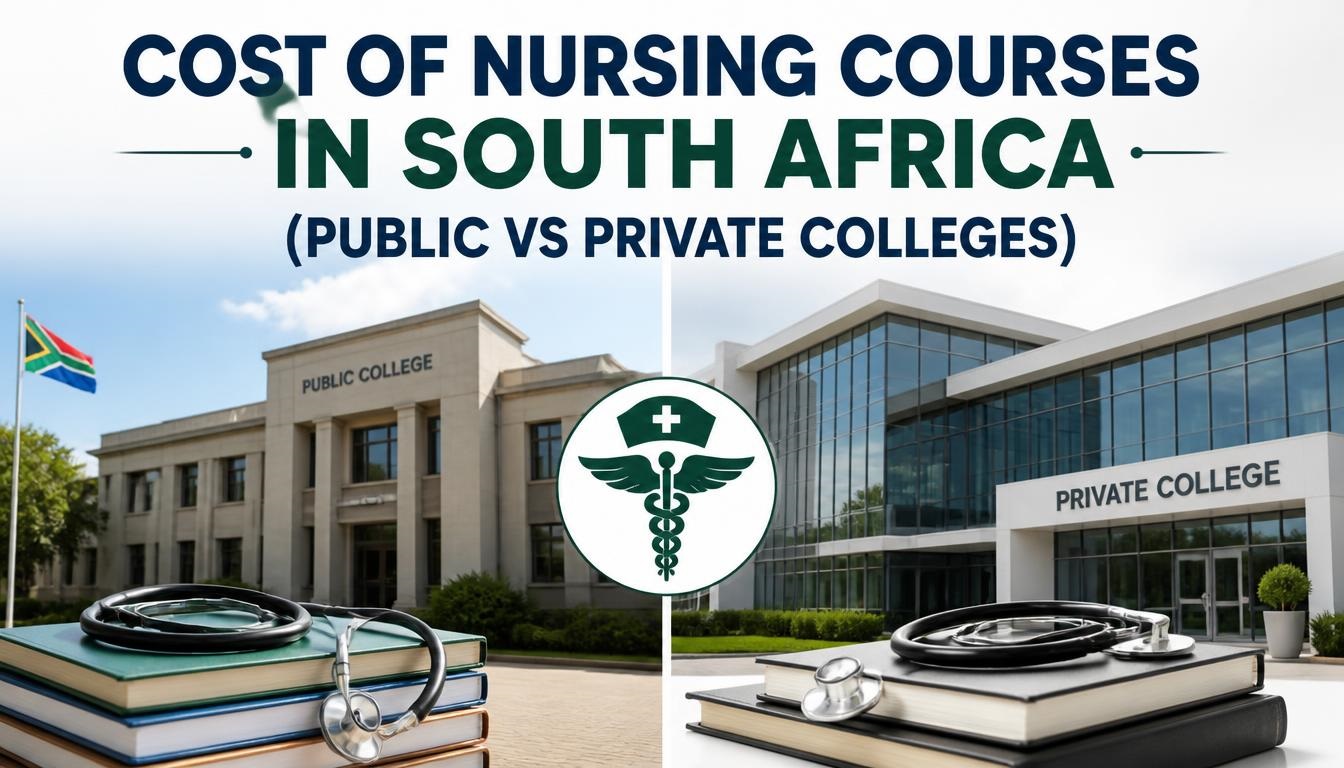
Quick-Answer Summary: Nursing qualification costs in South Africa range from R12,000 to R45,000/year at public provincial colleges, R40,000 to R68,000/year at public universities, and R48,000 to R85,000/year at private hospital colleges (Netcare, Life Healthcare, Mediclinic). Top Choice: Provincial Nursing Colleges (best affordability & direct clinical exposure). Best Budget: Public Universities with full NSFAS coverage. Buyer Warning: Watch out for unaccredited private “nursing schools” charging R30,000+ without SANC registration numbers.
The True Price Trap of Studying Nursing in Mzansi
The demand for qualified nurses across Gauteng, KwaZulu-Natal, the Western Cape, and rural provinces is sky-high, but training capacity remains tightly choked. When public nursing colleges open their online portals, hundreds of thousands of applicants compete for a tiny fraction of available seats. This bottleneck forces desperate students toward private nursing education institutions (PNEIs), where fee structures vary wildly.
Understanding the exact cost breakdown is essential before signing any registration agreement or paying a non-refundable application fee. Tuition fees differ significantly depending on whether you pursue a 1-year Higher Certificate in Nursing (NQF Level 5), a 3-year Diploma in Nursing (NQF Level 6), or a 4-year Bachelor of Nursing (NQF Level 8).
SA Nursing Training Fee Matrix: Public vs Private Comparison
This comparative matrix breaks down current annual fees, accreditation standing, payment flexibility, and additional operational costs across South Africa’s main nursing education pathways.
| Institution Type | Qualification Offered | Avg. Annual Tuition (ZAR) | 15% VAT Status | Funding Options | Real-World Value Rating |
| Provincial Colleges (e.g., SG Lourens, Lilitha, Ann Latsky) | Higher Certificate / Diploma | R12,000 – R28,000 | Exempt / Included | Provincial Bursaries, NSFAS (Select) | 4.8 / 5.0 |
| Public Universities (e.g., UP, UWC, DUT, UKZN) | 4-Year Bachelor Degree (BCur) | R40,000 – R68,000 | Exempt | NSFAS, University Merit Bursaries, Fundi | 4.6 / 5.0 |
| Netcare Education (Private Hospital College) | Higher Certificate / Diploma | R65,000 – R78,000 | Included | Monthly Installments, Student Loans, Eduloan | 4.1 / 5.0 |
| Mediclinic Higher Education | Higher Certificate / Diploma | R60,000 – R85,000 | Included | Debit Order Plans, Bank Student Loans | 4.2 / 5.0 |
| Life Healthcare College | Higher Certificate / Diploma | R47,000 – R52,000 | Included | 50% Upfront + 4-Month Settlement | 4.3 / 5.0 |
| Private NPO Colleges (e.g., Ukwazi School of Nursing) | Higher Certificate / Diploma | R45,000 – R62,000 | Included | Self-funded, Payment Agreements | 3.8 / 5.0 |
Note: All prices represent current market averages per academic year and exclude textbook, uniform, and clinical equipment costs.
Value, Durability, and Real Return on Investment
Evaluating a nursing qualification requires looking far beyond the upfront tuition invoice. Return on investment depends heavily on clinical placement exposure, SANC board pass rates, and immediate post-graduation employability.
Public Institutions (Provincial Colleges & Universities)
-
Cost Efficiency: Unbeatable annual tuition rates starting around R12,000 at provincial campuses. Full NSFAS coverage is widely available for eligible students with a combined household income under R350,000/year, covering tuition, accommodation, transport allowances, and book allowances.
-
Clinical Exposure: Public nursing students complete practical hours in high-volume regional public hospitals (e.g., Chris Hani Baragwanath, Tygerberg, King Edward VIII). This environment builds resilience and fast-paced clinical skills.
-
Financial Red Tape: Public bursary allocations can suffer from administrative delays. Stipends or allowance payouts are sometimes delayed, leaving students to cover immediate living expenses out of pocket for the first few months of the academic term.
Private Hospital Nursing Colleges (Netcare, Mediclinic, Life Healthcare)
-
Modern Infrastructure: Private hospital simulation labs feature updated medical technologies, modern mannequins, and well-maintained training facilities.
-
Direct Placement Access: Practical work takes place in private hospital wards, offering clean working conditions and direct exposure to private healthcare protocols.
-
Heavy Upfront Costs: Expect strict deposit terms. Most private institutions require a 50% deposit upon registration, with the remaining balance spread over 4 to 10 months. NSFAS funding is generally not available for private hospital college tuition.
Insider Deal & Savings Spotlight:“To save up to R8,000 in your first year, never buy brand-new prescribed medical textbooks directly from campus bookstores. Use student community boards or platforms like Takealot and local Facebook buy-and-sell groups to buy second-hand SANC-approved reference guides. Additionally, apply for corporate bursaries offered by private hospital networks early in your matric year—some private groups offer partial fee discounts or work-back agreements to high-performing candidates.”
Budgeting strictly for published tuition fees is a financial trap. Real-world training conditions in South Africa introduce mandatory, non-negotiable expenses that must be planned for in advance:
-
SANC Registration & Exam Fees: You must register as a student nurse with the South African Nursing Council (SANC). Expect an initial student registration fee of R350 – R600, plus SANC annual fees and final examination costs ranging from R2,000 to R3,000 upon completion.
-
Mandatory Uniform & Equipment Kits: Student nurse uniforms, comfortable non-slip clinical shoes, medical watch, stethoscopes, diagnostic penlights, and protective gear cost between R3,000 and R5,000 upfront.
-
Indemnity Insurance & Health Screenings: Private institutions like Mediclinic require mandatory professional indemnity cover (roughly R360 – R450/year). Hepatitis B vaccinations, occupational health clearances, and drug screenings add another R1,500 – R2,500 prior to clinical rotation entry.
-
Commuting & Shift Work Logistics: Clinical hours include early morning (07:00) and night shifts (19:00). Public transport options like Metrorail or standard taxi routes are rarely operational during shift changes. Budgeting for local rideshare services or reliable personal transport to clinical sites is mandatory.
-
Load-Shedding & Digital Access Requirements: Course materials, clinical logs, and academic portals require steady internet access and reliable devices. Factor in a sturdy laptop and a reliable power bank or uninterpretable power setup to ensure assignments are completed during local power outages.
Frequently Asked Questions
Do private nursing colleges in South Africa accept NSFAS funding?
No, NSFAS bursaries do not cover tuition or living allowances at private nursing colleges or private higher education institutions (e.g., Netcare Education, Mediclinic Higher Education). NSFAS funding is strictly reserved for eligible public universities and public TVET/provincial nursing colleges.
How do I check if a private nursing college is fully accredited?
Before paying any application fee, verify that the college holds active accreditation with three main bodies:
-
SANC (South African Nursing Council): Must be listed on the official SANC register of accredited nursing education institutions.
-
DHET (Department of Higher Education and Training): Must hold a valid registration certificate as a private higher education provider.
-
CHE (Council on Higher Education): Qualification must be registered on the NQF Framework.
What happens if I fail a subject or practical rotation module?
Programme extensions are billed per module. At private colleges, repeating a single theoretical subject or clinical placement block costs between R4,500 and R12,000, depending on credit weight and required clinical oversight hours.
Community Discussion: What Are Your Local Quotes?
Have you recently applied or registered at a nursing college in your province? Share the tuition rates, registration deposits, or unexpected hidden fees you’ve encountered at local institutions like SG Lourens, Lilitha, Netcare, or Mediclinic. Drop your experience in the comments below to help fellow South African students navigate their career journey!
Disclaimer: Nursing course fees and SANC regulatory rates fluctuate over time. Figures published in this guide reflect independent market tracking across public and private South African nursing institutions at the time of publication.

Joseph Mathebula is a consumer tech analyst and market researcher at Prices in South Africa. He specializes in tracking smartphone prices and consumer electronics, helping everyday shoppers navigate the market to secure the best value.