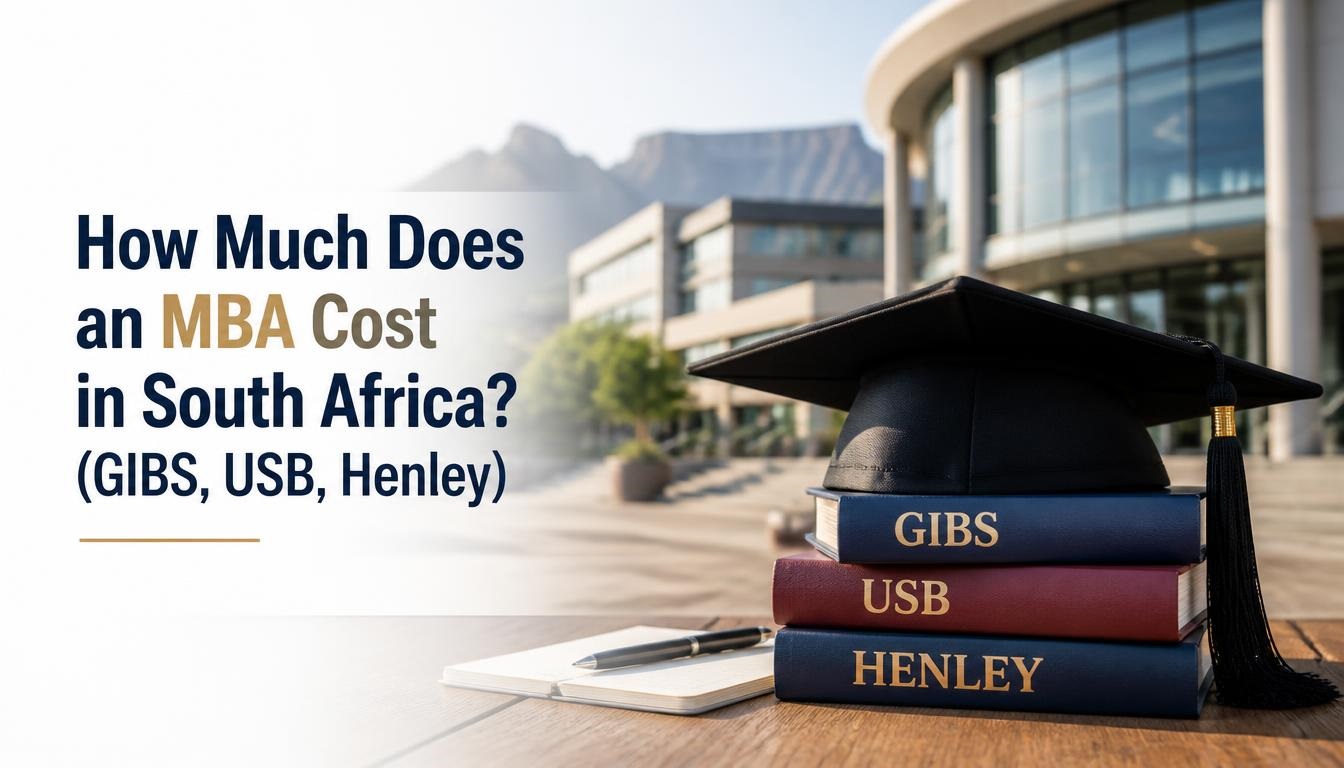
Quick-Answer Cost Summary: Local SA MBA tuition now ranges from R355,000 to R415,800+. Top choices: GIBS (Best Executive Networking, ~R355,000–R365,000), Stellenbosch USB (Best Innovation & Blended Learning, ~R383,490), and Henley Africa (Best Triple-Accredited Global Value, ~R415,800). Warning: Mandatory international study tours, textbooks, and interest on student bank loans can instantly inflate your total bill by R40,000 to R120,000+.
Dropping hundreds of thousands of Rands on a Master of Business Administration isn’t a decision you make over a casual Saturday braai. With inflation squeezing corporate budgets and tuition fees rising, signing up for an MBA in South Africa requires cold, hard financial calculation.
Between career progression, networking access, and pure ROI, local business schools make massive promises. But behind the polished brochures lie hidden line items—international travel levies, registration deposits, and heavy interest rates on study loans. We tracked tuition structures across South Africa’s elite business schools—Gordon Institute of Business Science (GIBS), Stellenbosch Business School (USB), and Henley Business School Africa—to break down what you actually pay, where the traps are, and whether the paper is worth the ZAR layout.
1. Comparing Top SA Business School Costs (ZAR)
Navigating business school fees requires looking past the baseline sticker price. The matrix below breaks down current tuition costs, delivery formats, and core terms across SA’s leading institutions:
| Business School | Estimated Base Tuition (ZAR) | Delivery Format | VAT Included? | Key Contract / Payment Terms | Overall Value Rating |
| GIBS (Univ. of Pretoria) | R355,000 – R365,000 | Part-time, Short-Block, Long-Block | Yes (15% VAT) | R25,000 non-refundable acceptance deposit. Payment plans available per module/year. | 4.8 / 5.0 (Top Corporate Network) |
| Stellenbosch USB | R383,490 | Modular & Blended (2 Years) | Yes (15% VAT) | Discounted financing via Capitec Credit Solution. Registration deposit applies. | 4.7 / 5.0 (Best Regional Leadership) |
| Henley Africa | R415,800 | Flexible Executive / Part-time | VAT Exempt (Foreign HEI rules) | R13,500 discount for upfront cash payment. Stage-by-stage pay-as-you-go available. | 4.9 / 5.0 (Triple International Crown) |
| Wits Business School (WBS) | R387,420 | Part-time / Full-time (2 Years) | Yes (15% VAT) | Standard public university fee rules; R9,340 upfront registration. | 4.5 / 5.0 (Solid Public Competitor) |
2. Real-World Value & Durability Breakdown
Investigating an MBA isn’t just about surviving the two-year academic stretch—it’s about long-term professional leverage. Here is how the top three stack up when exposed to real-world career pressures:
-
GIBS (Gordon Institute of Business Science)
-
The Upside: Unrivalled connection to Sandton’s corporate ecosystem. Highly practical, strategy-driven curriculum that resonates with South African boardrooms.
-
The Downside: Heavy class schedule and intensive block releases can stretch working professionals to absolute burnout without employer support.
-
-
Stellenbosch Business School (USB)
-
The Upside: Triple-accredited (AACSB, AMBA, EQUIS) with a strong focus on responsible leadership and development finance. Excellent flexible, blended-learning options.
-
The Downside: Travel and accommodation expenses for physical block visits to the Bellville campus add up fast for Gauteng-based students.
-
-
Henley Business School Africa
-
The Upside: Offers a full UK qualification alongside local NQF Level 9 accreditation. The stage-by-stage payment structure provides exceptional cash-flow flexibility for self-funded students.
-
The Downside: Higher baseline sticker price than local public university options.
-
3. Insider Deal & Savings Spotlight
Local Fee-Cutting Strategies: Don’t pay full price out of pocket if you can avoid it. Henley Africa offers up to R13,500 off if you settle your full tuition upfront. If you are self-funding, look at specialised credit facilities—Stellenbosch Business School partners directly with Capitec to offer dedicated education credit up to R500,000 over 84 months at reduced interest rates. Additionally, self-funding professionals can claim tax relief under Section 11(a) of the Income Tax Act if the MBA directly relates to your current trade and job function—speak to your tax practitioner before enrolling.
4. The Real-World South African Reality Test
Doing an MBA in South Africa presents distinct local friction points that international guides completely ignore.
-
Load-Shedding & Grid Stability: Remote lectures, group assignments, and tight thesis deadlines demand uninterrupted power and connectivity. You need to factor in a reliable home UPS, mini-inverter, or backup generator setup (R5,000 – R15,000) to ensure you don’t drop out during evening Zoom electives.
-
Employer Co-Funding Lock-Ins: Many SA corporates (banks, mining houses, and retailers) will happily cover 50% to 100% of your MBA fees via their HR skills development budget. The catch? You will sign a clawback agreement tying you to the company for 2 to 3 years post-graduation. Leave early, and you must repay every cent immediately.
-
Hidden Overseas Tour Costs: Global exposure modules are often framed as highlight reels, but they carry distinct financial stingers. While base tuition might cover the academic side, airfares, visas, accommodation, and foreign currency expenses (converting ZAR to USD or Euros) can easily add R50,000 to R90,000 out of pocket.
-
Financing Options: Local institutions support flexible payment structures via Direct Bank EFT, Mobicred, or student loans through Fundi, FNB, Absa, and Capitec.
Local Consumer Protection & Fee FAQs
Can I cancel my MBA registration and get my money back under the CPA?
If you register as an individual consumer, the Consumer Protection Act (CPA) applies. You have the right to cancel your enrollment, but the business school is legally entitled to charge a “reasonable cancellation fee.” Non-refundable registration deposits (like GIBS’s R25,000 acceptance fee) are rarely returned in full once orientation starts.
Are SA MBA tuition fees exempt from 15% VAT?
Tuition provided by recognized public higher education institutions (like UP/GIBS, Wits, or Stellenbosch) is exempt from VAT under Section 12(h) of the Value-Added Tax Act. Private entities or foreign-based schools like Henley structure their pricing in accordance with local higher education regulations. Always verify whether your fee quote is inclusive or exempt from VAT.
What happens if I fail a module or delay my research report?
Retaking a failed module or extending your dissertation period past the 24-month mark triggers “continuation fees.” Most SA business schools charge between R12,000 and R35,000 per additional semester to keep your registration active.
Community Discussion & Local Price Tracking
Have you recently requested a formal quote or started an MBA at GIBS, USB, Henley, Wits, or UCT GSB? Share the updated figures, hidden fees, or employer bursary conditions you’ve encountered in the comments below!
Disclaimer: Tuition fees, payment structures, and institutional policies fluctuate over time; figures quoted in this guide reflect independent market tracking at the time of publication.

Joseph Mathebula is a consumer tech analyst and market researcher at Prices in South Africa. He specializes in tracking smartphone prices and consumer electronics, helping everyday shoppers navigate the market to secure the best value.