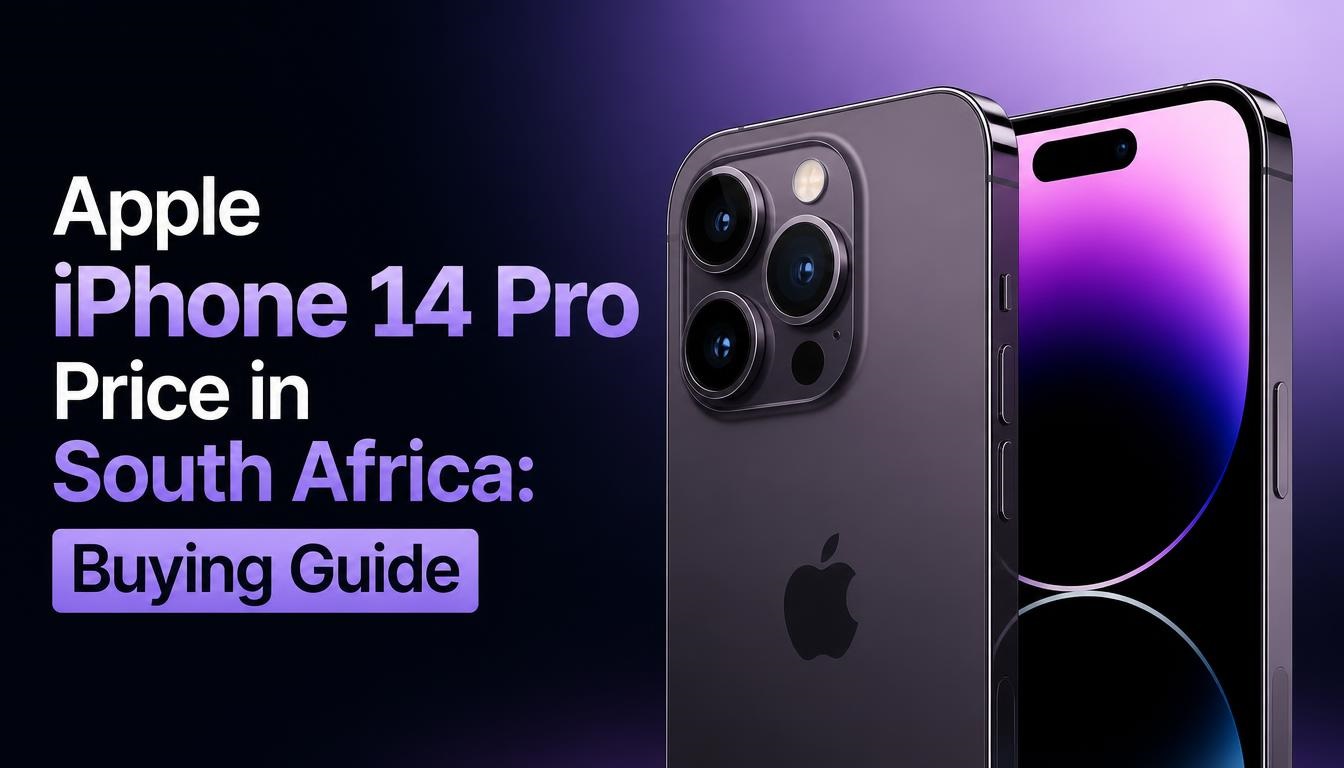
The Apple iPhone 14 remains a powerful and incredibly practical entry point into the Apple ecosystem. Featuring the fast A15 Bionic chip (with an extra GPU core compared to the iPhone 13), stellar battery endurance, and a highly capable dual-camera setup with Action Mode video stabilization, it offers modern flagship performance at a far lower cost.
However, because the iPhone 14 has been on the market for a few years, local retail dynamics have shifted toward clearance promotions and the pre-owned market. Here is a realistic look at pricing and stock availability across South Africa.
While initial launch pricing was much higher, the entry-level iPhone 14 (128GB) cash price typically ranges between R13,999 and R15,499 when bought brand-new from authorized retailers on clearance.
If you are seeing a price tag closer to that R9,000 to R11,000 sweet spot, you are looking at the highly active Certified Pre-Owned (CPO) or refurbished market, which offers exceptional value for money.
The baseline cash pricing across local channels generally splits like this:
128GB (Brand-New Clearance): ~R13,999 to R14,999
128GB (Certified Pre-Owned / Refurbished): ~R9,500 to R11,000
256GB (Certified Pre-Owned / Refurbished): ~R11,500 to R12,500
Note on Location & Stock Availability: Because brand-new factory distribution has slowed down to prioritize newer generations, finding a brand-new box unit in physical brick-and-mortar stores depends heavily on location. Flagship outlets in major hubs like Johannesburg, Cape Town, and Durban are much more likely to have remaining stock or demo units. For the most consistent access and competitive pricing, online channels are your best bet.
Depending on whether you want a brand-new clearance model or a high-quality pre-owned unit, the availability across classic South African storefronts breaks down as follows:
These are the most reliable options for tracking down both end-of-line box stock and verified pre-owned devices:
Takealot: The easiest digital route for immediate pricing comparisons. While Takealot lists brand-new clearance units, it also hosts vetted third-party tech refurbishers selling graded CPO iPhone 14s, complete with platform return policies and user reviews.
Cellucity & 4U: As premium authorized cellular specialists, they frequently run dedicated CPO programs, giving you walk-in access to pristine-grade, rigorously tested pre-owned devices backed by a store warranty.
Makro & Game: Massive mass-mart options where you can use store credit cards, earn loyalty points, or find occasional clearance bundle deals.
HiFi Corp: Regularly features older flagship models on cash promotions or accessible in-store financing.
If you want to purchase a device using an established retail credit facility or store card to break up the cost:
Foschini (TFG): Allows you to use your TFG store card to buy smartphones online or at select high-end jewelry and tech branches within the group.
Mr Price (MRP Money): Provides an accessible route to purchase mobile devices on a monthly clothing/store account line.
PEP & Ackermans: These budget-focused giants deal almost exclusively in entry-level, prepaid Android phones. You will rarely find premium Apple flagships like the iPhone 14 on their physical shelves outside of select ultra-large flagship hyper-stores.
If you prefer to avoid the upfront cash layout, major cellular providers still offer the iPhone 14 on postpaid contracts at highly competitive monthly premiums compared to current flagships:
MTN
Chatz Connect (The country’s largest independent Vodacom dealer network)
Hi Online (Telkom’s official online upgrade and contract portal)
Insist on a Store Warranty for Pre-Owned: If you are buying a CPO or refurbished unit to hit that lower price point, ensure the seller or platform provides a 6-month to 12-month store warranty covering internal hardware defects. Avoid private, unprotected cash handovers on informal classified sites.
Verify Battery Health: If buying pre-owned, check the maximum capacity immediately under Settings > Battery > Battery Health & Charging. You want a reading of 80% or higher to ensure a solid, uninterrupted full day of normal usage.
| Brand | Apple |
| Model | Apple iPhone 14 |
| Announced | 07 September, 2022 |
| Released | 16 September, 2022 |
| Status | Available |
| Price | ZAR 9,000 |
| Type Design Type called form factor refers to a mobile phone's size, shape, and style as well as the layout and position of major components of phone. There are three major form factors seen in mobile phones => bar phones, folding phones and sliding phones. | Bar |
| Dimensions | 146.7 x 71.5 x 7.8 mm (5.78 x 2.81 x 0.31 in) |
| Weight | 172 g (6.07 oz) |
| Protection | IP68 dust/water resistant (up to 6m for 30 min) |
| Colors | Midnight, Purple, Starlight, Blue, Red, Yellow |
| 2G Network | |
| 3G Network | |
| 4G Network | |
| 5G Network | |
| SIM SIM (Subscriber Identity Module) is a small card that contains mobile network subscriber's account information. This allows the phone using the card to attach to a mobile network. The SIM card is most commonly associated with GSM and UMTS mobile networks. Moving a SIM card from one phone to another allows a subscriber to switch mobile phones without having to contact their mobile network carrier. SIM cards can also be used by a phone to store limited amounts of data, such as phone numbers and text messages. | Nano-SIM and eSIM |
| Display Type Display Technology => A number of display technologies and types used in mobile phones => TFT (Thin Film Transistor), IPS (In-Place Switching), OLED (Organic Light Emitting Diode), AMOLED (Active-Matrix Organic Light-Emitting Diode), Super AMOLED (an even advanced version of AMOLED), Resistive Touchscreen (Resistive touchscreens contain two layer of conductive material with a very small gap between them which acts as a resistance), Capacitive Touchsceen (Capacitive touchscreen technology consists of a layer of glass coated with a transparent conductor) | Super Retina XDR OLED, HDR10, Dolby Vision, 800 nits (HBM), 1200 nits (peak) |
| Size | 6.1 inches, 90.2 cm2 (~86.0% screen-to-body ratio) |
| Resolution | 1170 x 2532 pixels, 19.5:9 ratio (~460 ppi density) |
| Display Protection Display Protection => Gorilla Glass is a special alkali-aluminosilicate glass shield with exceptional damage resistance that helps protect mobile displays from scratches, drops, and bumps of everyday use, It is always better to go for a smartphone with Gorilla Glass for that added protection and peace of mind. | Ceramic Shield glass |
| Audio Playback | |
| Video Playback | |
| FM Radio | No |
| Ring Tones | |
| Loudspeaker |
| Main Camera Camera is able to capture photographs and usually videos, The most important characteristics of a camera are the resolution (measured in megapixels), lens focus type (fixed or automatic), higher megapixel cameras are known to capture higher quality photos, but not always a good measurement of the photos quality. |
12 MP, f/1.5, 26mm (wide), 1/1.7", 1.9µm, dual pixel PDAF, sensor-shift OIS 12 MP, f/2.4, 13mm, 120˚ (ultrawide) |
| Camera Features | HDR, Cinematic mode (4K@30fps) |
| Video | 4K@24/25/30/60fps, 1080p@25/30/60/120fps, gyro-EIS |
| Selfie Camera |
12 MP, f/1.9, 23mm (wide), 1/3.6", PDAF SL 3D, (depth/biometrics sensor) |
| Camera Features | HDR, Cinematic mode (4K@30fps) |
| Video | 4K@24/25/30/60fps, 1080p@25/30/60/120fps, gyro-EIS |
| Operating System OS => Every computer system run on a base software called Operating System (OS). Operating System controls all basic operations of the computer (such as smartphone, PDAs, tablet computers and other handheld devices). The Operating System allows the user to install and run third party applications (apps), apps are used to add new functionality to the device. | iOS 17.5.1 |
| Chipset Chipset is a group of integrated circuits designed to perform one or a more dedicated functions, often with real time computing constraints, Popular smartphones are equipped with more advanced embedded chipsets that can do many different tasks depending on their programming. | Apple A15 Bionic (5 nm) |
| CPU CPU (Central Processing Unit) mostly known as processors, CPU processes instructions in order to carry out certain functions that make your device operate properly. Processors are often described as the brain of computers, smartphones and tablets, Smartphones and tablets rely on processors to carry out their every task, Processors are an incredibly important factor in selecting any type of computing device, including your smartphone. | Hexa-core (2x3.23 GHz Avalanche + 4x1.82 GHz Blizzard) |
| GPU GPU (Graphics Processing Unit) is a single-chip processor designed to rapidly manipulate and alter memory to accelerate the creation of images in a frame buffer intended for output to a display, This includes things such as lighting effects, object transformations, and 3D motion. | Apple GPU (5-core graphics) |
| RAM (Memory) RAM (Random Access Memory) is a type of computer memory that can be accessed randomly, any byte of memory can be accessed without touching the preceding bytes that allows information to be stored and accessed quickly from random locations. RAM is the most common type of memory found in computer systems, smartphones, tablets and other electronic devices. | 6GB |
| Internal Storage Internal Storage is a data storage space (flash memory) mostly used in smartphones, tablets and other electronic devices where operating system, apps, music, photos, videos, files and other user data Is stored. | 128GB/256GB/512GB |
| Card Slot Memory Card Slot is a special slot for inserting a memory card. Memory cards allow you to expand the phone's built-in memory, A memory card (sometimes called a flash memory card or a storage card) is a small storage medium used to store data such as text, pictures, audio, and video, for use on small, portable or remote computing devices such as mobile phones, mp3 players, digital cameras. | No |
| Sensors Sensors are electronic components that detects and responds to some type of input from the physical environment. The specific input could be light, heat, motion, moisture, pressure and location, The output is generally a signal that is converted to use in computing systems, a location sensor, such as a GPS receiver is able to detect current location of your electronic device. |
Face ID, accelerometer, gyro, proximity, compass, barometer Ultra Wideband (UWB) support Emergency SOS via satellite (SMS sending/receiving) |
| Bluetooth Bluetooth is a wireless communications technology for exchanging data between mobile phones, headsets, computers and other network devices over short distances without wires, Bluetooth technology was primarily designed to support simple wireless networking of personal consumer devices. | 5.3, A2DP, LE |
| Wi-fi Wi-Fi is a popular wireless networking technology using radio waves to provide high-speed network connections that allows devices to communicate without cords or cables, Wi-Fi is increasingly becoming the preferred mode of internet connectivity all over the world. | Wi-Fi 802.11 a/b/g/n/ac/6, dual-band, hotspot |
| Wi-fi Hotspot | |
| USB | Lightning, USB 2.0 |
| Positioning GPS The Global Positioning System is a satellite-based radio navigation system, GPS permits users to determine their position, velocity and the time 24 hours a day, in all weather, anywhere in the world, In order to locate your position, your device or GPS receiver must have a clear view of the sky. | GPS, GLONASS, GALILEO, BDS, QZSS |
| NFC NFC (Near field communication) is a set of standards for smartphones and similar devices to establish peer-to-peer radio communications with each other by touching them together or bringing them into proximity, usually no more than a few inches. |
| Battery Type Battery Type => Cell phones run on various kinds of batteries depending on the manufacturer, phone size or shape and features. There are basically four types of cell phone batteries => Lithium Polymer, Lithium Ion, Nickel Metal Hydride and Nickel Cadmium. | Li-Ion 3279 mAh, non-removable (12.68 Wh) |
| Charging Wireless Charging (Inductive Charging) uses an electromagnetic field to transfer energy between two objects. This is usually done with a charging station. Energy is sent through an inductive coupling to an electrical device, which can then use that energy to charge batteries or run the device. |
Wired, PD2.0, 50% in 30 min (advertised) 15W wireless (MagSafe) 15W wireless (Qi2) - requires iOS 17.2 update |
The information contained in this post is for general information purposes only.