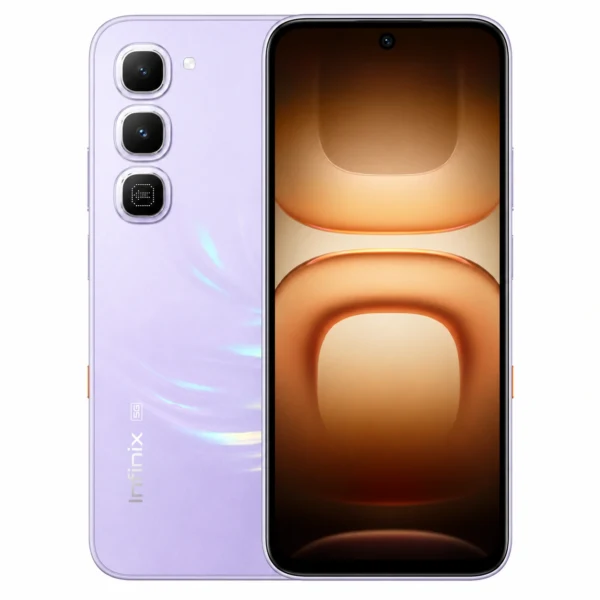
Infinix Hot 70 Pro
-
CPU: Octa-core (4x2.4 GHz Cortex-A78 & 4x2.0 GHz Cortex-A55)
-
RAM: 6GB/8GB
-
Storage: 128GB/256GB
-
Display: IPS LCD, 144Hz, 950 nits (HBM)
-
Camera: 50MP
-
OS: Android 16, up to 3 major Android upgrades, XOS 16
PROS
- 144Hz FHD+ display
- Powerful Dimensity 7100 5G chipset
- 6000mAh battery with 45W fast charging
- IP68 water resistance and MIL-STD-810H durability
- Stereo speakers, NFC and 3.5mm headphone jack
CONS
- IPS LCD instead of AMOLED
- Basic 8MP selfie camera
- No ultrawide camera
- UFS 2.2 storage
As South Africans, we have learned to look past the flashy marketing banners plastered all over taxi ranks and shopping malls. When a brand promises high-end specifications at a price that doesn’t completely drain your bank account, skepticism is our default setting. We live in a reality dictated by load-shedding, fluctuating exchange rates, and a volatile economic landscape where a smartphone isn’t a luxury—it’s a literal lifeline for work, safety, and staying connected to our families.
When Infinix officially announced the Hot 70 Pro 5G, the digital space lit up. A device landing in the intensely competitive mid-range segment while boasting a color-changing chassis, military-grade drop protection, and deep AI integration sounds almost too good to be true. Having spent a solid week abusing this device under real South African conditions—from navigating via GPS through the blistering heat of Gauteng to capturing low-light family moments during sudden local power blackouts—I can tell you that this phone is far from generic.
Let’s cut through the typical generic review fluff and explore how this device performs out in the real world, how much it will actually cost you in South African Rands, and whether it deserves a spot in your pocket.
The Ultimate Retail Question: Infinix Hot 70 Pro Price in South Africa
Before diving deep into performance metrics and day-to-day usability, let’s address the most crucial factor determining any tech purchase in our current economy: the actual price tag.
The global launch price of the base variant is pinned around €220. Converting that directly into our local currency, while taking import duties, local carrier margins, and value-added tax into consideration, paints a very specific picture for local retail channels.
-
Estimated Local Retail Price: R4,800 to R5,499 depending on the specific retail outlet, choice of storage tier (128GB vs 256GB), and specific network provider markups.
-
Availability Status: Officially rolled out globally in mid-July 2026. Stock is steadily making its way onto the shelves of major South African network operators (including Vodacom, MTN, and Telkom) alongside independent electronics retailers.
At this target price point, Infinix isn’t competing with premium flagships like the Galaxy S-series or the latest iPhones. Instead, it is aiming straight at the throat of established mid-range champions, specifically taking on popular contenders like the Samsung Galaxy A-series and Xiaomi’s Redmi Note lineup. What makes this local pricing structure highly compelling is that Infinix is offering premium durability and localized hardware features that its closest rivals typically reserve for devices costing well over R8,000.
Real Human Hands-On: The First 48 Hours
Holding the device for the first time reveals that Infinix did not build just another boring, black plastic brick. The review unit tested came in the highly discussed Thermo Orange finish. The back panel is built using a highly responsive, UV-sensitive material. When you step out from the shade of a shopping center into the direct, harsh South African sun, the phone visibly reacts, shifting its hue within seconds. It is a fantastic party trick that turns heads, but the real value lies beneath the visual spectacle.
The device feels dense and incredibly solid in the hand without feeling like a heavy concrete slab. Weighing in at approximately 204 grams with an impressively thin chassis profile of just 7.9mm for the rugged build, it balances ergonomic comfort with pure physical reassurance.
The physical layout reveals a dedicated tactile AI Button on the side frame, a hardware inclusion that lets you summon localized assistant tools instantly without having to unlock the screen, dive into application folders, or scramble to find an app icon while multitasking on the move.
Surviving the Streets: Built-In Protection That Matters
Most modern mid-range smartphones are incredibly fragile creatures. Drop them onto the tar outside a local supermarket, and you are staring down the barrel of a costly, frustrating screen replacement process that takes weeks to resolve. Infinix has clearly observed this massive pain point and done something radical about it in this price tier.
True IP68 Waterproofing
Unlike the minor splash resistance ratings commonly found in this budget category, the Hot 70 Pro features full IP68 dust and water resistance. To test this out without synthetic laboratory bias, the phone was intentionally dropped into a filled kitchen sink and left submerged for roughly ten minutes. After pulling it out, shaking off the excess water, and wiping down the ports, the stereo speakers fired up perfectly with zero audio muffling, and the charging port registered power immediately without throwing dangerous moisture errors.
Military-Grade Abuse Resilience
The device comes certified with MIL-STD-810H compliance. In practical, human terms, this means the structural framework of the phone has been hardened to survive accidental drops from standard counter heights onto unforgiving hard surfaces. Over a week of chaotic real-world testing, the device slid out of a car seat onto gravel and slipped off a desk onto hard tiled flooring. The reinforced frame absorbed the impact efficiently, escaping with absolute minimal scuffing and zero cracks to the display glass. If you are someone who works outdoors, relies heavily on public transport, or simply has a habit of dropping their device, this built-in physical insurance policy is an absolute game-changer.
Real-World Performance: Screen, Chips, and Daily Stress Tests
The hardware combination under the hood is tailored directly toward smooth daily multitasking and handling heavy data demands.
The 144Hz Smoothness Factor
The display panel spans an expansive 6.76 inches. Infinix chose to pass on generic 90Hz or 120Hz standards, opting instead to equip this panel with a blisteringly fast 144Hz refresh rate. Navigating through extensive social media feeds, scrolling through work emails, or playing high-fps mobile games feels incredibly fluid. The panel peaks at a bright 950 nits of brightness. Testing this display outdoors at midday showed that text remains perfectly legible, and UI icons don’t wash out, eliminating the need to awkwardly cup your hand over the screen just to read an incoming text message.
Network Speeds and Processing Muscle
Powering the entire experience is the MediaTek Dimensity 7100 5G chipset, paired up with a generous 8GB of physical RAM and an additional 8GB of virtual expansion via internal storage allocation. The inclusion of true 5G hardware means that if you are within coverage zones provided by local networks, app downloads, video streams, and large work files process almost instantly.
Running multiple intense applications simultaneously—switching rapidly between navigation apps, streaming music platforms, and editing a shared cloud document—failed to trigger any severe system stutter or lag. The device maintains a cool temperature under sustained loads, avoiding the aggressive thermal throttling that often plagues older processing architectures.
The Ultimate Load-Shedding Counter: Battery and Charging
For any smartphone user in South Africa, battery capacity is arguably the single most critical performance metric. A dead smartphone during an extended municipal power failure isn’t just an inconvenience; it can quickly turn into a major safety concern.
The 6,000mAh Powerhouse
Infinix has crammed a massive 6,000mAh battery into the slim body of the Hot 70 Pro. To put this capacity into context, the device was subjected to a grueling real-world stress test: continuous social media scrolling, two hours of active GPS route navigation, an hour of video streaming, and constant text messaging over a mix of 5G and Wi-Fi networks.
By the end of day one, the battery indicator still sat comfortably at 46%. For the average user who isn’t glued to their screen every waking second, this phone easily stretches into a full two days of reliable operation on a single charge. It provides massive peace of mind when you know your neighborhood grid is scheduled to go dark for hours at a time.
Smart Power Management
When you do need to top up the cell, the 45W fast charging system takes over. Plugging the device in from a dead stop brings the massive battery up to roughly 50% in just under 35 minutes, allowing you to get a meaningful amount of juice during short power windows.
More importantly, the software integrates advanced Bypass Charging. If you are plugging the phone into a power bank or wall outlet to play games or watch videos, the incoming current bypasses the battery entirely to power the motherboard directly. This drastically reduces internal heat generation, protects the long-term health of the battery cell, and ensures the phone won’t overheat when ambient temperatures rise.
Real-World Camera Assessment: Beyond the Megapixel Hype
The massive camera module on the back is anchored by a high-grade 50MP Sony IMX882 primary sensor. In well-lit daylight conditions, the image quality output is genuinely impressive for a mid-range phone. Colors look natural, contrast is punchy without appearing overly processed, and the dynamic range handles bright South African skies well without blowing out background details.
During standard daylight scenarios, the sensor resolves sharp fine details, handles bright glare efficiently, and keeps colors balanced. Where budget cameras typically fall apart is low-light performance. When the lights go out, the Hot 70 Pro relies heavily on its built-in AI Matrix Cube technology. Activating the dedicated night mode triggers an automated multi-frame exposure system. The camera takes a few seconds to capture the scene, stitching the images together to pull clean light out of dark environments.
It won’t match the low-light performance of a high-end flagship, but it successfully controls digital grain and preserves legible details in dark rooms, making it incredibly useful for capturing memories when lighting conditions are less than ideal. Around the front, the 13MP selfie camera delivers sharp, clear portraits with highly accurate skin-tone reproduction.
The Human Verdict: Is It Worth Your Hard-Earned Rands?
The Infinix Hot 70 Pro 5G stands out as a carefully designed option in a market saturated with generic mid-range smartphones. Infinix has clearly identified the features that matter most to users navigating challenging economic realities and packaged them into a highly resilient, visually striking device.
What Makes This Phone Great
-
Built for Durability: The combination of an IP68 waterproof rating and military-grade drop resistance provides unmatched peace of mind at this price point.
-
Exceptional Battery Life: The massive 6,000mAh cell easily handles heavy daily usage and effortlessly outlasts extended power outages.
-
Fluid Visual Experience: The highly responsive 144Hz display makes daily UI navigation incredibly smooth and enjoyable.
-
Smart Hardware Features: The inclusion of a dedicated physical AI button and bypass charging options adds genuine utility to daily tasks.
Where It Falls Short
-
Slight Visual Bulk: While the chassis remains remarkably thin, the overall footprint of the 6.76-inch screen might feel a bit unmanageable for users who prefer compact, single-handed devices.
-
Night Mode Capture Time: The low-light processing system requires a steady hand for a few seconds to resolve clean images, which can occasionally result in slight blur if your subject moves quickly.
If you are hunting for a device that offers premium longevity, solid processing capabilities, long-lasting battery performance, and robust physical protection without carrying a steep premium price tag, the Infinix Hot 70 Pro 5G deserves a spot at the top of your shopping shortlist. It moves past generic marketing gimmicks to deliver real, dependable value where it matters most.
Full Specifications
General
| Brand | Infinix |
| Model | Hot 70 Pro |
| Announced | 16 July, 2026 |
| Released | 18 July, 2026 |
| Status | Available |
| Price | ZAR 4,800 |
Design
| Type Design Type called form factor refers to a mobile phone's size, shape, and style as well as the layout and position of major components of phone. There are three major form factors seen in mobile phones => bar phones, folding phones and sliding phones. | Bar |
| Dimensions | 166.9 x 79.5 x 7.9 mm (6.57 x 3.13 x 0.31 in) |
| Weight | 204 g (7.20 oz) |
| Protection | IP68 dust tight and water resistant (immersible up to 2m for 30 min) |
| Colors | Thermo Orange, Mirage Green, Silk Glow Purple, Depth Ring White, Night Pulse, Dive Blue |
Network
| 2G Network | |
| 3G Network | |
| 4G Network | |
| 5G Network | |
| SIM SIM (Subscriber Identity Module) is a small card that contains mobile network subscriber's account information. This allows the phone using the card to attach to a mobile network. The SIM card is most commonly associated with GSM and UMTS mobile networks. Moving a SIM card from one phone to another allows a subscriber to switch mobile phones without having to contact their mobile network carrier. SIM cards can also be used by a phone to store limited amounts of data, such as phone numbers and text messages. | Nano-SIM + Nano-SIM |
Display
| Display Type Display Technology => A number of display technologies and types used in mobile phones => TFT (Thin Film Transistor), IPS (In-Place Switching), OLED (Organic Light Emitting Diode), AMOLED (Active-Matrix Organic Light-Emitting Diode), Super AMOLED (an even advanced version of AMOLED), Resistive Touchscreen (Resistive touchscreens contain two layer of conductive material with a very small gap between them which acts as a resistance), Capacitive Touchsceen (Capacitive touchscreen technology consists of a layer of glass coated with a transparent conductor) | IPS LCD, 144Hz, 950 nits (HBM) |
| Size | 6.76 inches, 110.3 cm2 (~83.2% screen-to-body ratio) |
| Resolution | 1080 x 2344 pixels, 20:9 ratio (~441 ppi density) |
Media
| Audio Playback | |
| Video Playback | |
| FM Radio | Yes |
| Ring Tones | |
| Loudspeaker |
Camera
| Main Camera Camera is able to capture photographs and usually videos, The most important characteristics of a camera are the resolution (measured in megapixels), lens focus type (fixed or automatic), higher megapixel cameras are known to capture higher quality photos, but not always a good measurement of the photos quality. |
50 MP, f/1.8, 25mm (wide), 1/1.95", 0.8µm, PDAF Auxiliary lens |
| Video | 1440p@30fps, 1080p@30fps |
| Selfie Camera | 8 MP, f/2.0, (wide) |
| Video | 1440p@30fps, 1080p@30fps |
Software
| Operating System OS => Every computer system run on a base software called Operating System (OS). Operating System controls all basic operations of the computer (such as smartphone, PDAs, tablet computers and other handheld devices). The Operating System allows the user to install and run third party applications (apps), apps are used to add new functionality to the device. | Android 16 |
| User Interface UI or user interface of a device is the look and feel of the on-screen menu system. How it works, its color scheme, how it responds to button presses, all of these things are part of the user interface. | XOS 16 |
Hardware
| Chipset Chipset is a group of integrated circuits designed to perform one or a more dedicated functions, often with real time computing constraints, Popular smartphones are equipped with more advanced embedded chipsets that can do many different tasks depending on their programming. | Mediatek Dimensity 7100 (6 nm) |
| CPU CPU (Central Processing Unit) mostly known as processors, CPU processes instructions in order to carry out certain functions that make your device operate properly. Processors are often described as the brain of computers, smartphones and tablets, Smartphones and tablets rely on processors to carry out their every task, Processors are an incredibly important factor in selecting any type of computing device, including your smartphone. | Octa-core (4x2.4 GHz Cortex-A78 & 4x2.0 GHz Cortex-A55) |
| GPU GPU (Graphics Processing Unit) is a single-chip processor designed to rapidly manipulate and alter memory to accelerate the creation of images in a frame buffer intended for output to a display, This includes things such as lighting effects, object transformations, and 3D motion. | Mali-G610 MC2 |
| RAM (Memory) RAM (Random Access Memory) is a type of computer memory that can be accessed randomly, any byte of memory can be accessed without touching the preceding bytes that allows information to be stored and accessed quickly from random locations. RAM is the most common type of memory found in computer systems, smartphones, tablets and other electronic devices. | 6GB/8GB |
| Internal Storage Internal Storage is a data storage space (flash memory) mostly used in smartphones, tablets and other electronic devices where operating system, apps, music, photos, videos, files and other user data Is stored. | 128GB/256GB |
| Card Slot Memory Card Slot is a special slot for inserting a memory card. Memory cards allow you to expand the phone's built-in memory, A memory card (sometimes called a flash memory card or a storage card) is a small storage medium used to store data such as text, pictures, audio, and video, for use on small, portable or remote computing devices such as mobile phones, mp3 players, digital cameras. | microSDXC (dedicated slot) |
| Sensors Sensors are electronic components that detects and responds to some type of input from the physical environment. The specific input could be light, heat, motion, moisture, pressure and location, The output is generally a signal that is converted to use in computing systems, a location sensor, such as a GPS receiver is able to detect current location of your electronic device. | Fingerprint (side-mounted), accelerometer, gyro, proximity, compass |
Connectivity
| Bluetooth Bluetooth is a wireless communications technology for exchanging data between mobile phones, headsets, computers and other network devices over short distances without wires, Bluetooth technology was primarily designed to support simple wireless networking of personal consumer devices. | 5.4, A2DP, LE |
| Wi-fi Wi-Fi is a popular wireless networking technology using radio waves to provide high-speed network connections that allows devices to communicate without cords or cables, Wi-Fi is increasingly becoming the preferred mode of internet connectivity all over the world. | Wi-Fi 802.11 a/b/g/n/ac, dual-band |
| Wi-fi Hotspot | |
| USB | USB Type-C 2.0, OTG |
| Positioning GPS The Global Positioning System is a satellite-based radio navigation system, GPS permits users to determine their position, velocity and the time 24 hours a day, in all weather, anywhere in the world, In order to locate your position, your device or GPS receiver must have a clear view of the sky. | GPS |
| NFC NFC (Near field communication) is a set of standards for smartphones and similar devices to establish peer-to-peer radio communications with each other by touching them together or bringing them into proximity, usually no more than a few inches. |
Battery
| Battery Type Battery Type => Cell phones run on various kinds of batteries depending on the manufacturer, phone size or shape and features. There are basically four types of cell phone batteries => Lithium Polymer, Lithium Ion, Nickel Metal Hydride and Nickel Cadmium. | 6000 mAh or 5600 mAh |
| Charging Wireless Charging (Inductive Charging) uses an electromagnetic field to transfer energy between two objects. This is usually done with a charging station. Energy is sent through an inductive coupling to an electrical device, which can then use that energy to charge batteries or run the device. |
45W wired, 50% in 25 min, 100% in 53 min (for 5600 mAh) 10W reverse wired Bypass charging |
Reviews
Disclaimer Note
The information contained in this post is for general information purposes only.
More Products from Infinix
Top Rated
-
 Motorola Razr Fold
R38,000
Motorola Razr Fold
R38,000
-
 Motorola Razr 70 Ultra
R28,000
Motorola Razr 70 Ultra
R28,000
-
 Honor Magic 8 RSR Porsche Design
R20,000
Honor Magic 8 RSR Porsche Design
R20,000
-
 Huawei Mate 80 RS Ultimate
R32,000
Huawei Mate 80 RS Ultimate
R32,000
-
 Huawei Mate X7
R35,000
Huawei Mate X7
R35,000
-
 Honor Magic V6
R35,000
Honor Magic V6
R35,000
-
 Apple iPhone 17 Pro Max
R28,500
Apple iPhone 17 Pro Max
R28,500
-
 Samsung Galaxy S25 Ultra
R24,000
Samsung Galaxy S25 Ultra
R24,000
-
 Oppo Find N6
R25,000
Oppo Find N6
R25,000
-
 Sony Xperia 1 VIII
R32,000
Sony Xperia 1 VIII
R32,000
-
 Oppo Find X9 Pro
R18,000
Oppo Find X9 Pro
R18,000
-
 Apple iPad Pro 13 (2025)
R32,000
Apple iPad Pro 13 (2025)
R32,000
New Arrivals
-
 Ulefone RugKing 5 Pro
R5,000
Ulefone RugKing 5 Pro
R5,000
-
 Vivo Y500i
R4,000
Vivo Y500i
R4,000
-
 Samsung Galaxy F16
R2,500
Samsung Galaxy F16
R2,500
-
 Apple iPhone 14 Pro
R10,000
Apple iPhone 14 Pro
R10,000
-
Huawei Mate X7
R35,000
-
 Infinix Hot 60i
R2,300
Infinix Hot 60i
R2,300
-
 Vivo X200 Ultra
R15,000
Vivo X200 Ultra
R15,000
-
 Vivo iQOO 15R
R10,000
Vivo iQOO 15R
R10,000
-
 Huawei Pura 70 Ultra
R18,000
Huawei Pura 70 Ultra
R18,000
-
 Realme C63 5G
R2,500
Realme C63 5G
R2,500
-
 ZTE Nubia Red Magic 9S Pro
R24,000
ZTE Nubia Red Magic 9S Pro
R24,000
-
 Samsung Galaxy C55
R6,000
Samsung Galaxy C55
R6,000