
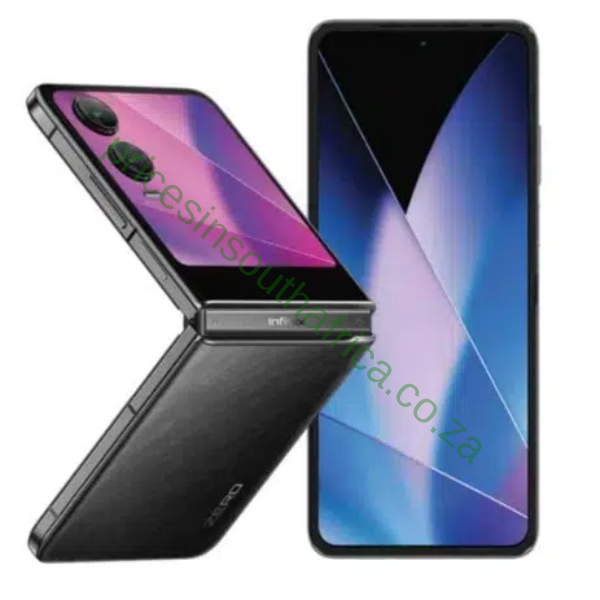
Infinix Zero Flip
-
CPU: Octa-core (4x2.6 GHz Cortex-A78 & 4x2.0 GHz Cortex-A55)
-
RAM: 8GB
-
Storage: 512GB
-
Display: Foldable LTPO AMOLED, 120Hz, 1400 nits (peak)
-
Camera: 50MP
-
OS: Android 14, XOS 14.5
PROS
- Foldable LTPO AMOLED, 120Hz refresh.
- Mediatek Dimensity 8020 chipset.
- Dual rear camera with 50MP, and 5MP selfie.
- Stereo loudspeaker, NFC and Fingerprint.
- 70W wired fast charging.
CONS
- No 3.5mm jack.
- 4730mAh battery.
The Infinix Zero Flip has landed in South Africa as a highly competitive option for those looking to jump into the foldable smartphone market without the premium price tag typically attached to flips.
Starting from ZAR 10,000, it targets a sweet spot by delivering the sought-after clamshell folding experience at a fraction of what mainstream flagships demand.
What to Expect with Pricing and Local Availability
While the baseline sits around ZAR 10,000, keep a few things in mind regarding localized pricing:
-
Market Variances: The final price tag can shift based on whether you are buying the device outright or bundling it into a contract.
-
Retailer Promos: Individual stores frequently offer their own regional discounts, trade-in specials, or value-add bundles (like bundled wireless earbuds or screen protectors).
Where to Buy in South Africa
Infinix has established a wide retail footprint across the country, making it exceptionally easy to track down the device whether you prefer cash upfront, store accounts, or network upgrades.
| Channel Type | Participating Retailers & Networks |
| Online & Tech Specialists | Takealot, HiFi Corp, Hi Online |
| Traditional & Department Retail | Makro, Game, Foschini, Mr Price |
| Cellular & Specialty Stores | Cellucity, 4U, Chatz Connect |
| Mobile Networks & Airtime Retail | MTN, PEP, Ackermans |
Pro Tip: If you are hunting for cash deals, check large e-commerce platforms like Takealot first for flash sales. If you are aiming for a monthly cellular contract or structured store payments, network providers like MTN or apparel group accounts like Foschini and Mr Price offer structured monthly billing.
Why the Zero Flip is Turning Heads
Even without diving into a exhaustive spec sheet, the core appeal of the Zero Flip is immediately clear. It solves the biggest issue people have with foldables: affordability.
It manages to feature a highly functional, large 3.64-inch cover screen that lets you check notifications, control music, and even interact with mini-apps without unfolding the phone. When you open it up, you get a massive 6.9-inch main display with a significantly minimized center crease. Because it folds completely flat (a zero-gap hinge), it avoids trapping pocket lint inside.
Additionally, creators have gravitated toward its Hover/DV Mode, which acts like a built-in tripod so you can place the phone flat on a table to shoot hands-free 4K vlogs or take group photos using the high-res 50MP rear cameras. Coupled with standard 70W fast charging to top up the battery quickly, it makes for a thoroughly modern daily driver.
Full Specifications
General
| Brand | Infinix |
| Model | Infinix Zero Flip |
| Announced | 27 September, 2024 |
| Released | 10 October, 2024 |
| Status | Available |
| Price | ZAR 10,000 |
Design
| Type Design Type called form factor refers to a mobile phone's size, shape, and style as well as the layout and position of major components of phone. There are three major form factors seen in mobile phones => bar phones, folding phones and sliding phones. | Bar |
| Dimensions |
Unfolded: 170.4 x 73.4 x 7.6 mm Folded: 87.5 x 73.4 x 16 mm |
| Weight | 195 g (6.88 oz) |
| Colors | Rock Black, Blossom Glow |
Network
| 2G Network | |
| 3G Network | |
| 4G Network | |
| 5G Network | |
| SIM SIM (Subscriber Identity Module) is a small card that contains mobile network subscriber's account information. This allows the phone using the card to attach to a mobile network. The SIM card is most commonly associated with GSM and UMTS mobile networks. Moving a SIM card from one phone to another allows a subscriber to switch mobile phones without having to contact their mobile network carrier. SIM cards can also be used by a phone to store limited amounts of data, such as phone numbers and text messages. | Nano-SIM |
Display
| Display Type Display Technology => A number of display technologies and types used in mobile phones => TFT (Thin Film Transistor), IPS (In-Place Switching), OLED (Organic Light Emitting Diode), AMOLED (Active-Matrix Organic Light-Emitting Diode), Super AMOLED (an even advanced version of AMOLED), Resistive Touchscreen (Resistive touchscreens contain two layer of conductive material with a very small gap between them which acts as a resistance), Capacitive Touchsceen (Capacitive touchscreen technology consists of a layer of glass coated with a transparent conductor) | Foldable LTPO AMOLED, 120Hz, 1400 nits (peak) |
| Size | 6.9 inches, 107.6 cm2 (~86.1% screen-to-body ratio) |
| Resolution | 1080 x 2640 pixels (~413 ppi density) |
| Display Protection Display Protection => Gorilla Glass is a special alkali-aluminosilicate glass shield with exceptional damage resistance that helps protect mobile displays from scratches, drops, and bumps of everyday use, It is always better to go for a smartphone with Gorilla Glass for that added protection and peace of mind. | Corning Gorilla Glass 2 |
| Secondary Display |
Cover display: AMOLED, 120Hz, 1100 nits (peak) 3.64 inches, 1056 x 1066 pixels, 413 ppi, |
Media
| Audio Playback | |
| Video Playback | |
| FM Radio | Unspecified |
| Ring Tones | |
| Loudspeaker |
Camera
| Main Camera Camera is able to capture photographs and usually videos, The most important characteristics of a camera are the resolution (measured in megapixels), lens focus type (fixed or automatic), higher megapixel cameras are known to capture higher quality photos, but not always a good measurement of the photos quality. |
50 MP, (wide), 1/1.57", 1.0µm, PDAF, OIS 50 MP, (ultrawide) |
| Video | 4K@30/60fps, 1080p@30/60fps |
| Selfie Camera | 50 MP, (wide), 1/2.76", 0.64µm, PDAF |
| Video | 4K@30/60fps, 1080p@30/60fps |
Software
| Operating System OS => Every computer system run on a base software called Operating System (OS). Operating System controls all basic operations of the computer (such as smartphone, PDAs, tablet computers and other handheld devices). The Operating System allows the user to install and run third party applications (apps), apps are used to add new functionality to the device. | Android 14 |
| User Interface UI or user interface of a device is the look and feel of the on-screen menu system. How it works, its color scheme, how it responds to button presses, all of these things are part of the user interface. | XOS 14.5 |
Hardware
| Chipset Chipset is a group of integrated circuits designed to perform one or a more dedicated functions, often with real time computing constraints, Popular smartphones are equipped with more advanced embedded chipsets that can do many different tasks depending on their programming. | Mediatek Dimensity 8020 (6 nm) |
| CPU CPU (Central Processing Unit) mostly known as processors, CPU processes instructions in order to carry out certain functions that make your device operate properly. Processors are often described as the brain of computers, smartphones and tablets, Smartphones and tablets rely on processors to carry out their every task, Processors are an incredibly important factor in selecting any type of computing device, including your smartphone. | Octa-core (4x2.6 GHz Cortex-A78 & 4x2.0 GHz Cortex-A55) |
| GPU GPU (Graphics Processing Unit) is a single-chip processor designed to rapidly manipulate and alter memory to accelerate the creation of images in a frame buffer intended for output to a display, This includes things such as lighting effects, object transformations, and 3D motion. | Mali-G77 MC9 |
| RAM (Memory) RAM (Random Access Memory) is a type of computer memory that can be accessed randomly, any byte of memory can be accessed without touching the preceding bytes that allows information to be stored and accessed quickly from random locations. RAM is the most common type of memory found in computer systems, smartphones, tablets and other electronic devices. | 8GB |
| Internal Storage Internal Storage is a data storage space (flash memory) mostly used in smartphones, tablets and other electronic devices where operating system, apps, music, photos, videos, files and other user data Is stored. | 512GB |
| Card Slot Memory Card Slot is a special slot for inserting a memory card. Memory cards allow you to expand the phone's built-in memory, A memory card (sometimes called a flash memory card or a storage card) is a small storage medium used to store data such as text, pictures, audio, and video, for use on small, portable or remote computing devices such as mobile phones, mp3 players, digital cameras. | No |
| Sensors Sensors are electronic components that detects and responds to some type of input from the physical environment. The specific input could be light, heat, motion, moisture, pressure and location, The output is generally a signal that is converted to use in computing systems, a location sensor, such as a GPS receiver is able to detect current location of your electronic device. | Fingerprint (side-mounted), accelerometer, gyro, proximity, compass |
Connectivity
| Bluetooth Bluetooth is a wireless communications technology for exchanging data between mobile phones, headsets, computers and other network devices over short distances without wires, Bluetooth technology was primarily designed to support simple wireless networking of personal consumer devices. | 5.4, A2DP, LE |
| Wi-fi Wi-Fi is a popular wireless networking technology using radio waves to provide high-speed network connections that allows devices to communicate without cords or cables, Wi-Fi is increasingly becoming the preferred mode of internet connectivity all over the world. | Wi-Fi 802.11 a/b/g/n/ac/6, dual-band |
| Wi-fi Hotspot | |
| USB | USB Type-C, OTG |
| Positioning GPS The Global Positioning System is a satellite-based radio navigation system, GPS permits users to determine their position, velocity and the time 24 hours a day, in all weather, anywhere in the world, In order to locate your position, your device or GPS receiver must have a clear view of the sky. | GPS |
| NFC NFC (Near field communication) is a set of standards for smartphones and similar devices to establish peer-to-peer radio communications with each other by touching them together or bringing them into proximity, usually no more than a few inches. |
Battery
| Battery Type Battery Type => Cell phones run on various kinds of batteries depending on the manufacturer, phone size or shape and features. There are basically four types of cell phone batteries => Lithium Polymer, Lithium Ion, Nickel Metal Hydride and Nickel Cadmium. | 4720 mAh, non-removable |
| Charging Wireless Charging (Inductive Charging) uses an electromagnetic field to transfer energy between two objects. This is usually done with a charging station. Energy is sent through an inductive coupling to an electrical device, which can then use that energy to charge batteries or run the device. |
70W wired 10W reverse wired |
Reviews
Disclaimer Note
The information contained in this post is for general information purposes only.
More Products from Infinix
Top Rated
-
 Motorola Razr Fold
R38,000
Motorola Razr Fold
R38,000
-
 Motorola Razr 70 Ultra
R28,000
Motorola Razr 70 Ultra
R28,000
-
 Honor Magic 8 RSR Porsche Design
R20,000
Honor Magic 8 RSR Porsche Design
R20,000
-
 Huawei Mate 80 RS Ultimate
R32,000
Huawei Mate 80 RS Ultimate
R32,000
-
 Huawei Mate X7
R35,000
Huawei Mate X7
R35,000
-
 Honor Magic V6
R35,000
Honor Magic V6
R35,000
-
 Apple iPhone 17 Pro Max
R28,500
Apple iPhone 17 Pro Max
R28,500
-
 Samsung Galaxy S25 Ultra
R24,000
Samsung Galaxy S25 Ultra
R24,000
-
 Oppo Find N6
R25,000
Oppo Find N6
R25,000
-
 Oppo Find X9 Pro
R18,000
Oppo Find X9 Pro
R18,000
-
 Apple iPad Pro 13 (2025)
R32,000
Apple iPad Pro 13 (2025)
R32,000
-
 Huawei MatePad Edge
R18,000
Huawei MatePad Edge
R18,000
New Arrivals
-
 Huawei Pura 90 Pro Max
R20,000
Huawei Pura 90 Pro Max
R20,000
-
 Huawei Pura 90 Pro
R18,000
Huawei Pura 90 Pro
R18,000
-
 Huawei Pura 90
R15,000
Huawei Pura 90
R15,000
-
 Honor 600 Smart
R7,000
Honor 600 Smart
R7,000
-
 Xiaomi 17T Pro
R18,000
Xiaomi 17T Pro
R18,000
-
 Xiaomi 17T
R15,000
Xiaomi 17T
R15,000
-
 Samsung Galaxy A37
R8,000
Samsung Galaxy A37
R8,000
-
 Samsung Galaxy A57
R10,000
Samsung Galaxy A57
R10,000
-
 Motorola Razr 70
R17,000
Motorola Razr 70
R17,000
-
 Motorola Razr 70 Plus
R23,000
Motorola Razr 70 Plus
R23,000
-
Motorola Razr 70 Ultra
R28,000
-
 Tecno Pop X 4G
R1,600
Tecno Pop X 4G
R1,600