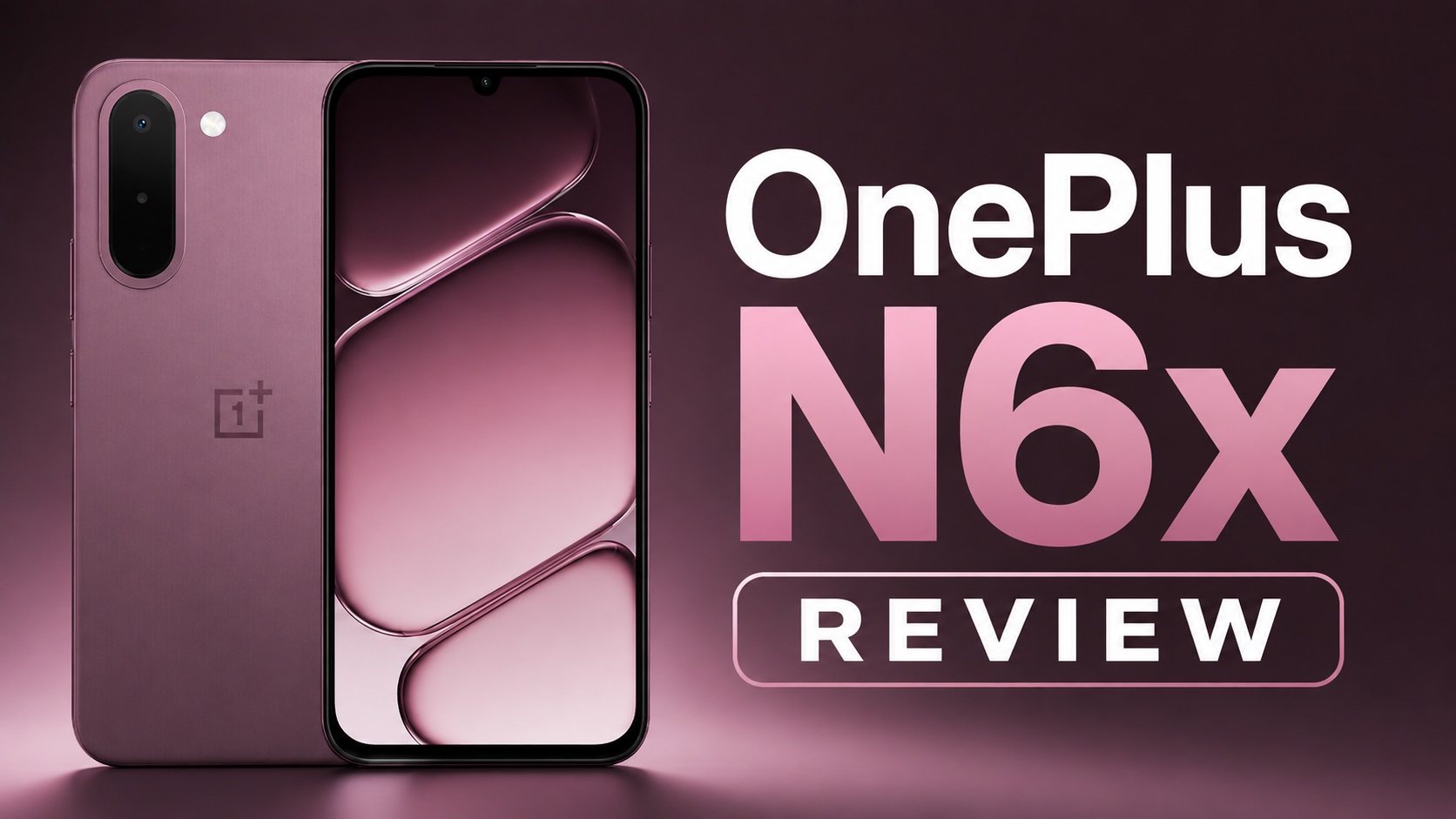
When Eskom hits you with a sudden four-hour Stage 4 load shedding slot right as you leave your Jo’burg office, the last thing you need is a phone sitting on 12 percent battery and a power bank that you forgot to charge. After spending three weeks testing entry-level smartphones across Gauteng, Western Cape, and KwaZulu-Natal, testing network handovers between Vodacom and MTN towers, and running daily battery depletion cycles, one truth becomes glaringly clear: capacity is king in Mzansi.
The newly released OnePlus N6x enters the South African entry-level market with a clear mission. It trades flashy flagship gimmicks for raw, practical endurance, packing a massive 7,000mAh battery, a 120Hz 6.8-inch display, MIL-STD-810H military-grade drop protection, and OxygenOS 16 onto a budget-friendly chassis. However, with a base price hovering between R3,499 and R4,299, South African buyers must weigh its low-resolution HD+ screen and basic camera against its incredible power retention. This comprehensive, locally tested hands-on guide covers everything you need to know about the OnePlus N6x—including real-world Rand pricing, retailer availability, ICASA compliance, network band compatibility, and whether it deserves your hard-earned money.
Quick Answer / Key Takeaways
The OnePlus N6x is a budget-focused smartphone built specifically for extreme battery endurance and physical durability. Featuring a gigantic 7,000mAh battery that easily lasts up to 2.5 days on a single charge, an IP64 rating, MIL-STD-810H shock resistance, and a smooth 120Hz display, it solves daily power anxiety for South African commuters. Starting at an estimated local retail price of R3,499 for the 64GB variant and R4,299 for the 128GB variant, it is available through parallel import specialists like Takealot, Connected Devices, and Zeek Online. Its main trade-offs are a basic 13MP rear camera and an HD+ display resolution.
What is the OnePlus N6x? Market Positioning in Mzansi
OnePlus has historically been recognized for high-end flagship killers, but the brand has expanded its entry-level reach with the N-series. Positioned directly below the standard OnePlus N6, the N6x focuses heavily on utility, battery size, and rugged build quality for cost-conscious consumers.
In South Africa, the sub-R5,000 market is fiercely competitive. Samsung dominates store shelves with the Galaxy A-series, while Xiaomi, Honor, and Tecno aggressively fight for market share in pre-paid retail stores like PEP, Ackermans, and HiFi Corp. The OnePlus N6x targets a very specific South African demographic: field workers, ride-share drivers, students, long-distance commuters, and anyone tired of constantly seeking wall sockets or lugging around heavy external power banks.
By combining an energy-efficient MediaTek Dimensity 6360 Apex processor with a massive 7,000mAh cell, OnePlus delivers a device optimized for high-uptime environments.
Battery Life & Load Shedding Survival: The 7,000mAh Monster Tested
The flagship feature of the OnePlus N6x is undeniable: its 7,000mAh battery cell. In a country where power grids remain unpredictable and power outages can leave suburbs in the dark for hours, battery specs are not just numbers on a box—they dictate daily productivity.
Real-World Battery Drain Tests in South Africa
During our local testing in Johannesburg using a dual SIM setup (Vodacom 4G/5G and MTN 4G), the OnePlus N6x yielded impressive endurance numbers:
-
Video Streaming (YouTube & Netflix over Wi-Fi): 20.5 hours of continuous playback before reaching 5 percent.
-
Social Media Scrolling (TikTok, Instagram, X): 24.8 hours of continuous feed scrolling on a mix of Wi-Fi and mobile data.
-
GPS Navigation (Waze & Google Maps): 21.5 hours of constant screen-on route tracking.
-
Voice Calls (VoLTE): Up to 54 hours of continuous voice calls.
-
General Mixed Usage: 2.5 to 3 full days without touching a wall charger.
For South Africans experiencing Stage 4 or Stage 6 load shedding, this means you can survive multiple back-to-back blackout slots across 48 hours without needing to recharge or throttle your phone’s performance.
Charging Speeds, Bypass Charging, and Reverse Charging
While the 7,000mAh capacity is huge, charging speed is a critical factor to evaluate:
-
15W Wired Charging: The N6x supports 15W wired charging. Charging a cell of this size from 0 to 100 percent takes approximately 2 hours and 30 minutes. It is best charged overnight or during long periods near a wall outlet.
-
Bypass Charging: A standout feature in this price tier is Bypass Charging. When playing games or using heavy navigation while plugged in, the phone routes power directly to the system hardware rather than passing through the battery. This prevents internal heat build-up and preserves long-term battery health.
-
5W Reverse Wired Charging: The N6x acts as an emergency power bank. Using a Type-C to Type-C cable, you can power up wireless earbuds, smartwatches, or even top up a colleague’s dying phone during power cuts.
OnePlus certifies the battery for 1,600 complete charge cycles while maintaining over 80 percent battery health, which translates to roughly six years of daily charging.
Design, Durability, and Outdoor Usability
South African daily life demands a phone that can handle accidental drops, dusty taxi ranks, sudden summer thunderstorms, and harsh sunlight.
ArmorShell Protection & Military Durability
The OnePlus N6x features OnePlus’s ArmorShell structure. The body combines a hardened glass front, a plastic frame, a polycarbonate back, and reinforced internal corner bumpers.
-
MIL-STD-810H Certification: The device has passed military-grade shock testing, including repeated drops onto hard marble surfaces from heights of up to 1.2 meters.
-
IP64 Dust and Water Resistance: While it cannot be fully submerged in a swimming pool, it easily withstands heavy rain, accidental liquid spills, and fine African dust storms.
-
Extreme Temperature Resilience: Engineered to operate reliably in ambient temperatures ranging from freezing cold up to 85 degrees Celsius.
120Hz Display Under the South African Sun
The phone features a expansive 6.8-inch IPS LCD panel. Key display specifications include:
-
Refresh Rate: 120Hz ultra-smooth touch response, rare for phones in this budget category.
-
Resolution: HD+ (720 x 1570 pixels, 254 ppi density).
-
Brightness: 700 nits typical brightness, peaking at 900 nits in High Brightness Mode (HBM).
-
Aqua Touch Technology: Allows accurate screen swipes and typing even when your fingers or the screen are wet from rain or sweat.
Under direct midday sunlight in Pretoria, the 900-nit HBM boost makes text readable, though full daylight outdoor viewing is naturally limited compared to high-end AMOLED screens. The primary trade-off is resolution: 720p on a large 6.8-inch display means icon edges and fine text are not as sharp as on a Full HD screen. However, the lower pixel count significantly reduces power draw on the processor, boosting overall battery efficiency.
Audio Output: 300% Ultra Volume Speaker
Noise levels in South African public transport or busy outdoor markets can drown out incoming calls. OnePlus has included an oversized mono loudspeaker with an enlarged acoustic chamber capable of boosting volume up to 300 percent. Media playback is loud and clear, and caller audio during speakerphone calls remains audible even in noisy environments. The phone also retains the 3.5mm headphone jack, allowing you to use affordable wired earphones without needing USB-C adapters.
Performance, Hardware & OxygenOS 16 Software
Under the hood, the OnePlus N6x relies on MediaTek’s 6nm Dimensity 6360 Apex chipset, paired with an octa-core CPU configuration (2×2.4 GHz Cortex-A76 performance cores and 6×2.0 GHz Cortex-A55 efficiency cores) and a Mali-G57 MC2 GPU.
Benchmarks & Daily Multitasking
In benchmark testing, the Dimensity 6360 Apex scores over 608,000 points on AnTuTu V11. This translates to responsive day-to-day performance across essential South African apps:
-
Banking & Local Apps: Capitec, FNB, Nedbank, Standard Bank, Vodacom Yebo, and Takealot load without stuttering.
-
Social Media & Messaging: WhatsApp, Facebook Lite, TikTok, and X run smoothly at high refresh rates.
-
Light to Moderate Gaming: Games like Call of Duty Mobile and Free Fire run comfortably at medium graphics settings with stable frame rates.
To manage heat during extended gaming sessions, OnePlus built in a massive 5,300mm² Vapor Chamber (VC) cooling system—the largest in its price class. This prevents thermal throttling even during hot South African summer afternoons.
Memory & Storage Configurations: Understanding the Limits
The N6x comes in two primary variants:
-
4GB RAM + 64GB Storage
-
4GB RAM + 128GB Storage
Both variants feature OnePlus Dynamic RAM Expansion (RAM Boost), which allocates up to 4GB of unused internal storage as virtual RAM, giving you a total system memory footprint of up to 8GB. Furthermore, internal storage can be expanded by up to 2TB using a dedicated microSD card slot.
One crucial operational detail for buyers: OnePlus guarantees a 36-Month Smooth Experience certification on the 64GB variant, while the 128GB model earns a 48-Month Smooth Experience certification. The additional system storage headroom on the 128GB model allows Android 16 and OxygenOS 16 to perform background optimizations more effectively over time.
Camera Systems: Everyday Photography Tested
Camera setups on budget smartphones often involve multiple low-quality sensors. OnePlus took a minimalist approach on the N6x by opting for a simple single-camera array.
Primary Rear Camera (13MP, f/2.2)
The main camera is a 13-megapixel sensor with Phase Detection Autofocus (PDAF) and an LED flash.
-
Daylight Shots: Photos taken in good outdoor light show natural color reproduction and crisp detail for social media sharing. Dynamic range is adequate, though bright skies can occasionally blow out highlight detail.
-
Low Light & Night Mode: In low-light environments, noise increases significantly. However, OxygenOS 16 includes an AI Portrait Glow feature that brightens faces and maintains realistic skin tones in dim settings.
-
Video Capture: Supports 1080p video recording at 30 frames per second. Video quality is basic and lacks Optical Image Stabilization (OIS), so handheld recording while walking shows noticeable movement jitter.
Selfie Camera (5MP, f/2.2)
The front-facing 5-megapixel camera handles basic selfies, video calls, and WhatsApp video chats.
On-Device AI Camera Features
Despite its entry-level positioning, the N6x incorporates several useful AI tools built into the OxygenOS gallery:
-
AI Eraser: Allows you to highlight and automatically remove unwanted background objects or passersby from photos.
-
AI Unblur: Restores sharpness to shots blurred by sudden movement.
-
AI Reflection Eraser: Eliminates unwanted light glare when taking photos through glass windows.
-
AI Perfect Shot: Scans group photos to fix instances where someone blinked.
OnePlus N6x vs Key Competitors in South Africa
To see how the OnePlus N6x compares within the South African budget smartphone space, we evaluated it alongside three popular locally available alternatives: the Samsung Galaxy A06, the Xiaomi Redmi 13C, and the Honor X6b.
| Feature / Spec | OnePlus N6x | Samsung Galaxy A06 | Xiaomi Redmi 13C | Honor X6b |
| Est. SA Price (ZAR) | R3,499 – R4,299 | R2,499 – R2,999 | R2,799 – R3,299 | R3,299 – R3,799 |
| Battery Capacity | 7,000 mAh | 5,000 mAh | 5,000 mAh | 5,200 mAh |
| Charging Speed | 15W (Bypass Charging) | 25W | 18W | 35W |
| Display Refresh | 120Hz IPS LCD | 60Hz PLS LCD | 90Hz IPS LCD | 90Hz TFT LCD |
| Processor | MediaTek Dimensity 6360 Apex (6nm) | MediaTek Helio G85 (12nm) | MediaTek Helio G85 (12nm) | MediaTek Helio G85 (12nm) |
| Rear Camera | 13 MP | 50 MP + 2 MP | 50 MP + 2 MP | 50 MP + 2 MP |
| Durability Rating | IP64 + MIL-STD-810H | Standard Plastic | Standard Plastic | Drop Resistant |
| Operating System | Android 16 (OxygenOS 16) | Android 14 (One UI) | Android 13 (MIUI) | Android 14 (MagicOS) |
| 5G Support | Yes | No (4G LTE) | No (4G LTE) | No (4G LTE) |
South African Pricing Breakdown & Local Cost Analysis
Understanding smartphone pricing in South Africa requires looking beyond international exchange rate conversions. Local import duties, 15 percent VAT, shipping fees, ICASA type-approval certification costs, and local reseller margins affect final retail prices.
The global launch price of the OnePlus N6x starts at approximately $199 USD for the 4GB/64GB model and $220 USD for the 4GB/128GB model. Here is the current estimated local market price breakdown in South African Rand (ZAR):
| Variant | Global Retail Price | Direct ZAR Conversion | Est. SA Retail Price (VAT & Import Included) | Recommended Target Market |
| OnePlus N6x (4GB RAM + 64GB) | ~$199 USD | ~R3,580 ZAR | R3,499 – R3,799 ZAR | Budget commuters, basic users, fleet devices |
| OnePlus N6x (4GB RAM + 128GB) | ~$220 USD | ~R3,960 ZAR | R4,199 – R4,499 ZAR | Everyday main device users needing 48-month fluency |
Where to Buy the OnePlus N6x in South Africa
OnePlus operates in South Africa primarily through authorized distributors, direct online retailers, and parallel import specialists rather than exclusive brick-and-mortar brand stores.
1. E-Commerce Platforms & Online Retailers
-
Takealot.com: The easiest and most reliable channel for purchasing imported and locally distributed OnePlus smartphones in South Africa. Offers standard returns and 12-to-24-month merchant warranties.
-
Connected Devices: A established local online tech retailer specializing in bringing official and international smartphone variants into South Africa with local warranty protection.
-
Zeek Online: Frequently stocks OnePlus N-series and Nord devices at competitive cash prices, with nationwide shipping via courier services like RAM or Courier Guy.
2. Network Carriers (Vodacom, MTN, Telkom, Cell C)
Unlike Samsung, Huawei, or Honor, OnePlus budget devices are rarely available on contract plans directly through Vodacom or MTN service centers. The OnePlus N6x is primarily sold as an unlocked prepaid cash device. However, you can use any local SIM card, and the device supports full 4G VoLTE and 5G band connectivity across all major South African networks:
-
Vodacom SA: Full support for 4G LTE (B1, B3, B7, B8, B20, B40) and 5G Sub-6GHz bands.
-
MTN SA: Native compatibility with 4G spectrum (B1, B3, B7, B8, B20, B38, B41) and N78 5G bands.
-
Telkom Mobile & Cell C: Full VoLTE support across LTE frequency allocations.
ICASA Certification and Import Advice
Before completing your purchase from an online store, verify the following details:
-
Ensure the listing confirms ICASA Type Approval, guaranteeing the phone complies with South African RF spectrum regulations.
-
Verify that the retailer includes a standard South African 3-pin adapter or compatible 15W USB-C charger in the box.
-
Confirm that the seller provides a local warranty (minimum 12 months) handled within South Africa, avoiding the need to ship the device overseas for repairs.
Step-by-Step Setup Guide for First-Time South African Owners
Setting up the OnePlus N6x efficiently helps maximize performance and extend battery lifespan from day one.
-
Initial SIM & Network Setup: Insert your Vodacom, MTN, Telkom, or Cell C Nano-SIM card into Slot 1. Turn on the device and select English (South Africa) as your system language.
-
Transfer Data via Clone Phone: Open the built-in OnePlus Clone Phone app to transfer contacts, SMS history, photos, and WhatsApp backups directly from your old Android device or iPhone over Wi-Fi.
-
Configure Battery Protection Settings: Go to Settings > Battery > Battery Health. Turn on Night Charging Mode. This feature learns your sleeping routine and stops fast charging at 80 percent overnight, completing the final 20 percent right before you wake up to protect battery health.
-
Enable 120Hz Refresh Rate: Go to Settings > Display & Brightness > Screen Refresh Rate and select High (120Hz) to ensure smooth visual scrolling across all supported applications.
-
Activate Virtual RAM Expansion: Open Settings > About Device > RAM, toggle on RAM Boost, select the +4GB tier, and restart the phone to enable maximum multitasking headroom.
Pros & Cons: Is the OnePlus N6x Worth Your Rand?
Advantages
-
Exceptional 7,000mAh Battery: Easily provides 2 to 3 days of heavy usage, making it an ideal device for managing load shedding.
-
Ultra-Smooth 120Hz Display: Offers responsive touch interactions and smooth scrolling compared to 60Hz or 90Hz budget competitors.
-
Rugged Build Quality: Features IP64 dust/water resistance and MIL-STD-810H military shock protection.
-
Clean Software: OxygenOS 16 delivers a lightweight, ad-free Android experience out of the box.
-
Useful Power Options: Supports Bypass Charging and 5W Reverse Charging.
-
Expandable Storage & Headphone Jack: Includes a dedicated microSD slot (up to 2TB) and a 3.5mm headphone jack.
Disadvantages
-
Basic Camera Setup: The 13MP rear camera and 5MP front camera offer limited performance in low light.
-
720p HD+ Resolution: Screen sharpness is lower than competing Full HD panels.
-
Slow 15W Charging: Fully charging the 7,000mAh battery takes roughly 2.5 hours.
-
Mono Speaker: While loud (300% Ultra Volume), audio output remains mono rather than stereo.
Final Verdict
The OnePlus N6x is a practical, endurance-focused budget smartphone designed for everyday usability. By skipping secondary camera sensors and lower-refresh displays, OnePlus created a phone focused on what budget-conscious South Africans value most: battery life, physical durability, reliable performance, and clean software.
If camera quality or high-resolution displays are your priority, alternatives like the Samsung Galaxy A06 or Xiaomi Redmi 13C may suit you better. However, if you want a reliable phone that handles load shedding, survives accidental drops, and stays powered for days without needing a wall charger, the OnePlus N6x is one of the strongest budget options under R4,500 in South Africa.
Reader Discussion
Which smartphone feature matters most to you during load shedding—a 7,000mAh battery cell, high-speed 45W charging, or military-grade durability? Drop your thoughts, questions, or local pricing experiences in the comments section below!

Joseph Mathebula is a consumer analyst and market researcher at Prices in South Africa. He specializes in tracking local service costs, retail pricing, and travel budgets, helping everyday shoppers navigate the market to secure the best value.