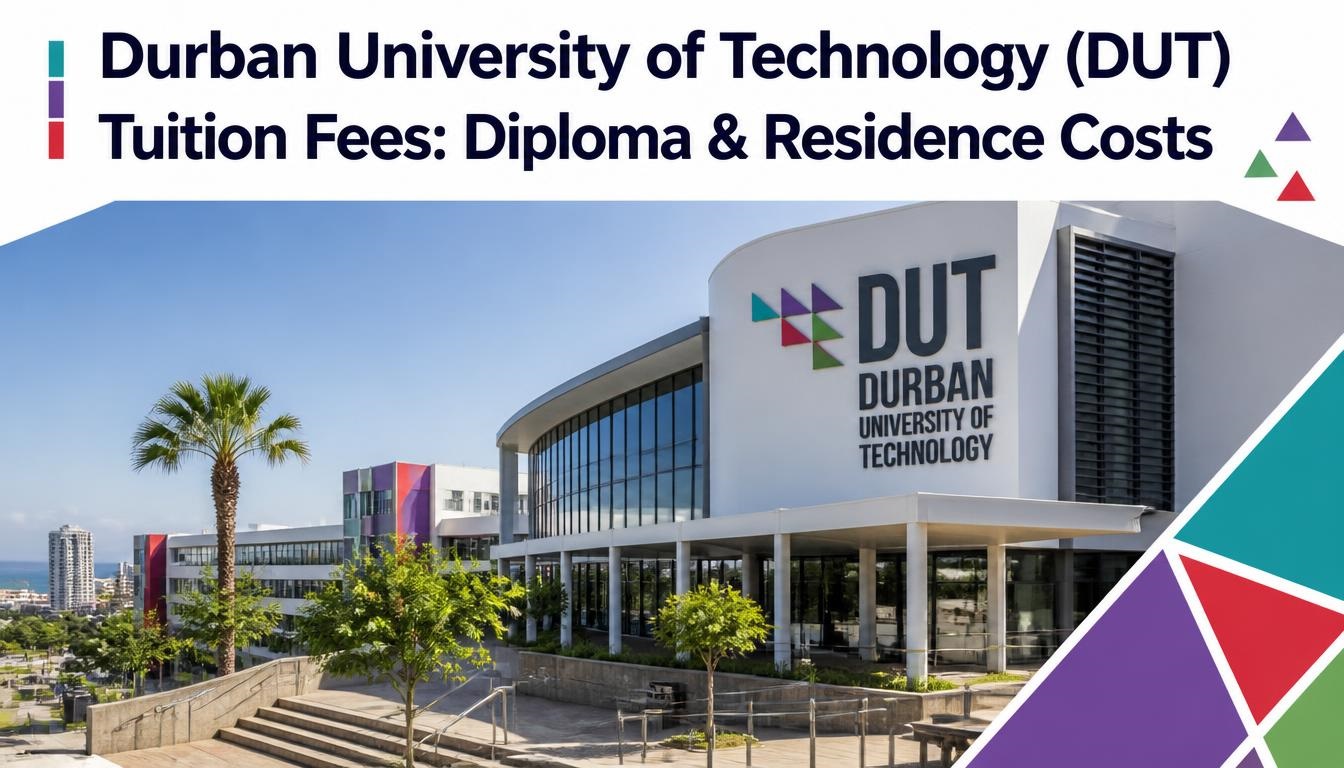
Standing in the registration queue at the Steve Biko or ML Sultan campus—or staring at the Central Applications Office (CAO) acceptance email on your phone—is usually followed by an immediate wave of financial anxiety. For thousands of matriculants and returning students across KwaZulu-Natal and South Africa, the biggest hurdle isn’t getting accepted into the Durban University of Technology (DUT); it is figuring out exactly how much the qualification will cost once module levies, registration deposits, and residence fees hit the student account.
The financial documentation published by tertiary institutions can feel intentionally confusing, leaving families scrambling to calculate whether their savings, bursary, or National Student Financial Aid Scheme (NSFAS) allocation will cover the full balance. Between varying per-module pricing across the six faculties and complex tier structures for residence accommodation, unexpected expenses often catch first-year students off guard. This comprehensive guide cuts through official jargon to deliver a clear, itemized financial roadmap for studying a Diploma at DUT in 2026, complete with mandatory upfront registration deposits, faculty-specific tuition costs, housing fees, and practical ways to avoid late penalty interest.
Quick Answer / Key Takeaways
-
First Instalment / Down Payment: Non-residence annual students must pay a compulsory deposit of R5,260 on registration day, while semester-based students pay R3,229. Residence students pay an initial upfront fee of R11,242 (annual) or R6,897 (semester).
-
Average Annual Diploma Tuition: Expect to pay between R28,000 and R48,000 per year for standard 3-year National Diplomas, depending on practical laboratory and equipment levies.
-
Residence Fees: On-campus and university-managed housing ranges from R20,900 to R53,337 per academic year, depending on single vs. double room configuration and campus location.
-
Early Payment Discount: A 5% settlement discount applies to tuition fees if the account is paid in full by 27 March 2026 for annual/first-semester courses.
Understanding DUT’s Fee Structure: How Diploma Costs Are Calculated
Unlike basic education where a single flat fee covers the academic term, tertiary education at DUT operates on a course-unit or credit-based pricing system. When registering for a National Diploma or Extended Curriculum Programme (ECP), tuition is not billed as one lump sum; instead, each individual module carries its own specific price tag based on contact hours, practical assessments, and specialized department equipment.
A standard undergraduate diploma comprises multiple modules per semester, typically totaling 120 credits per academic year. If a student fails a module and needs to repeat it, they pay for that specific module again the following year. Additionally, students must factor in mandatory university-wide administrative levies, including technology access, health services, and sports facility access, which are automatically billed onto the provisional fee statement during online registration.
Faculty-by-Faculty Diploma Tuition Cost Breakdown
Tuition fees vary significantly depending on the field of study. Qualifications in the Faculty of Engineering and the Built Environment or the Faculty of Applied Sciences command higher annual totals due to high-cost laboratory consumables, specialized software licenses, and practical workshop supervision. Conversely, programmes in Management Sciences or Accounting and Informatics generally have lower overhead costs, resulting in lower per-module pricing.
Estimated Annual Tuition Fees by Faculty for National Diplomas
The table below outlines the estimated annual tuition fee ranges for full-time diploma programmes across DUT campuses. These estimates exclude residence charges, textbook allowances, and personal living expenses.
| DUT Faculty | Typical Annual Diploma Tuition (ZAR) | Key Cost Factors & Levies |
| Accounting and Informatics | R28,000 – R38,000 | Computer laboratory access, specialized auditing and tax software tools |
| Management Sciences | R27,000 – R36,000 | Primarily lecture-based; lower practical laboratory levies |
| Arts and Design | R32,000 – R44,000 | Design studio access, specialized printing, media lab software, and exhibition costs |
| Engineering and Built Environment | R34,000 – R48,000 | Workshop safety gear, heavy engineering lab consumables, CAD software licenses |
| Applied Sciences | R32,000 – R45,000 | Chemical and biological lab consumables, field trips, specialized scientific testing equipment |
| Health Sciences | R33,000 – R46,000 | Clinical placement levies, medical consumable kits, laboratory practical sessions |
Module Pricing Examples
To illustrate how these costs accumulate, consider a typical first-year Diploma in Financial Accounting or Public Management. Individual semester modules generally range from R3,200 to R4,500 each. Registering for 8 to 10 modules across the two semesters yields a baseline tuition cost of roughly R32,000 to R37,000 before adding mandatory student activity levies.
Mandatory Down Payments and Registration Deposits
One of the most frequent friction points during the South African academic registration window is the minimum initial payment. DUT requires all self-funding or partially funded students to settle a compulsory first instalment before their online course registration can be validated. Payments must be cleared into the university bank account at least five working days prior to logging into the registration portal to avoid automated hold blocks.
2026 Compulsory First Instalment Structure
-
Annual Non-Residence Students: R5,260 minimum down payment on registration day.
-
Semester Non-Residence Students: R3,229 minimum down payment on registration day.
-
Annual Residence Students (Tuition + On-Campus Housing): R11,242 total minimum down payment.
-
Semester Residence Students (Tuition + On-Campus Housing): R6,897 total minimum down payment.
Standard Payment Due Dates for Outstanding Balances
Once the first instalment is paid, the remaining balance on the student account is split into structured payment deadlines throughout the academic year:
-
First Instalment: Payable immediately before or on the official day of registration.
-
Second Instalment (Annual Courses): 35% of the outstanding fee balance due by late April / early May.
-
Third Instalment (Annual Courses): 35% of the remaining balance due by late July.
-
Final Instalment (Annual Courses): 100% full account settlement due by end of October.
Failure to clear outstanding balances by these deadlines results in financial blocks, preventing students from accessing examination results, registering for subsequent semesters, or receiving official graduation certificates.
DUT Residence and Accommodation Costs
Securing accommodation is a major priority for students relocating to the Durban (Steve Biko, Ritson, ML Sultan, City Campus) or Pietermaritzburg (Indumiso, Riverside) campuses. DUT offers both university-owned (in-house) residences and university-accredited private off-campus digs.
Accommodation fees are billed separately from academic tuition and depend on room occupancy (single vs. double room) and building amenities.
On-Campus vs. Off-Campus Student Accommodation Cost Comparison
The table below contrasts official university-owned residence rates with private off-campus options in surrounding areas like Musgrave, Berea, Glenwood, and Umbilo.
| Accommodation Category | Typical Annual Cost Range (ZAR) | Average Monthly Equivalent | What Is Included / Key Features |
| DUT Owned Single Room (e.g., Indumiso / PMB) | R36,000 – R53,337 | ~R3,600 – R5,330 / month | Private room, shared kitchen/ablutions, campus security, campus Wi-Fi, electricity included |
| DUT Owned Double Room (e.g., Indumiso / PMB) | R20,900 – R30,000 | ~R2,090 – R3,000 / month | Shared bedroom, shared common facilities, basic campus security, water and electricity included |
| Accredited Off-Campus Digs (Berea, Glenwood, Umbilo) | R27,000 – R65,000 | R2,700 – R6,500 / month | Fully furnished options, independent living, variable security, private or shared utilities |
| Private Studio / Cottage (Durban Central / North) | R50,000 – R84,000 | R5,000 – R7,000 / month | High privacy, off-street parking, independent utilities, longer lease agreements |
When constructing an academic budget, tuition and accommodation are only two pieces of the financial puzzle. First-year students frequently encounter several indirect expenses that must be planned for in advance.
Mandatory Student Administrative Levies
Every registered student is charged an annual administration service levy (typically between R2,100 and R2,500) that covers access to campus Wi-Fi networks, library databases, computer laboratories, student health clinics, and sports facilities.
Textbooks and Course Material
Unlike high school, tertiary learning materials are not provided free of charge. Textbooks for a full diploma curriculum cost between R4,000 and R8,000 annually if bought brand new. Joining campus buy-and-sell groups or buying second-hand textbooks from senior students can cut this expense in half.
CAO and University Application Fees
For prospective students applying via the Central Applications Office (CAO), the standard application fee for South African citizens is R220. Submitting an application after the standard closing dates incurs a late application fee of R470. International applicants pay R250.
Meal and Living Allowances
Students in self-catering residences or off-campus digs should budget between R2,000 and R3,500 monthly for food, groceries, toiletries, and local transport (such as minibus taxis between accommodation and campuses like City Campus or Ritson).
Funding Options, NSFAS, and How to Secure Settlement Discounts
Navigating university payments requires leveraging every financial relief tool available in South Africa.
The National Student Financial Aid Scheme (NSFAS)
For students coming from households with a combined annual income of R350,000 or less (or R600,000 for students with disabilities), NSFAS provides comprehensive bursary funding.
-
Registration Fee Exemption: Approved NSFAS students do not pay the upfront R5,260 tuition deposit or housing deposit out of pocket.
-
Coverage Scope: NSFAS covers 100% of approved tuition fees, accommodation (up to the national capped rate), a learning material (textbook) allowance, and a monthly personal care living allowance.
-
Missing Middle Funding: Students from households earning above the R350,000 threshold but unable to afford full commercial fees can apply for the government’s “Missing Middle” student loan scheme administered through NSFAS, which offers concessional loan terms with partial conversion to bursaries based on academic performance.
Early Payment Settlement Discount
For self-funding families, paying fees early offers direct financial savings. DUT provides a 5% settlement discount on tuition fees if the annual fee balance or first-semester fees are paid in full by 27 March 2026. A similar 5% discount applies to second-semester fees settled in full by 31 July 2026.
Note that this discount applies strictly to tuition fees and does not extend to residence charges, short courses, or students funded by NSFAS or corporate bursaries.
Financial Planning Strategy for Future DUT Graduates
Budgeting for tertiary education at DUT requires proactive planning long before the academic year begins. By understanding the exact breakdown of module costs, tracking down payment deadlines, and preparing for indirect living expenses, students can avoid mid-year financial blocks and stay focused on completing their diplomas.
What has been your experience when applying for DUT accommodation or navigating registration fee deposits? Are you planning to fund your studies through NSFAS, a private bursary, or self-funding? Drop your thoughts, questions, or tips in the comments section below to help other prospective South African students!

Joseph Mathebula is a consumer tech analyst and market researcher at Prices in South Africa. He specializes in tracking smartphone prices and consumer electronics, helping everyday shoppers navigate the market to secure the best value.
Post Disclaimer
Prices and availability are subject to change without notice and may vary by store or region. pricesinsouthafrica.co.za is an independent informational platform; we do not sell products directly, nor are we responsible for third-party pricing errors.