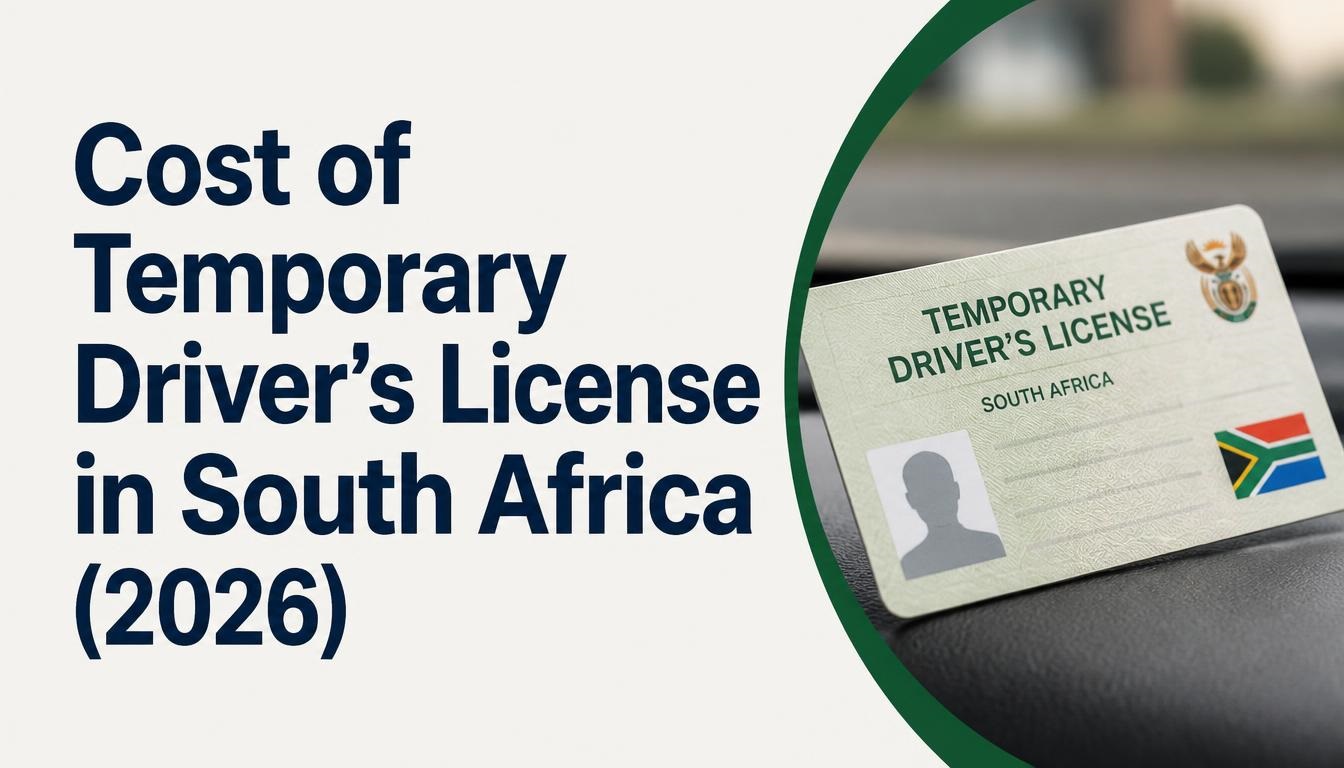
Getting pulled over at a metro police roadblock in Johannesburg, Cape Town, or Durban with an expired driving licence card is an instant recipe for a heavy fine—often ranging from R500 to R1,250 depending on the local municipality. Whether your permanent card has expired, gone missing, or is trapped in the National Department of Transport’s production backlog, securing a valid Temporary Driving Licence (TDL) is your only legal safeguard on South African public roads. However, calculating the actual out-of-pocket cost is surprisingly tricky. While the official government tariff for the temporary document itself sits between R72 and R150 depending on the province, the total expense quickly escalates once you factor in passport photos, optometrist eye tests, police affidavits, online NATIS booking administrative charges, and time off work. Having personally evaluated licensing workflows across major Driver Licence Testing Centres (DLTCs) in Gauteng, the Western Cape, and KwaZulu-Natal, this pricing guide breaks down every direct fee, hidden cost, and local municipal variance to help you navigate the process without overpaying.
Quick Price Summary: Temporary Driver’s License Fees
-
Official Government Fee: R72 to R150 (Note: The Department of Transport announced fee waivers for backlogs, but individual municipalities still enforce tariffs).
-
ID Photograph Set (4 Photos): R40 to R120 (DLTC on-site booths vs. private retail studios like Kodak Express or Dis-Chem).
-
Mandatory Visual Examination: R0 at DLTC (included in booking) or R80 to R220 via a registered private optometrist.
-
Police Affidavit (Lost/Stolen Cards): R0 at South African Police Service (SAPS) stations.
-
Realistic Total Out-of-Pocket Expense: R112 to R450 depending on your choice of private eye testing and photo services.
What Did Your Temporary License Cost You?
We want to keep this pricing database as accurate and up-to-date as possible for drivers across South Africa. Did your local DLTC charge the standard official rate, or did you run into unexpected fees for photos or private eye testing? How long did you wait in line at your station? Share your recent experience, the location you visited, and the total amount you paid in the comments below to help fellow motorists budget wisely.
Official Regional Price & DLTC Expense Matrix
Pricing for a Temporary Driving Licence is regulated under provincial road traffic regulations, meaning exact costs vary slightly depending on whether you visit a metropolitan centre in Gauteng, a provincial station in the Western Cape, or a local municipality in KZN or the Eastern Cape. The matrix below details the standard fee breakdown across major South African metropolitan areas.
| Metro / DLTC Region | Official Temporary Licence Fee | On-Site Photo Cost | Optometrist Eye Test (Optional) | Total Estimated Out-of-Pocket |
| City of Johannesburg (Gauteng) | R72 – R90 | R50 – R80 | R120 – R200 | R122 – R290 |
| City of Tshwane / Pretoria (Gauteng) | R72 – R90 | R45 – R75 | R100 – R180 | R117 – R270 |
| City of Cape Town (Western Cape) | R85 – R110 | R60 – R90 | R150 – R220 | R145 – R320 |
| eThekwini / Durban (KwaZulu-Natal) | R90 – R140 | R50 – R80 | R120 – R190 | R140 – R310 |
| Nelson Mandela Bay (Eastern Cape) | R80 – R120 | R40 – R70 | R100 – R170 | R120 – R260 |
| Private Concierge / Queueing Service | R72 – R140 (Govt) | R60 – R90 | R150 (Private) | R450 – R850 (Includes Service Fee) |
Note: In Gauteng and parts of the Eastern Cape, NATIS booking systems require upfront reservation, whereas walk-ins are permitted under specific conditions at designated Western Cape and rural DLTCs.
Step-by-Step Application & Buyer’s Decision Framework
Obtaining a temporary driver’s licence requires presenting specific documentation and selecting the most cost-effective processing pathway. Following this structured approach prevents wasted trips, extra photo fees, and repeated queueing.
Step 1: Confirm Your Eligibility and Need
A Temporary Driving Licence (TDL) is legally issued under Regulation 109 of the National Road Traffic Act. You are eligible to apply only if:
-
You are simultaneously applying to renew your expired or expiring permanent driving licence card.
-
Your existing licence card was lost, damaged, or stolen, and you have applied for a replacement card.
-
You have recently passed your K53 practical driving test and are waiting for your initial permanent card to be produced.
Note: A temporary licence cannot be issued as a standalone document without an accompanying application for a permanent card or a valid driving test pass record.
Step 2: Book an Appointment via NATIS or Visit Your Station
In Gauteng and metropolitan regions operating under the electronic National Traffic Information System (eNaTIS), you must register and book a slot online via the official online.natis.gov.za portal.
-
Select your preferred DLTC location, date, and time slot.
-
Download and print your slot confirmation booking slip.
-
In provinces like the Western Cape or KwaZulu-Natal where walk-in queues are maintained alongside online slots, arrive at least 45 minutes before opening time to secure a spot.
Step 3: Gather Mandatory Paperwork and Avoid Photo Scams
Arriving unprepared leads to missed appointment slots and forced purchases at expensive mobile photo vans parked outside testing centres. Prepare the following checklist in advance:
-
Original South African Smart ID Card, Green Barcoded ID Book, or valid Passport.
-
Certified copy of your ID or Passport (certified for free at any SAPS station, valid for under 3 months).
-
Four identical black-and-white passport-sized photographs (35mm x 45mm). While modern DLTC live capture units handle photos for permanent cards, temporary paper licences still require physical pasted photographs at many municipal branches.
-
Proof of residential address (utility bill, retail account statement, or lease agreement not older than 3 months). If living with a homeowner, include a signed affidavit from the owner alongside their utility bill.
-
Official SAPS Police Affidavit if applying due to a stolen or lost card (must state the exact licence card number or declare the loss).
-
Pre-filled DL1 Form (Application for Driving Licence) to bypass administrative delays inside the hall.
Step 4: Complete the Visual Screening
You have two choices for your compulsory eye examination:
-
Option A (Free at DLTC): Undergo the visual test on the basic optical apparatus at the testing centre. While cost-effective, failing the DLTC machine forces you to restart the queue after visiting an optometrist.
-
Option B (Private Optometrist Certificate): Visit a registered optometrist (such as Spec-Savers, Torga Optical, or an independent practitioner) beforehand to complete a standardized certificate. The cost ranges between R80 and R220, but it completely eliminates the eye test queue at the DLTC and guarantees accurate prescription parameters.
Step 5: Document Processing and Immediate Issuance
Once your fingerprints are captured and payments are processed at the cashier counter, the officer will paste your physical photograph onto a standardized green or white paper temporary licence template, apply an official municipal stamp, and issue the document on the spot.
Real-World Expert Commentary: Maximizing Value at the DLTC
“Most drivers assume the official tariff on the government notice is the total amount they will spend, but incidental expenses are where budget overruns happen,” notes senior retail data analyst and consumer advocate Michael van der Merwe. “If you walk into a major centre like Akasia in Pretoria or Gallows Hill in Cape Town without physical photographs, mobile vendors outside will charge up to R120 for four basic prints. Having your photos taken at a retail pharmacy like Dis-Chem or a local print shop beforehand cuts that cost by 50%. Furthermore, paying R150 for a private optometrist certificate is often worth every cent—it bypasses the single longest bottleneck at the DLTC, saving you hours of waiting time.”
Cost vs. Urgency Breakdown: Evaluating Your Options
Depending on your work schedule, risk tolerance, and driving requirements, choosing how to apply for your temporary licence involves balancing direct financial costs against time investment. The breakdown below compares three common applicant profiles.
Profile 1: Budget DIY Applicant
-
Direct Expenses: Official Municipal Fee (R72) + Pre-printed Photos (R40) + DLTC Eye Test (R0) = R112 Total.
-
Time Required: 2 to 4 hours at the DLTC.
-
Best Suited For: Students, retirees, or flexible workers who can book early morning slots (07:30 AM) and handle potential system delays.
-
Worth It Index: 9/10 for strict cost savings; 5/10 for convenience.
Profile 2: Time-Optimized Smart Applicant
-
Direct Expenses: Official Fee (R72) + Retail Studio Photos (R50) + Private Optometrist Screening (R120) = R242 Total.
-
Time Required: 30 to 60 minutes total at the DLTC.
-
Best Suited For: Employed professionals, commercial drivers, and parents who need to get in and out quickly during office hours.
-
Worth It Index: 10/10 overall balance of affordability and speed.
Profile 3: Concierge / Queueing Agency Service
-
Direct Expenses: Government Fees (R72 – R224 renewal bundle) + Agency Handling Fee (R350 – R500) + Private Photos/Eye Test (R170) = R592 – R894 Total.
-
Time Required: Minimal personal queueing (agency manages queue position or document delivery where legally permitted).
-
Best Suited For: Corporate executives or individuals unable to stand in public queues due to mobility constraints.
-
Worth It Index: 6/10 due to high cost markup, but highly valued by time-poor drivers.
Common Consumer Pitfalls & Hidden Costs
When budgeting for a temporary driver’s licence, several indirect charges and operational pitfalls can quickly double your expected spend. Being aware of these local factors ensures you do not encounter unexpected costs at the counter.
1. The Ministerial Waiver vs. Local Municipal Enforcement Gap
In late 2025, the Minister of Transport announced intentions to waive the R72 temporary licence fee to compensate for massive card production backlogs caused by printing machine downtime. However, because municipal testing centres operate under local provincial and council revenue frameworks, many centres across South Africa continue to collect the standard R72 to R150 fee at cashiers. Always bring sufficient cash or card funds to pay the fee directly; assuming it will be free can leave you stranded at the cashier counter without a valid licence.
2. “Cash-Only” Systems and POS Offline Outages
Card payment terminals at municipal offices frequently experience network connectivity drops due to local load shedding or technical glitches. While major metropolitan centres accept credit and debit cards, walking in without cash reserves can force you to hunt for an ATM outside the facility, losing your spot in line. Always carry between R200 and R300 in physical cash as a backup.
3. Invalid Passport Photos
Temporary licences require physical black-and-white photos pasted directly onto the document. If your photos feature a dark background, shadow reflections, incorrect dimensions, or color prints, DLTC officers will reject them on the spot. Ensure your studio provides strict black-and-white, high-contrast 35mm x 45mm prints against a plain white background.
4. Third-Party “Fast-Track” Scams
Touts operating outside busy centres like Wynberg, Randburg, or Pinetown often approach motorists promising to “bypass the queue” or “issue a temporary licence in 5 minutes” for fees between R300 and R800. These are unauthorized scams. Temporary licences printed outside official municipal systems or without valid NATIS capture are illegal, counterfeit documents that will lead to criminal arrest at traffic checkpoints. All official fees must be paid directly to the official municipal cashier counter inside the facility.
Frequently Asked Questions
How long is a temporary driver’s licence valid in South Africa?
A Temporary Driving Licence is valid for exactly six months from the date of issue. It is designed as a bridge document to cover you legally while the national card production facility processes your permanent card.
Can I extend or renew my temporary licence if my permanent card is delayed?
Yes. If your permanent licence card has not arrived at the DLTC before your six-month temporary licence expires, you can apply for a second temporary licence. You will need to present your original receipt, your expiring temporary licence, a new set of photos, and complete a fresh DL1 form.
What happens if I drive with an expired driver’s licence card and no temporary licence?
Driving with an expired licence card without a valid temporary paper licence is an offense under the National Road Traffic Act. Traffic officers can issue a spot fine ranging from R500 to R1,250. More critically, insurance providers in South Africa may repudiate vehicle accident claims if the driver’s licence card was expired at the time of an incident and no valid temporary licence was in place.
Can I travel across South African borders using a temporary driver’s licence?
While a temporary driving licence is a legally recognized document within South Africa, neighboring countries such as Namibia, Botswana, Mozambique, and Eswatini have varying regulations regarding paper licences. If you plan to drive across international borders, carry your temporary licence alongside your expired card, official renewal payment receipt, and a certified copy of your ID. Contact the specific border post control office prior to travel to confirm acceptance.
Important Price & Regulatory Notice
This article is an independent pricing evaluation and consumer information guide provided for educational purposes only. Driving licence fees, municipal tariffs, and administrative procedures are determined by provincial traffic departments and the National Department of Transport and are subject to official revision. pricesinsouthafrica.co.za is not affiliated with the Road Traffic Management Corporation (RTMC), eNaTIS, or any municipal testing facility. Always verify final processing requirements with your local licensing office prior to submitting documentation.

Joseph Mathebula is a consumer tech analyst and market researcher at Prices in South Africa. He specializes in tracking smartphone prices and consumer electronics, helping everyday shoppers navigate the market to secure the best value.
Post Disclaimer
Prices and availability are subject to change without notice and may vary by store or region. pricesinsouthafrica.co.za is an independent informational platform; we do not sell products directly, nor are we responsible for third-party pricing errors.