Walk into any Vodacom 4U store or scroll through Takealot during a payday sale, and you will notice a distinct shift in the South African smartphone market. Local consumers are no longer defaulting automatically to R30,000 flagships. Between Eskom grid pressures requiring ultra-reliable power banks, shrinking real disposable incomes, and the rapid expansion of 5G coverage across Gauteng, the Western Cape, and KwaZulu-Natal, value-for-money has become the ultimate deciding factor.
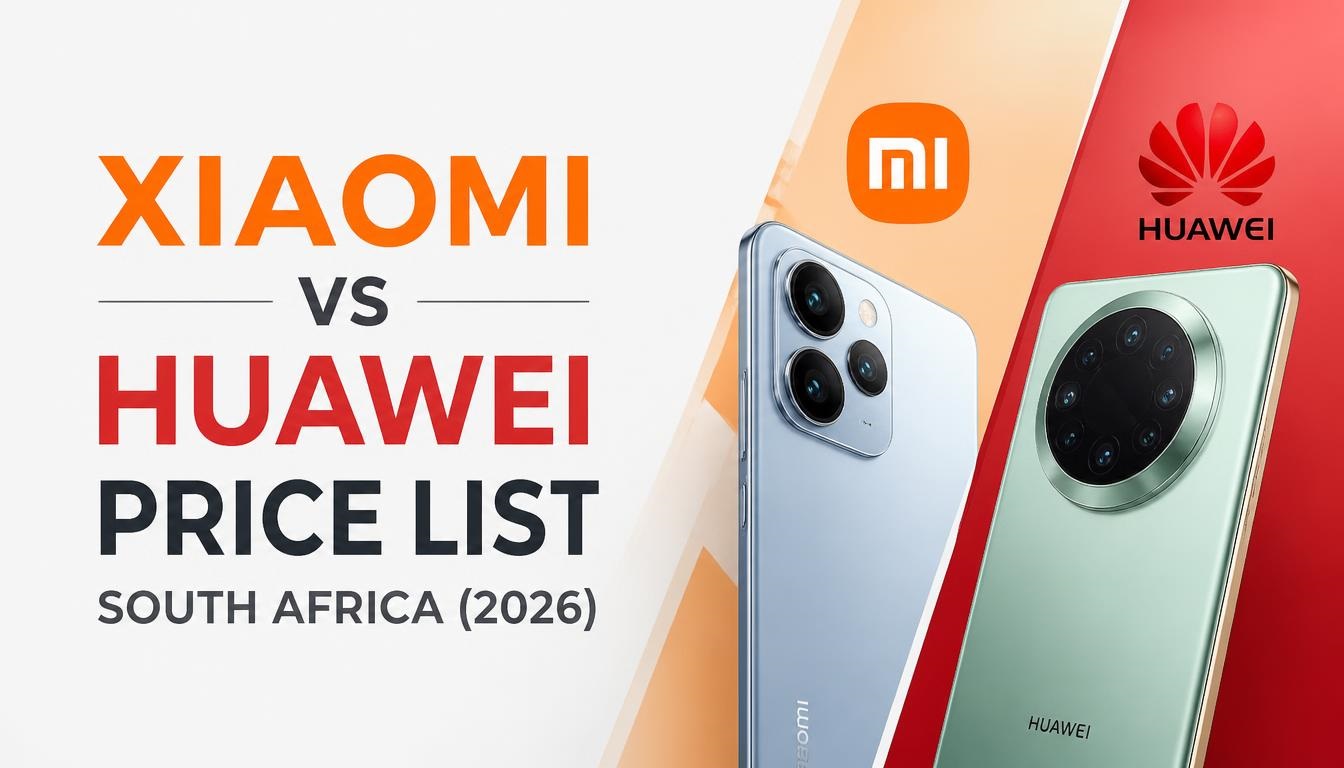
Xiaomi and Huawei continue to dominate this value-driven battleground across Mzansi. However, navigating their current product lineups, carrier contract pricing, and Google Mobile Services (GMS) availability can be tricky. This comprehensive pricing guide breaks down the latest Xiaomi and Huawei smartphones available in South Africa, comparing real-world retail cash prices, contract deals, hardware performance, and software ecosystems to help you spend your hard-earned Rands wisely.
Quick Answer / Key Takeaways
-
Budget Segment (Under R4,000): Xiaomi Redmi 14/15 series and Huawei nova Y-series offer exceptional battery life and reliable performance for daily social media and Banking app use.
-
Mid-Range Segment (R4,000 – R11,000): Xiaomi Redmi Note 14/15 Pro models lead in raw display quality, 5G performance, and full Google Play access, while Huawei’s nova 14/15 series delivers premium camera hardware and aesthetic design.
-
Flagship Segment (R12,000+): Huawei’s Pura 80 series and Mate lineup set industry benchmarks in mobile photography, whereas Xiaomi’s T-series delivers flagship-tier specs at a reduced price point.
-
Software Ecosystem: Xiaomi natively runs Google Mobile Services (GMS) via Android/HyperOS, whereas Huawei relies on Huawei Mobile Services (HMS) and AppGallery, requiring light workarounds like MicroG or Petal Search for specific Google apps.
The South African Smartphone Market Landscape
Choosing between Xiaomi and Huawei in South Africa involves evaluating both raw specifications and ecosystem compatibility. Both brands have adjusted their retail strategies to meet local economic needs, offering aggressive trade-in promotions, bundle deals with smartwatches or air fryers, and competitive monthly contract options across Vodacom, MTN, Telkom, and Cell C.
Why Xiaomi Has Gained Major Traction in Mzansi
Xiaomi’s rise in South Africa stems from a straightforward formula: providing high refresh rate AMOLED screens, fast charging technology, and generous onboard storage at competitive price tiers.
-
Full Google Services Integration: Xiaomi devices come standard with Android and Xiaomi HyperOS, giving local users out-of-the-box access to Google Play Store, Google Maps, Gmail, and native banking security integrations required by South African banks such as Capitec, FNB, Standard Bank, Absa, and Nedbank.
-
Rapid Charging Protocols: With charger bricks included in the box for most budget and mid-range devices, Xiaomi’s 33W to 120W fast-charging capabilities ensure your device recharges quickly during brief power windows.
-
Aggressive Retail Availability: Beyond mobile network operators, Xiaomi has established a strong presence through major local retailers, including Takealot, Incredible Connection, Makro, HiFi Corp, and Game.
Where Huawei Holds Its Ground
Despite historical software adjustments, Huawei remains a household name in South Africa. The brand maintains strong brand loyalty due to superior hardware build quality, class-leading camera optics, and deep telecom relationships.
-
Camera Hardware Dominance: Huawei’s XMAGE image processing engine, variable aperture lenses, and RYYB sensor tech consistently outperform competitors in low-light photography and portrait rendering.
-
Battery Efficiency & Signal Reception: Huawei antennas are engineered for signal strength, providing reliable connectivity in rural areas or regions with spotty cellular coverage.
-
AppGallery Expansion: HMS and Huawei AppGallery now natively host almost all major South African banking apps, taxi services (Bolt, Uber), shopping portals (Takealot, Checkers Sixty60), and entertainment options. Accessing missing Google apps has also become seamless through built-in engine tools like MicroG and GBox.
Detailed Xiaomi Smartphone Price List in South Africa
Xiaomi categorizes its devices into distinct tiers: the entry-level Redmi series, the popular mid-range Redmi Note line, and the flagship Xiaomi numbered and T-series.
Entry-Level Tier: Xiaomi Redmi Series (Under R4,000)
Ideal for students, gig drivers, or anyone needing a reliable primary driver without breaking the bank, these phones focus on multi-day battery endurance and large displays.
-
Xiaomi Redmi 14 / 14C (128GB/256GB): Priced around R2,499 to R3,299 cash. Features a 6.88-inch smooth display, a massive 5000mAh+ battery, and a clean side-mounted fingerprint sensor.
-
Xiaomi Redmi Note 13 / 14 4G (128GB/256GB): Priced between R4,599 and R4,999 cash. Offers an upgraded AMOLED display, 108MP camera sensors, and 33W fast charging.
Mid-Range Tier: Xiaomi Redmi Note Pro Series (R5,000 – R12,000)
The Redmi Note Pro lineup represents the sweet spot for South African buyers, offering 5G connectivity, crisp AMOLED screens, and optical image stabilization (OIS) camera modules.
-
Xiaomi Redmi Note 14 5G / Note 15 (256GB): Priced at approximately R5,499 to R5,899 cash or available on 24-month contract from R349 per month.
-
Xiaomi Redmi Note 14 Pro 5G / Note 15 Pro (256GB/512GB): Priced at approximately R7,499 to R7,999 cash or from R389 per month on contract. Equipped with 67W Turbo Charge, IP68 dust/water resistance, and high-performance MediaTek Dimensity processors.
-
Xiaomi Redmi Note 14 Pro+ 5G / Note 15 Pro+ (256GB/512GB): Priced between R9,999 and R10,799 cash or from R429 per month on contract. Features 120W HyperCharge (0 to 100 percent in under 20 minutes) and premium glass finishes.
Upper Mid-Range & Flagship Tier: Xiaomi T-Series (R12,000+)
-
Xiaomi 14T / 15T & 17T Series (512GB 5G): Priced from R18,999 cash or around R699 per month on contract. Co-engineered with Leica optics, offering pro-grade photography, flagship processors, and aluminum chassis construction.
Summary Specification & Price Matrix: Xiaomi South Africa
| Xiaomi Model | Display Type & Refresh | Key Processor | Storage / RAM | Est. Cash Price (ZAR) | Est. Contract (24m Vodacom/MTN) |
| Redmi 14 / 14C | 6.88-inch IPS LCD, 120Hz | MediaTek Helio G81 Ultra | 128GB + 4GB | R2,499 – R3,299 | R199 / month |
| Redmi Note 14 4G | 6.67-inch AMOLED, 120Hz | Qualcomm Snapdragon 685 | 128GB + 6GB | R4,599 – R4,999 | R279 / month |
| Redmi Note 14 5G | 6.67-inch AMOLED, 120Hz | MediaTek Dimensity 7025 Ultra | 256GB + 8GB | R5,499 – R6,999 | R349 / month |
| Redmi Note 15 Pro | 6.67-inch Curved AMOLED, 120Hz | MediaTek Dimensity 7300 Ultra | 256GB + 8GB | R7,499 – R8,499 | R389 / month |
| Redmi Note 15 Pro+ 5G | 6.67-inch Curved AMOLED, 120Hz | Snapdragon 7s Gen 3 | 256GB/512GB + 12GB | R10,799 – R12,499 | R429 / month |
| Xiaomi 17T 5G | 6.67-inch CrystalRes AMOLED, 144Hz | MediaTek Dimensity 8300 Ultra / 9300+ | 512GB + 12GB | R18,999 – R19,999 | R699 / month |
Detailed Huawei Smartphone Price List in South Africa
Huawei structures its smartphone catalog across three main lines: the affordable Y-series, the mid-range nova series, and the elite Pura and Mate flagship series.
Budget Tier: Huawei nova Y-Series (Under R6,000)
-
Huawei nova Y63 / Y74S (128GB 4G): Priced from R2,499 to R2,999 cash or from R199 to R249 per month on contract. Known for long battery life, rugged drop protection, and clear outdoor screens.
-
Huawei nova Y74 (256GB 4G): Priced from R4,999 to R5,799 cash or around R299 per month on contract. Offers 8GB RAM, 256GB storage, and 22.5W SuperCharge technology.
Mid-Range Tier: Huawei nova Series (R6,000 – R11,000)
The nova series combines sleek design, high-resolution front selfie cameras, and slim form factors.
-
Huawei nova 14i / 14 4G (256GB): Priced from R4,499 to R7,999 cash or from R329 per month on contract. Features high-resolution main camera sensors, fast charging, and thin body profiles.
-
Huawei nova 15 Max / nova 14 Pro (256GB/512GB): Priced between R8,599 and R9,999 cash or from R349 to R449 per month on contract. Features dual front portrait cameras, 66W/100W SuperCharge, and 50MP RYYB Ultra-Clear sensors.
Flagship Tier: Huawei Pura & Mate Series (R12,000+)
Designed for mobile photographers and executive power users who demand top-tier hardware regardless of cost.
-
Huawei Pura 80 / Pura 80 Pro (256GB/512GB): Direct promotional pricing on Huawei Store SA starts around R9,999 to R11,999, with full retail list pricing at R21,499 to R27,999. Contracts start from R499 to R569 per month. Features Kunlun Glass durability, retractable camera modules, and variable physical aperture lenses.
-
Huawei Mate 80 Pro / Mate X7 Foldable: Premium flagships priced from R12,999 promo / R21,999 list up to R39,999 / R46,999 for foldable hardware, with monthly contract tiers running up to R1,399 per month.
Summary Specification & Price Matrix: Huawei South Africa
| Huawei Model | Display & Build | Primary Camera Setup | Battery & Charging | Est. Cash Price (ZAR) | Est. Contract (24m Vodacom/MTN) |
| nova Y63 / Y74S | 6.75-inch LCD, Standard Glass | 50MP Dual Camera | 5000mAh, 22.5W SuperCharge | R2,499 – R2,999 | R199 – R249 / month |
| nova Y74 256GB | 6.75-inch LCD, 90Hz | 50MP Main + Depth | 6000mAh, 22.5W SuperCharge | R4,999 – R5,799 | R299 / month |
| nova 14 / 14i 256GB | 6.7-inch OLED, 120Hz | 50MP RYYB Main Camera | 4500mAh, 66W SuperCharge | R4,499 – R7,999 | R329 / month |
| nova 15 Max / 14 Pro | 6.78-inch OLED, 120Hz | 50MP RYYB + Ultra-Wide + Dual Selfie | 4600mAh, 100W SuperCharge | R8,599 – R9,999 | R349 – R449 / month |
| Pura 80 256GB | 6.6-inch LTPO OLED, Kunlun Glass | 50MP Ultra Lighting + 13MP UW + 12MP Tele | 4900mAh, 66W SuperCharge | R9,999 (Promo) – R21,499 | R499 / month |
| Pura 80 Pro 512GB | 6.8-inch LTPO OLED, Kunlun Glass 2 | 50MP Variable Aperture + 48MP Macro Tele | 5050mAh, 100W Wired / 80W Wireless | R11,999 (Promo) – R27,999 | R569 / month |
| Mate X7 Foldable | 7.85-inch Inner OLED, Kunlun Glass | 50MP Triple XMAGE Camera | 5050mAh, 66W SuperCharge | R39,999 – R46,999 | R1,399 / month |
Head-to-Head Comparison: Xiaomi vs. Huawei in South Africa
To help simplify your decision, let’s break down how these two Chinese smartphone giants perform against each other across key real-world criteria.
Software Experience & Google Banking Compatibility
The most crucial difference for South African users centers on software compatibility.
-
Xiaomi: Operates on full Android with HyperOS. All local banking apps (Capitec, Absa, Standard Bank, FNB, Nedbank, Discovery Bank, Tymebank) function natively out-of-the-box with biometric login and push notifications. Android Auto, Google Pay, and contactless NFC payments work seamlessly.
-
Huawei: Operates on HarmonyOS / EMUI powered by Huawei Mobile Services (HMS). AppGallery hosts the vast majority of local bank apps, Checkers Sixty60, and WhatsApp directly. For missing Google services or corporate Gmail/Drive accounts, tools such as MicroG or GBox allow full access. However, native contactless Google Pay is replaced by Huawei Pay or bank-specific scan-to-pay apps.
Hardware Durability & Screen Toughness
Drop protection and build quality are essential factors when investing in a smartphone.
-
Huawei: Sets the industry standard with its in-house Kunlun Glass technology on mid-to-high-tier models. Drop tests consistently prove Kunlun Glass handles accidental pavement falls better than standard glass panels, making it popular among active users.
-
Xiaomi: Utilizes industry-standard Corning Gorilla Glass (ranging from Gorilla Glass 5 to Gorilla Glass Victus depending on price tier). While durable, higher-end models benefit from screen protectors or protective cases.
Battery Life & Charging Speeds
-
Xiaomi: Focuses on pure charging velocity. Included charger bricks in Redmi Note Pro packages reach 67W to 120W, enabling a complete recharge in roughly 20 to 30 minutes—a major benefit during tight daily schedules.
-
Huawei: Focuses on power management and efficiency. Large 5000mAh to 6000mAh batteries paired with EMUI power optimization often deliver close to two full days of typical usage on a single charge.
Buying Guide: Where to Find the Best Deals in South Africa
Purchasing a smartphone in South Africa requires evaluating cash discounts, trade-in allowances, and contract extras.
Cash Deals & Direct Retailers
-
Takealot: Frequently hosts daily deals and clearance sales on both Xiaomi and Huawei open-market stock. Excellent for unattached prepaid purchases.
-
Huawei Online Store SA: Offers direct factory promotions, often bundling free smartwatches, Bluetooth earbuds, or tablet accessories worth up to R3,000 with phone purchases.
-
Incredible Connection & Makro: Reliable brick-and-mortar stores offering extended warranties, store finance, and immediate stock collection.
-
HiFi Corp & Game: Great destinations for budget-focused entry devices (Redmi C-series and Huawei Y-series) with flexible lay-by or store card options.
Cellular Contracts (Vodacom, MTN, Telkom, Cell C)
If you prefer spreading costs over a 24-month or 36-month period, network providers frequently pair Xiaomi and Huawei devices with extra perks:
-
Vodacom & MTN: Offer competitive monthly device finance plans. Look out for seasonal “Double Deal” promotions where a mid-range phone comes bundled with a second entry-level phone, Mi-Fi router, or power bank.
-
Telkom: Typically offers lower monthly contract subscription rates with generous monthly data allocations (FreeMe bundles).
Practical Buyer Checklist Before Purchasing
Before finalizing your phone purchase online or in-store, run through this quick checklist:
-
Verify Network 5G Band Support: Ensure the specific sub-model supports local South African 5G frequency bands (n1, n3, n28, n78) if you want high-speed coverage on Vodacom, MTN, or Rain.
-
Check Charger Box Contents: While Xiaomi generally includes high-speed chargers in Redmi boxes, double-check whether your selected flagship model requires buying an additional high-wattage power brick separately.
-
Confirm Banking App Requirements: If you rely on specialized banking apps or enterprise security software, test if your required tools run natively or require workaround apps on HMS devices.
-
Inspect Bundle Gifts: Huawei online promos often include free wearables or earbuds. Factor the value of those accessories into the overall cash price when comparing options.
Which brand are you currently using, and what feature matters most for your next upgrade—ultra-fast charging, native Google Play access, or unbreakable drop-resistant glass? Share your thoughts and questions in the comments below!

Joseph Mathebula is a consumer tech analyst and market researcher at Prices in South Africa. He specializes in tracking smartphone prices and consumer electronics, helping everyday shoppers navigate the market to secure the best value.
Post Disclaimer
Prices and availability are subject to change without notice and may vary by store or region. pricesinsouthafrica.co.za is an independent informational platform; we do not sell products directly, nor are we responsible for third-party pricing errors.