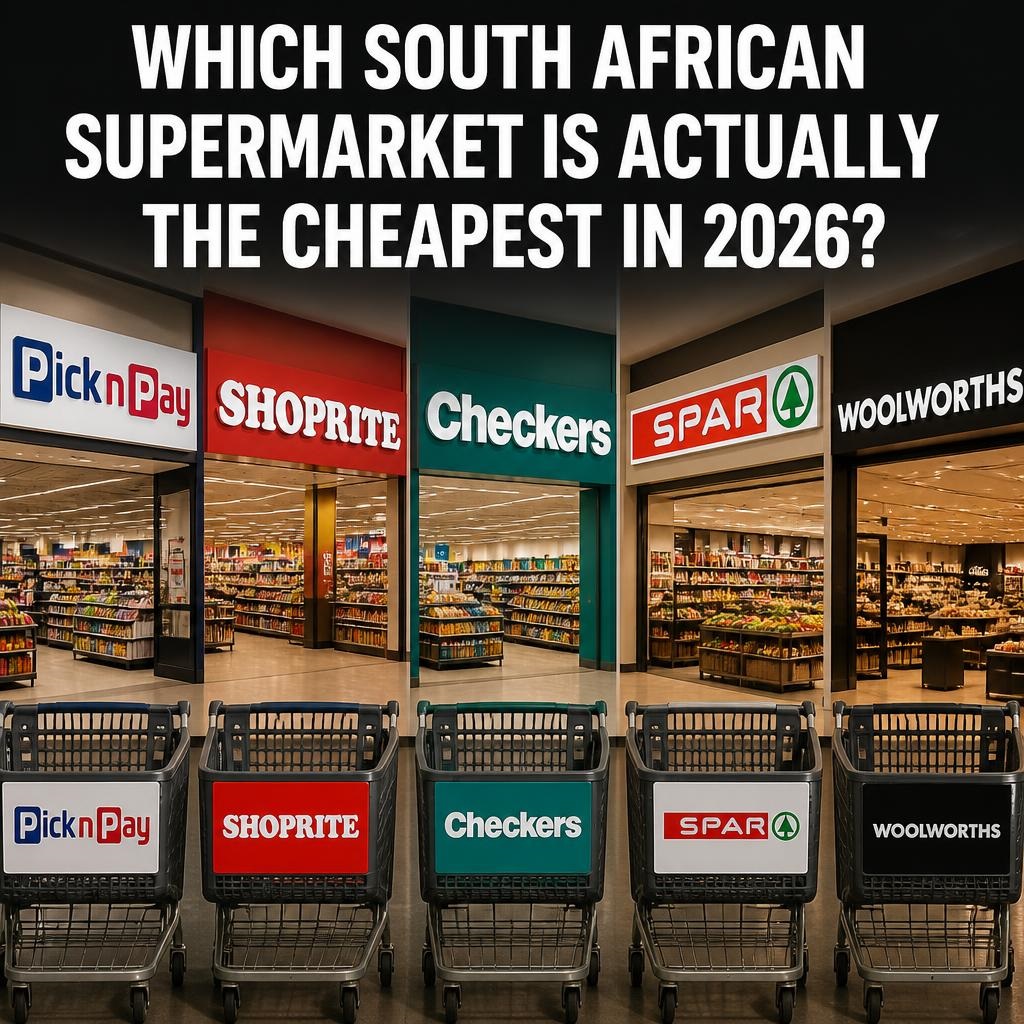
If you have stepped up to a till point lately, you know the feeling. Headline annual food and non-alcoholic beverage inflation dropped down to 0.9%, its lowest level in over sixteen years, but your weekly grocery slip tells an entirely different story. The reality is that prices have not rolled back; they have simply stabilized at historical highs. With the Pietermaritzburg Economic Justice & Dignity Group (PMBEJD) tracking the average South African 44-item household food basket at approximately R5,479.80, deciding which South African supermarket is actually the cheapest is no longer just a casual choice—it directly dictates monthly survival for millions of households and small catering operators.
Marketing campaigns throw massive discount banners at us daily, but once you factor in fuel, loyalty program traps, house brand quality drops, and local supply chain markups, the “cheapest” title shifts depending on how and what you buy. Below is a raw, independent market breakdown of how South Africa’s major supermarket chains stack up at the till.
SA Supermarket Price Snapshot
The Real Cost Breakdown: Comparing SA’s Top Retailers
To truly determine which store offers the best value, we must break down the market into realistic consumer profiles. A bulk buyer in Pietermaritzburg grabbing 10kg maize meal and frozen chicken portions lives in a completely different financial reality than a suburban family in Sandton filling a trolley with fresh produce and pantry goods via an on-demand app.
Below is a detailed comparative breakdown across South Africa’s major supermarket brands, reflecting current baseline pricing across urban metros:
| Supermarket Chain | Baseline Basket (44 Staples) | Fresh Produce & Meat Quality | House Brand Value | Loyalty Program Impact | Best For | Retail Market Data |
| Shoprite | R5,170 – R5,320 | Moderate / Functional | Excellent (Ritebrand) | High (Xtra Savings) | Basic bulk staples, low-income household budget | Shoprite SA – View Deals |
| Makro / Game (Massmart) | R5,220 – R5,400 | Bulk Packaged Focus | Good (M|Saver / First Choice) | Moderate (mCard) | Monthly non-perishable pantry resets & bulk buys | Makro Wholesale – View Deals |
| Pick n Pay | R5,410 – R5,580 | Good | Good (No Name) | High (Smart Shopper) | Weekly family shopping with targeted Smart Shopper vouchers | Pick n Pay SA – View Deals |
| Checkers | R5,450 – R5,620 | Very High | High (Simple Truth / House) | Very High (Xtra Savings) | Value-seeking middle market, fresh meat/produce & Sixty60 | Checkers SA – View Deals |
| SPAR (Kwikspar / SuperSPAR) | R5,500 – R5,720 | High (Store Dependent) | Moderate (SPAR Brand) | Low/Medium (SPAR Rewards) | Convenience, localized butchery specials, quick trips | SPAR SA – View Details |
| Woolworths (Food) | R5,850 – R6,200 | Exceptional | Premium Focus | Moderate (WRewards) | Premium fresh produce, organic items, high-tier ready meals | Woolworths SA – View Deals |
Retailer Deep-Dive: Who Wins Where?
-
Shoprite: Baseline Price King (Hard Staples & Ritebrand)
-
Checkers: Value & Quality Sweet Spot (Xtra Savings & Fresh)
-
Pick n Pay: Rebuilding Phase (Heavy Smart Shopper Discounts Needed)
-
SPAR: Convenience & Local Butchery Play (Slightly Higher Basket)
-
Woolworths: Premium Champion (Highest Till Total, Best Shelf Life)
1. Shoprite: The Undisputed King of Hard Staples
When it comes to raw, unvarnished affordability on basic survival food, Shoprite continues to hold off all competitors. If your monthly trolley consists primarily of maize meal, rice, sunflower oil, sugar beans, and frozen chicken portions, Shoprite consistently turns in the lowest till slip.
-
The House Brand Advantage: The Ritebrand label offers no-frills, maximum-volume packaging. While you sacrifice fancy packaging, the actual manufacturing often comes from the exact same third-party food processors packaging brand-name goods in South Africa.
-
Price Lock System: Shoprite’s commitment to keeping core bakery items (like their R5.00 bread loaf program) and basic deli meals accessible remains a critical buffer for low-income households struggling against broader economic pressures.
2. Checkers: The Middle-Market Disruptor
Part of the same Shoprite Holdings group, Checkers has successfully captured the middle-to-upper retail segment without completely abandoning price competition. While its baseline non-discounted prices sit slightly higher than Shoprite’s, its aggressive Xtra Savings promotions narrow the gap significantly.
-
Fresh Meat & Produce: Checkers outpaces standard mid-tier competitors on butchery quality and fresh produce shelf-life. Buying fresh items that last an extra four days in your fridge prevents food waste—a hidden cost that many budget calculators completely ignore.
-
The Sixty60 Factor: Delivery fees (typically R35) can easily be offset by instant access to app-only promotional deals and eliminating the fuel cost of driving to a regional mall.
3. Pick n Pay: The Smart Shopper Dependency
Pick n Pay has been in the middle of a massive operational overhaul to realign its pricing strategy. In a pure shelf-price comparison without loyalty cards swiped, Pick n Pay often ends up slightly more expensive on dry pantry goods than Shoprite.
-
Strategic Smart Shopper Use: To get value out of Pick n Pay, you must use their Smart Shopper app aggressively. Personalised discount vouchers, weekly category boosts, and points redemptions are the only way to bring their basket cost down to parity with Checkers.
-
QualiSave Stores: In lower-to-middle income nodes, Pick n Pay’s QualiSave store format offers stripped-down product lines specifically designed to compete head-to-head with Shoprite on bulk pack sizes.
Because SPAR operates under a voluntary trading model where individual store owners own and run their franchises, pricing varies significantly from one suburb or town to another.
-
Location Variance: A SuperSPAR in a rural town with limited competition will carry higher markups than one situated 500 meters from a Shoprite.
-
Where SPAR Wins: Localized butcheries and in-store bakeries. SPAR stores often run exceptional hyper-local meat specials (like bulk braai pack promotions or regional biltong deals) that beat national corporate chains on per-kilogram pricing.
Woolworths Food makes no pretense about being a budget supermarket, but it remains a benchmark for consumer spending power in South Africa.
-
The True Cost Analysis: While Woolies comes out 15% to 25% more expensive on basic dry goods (like flour, sugar, and canned legumes), their fresh produce and dairy often display superior cold-chain integrity. For households that can afford the upfront cost, less spoilage on fresh greens can somewhat soften the overall basket hit, though it remains out of reach for strict budget shopping.
Calculating the cheapest store based solely on a published grocery index ignores the real-world operational costs of being a consumer in South Africa.
1. Fuel & Transport Overhead
Driving 12 kilometers out of your way to save R40 on a bulk pack of chicken makes zero financial sense when fuel sits at current inland pump prices. For many suburban and township residents, the local taxi fare or private vehicle fuel burned completely swallows small price differences between a nearby SPAR and a distant Shoprite.
2. Cold Chain Security & Power Disruptions
With municipal infrastructure strain and localized power outages impacting store operations, larger retail chains spend millions on industrial generator capacity and solar microgrids to preserve the cold chain. Smaller independent wholesalers or neglected franchise stores sometimes suffer temporary cold-chain breaks. Buying dairy or processed meat that spoils two days after purchase due to compromised store refrigeration is the ultimate price trap.
3. “Loyalty Card” Pricing Masks
Retailers have shifted heavily toward dual-tier pricing. At chains like Checkers and Pick n Pay, the price tag printed in bold yellow might say R89.99, but a smaller sub-text notes “Non-Members R119.99”. If you fail to register and swipe your loyalty card, or if you opt out due to data privacy concerns, you are effectively paying an implicit 20% to 30% tax on your grocery basket.
Consumer Protection & Legal Safeguards in SA Retail
When navigating South African supermarkets, consumers are protected by several critical legal frameworks that govern pricing, weight accuracy, and product safety.
-
Consumer Protection Act (CPA) & Price Labeling: Under Section 23 of the CPA, if a display price on a shelf is lower than the price scanned at the till, the retailer is legally bound to honor the lower displayed price (provided it is not an obvious technological error that was immediately corrected). Always take a photo of shelf tags when buying high-value items or big-ticket promotion goods.
-
Net Weight Standards (SANAS & NRCS): Pre-packaged meat and produce must conform strictly to national metrology standards. When buying a 2kg bag of frozen chicken, the legally declared weight must exclude the ice-glazing percentage beyond allowable regulatory thresholds. The National Regulator for Compulsory Specifications (NRCS) conducts regular audits to ensure shoppers aren’t paying meat prices for frozen water.
-
Value-Added Tax (VAT) Zero-Rating: In South Africa, key basic foodstuffs are zero-rated for 15% VAT. These include maize meal, brown bread, dried beans, samp, canned pilchards, rice, vegetables, fruit, vegetable oil, milk, and eggs. If you notice 15% VAT applied to these core raw items on your till slip, raise an immediate query at the store’s customer service counter.
Retail Price Comparison: Regional Staples Test
To demonstrate how localized market forces shape your actual bill, here is a snapshot comparison of core staple categories across major urban centres like Johannesburg, Cape Town, and Pietermaritzburg, based on broad PMBEJD tracking metrics:
-
Pietermaritzburg: Lowest Regional Basket (Avg R5,173)
-
Cape Town: Mid-Tier Regional Basket (Avg R5,367)
-
Johannesburg: Higher Regional Basket (Avg R5,763)
-
Springbok / Remote: Highest Regional Basket (Avg R6,109+)
Notice how geographical location often impacts your final grocery spend far more than your choice of store chain. Logistics overheads and distance from major distribution centers in Gauteng and the Western Cape mean remote regions pay a heavy premium on identical goods.
Local SA Retail FAQs
Which supermarket has the cheapest basic food basket in South Africa?
Shoprite consistently delivers the lowest total for a standardized basket of raw basic staples (maize meal, rice, sugar beans, cooking oil, and frozen poultry). Their focus on bulk house-brand items like Ritebrand keeps them at the bottom of the price curve for low-income and budget-conscious shoppers.
Is shopping online via apps like Sixty60 or Pick n Pay asap! more expensive?
The product shelf prices on major apps generally match in-store promotional pricing, provided your loyalty card is linked to the app. However, you must factor in the standard R35 delivery fee plus an optional driver tip (typically R20–R30). For smaller top-up shops, this extra cost can cancel out item savings, but for a full weekly shop, it often saves money by eliminating fuel expenses and impulse buying in store aisles.
What should I do if a till scans a price higher than the shelf tag?
Under the Consumer Protection Act (CPA), you have the right to query the discrepancy before paying. Point out the displayed shelf price to the cashier or floor manager. Unless the discrepancy is a clear, obvious system error that was already being rectified with printed warning notices, the store must sell you the item at the lower advertised price.
Are house brands actually lower quality than name brands?
Not necessarily. In South Africa, a large portion of house-brand staples (such as canned tomatoes, long-life milk, pasta, and sugar) is manufactured by the exact same national producers that make top-tier brand-name items. The lower cost comes from reduced marketing, simpler packaging, and direct distribution contracts, rather than lower raw ingredient standards.
SA Shopper Community Discussion
Which supermarket chain has won your monthly grocery budget this year? Have you noticed significant shrinkflation on house-brand items or unexpected price jumps at your local store? Drop your recent till slip experiences, regional store feedback, or clever shopping hacks in the comments below!
Disclaimer: Prices fluctuate constantly based on promotional cycles, regional distribution costs, and independent market conditions at the time of publication. We may earn a small affiliate commission through qualified links at no extra cost to you.

Joseph Mathebula is a consumer analyst and market researcher at Prices in South Africa. He specializes in tracking local service costs, retail pricing, and travel budgets, helping everyday shoppers navigate the market to secure the best value.