If you have ever tried pitching a new consumer product to buyers at Shoprite, Pick n Pay, Woolworths, or setting up a merchant store on Takealot or Amazon South Africa, you have likely hit a massive operational brick wall: the dreaded GS1 GTIN requirement.
When I first assisted a local hardware brand in Johannesburg with getting their custom tech accessories into major nationwide retail channels, we almost derailed our launch timeline over a common misconception. We thought we could simply buy cheap, once-off, pre-owned barcodes from a third-party reseller website for a few hundred Rand. Two weeks later, our stock was rejected during vendor onboarding because the barcode numbers did not map back to our company name in the global GEPIR database.
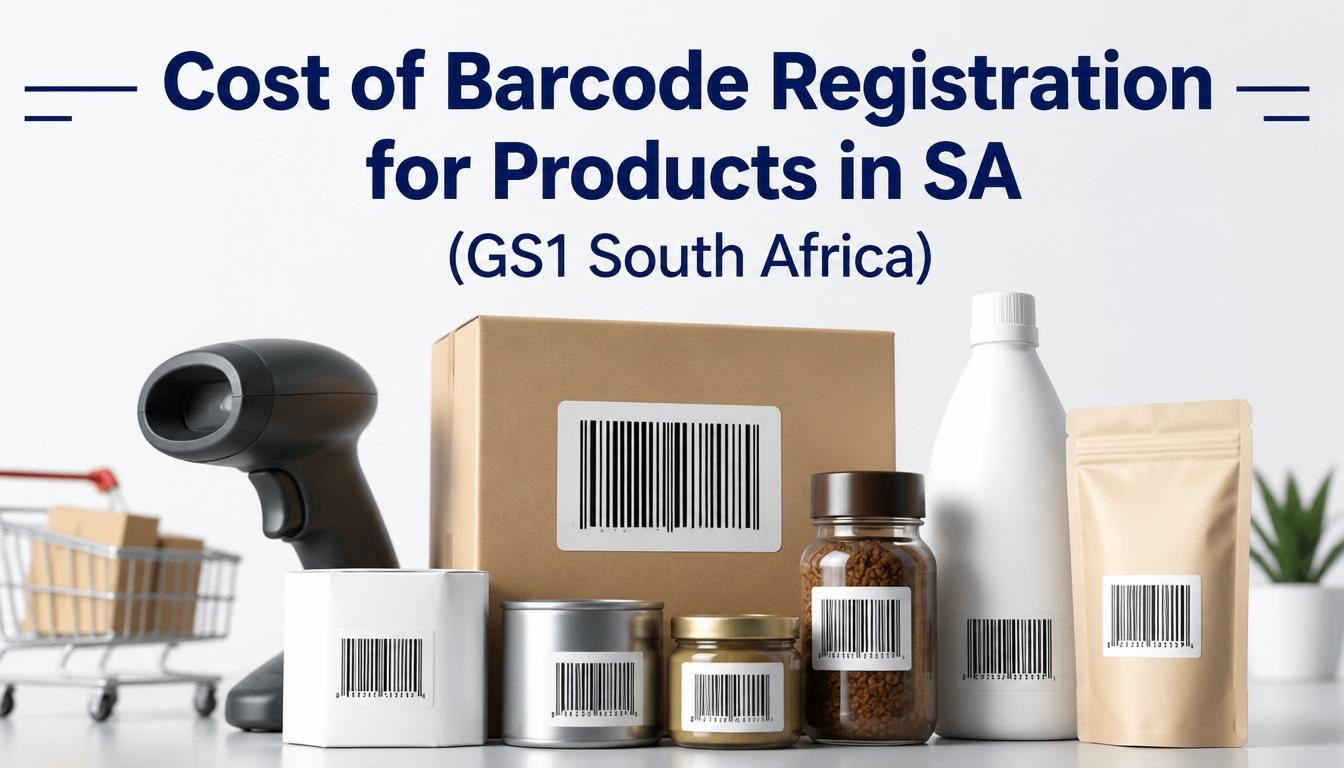
Navigating product barcode registration in South Africa requires understanding how GS1 works, what the official license fees look like, and how to avoid costly retail supply chain mistakes. Below is an exhaustive breakdown of the official GS1 South Africa pricing structure, additional hidden expenses, retail compliance rules, and a direct comparison between official GS1 licensing and third-party barcode resellers.
What Is GS1 South Africa and Why Do You Need It?
GS1 (Global Standards 1) is the official, internationally recognized non-profit organization responsible for assigning Global Trade Item Numbers (GTINs) and Global Company Prefixes (GCPs). When you register through GS1 South Africa, your business receives a unique prefix that identifies your company as the brand owner across the global supply chain.
The Difference Between EAN-13, UPC, and GTIN
Before analyzing pricing, it helps to clear up terminology that often confuses new entrepreneurs:
-
GTIN (Global Trade Item Number): The actual number string encoded within the barcode lines.
-
EAN-13: The 13-digit standard barcode format used across South Africa, Europe, Asia, and most of the world for retail items.
-
UPC-A: The 12-digit standard barcode format primarily used in North America (USA and Canada).
-
GS1 Prefix: The first 3 to 9 digits of your barcode. GS1 South Africa assigns prefixes starting with 600 or 601, signaling that the number was issued by GS1 SA.
When major retail stock management systems scan an EAN-13 barcode on a store shelf, they cross-reference the GTIN with GS1’s global registry (Verified by GS1) to confirm who manufactured or branded the item.
Official GS1 South Africa Barcode Pricing Breakdown
GS1 South Africa structures its licensing fees based on the number of unique items (GTINs) your business needs to barcode. The pricing framework consists of two main financial components:
-
Initial Entrance / Registration Fee: A once-off registration cost paid when you first sign up or request a new prefix bank.
-
Annual Renewal Fee: An ongoing annual maintenance fee (billed annually in March) that keeps your company prefix active and publicly listed under your name in the global database.
Note: All prices listed below are sourced directly from official GS1 South Africa fee schedules and are quoted in South African Rand (ZAR), excluding 15% VAT. Companies applying from outside South African borders are exempt from local SA VAT.
GS1 South Africa Barcode Pricing Table
| Number of Barcodes / GTINs | Initial Entrance Fee (Excl. VAT) | Annual Renewal Fee – March (Excl. VAT) | Primary Use Case |
| 1 Single GTIN | R 176 | R 0 (Exempt) | Solo product test, single SKU startup |
| 10 Barcodes | R 1,964 | R 433 | Small boutique brands, specialized tech accessories |
| 100 Barcodes | R 6,823 | R 2,409 | Growing FMCG brands, electronics lines, clothing sizes |
| 1,000 Barcodes | R 8,215 | R 4,709 | Established manufacturers, multi-category retailers |
| 10,000 Barcodes | R 9,051 | R 9,628 | Enterprise producers, large distribution houses |
| 100,000 Barcodes | R 9,888 | R 28,878 | Major global corporate conglomerates |
| GLN (Location Number) | R 176 | R 0 | Supply chain facility & warehouse identification |
Important Rules to Remember About Single GTINs vs. Company Prefixes
-
Single GTIN Exemption: GS1 South Africa allows businesses to purchase up to 20 individual GTINs (or up to 5 banks of 10 barcode numbers). Single barcode numbers are unique because they carry no annual license renewal fee. This makes single GTINs ideal for micro-businesses launching only 1 to 3 products.
-
Pro-Rated First Year Fees: If you register midway through the calendar year, GS1 South Africa pro-rates your initial annual license fee for the remaining months up to December, before placing you on the standard March annual renewal cycle.
-
Additional Prefix Banks: If your business expands and exhausts its original prefix capacity (for example, you used all 100 numbers in your bank), you do not pay the full entrance fee again. Instead, GS1 SA charges an administration fee of R 1,836.00 (Excl. VAT) to issue an additional number bank.
Calculating How Many Barcodes You Actually Need
A common costly error for expanding brands is underestimating how many GTINs they require before applying to GS1. In retail inventory management, every single variation of a product requires its own unique barcode.
To calculate your exact requirement, multiply your core products by every variable factor:
Real-World Example: Mobile Phone Accessories Line
Imagine you are launching a protective smartphone case brand in South Africa with the following product catalog:
-
2 Phone Models: (e.g., Samsung Galaxy S24, iPhone 15)
-
3 Colors: (Black, Clear, Navy Blue)
-
2 Pack Configurations: (Single retail unit, 10-unit inner carton case pack for wholesale)
To barcode this product lineup properly:
2 models $\times$ 3 colors = 6 unique retail items (EAN-13 barcodes required for individual store shelves).
6 retail items $\times$ 1 wholesale outer case pack = 6 wholesale outer case barcodes (ITF-14 or EAN-13).
Total Barcodes Needed = 12 GTINs.
In this scenario, purchasing 12 single GTINs individually would cost $12 \times \text{R 176} = \text{R 2,112}$ (Excl. VAT) without ongoing annual renewal fees, whereas stepping up to a 100-number prefix bank would cost R 6,823 initially plus R 2,409 annually. Evaluating your 3-year product roadmap determines which tier saves your business money.
GS1 South Africa vs. Third-Party Barcode Resellers: The Great Debate
When searching online for “buy barcodes in South Africa,” search engine results often highlight third-party resellers promising once-off barcodes starting from as little as R 99 to R 250 without annual subscription fees.
While reseller barcodes are legal for certain isolated use cases, relying on them carries major commercial risks if your goal is long-term retail distribution.
Detailed Comparison Table
| Feature / Requirement | Official GS1 South Africa | Third-Party Barcode Reseller |
| Company Name on Database | Listed directly under your registered company name on Verified by GS1 | Listed under the original buyer/reseller’s company name |
| Initial Cost | Higher (Tiered by capacity: R 176 – R 9,888+) | Very Low (R 99 – R 300 once-off) |
| Annual Fees | Yes (Except single GTINs) | None |
| SA Supermarket Acceptance | 100% Accepted (Shoprite, Pick n Pay, Woolworths, Spar, Clicks, Dis-Chem) | High risk of rejection during vendor onboarding |
| Amazon & Takealot Listing | Fully compliant with GS1/GTIN brand verification | Frequently rejected or flagged for brand mismatch |
| GS1 Prefix Origin | Official 600 / 601 South African prefix | Typically older USA UPC prefixes (starts with 0 or 6-7) |
| Recall & Traceability | Full global traceability under your brand | Zero official brand traceability |
Why Major SA Retailers Reject Reseller Barcodes
Major South African retailer chains enforce strict electronic data interchange (EDI) and vendor compliance standards. When you apply to become a vendor at Pick n Pay, Shoprite Checkers, Woolworths, or Dis-Chem, their inventory teams run your GTINs through the GS1 GEPIR database.
If the database reveals that barcode number 6001234567890 belongs to a defunct chemical company from 1998 rather than your registered business entity, your vendor application will likely be denied immediately. Retailers insist on brand matching to prevent inventory collisions, counter-feiting, and product liability disputes.
Step-by-Step Guide to Registering with GS1 South Africa
Registering your products directly through GS1 South Africa is a straightforward digital process. Follow these step-by-step operational instructions to obtain verified GTINs without delays.
Step 1: Conduct a Product Audit
List every single product stock keeping unit (SKU) you intend to sell over the next 12 to 24 months. Include variations in size, color, flavor, bundled packs, and outer shipping cartons.
Step 2: Select the Correct Registration Plan
Visit the official GS1 South Africa portal (gs1za.org). Select your tier:
-
If you need 1 to 20 individual barcodes, apply under the Single GTIN allocation model.
-
If you plan to scale rapidly past 20 SKUs, choose the appropriate Company Prefix Bank (100, 1,000, or 10,000 items).
Step 3: Complete Company Verification & Documentation
You will need to submit:
-
Registered Business Name & CIPC Registration Number (or ID document for sole proprietors).
-
Valid South African Tax Reference Number.
-
Official Business Contact Details and Physical Address.
-
Preferred Direct Debit Mandate details for annual renewal fee automation.
Step 4: Pay the Registration Fee
Pay the required fee via Instant EFT or Credit Card. Once payment is confirmed, GS1 SA releases your Global Company Prefix (GCP) and log-in credentials to the online GS1 Barcode Manager / MyGS1 Tool.
Step 5: Assign GTINs and Generate High-Resolution Barcode Artwork
Inside the portal, assign unique item numbers to each product SKU. Download the high-resolution vector graphics (EPS, SVG, or high-DPI PNG format) to forward directly to your packaging printer or label designer.
Technical Printing & Packaging Guidelines for South Africa
Securing your official GS1 numbers is only half the job; printing them incorrectly can lead to scanning failures at checkout points, resulting in store fines or rejected deliveries at central distribution centers (CDCs).
Critical Barcode Print Specifications
-
Barcode Color Contrast: Scanners read barcodes using red laser light. The background must reflect light while the bars absorb it.
-
Best Combination: Solid Black bars on a clean White background.
-
Acceptable Combinations: Dark Blue/Dark Green/Dark Brown bars on White, Yellow, or Red backgrounds.
-
Unacceptable Combinations: Red bars on White (invisible to red lasers), Black bars on Dark Blue backgrounds, or metallic/foil backing.
-
-
Quiet Zones (Light Margins): Leave a minimum blank space of at least 2.5 mm to 3 mm on both the left and right sides of the barcode bars. If text or package graphics invade the quiet zone, retail scanners will fail to register the start and end of the scan.
-
Bar Height and Magnification: The standard retail EAN-13 barcode size is 37.29 mm wide by 25.93 mm high (100% magnification). Never shrink a barcode below 80% magnification (29.8 mm width), as low-grade thermal printers at store checkouts will fail to read compressed lines.
-
Placement on Packaging: Place the barcode on a flat, smooth surface near the bottom corner of the package. Avoid placing barcodes over curves, folds, seals, or package ridges.
Additional Costs to Budget For in Your Supply Chain
When budgeting for product launch expenses in South Africa, the GS1 registration fee is just one component. Account for these related technical and administrative costs:
-
Barcode Image Generation Software: While GS1 provides basic barcode output, specialized label design programs or graphic design fees for artwork integration typically range from R 500 to R 2,500 per packaging batch.
-
GS1 Barcode Verification Testing: Major retailers (specifically Woolworths and Shoprite CDC) may request an official GS1 Barcode Verification Report prior to full store listing. GS1 SA tests your physical printed packaging on specialized optical equipment to grade print quality, quiet zones, and contrast. Testing costs approximately R 350 to R 650 per sample label.
-
Outer Carton Barcoding (ITF-14): If you ship goods in corrugated cardboard master boxes of 12 or 24 units to distribution centers, you must print ITF-14 barcodes on the outer carton. These are generated using your existing GS1 prefix bank.
E-Commerce Requirements: Amazon SA & Takealot
If your primary sales channel is online retail rather than traditional brick-and-mortar stores, GTIN compliance rules remain strictly enforced.
Amazon South Africa
Amazon utilizes an automated brand registry validation engine. When creating a new product listing, Amazon checks the entered GTIN against GS1’s Verified by GS1 database in real time. If the brand name on your Amazon seller account does not match the company name registered under that GTIN on GS1, Amazon will reject your product listing with Error Code 8572.
Takealot Marketplace
Takealot requires every physical item sent to their distribution centers (in Johannesburg or Cape Town) to feature a scannable barcode. While Takealot allows sellers to print internal Takealot-generated shipment labels for certain unbranded white-label goods, registered brands selling original items must provide legitimate GTINs to prevent duplicate listings and inventory mix-ups.
Real Industry Experience: How to Choose the Right Strategy
Having guided multiple local startups through retail readiness, here is my practical advice based on business stage:
-
Early-Stage Bootstrapped Startup (1 – 3 Products):
-
Action: Purchase Single GTINs directly from GS1 South Africa.
-
Cost: R 176 per barcode once-off.
-
Benefit: You obtain 100% official, retailer-compliant GS1 barcodes registered under your name without paying annual subscription renewal fees.
-
-
Growing Brand (10 to 50 SKUs with Multiple Variants):
-
Action: Subscribe to the 100 Barcode Prefix Bank from GS1 South Africa.
-
Cost: R 6,823 entrance fee + R 2,409 annual renewal.
-
Benefit: Ensures full scalability for color, size, and packaging variations while maintaining a low cost-per-barcode ratio.
-
-
Purely Internal / Non-Retail Items:
-
Action: If you are barcoding internal assets, store room shelves, or custom service tickets that will never be sold in external retail stores or online marketplaces, you do not need GS1 at all. Use free internal barcode formats like Code 128 or Code 39.
-
Are you currently preparing to launch a new product line in South African retail stores or setting up shop on Takealot and Amazon SA? Have you ever run into inventory issues or listing rejections due to barcode mismatched names?
Drop your questions, experiences, or challenges in the comments section below! Let’s discuss your specific product line and figure out the most cost-effective barcode registration path for your business.

Joseph Mathebula is a consumer analyst and market researcher at Prices in South Africa. He specializes in tracking local service costs, retail pricing, and travel budgets, helping everyday shoppers navigate the market to secure the best value.