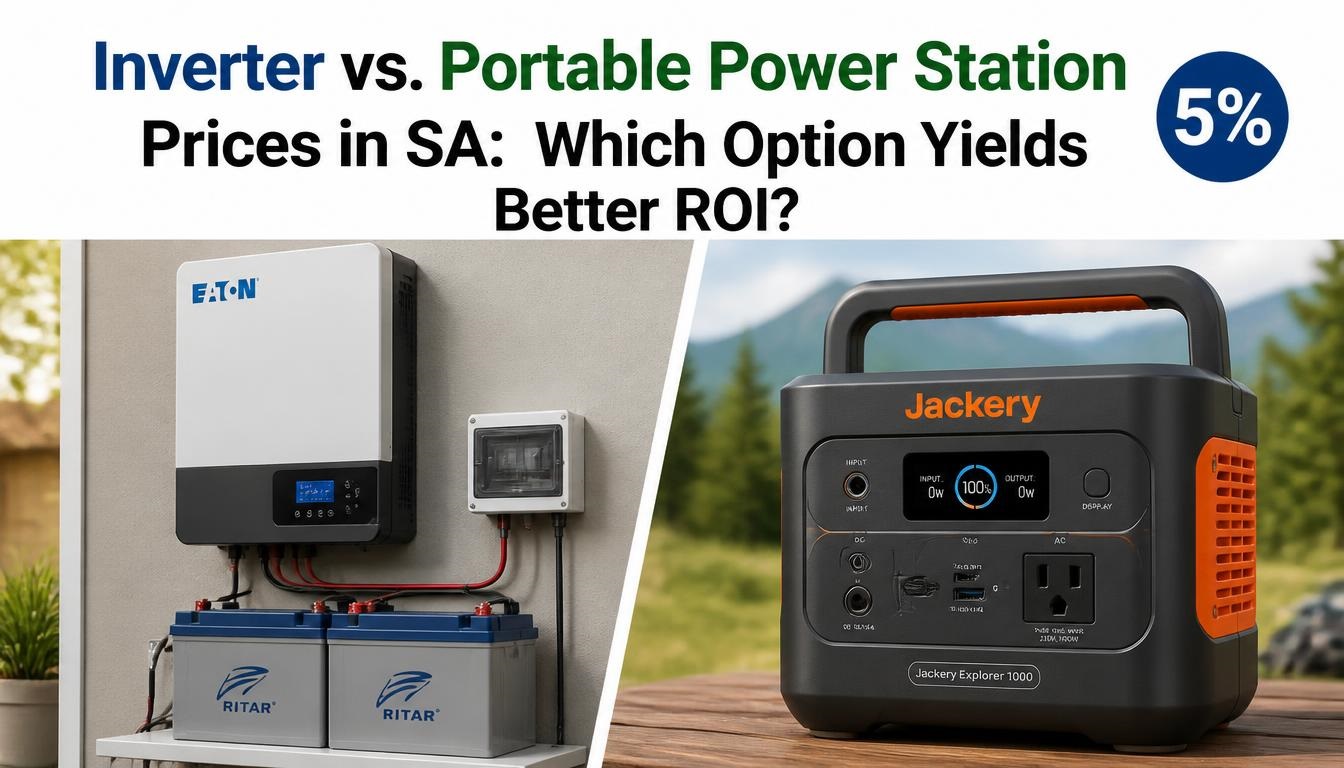
Load shedding stage shifts continue to drive South Africans toward secondary power solutions, but determining whether a modular inverter setup or an all-in-one portable power station offers superior long-term financial yield depends strictly on your installation scope and power usage profile. While entry-level portable units start as low as R3,500, fixed hybrid inverter systems paired with LiFePO4 batteries scale beyond R85,000, making life-cycle cost per kilowatt-hour ($\text{kWh}$) the ultimate metric for measuring ROI.
| Power System Type | Capacity / Output | Price Range (ZAR) | Typical Battery Chemistry | Primary Use Case & ROI Horizon |
| Entry Portable Power Station | 250Wh – 600Wh / 300W–600W | R3,500 – R7,500 | LiFePO4 / Li-ion | Wi-Fi routers, laptops, phone charging. Short ROI (6–12 months). |
| Mid-Range Power Station | 1,000Wh – 2,000Wh / 1,000W–2,000W | R11,000 – R24,000 | LiFePO4 | TV, fridge, desktop PCs, workstation. Moderate ROI (1.5–2 years). |
| Trolley Inverter Unit | 1kW – 3kW / 1.2kWh–2.5kWh | R7,500 – R16,500 | AGM / Gel or LiFePO4 | Plug-and-play home office backup. Moderate ROI (1.5–2.5 years). |
| Full Fixed Hybrid Inverter | 5kW – 8kW / 5kWh–10kWh | R35,000 – R85,000+ | LiFePO4 Wall Mount | DB board integration, whole-home power. Long ROI (3–5 years). |
Factors Shaping Upfront and Long-Term Costs
-
Battery Chemistry & Lifecycles: Cheaper trolley inverters often utilize Lead-Acid or Gel batteries, offering roughly 500–800 cycles before degradation. Portable power stations from brands like EcoFlow or Bluetti almost exclusively feature LiFePO4 (Lithium Iron Phosphate) cells, which deliver 3,000+ cycles to 80% capacity. Over 5 to 7 years, LiFePO4 options consistently lower the total cost per operational cycle.
-
Installation and Compliance (CoC): Fixed hybrid inverters (e.g., Sunsynk, Deye, Luxpower) require professional installation by a qualified electrician and a Certificate of Compliance (CoC) under SANS 10142-1 standards. Installation, switchover gear, and wiring add an extra R8,000 to R18,000 to fixed setup costs. Portable power stations eliminate these labor and compliance overheads completely.
-
Scalability: Fixed hybrid systems allow you to add solar panels or additional battery banks over time. Portable power stations are generally capped at their internal capacity, though higher-tier models support limited expansion batteries at a premium per kWh.
Retailer & System Options Compared
-
Takealot & Makro (Portable Power Stations): Stock brands like EcoFlow, Jackery, and Gizzu. Highly competitive pricing for plug-and-play units. An EcoFlow River 2 Max (512Wh) typically retails around R6,500 to R8,000, making it the fastest way to shield a home office without installation delays.
-
Builders & Leroy Merlin (Trolley & Fixed Inverters): Carry brands like Lalela, Mecer, and Must. A 1.2kW Mecer trolley inverter sells for around R7,500 – R9,500. While cheaper initially, gel-battery models require battery replacements every 18 to 24 months under heavy load shedding schedules.
-
Specialist Solar/Inverter Suppliers: Provide full hybrid solutions using Sunsynk, Deye, and Freedom Won batteries. A complete 5kW Sunsynk system with a 5.12kWh Lithium battery costs roughly R42,000 – R55,000 including installation and CoC, yielding maximum ROI when combined with rooftop solar panels to cut monthly municipal electricity bills.
Strategic Buying Advice for SA Consumers
-
Calculate total load before buying: Multiply the wattage of your essential appliances by the hours of load shedding expected. A 100W TV and a 15W Wi-Fi router running through a 4-hour slot require roughly 460Wh. A 500Wh to 600Wh unit will cover this comfortably without draining below safe thresholds.
-
Watch out for pure sine wave vs. modified sine wave: Sensitive electronics like modern OLED televisions, desktop computers, and fridge compressors require Pure Sine Wave power. Avoid ultra-cheap modified sine wave inverters, as they generate heat that damages motor windings and sensitive switch-mode power supplies over time.
-
Evaluate solar expansion options: If you intend to supplement grid charging with solar power, verify the Max Solar Input (VOC voltage and amperage) of your chosen system. Portable power stations often have lower solar input thresholds compared to dedicated MPPT controllers on hybrid inverters.
-
Account for warranty terms and local support: Ensure the manufacturer has local servicing centers in South Africa (e.g., Johannesburg, Cape Town, or Durban). Shipping a 20kg power station back overseas for warranty repairs will destroy any initial cost savings.
Disclaimer: Prices listed in this guide are estimates based on average South African market rates at the time of publication and are subject to change without notice. Always verify final pricing with official providers or retailers before making purchase decisions.
Determining whether a portable power station or a fixed inverter offers a better return on investment comes down to property ownership and power scope. For tenants, apartment dwellers, or remote workers needing immediate protection for digital equipment, portable power stations yield superior immediate value due to zero installation costs and mobility. For homeowners looking to maintain high-draw appliances and eventually transition to solar energy, a fixed hybrid inverter provides a significantly lower cost per kilowatt-hour over a 10-year period, making it the stronger asset for long-term equity.

Joseph Mathebula is a consumer analyst and market researcher at Prices in South Africa. He specializes in tracking local service costs, retail pricing, and travel budgets, helping everyday shoppers navigate the market to secure the best value.