Quick Overview
Estimated Total Price Range: R6,500 – R28,500+ (Includes multi-stage Big Blue filtration hardware, 55W UV sterilizer, bypass valves, and PIRB-registered plumbing installation labor)
Primary Cost Factors: Source water quality (municipal tap vs. borehole/rainwater harvesting), total household peak flow rate requirements (20″ Big Blue vs. industrial vessel arrays), and electrical infrastructure for constant UV power
Recommended Retailers & Installers: Takealot, Builders Warehouse, H2O Warehouse, Makro, and PIRB-certified local plumbing contractors
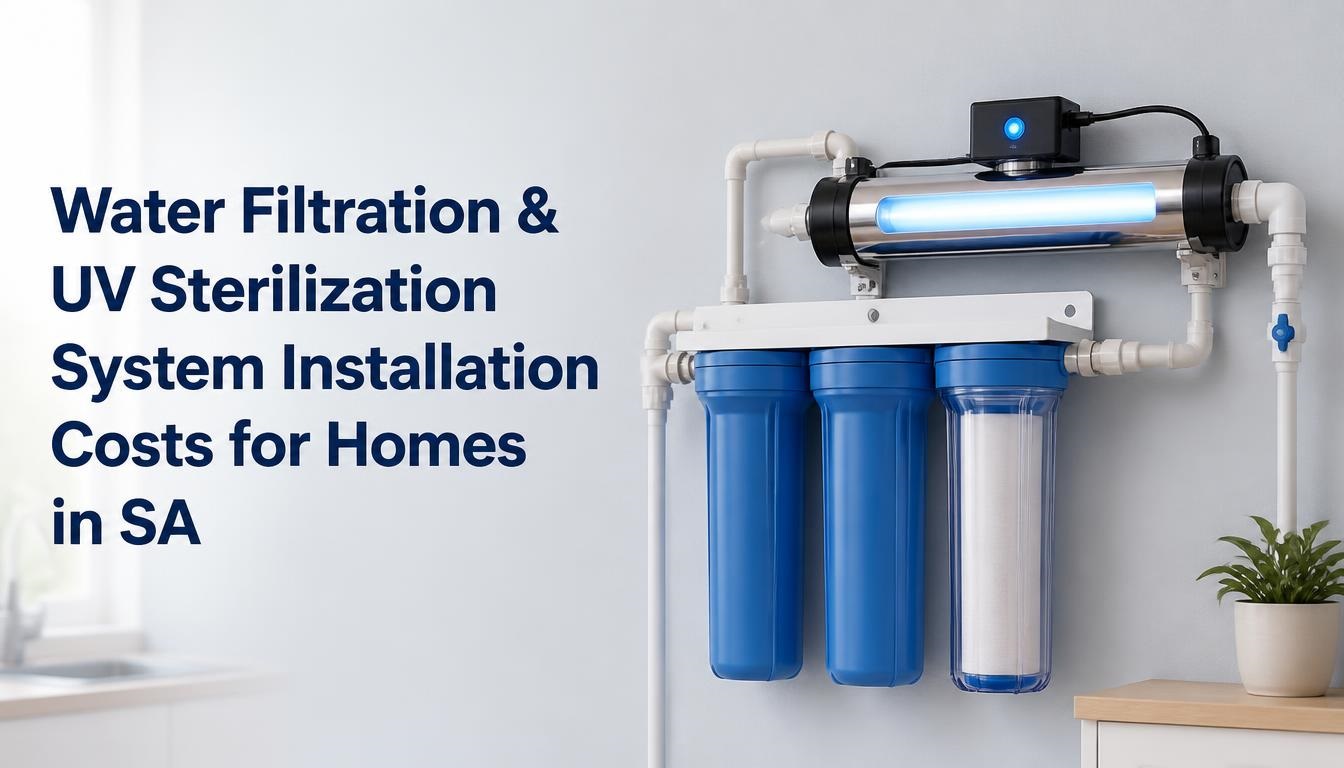
Bottom-Line Verdict: A 3-stage 20-inch Big Blue filter paired with a 55W stainless steel UV sterilizer represents the optimal sweet spot for South African residential properties, delivering purified, pathogen-free water across all taps while protecting household plumbing from municipal silt and load shedding backflow contamination.
Comprehensive Water Filtration & UV Sterilization System Installation Costs in South Africa
Municipal water infrastructure across South African metros—from Johannesburg and Tshwane to Ethekwini and Nelson Mandela Bay—faces recurring reliability challenges, pressure fluctuations, and biological safety concerns. Installing a whole-house water filtration and ultraviolet (UV) sterilization system has transitioned from a luxury upgrade to an essential home utility.
A standard residential whole-house filtration and UV disinfection setup in South Africa typically costs between R6,500 and R28,500, fully installed. Standard entry-level 3-stage municipal filtration kits paired with a basic 55W UV chamber hover around R4,800 to R7,800 for hardware alone, while professional installation, pressure-reducing valves, bypass manifold plumbing, and backup power integration account for the remaining balance.
Detailed Cost Breakdown of Residential Water Systems in ZAR
To accurately budget for a home water purification plant, homeowners must separate component hardware expenses from installation labor and recurring consumables. The table below outlines real-world South African market pricing for complete whole-house systems, individual sub-assemblies, and professional installation rates.
| System Configuration / Service Component | Average Hardware Cost (ZAR) | Professional Installation (ZAR) | Estimated Total Installed Cost (ZAR) |
| Basic 3-Stage 20″ Big Blue System (Sediment + Carbon) | R3,200 – R4,800 | R1,800 – R3,000 | R5,000 – R7,800 |
| Standard Whole-House 3-Stage + 55W UV Sterilizer (2,700 L/h) | R5,200 – R8,500 | R2,500 – R4,200 | R7,700 – R12,700 |
| Advanced Borehole / Rainwater Filtration + UV System | R12,500 – R22,000 | R4,000 – R8,000 | R16,500 – R30,000 |
| 55W UV Sterilizer Set (Chamber, Glass Sleeve, Ballast, Bulb) | R1,950 – R2,999 | R800 – R1,500 | R2,750 – R4,499 |
| Replacement 55W UV Lamp / Bulb (Annual Changeout) | R450 – R850 | DIY / R500 Callout | R450 – R1,350 |
| 20″ Big Blue Replacement Cartridge Set (PP Sediment + CTO Carbon) | R550 – R1,200 | DIY | R550 – R1,200 |
Note: All prices include 15% South African Value Added Tax (VAT).
South African Market Overview and Municipal Water Quality Dynamics
The demand for point-of-entry (POE) water filtration in South Africa is driven by two distinct factors: physical particulate loading and microbiological risks. Municipal piping networks frequently experience burst pipes and rapid pressure surges. When main lines are re-pressurized, rust, pipe scale, sand, and fine silt are flushed straight into residential water meters. Without a robust primary sediment filter, this grit ruins ceramic tap cartridges, blocks washing machine solenoids, and shortens geyser lifespans.
Microbiological safety presents another challenge. During localized water outages or supply interruptions, back-siphonage can introduce E. coli, coliform bacteria, and viral pathogens into standard municipal distribution mains. While multi-stage carbon and sediment filters extract physical debris, heavy metals, and residual chlorine, they cannot reliably kill biological micro-organisms.
This is where UV sterilization becomes critical. Operating at a wavelength of 254 nanometers, a 55W UV lamp alters the DNA of bacteria and viruses passing through the stainless steel reaction chamber, rendering them unable to replicate. Unlike chemical dosing (such as chlorine or ozone), UV treatment leaves zero chemical residue, alters no taste or pH levels, and provides instant disinfection at high residential flow rates of up to 2,700 liters per hour.
Real-World Field Notes from Local Plumbing Installations
Installing a high-flow filtration unit in a South African residence involves specific environmental and operational variables that do not appear on standard product spec sheets.
Load Shedding and Electrical Surge Risks
A UV sterilizer requires uninterrupted 220V power to keep its electronic ballast and mercury discharge tube illuminated. During grid load shedding or power restoration, severe voltage spikes can instantly fry delicate electronic ballasts. Furthermore, if water flows through the UV chamber while power is offline, untreated water bypasses disinfection and contaminates downstream domestic piping.
Field technicians strongly recommend wiring the UV ballast into an existing home inverter system or installing a dedicated 600VA mini-UPS alongside a surge protection plug. If power drops, a solenoid valve installed upstream should automatically shut off main line water flow to prevent unsterilized water from reaching household taps.
Flow Rates and Pressure Drops
A common post-installation complaint among homeowners is a sudden drop in shower water pressure. Standard 10-inch “Slimline” filters restrict water volume and are only suitable for single-tap under-sink setups. Whole-house installations require 20-inch Big Blue (20″ BB) filter housings with 1-inch or 3/4-inch BSP brass threaded ports.
When fresh, a 20″ BB system introduces a minor pressure drop of roughly 0.2 to 0.4 bar. However, as sediment accumulates over 3 to 6 months, pressure loss increases significantly. Plumbing installers must measure baseline pressure at the municipal boundary. If incoming pressure is under 2.5 bar, an auxiliary booster pump and pressure vessel must be integrated before the filtration array.
Outdoor Weathering and UV Chamber Mounting
Most South African water meters and primary line entry points are situated outdoors near garage walls or boundary fences. Polymer filter sumps and plastic mounting brackets degrade rapidly under intense African sunshine. Outdoor installations require a lockable, weather-resistant steel or fiber enclosure to protect filter sumps from UV degradation and shield the UV ballast box from rainwater driving under gutters.
Comparative Retailer Guide for Filtration Hardware in South Africa
Purchasing filtration equipment in South Africa offers options ranging from major hardware chains to specialized online purification importers. Selecting the right retailer depends on component availability, replacement cartridge pricing, and technical support.
1. Specialized Importers (e.g., H2O Warehouse, Reverse Osmosis SA, Aqua Pura)
-
Pricing & Range: Highly competitive bulk pricing on complete sets. A 3-stage 20″ Big Blue unit with a 55W UV sterilizer ranges from R4,800 to R7,900.
-
Pros: Direct access to replacement quartz sleeves, high-output replacement bulbs, and high-density carbon cartridges. Technical support is delivered by water purification specialists who understand water analysis reports.
-
Cons: Physical walk-in branches are limited primarily to major industrial hubs in Gauteng, Cape Town, and Durban. Orders often require courier delivery.
2. General E-Commerce Platforms (e.g., Takealot)
-
Pricing & Range: Entry-level 55W UV sterilizer kits start around R1,950 to R2,700, with full 3-stage filter kits listed between R4,500 and R8,000.
-
Pros: Fast doorstep delivery across South Africa, easy door-to-door returns, and user review verification.
-
Cons: Seller quality varies. Replacement internal spares (like specific ballast pin configurations or optical quartz sleeves) can be difficult to source reliably from generic marketplace listings.
3. Retail Hardware Stores (e.g., Builders Warehouse, Makro)
-
Pricing & Range: Standard DIY-oriented filtration stock. Standalone 25W to 55W UV chambers range from R2,500 to R3,800.
-
Pros: Immediate over-the-counter availability in major suburban areas. Convenient for emergency replacement cartridges or brass plumbing fittings.
-
Cons: Retail markups mean hardware costs run 15% to 30% higher than direct importer pricing. Stock choices for industrial-grade 20″ BB housings can be limited.
Practical Money-Saving Strategies for South African Homeowners
-
Install a Three-Valve Manual Plumbing Bypass: Always instruct your plumber to fit a manual three-valve bypass manifold around the filter array. When replacing cartridges or performing UV lamp maintenance, you can isolate the system and route raw water to garden irrigation without shutting off water to the entire house.
-
Standardize on Generic 20″ x 4.5″ Cartridges: Avoid proprietary “twist-and-lock” brand-locked filter sumps. Universal 20″ Big Blue housings accept non-proprietary meltblown sediment filters and carbon blocks manufactured by multiple reputable brands, keeping ongoing filter replacements to around R550 per set.
-
Use a Washable Pleated Pre-Filter for High Sediment Lines: If your municipal supply carries excessive sand or you draw from a borehole, use a 20-micron washable pleated polyester cartridge in Stage 1 instead of a disposable spun polypropylene filter. You can spray down the pleated filter with a garden hose up to three times before replacing it, saving hundreds of rands annually.
-
Wipe down the Quartz Sleeve During Annual Service: When changing your UV lamp after its 9,000-hour rated lifespan (roughly 12 months), isolate the system, carefully extract the quartz glass sleeve, and wipe off mineral scale using mild citric acid or household vinegar. A scaled-up sleeve blocks UV light transmission, reducing sterilization performance even if the lamp glows visibly.
Frequently Asked Questions
How often do I need to replace water filter cartridges and UV bulbs?
Sediment and activated carbon block cartridges should be replaced every 3 to 6 months, depending on input water clarity and household usage. UV lamps must be replaced every 9,000 operating hours (approximately 12 months). Although the bulb may still glow beyond a year, its intensity degrades past the threshold required to neutralize pathogens.
Can a UV sterilizer remove chemicals, chlorine, or mud from my water?
No. A UV sterilizer is purely a biological disinfectant that uses ultraviolet light energy to destroy micro-organisms. It does not remove suspended solids, heavy metals, chemicals, or unpleasant chlorine tastes. This is why UV units must always be preceded by sediment and carbon block filtration.
What happens to my UV sterilization system during load shedding?
If power drops, the UV lamp turns off completely. If water continues to flow through the unit while the bulb is unlit, untreated water enters your domestic plumbing. To maintain protection, connect the UV unit to an uninterrupted power supply (UPS) or solar inverter system, or install a normally closed solenoid valve that shuts off water flow during power outages.
Does installing a whole-house water filter require a licensed plumber?
While DIY kits are available, hiring a PIRB-registered (Plumbing Industry Registration Board) plumber is strongly recommended. Professional installation ensures proper pressure regulation, installation of isolation bypass valves, compliance with local SANS 10252-1 plumbing regulations, and preservation of home insurance coverage against burst pipe damage.
Will a UV filter system work on raw borehole water in South Africa?
Yes, but borehole water requires a comprehensive chemical water test first. High levels of iron, manganese, hardness minerals (calcium/magnesium), or extreme turbidity will coat the UV quartz sleeve and render the sterilization ineffective. Pre-treatment equipment—such as iron removal vessels or water softeners—must be installed upstream of the UV unit if mineral levels exceed standard limits.
Disclaimer: Prices listed in this guide are estimates based on average South African market rates at the time of publication and are subject to change without notice. Always verify final pricing with official providers or retailers before making purchase decisions.
Investing in a whole-house water filtration and UV sterilization system is one of the most effective ways to safeguard your family’s health and protect your home’s plumbing assets against fluctuating municipal water conditions. By matching your system size to your peak flow requirements and planning for power backup during load shedding, you can enjoy clean, pure water from every tap in your home.
Have you recently installed a water purification system or replaced a UV unit in your home? Share your installation costs, preferred local suppliers, or questions in the comments below to help fellow South African homeowners make informed choices!

Joseph Mathebula is a consumer analyst and market researcher at Prices in South Africa. He specializes in tracking local service costs, retail pricing, and travel budgets, helping everyday shoppers navigate the market to secure the best value.