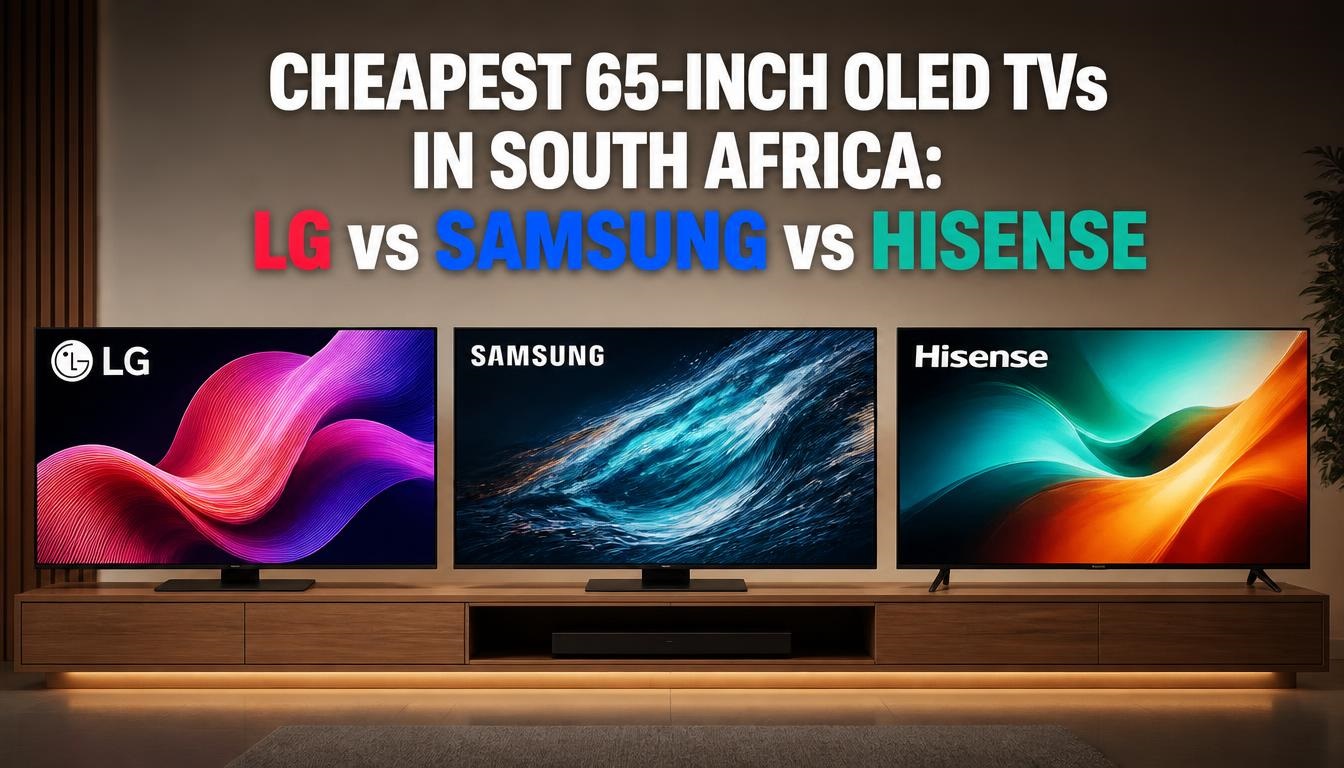
Upgrading to a 65-inch display is the sweet spot for modern South African living rooms. It offers an immersive home cinema experience without overwhelming standard lounge spaces. However, choosing an OLED panel historically meant spending well over R40,000.
Market dynamics have shifted significantly. While LG continues to hold its ground as the traditional OLED benchmark, Samsung has aggressively entered the space with its bright QD-OLED technology, and Hisense offers value-packed alternatives designed to challenge premium pricing tiers.
This buying guide breaks down the cheapest entry-level 65-inch OLED TVs available in South Africa. We compare price-to-performance ratios, picture quality, gaming performance, and local warranty support across LG, Samsung, and Hisense to help you make an informed purchase.
Quick Price & Key Specs Comparison
Note: Retail prices in South Africa fluctuate frequently based on promotions (e.g., Payday sales, Black Friday) and stock availability across major retailers.
| Brand & Model | Screen Tech | Refresh Rate | Avg. Price Range (ZAR) | Key Strength |
| Hisense 65A9H / 65X8K Series | WOLED | 120 Hz | R24,000 – R32,000 | Lowest price entry point & built-in multi-channel audio |
| LG OLED65B4 / OLED65C3 Series | WOLED | 120 Hz | R22,999 – R38,000 | 4x HDMI 2.1 ports, webOS reliability & Dolby Vision support |
| Samsung 65S85D / 65S90C Series | QD-OLED / WOLED | 120 Hz / 144 Hz | R19,999 – R42,599 | Superior peak brightness & vibrant QD-OLED color volume |
Detailed Brand-by-Brand Breakdown
1. LG 65-Inch OLED (The OLED Benchmark)
-
Target Models: LG OLED65B4, OLED65C3, OLED65C4
-
Average Price in SA: R22,999 – R38,000
-
Best For: Movie purists and console gamers seeking proven long-term durability and full Dolby Vision integration.
LG remains the brand most consumers think of when discussing OLED technology. The entry-level B-series (B3/B4) and slightly higher-tier C-series (C3/C4) feature self-lit WOLED panels that deliver perfect black levels, infinite contrast, and wide viewing angles.
Pros
-
Full HDMI 2.1 Capability: Unlike many mid-range TVs, LG offers four full-bandwidth HDMI 2.1 ports across its entry B- and C-series, allowing you to connect a PS5, Xbox Series X, and eARC soundbar simultaneously at 4K 120Hz.
-
webOS Ecosystem: Smooth interface with native app support for local platforms like DSTV Stream, Showmax, Netflix, and Prime Video.
-
Dolby Vision Support: Native support for Dolby Vision HDR dynamically optimizes picture parameters frame-by-frame.
Cons
-
Slightly Lower Peak Brightness: Standard WOLED panels do not achieve the high peak nit brightness of Samsung’s QD-OLED or high-end Mini-LED options in very bright living rooms.
2. Samsung 65-Inch OLED (The Brightness & QD-OLED Contender)
-
Target Models: Samsung 65S85D, 65S90C, 65S90D
-
Average Price in SA: R19,999 – R42,599
-
Best For: Bright South African living rooms and gamers looking for high 144Hz refresh rates.
Samsung’s entry into the OLED market utilizes Quantum Dot OLED (QD-OLED) technology on select S90/S95 series models, alongside WOLED panels on entry tiers like the S85D. QD-OLED combines OLED’s deep black levels with Quantum Dot color saturation and higher overall brightness.
Pros
-
Vibrant Color & Brightness: Outstanding peak brightness levels mean sports and HDR movies pop even during daytime viewing in well-lit rooms.
-
144Hz Refresh Rate Support: Select models (like the 65S90C/S90D) support PC gaming up to 144Hz alongside standard console 120Hz VRR support.
-
Anti-Reflective Coating: Superior reflection handling helps reduce glare from large windows or bright indoor lights.
Cons
-
No Dolby Vision: Samsung relies on HDR10+ instead. While HDR10+ performs well, Dolby Vision remains the standard for most streaming platforms.
3. Hisense 65-Inch OLED (The Value & Features Challenger)
-
Target Models: Hisense 65A9H, 65X8K (or local equivalent OLED models)
-
Average Price in SA: R24,000 – R32,000
-
Best For: Value-conscious buyers who want an OLED panel and improved built-in audio without paying a premium brand mark-up.
Hisense offers true OLED panels at competitive promotional price points. Designed to lower the barrier of entry for 65-inch premium displays, Hisense models often bundle high-spec features like multi-speaker audio configurations directly into the cabinet.
Pros
-
Competitive Entry Pricing: Frequently listed on aggressive promotional discounts at local retailers like Makro and Takealot.
-
Built-in Multi-Channel Sound: Select Hisense OLEDs feature rear subwoofer units or multi-driver sound systems directly integrated, reducing the immediate need for a separate soundbar setup.
-
Strong Local Warranty Coverage: Backed by Hisense South Africa’s local service network, often offering up to a 4-year local warranty upon registration.
Cons
-
VIDAA OS App Ecosystem: While VIDAA is fast and responsive, it can occasionally lag behind LG’s webOS or Samsung’s Tizen in carrying hyper-niche local app updates.
-
Motion Processing: Fine motion handling in high-speed sports isn’t as refined as LG or Samsung’s flagship processors.
Buying Advice: What South African Buyers Must Consider
1. Room Lighting & Glare Handling
If your TV will sit in a sunlit lounge with north- or west-facing windows, Samsung’s QD-OLED models (S90 series) generally handle daylight ambient light and glare better. If you stream primarily in dark or light-controlled rooms, LG’s WOLED options offer unmatched black levels and shadow detail.
2. Gaming Capabilities (120Hz vs 144Hz)
If you own a PS5 or Xbox Series X, verify that the display includes at least two HDMI 2.1 ports supporting 4K at 120Hz, Variable Refresh Rate (VRR), and Auto Low Latency Mode (ALLM). LG provides four full-bandwidth ports on its B and C models, while Samsung supports up to 144Hz for connected gaming PCs.
3. Local Smart OS & Streaming Support
Ensure the operating system supports the local services you use. webOS (LG), Tizen (Samsung), and VIDAA (Hisense) all natively support heavyweights like Netflix, Prime Video, YouTube, DSTV Stream, and Showmax.
4. Power Stability & Surge Protection
Due to power surges from grid instability or load restoration, direct power spikes can damage sensitive TV power supply boards.
-
Always plug your 65-inch OLED TV into a reputable surge protector (such as Clearline or Ellies).
-
Consider an uninterrupted power supply (UPS) or dedicated inverter backup to gracefully shut down your TV during unexpected power loss, preventing panel retention issues.
Final Verdict: Which One Should You Buy?
-
Overall Best Value: LG 65-inch B4/C3 Series. With four full HDMI 2.1 ports, Dolby Vision, webOS, and mature panel reliability, LG offers the most complete overall package for home theaters and console gaming.
-
Best for Bright Rooms & High Brightness: Samsung 65-inch S90 Series (QD-OLED). If your TV is positioned in a bright living room, Samsung’s higher peak brightness and color volume outperform standard OLED panels.
-
Best Budget Option: Hisense 65-inch OLED Series. When found on promotional discount, Hisense provides genuine 120Hz OLED black levels and strong local warranty support at a lower cost.
Price & Information Disclaimer: Prices listed in this article are accurate at the time of publication and represent average retail price ranges across major South African retailers (including Takealot, Makro, Hirsch’s, and Incredible Connection). Actual retail prices, stock availability, and promotional discounts are subject to change without notice. Prices in South Africa does not directly sell products or process transactions. Please verify current pricing, shipping costs, and official manufacturer warranty terms directly with authorized local stockists before finalizing your purchase.

Joseph Mathebula is a consumer analyst and market researcher at Prices in South Africa. He specializes in tracking local service costs, retail pricing, and travel budgets, helping everyday shoppers navigate the market to secure the best value.