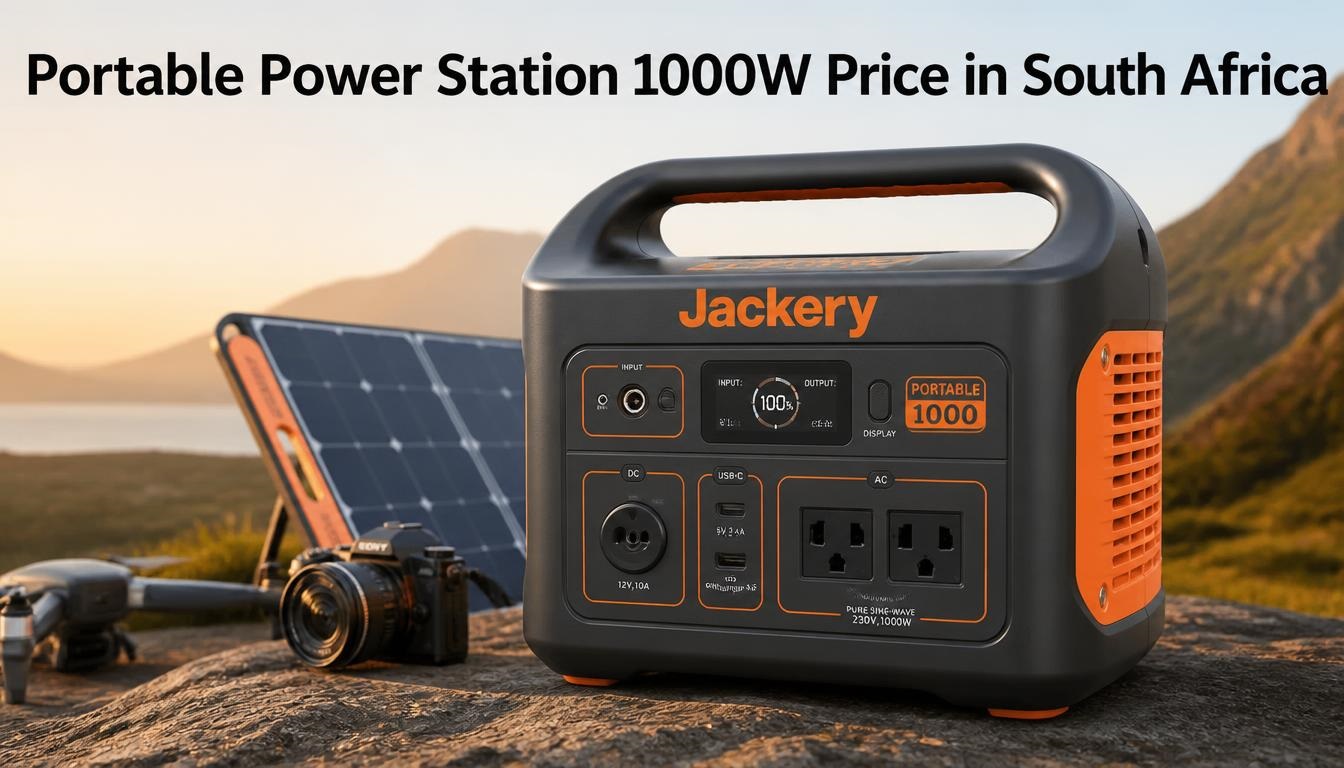
Navigating load shedding and grid instability in South Africa requires backup power systems that balance price, speed, and long-term durability. While smaller 300W–500W power banks work fine for basic phone charging and Wi-Fi, a 1000W / ~1000Wh portable power station represents the true “sweet spot” for South African households. It offers enough inverter output to start full-sized fridges, run entertainment setups uninterrupted, and keep remote work rigs powered through 2-hour to 4-hour power cuts.
In 2026, the retail price for a 1000W portable power station in South Africa generally ranges between R7,500 and R18,000 ZAR. Entry-level models hover near the lower end, while premium units featuring ultra-fast AC charging, expandable battery ports, and LiFePO4 chemistry sit closer to the top tier.
Price Overview & Comparison
To give you an immediate snapshot of current market rates across major local retailers, here is a breakdown of top-performing 1000W-tier units in South Africa:
| Brand & Model | Approx. Battery Capacity (Wh) | Battery Tech | Estimated Price Range (ZAR) | Best Used For |
| Gizzu Hero Max 1000W | 1024Wh | LiFePO4 | R7,500 – R8,500 | Budget-conscious home office backup with fast UPS switching. |
| Bluetti EB70 1000W | 716Wh | LiFePO4 | R9,000 – R11,000 | Lightweight portability, outdoor camping, and lighter home essentials. |
| Anker Solix C1000 | 1056Wh | LiFePO4 | R12,500 – R15,500 | Ultra-fast grid recharge (58 min) and heavy continuous surge handling. |
| EcoFlow DELTA 2 1000W | 1024Wh | LiFePO4 | R13,500 – R16,500 | Modular expansion capability, smart app control, and rapid grid charging. |
What Affects the 1000W Price in South Africa?
When comparing prices across brands like EcoFlow, Bluetti, Gizzu, Anker, Magneto, and Lalela, you will notice significant price spreads for units rated at similar wattage levels. The price differences come down to internal build quality and key technical specifications:
-
Battery Chemistry (LiFePO4 vs. Older Lithium-ion): Older NCM/NCA Lithium-ion batteries last around 500 to 800 charge cycles before dropping to 80% original capacity. Modern LiFePO4 (Lithium Iron Phosphate / LFP) batteries yield 3,000 to 4,000+ full charge cycles. Paying a slight premium for LFP guarantees a unit that lasts 8 to 10 years of daily use rather than degrading after two years of frequent load shedding.
-
Inverter Output Type (Pure Sine Wave vs. Modified): All reputable 1000W units use Pure Sine Wave inverters. This clean power mirrors grid electricity and safely runs sensitive circuitry found in modern laptops, smart TVs, and variable-speed fridge compressors.
-
AC Charging Speed (Eskom Slot Efficiency): Standard power stations take 4 to 6 hours to recharge from a wall socket. High-end units (such as the EcoFlow DELTA 2 or Anker Solix C1000) feature rapid AC charging that refills the battery from 0% to 100% in under 70 minutes. This rapid charge capability increases manufacturing costs but proves essential during tight Eskom slots.
-
UPS Mode & Pass-Through Charging: Units equipped with Uninterruptible Power Supply (UPS) functionality automatically switch from grid power to battery power in less than 20 milliseconds when the grid fails. This keeps desktop computers and Wi-Fi routers online without a reboot.
-
Local South African Warranty & Service Support: Inverter and power station repairs require local technical centers. Brands offering official 2-year to 5-year South African warranties (backed by local agents with spare parts in Johannesburg, Cape Town, or Durban) command slightly higher retail prices than grey-import alternatives.
Real-World Appliance Compatibility & Runtime Calculation
A power station’s inverter rating (1000W) determines what appliances can turn on, while its battery capacity (Wh or Watt-hours) dictates how long they run.
Standard Runtime Formula
Because all power stations lose a small amount of energy to heat and DC-to-AC conversion, apply a standard 85% efficiency factor (0.85):
-
Formula: Runtime (Hours) = (Battery Capacity in Wh x 0.85) ÷ Appliance Power Consumption in Watts
Runtime Estimates for a 1024Wh Power Station
-
Wi-Fi Router (15W): (1024Wh x 0.85) ÷ 15W = 58 Hours
-
Laptop Setup (60W continuous): (1024Wh x 0.85) ÷ 60W = 14.5 Hours
-
55-inch LED TV + Decoder (100W combined): (1024Wh x 0.85) ÷ 100W = 8.7 Hours
-
Full-size Double Door Fridge (150W average running power): (1024Wh x 0.85) ÷ 150W = 5.8 Hours
Important Note on Fridges & Surge Wattage: Compressors on full-sized refrigerators draw a temporary surge spike (often 3x to 5x their operational rating) for a few milliseconds when kicking on. Ensure your 1000W station supports a surge peak rating of at least 1800W to 2000W to prevent inverter overload trips.
Where to Buy & Buying Tips for South Africans
When shopping for a 1000W power station, buying through authorized local distribution networks protects your warranty:
-
Major Online Retailers: Takealot and Loot carry the widest selection, frequently running seasonal promotions.
-
Home Improvement & Tech Stores: Physical chains such as Builders Warehouse, Incredible Connection, Leroy Merlin, and Makro allow for direct store collection and simplified warranty returns.
-
Direct Brand Webstores: Purchasing directly from official brand portals (e.g., EcoFlow SA, Gizzu, or local solar distributors) often grants access to bundle discounts on solar panels.
Buyers Tips for South Africa
-
Factor in Courier Shipping Fees: A 1000W LiFePO4 power station weighs between 10kg and 14kg. Double-check delivery costs at checkout if the retailer does not offer free shipping on high-value orders.
-
Beware of Unofficial Imports: Ensure the unit ships with an official South African 3-pin plug (Type M) or compliant adapter setup out of the box, rather than requiring uncertified travel adapters.
-
Verify Return Policies: Confirm whether the seller handles DOA (Dead on Arrival) replacements locally or requires you to ship products back at your own expense.
Frequently Asked Questions
1. Can a 1000W power station run a kettle or microwave in South Africa?
Generally, no. Standard South African electric kettles draw 2000W to 2400W, and household microwaves pull between 1200W and 1500W. Attempting to run a standard kettle will trip the 1000W inverter’s overload protection. However, you can run specialized low-wattage travel kettles (600W–800W) or units equipped with voltage-scaling technology (such as EcoFlow’s X-Boost feature).
2. How long does a 1000W power station take to charge during a 2-hour Eskom slot?
It depends entirely on the model’s maximum AC charging input rate. Units with ultra-fast charging (1200W–1600W AC input) will recharge fully from 0% to 100% in approx 50 to 70 minutes, making them well-suited for tight Eskom windows. Units limited to 200W–300W charging will take 4 to 5 hours and will not reach a full charge during a single 2-hour slot.
3. Is LiFePO4 worth the higher price tag compared to older battery tech?
Yes, absolutely. While standard Lithium-ion models may cost 15% to 20% less upfront, they degrade significantly after 500 to 800 cycles. In contrast, LiFePO4 batteries deliver 3,000+ cycles while maintaining higher thermal safety. Over the product’s lifespan, LiFePO4 offers a far lower cost-per-watt-hour.
Disclaimer: The prices listed in this guide are estimates based on market research from major South African retailers and online stores as of 2026. Actual retail prices may vary due to exchange rate fluctuations, retailer promotions, stock availability, and shipping fees. pricesinsouthafrica.co.za does not sell products directly or guarantee stock availability. Always confirm current pricing, warranty conditions, and technical specifications directly with the official retailer before making a purchase decision.

Joseph Mathebula is a consumer analyst and market researcher at Prices in South Africa. He specializes in tracking local service costs, retail pricing, and travel budgets, helping everyday shoppers navigate the market to secure the best value.