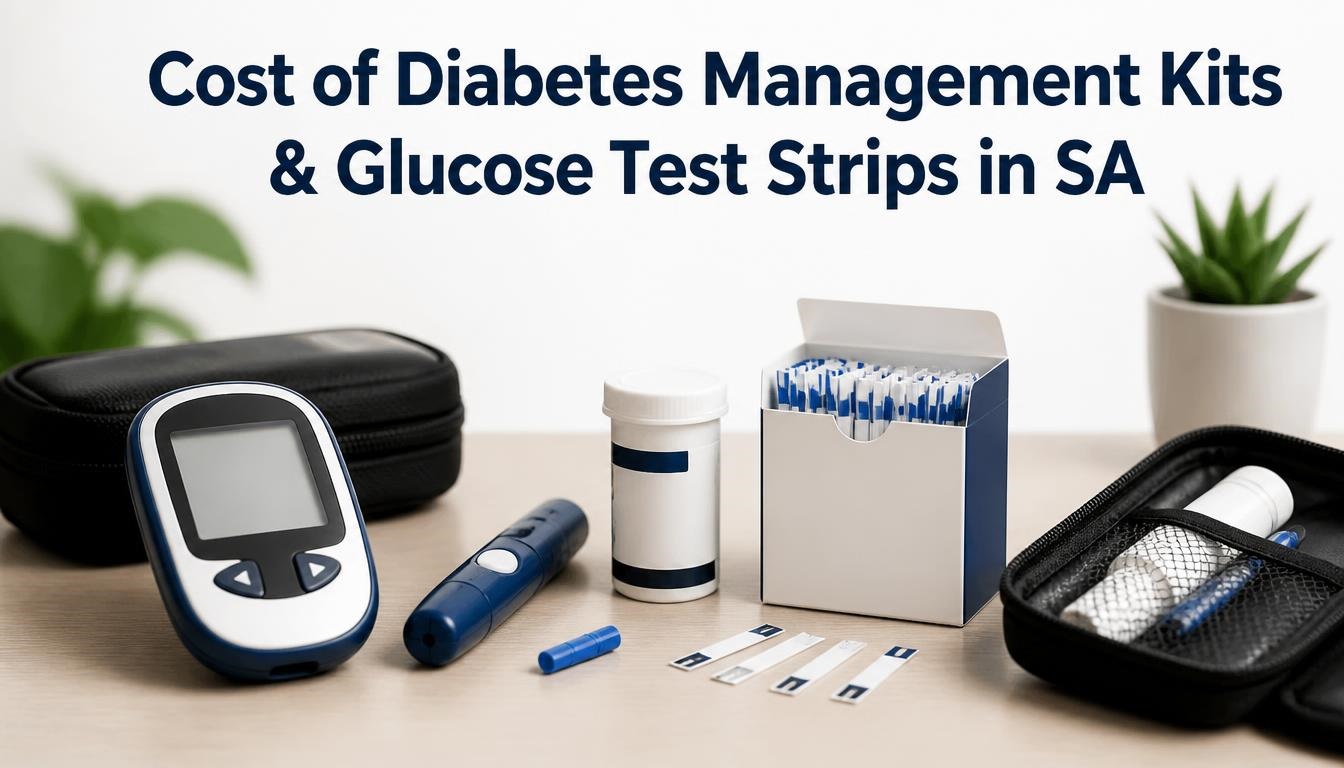
If you or a family member have recently received a Type 1 or Type 2 diabetes diagnosis, you’ve likely noticed a frustrating reality in South African healthcare: getting the starter glucometer kit is relatively cheap, but recurring consumable costs pull money out of your wallet every single month.
Navigating diabetes management kits & glucose test strips across local pharmacies reveals a clear dynamic—retailers frequently heavily discount starter monitors to capture your ongoing business on test strips and lancets. With medical aid chronic benefits constantly tightening and out-of-pocket expenses rising, understanding the true long-term price of blood glucose monitoring in South Africa is essential for your monthly budget.
ZAR Price Ranges (2026): Starter Monitor Kits: R180 – R350 | Test Strips (50s Pack): R135 – R195 | Lancets (100s Pack): R90 – R150 | CGM Continuous Sensors (14-Day): R1,089 – R1,250Top Overall Pick: Accu-Chek Instant Starter Kit – View on Dis-Chem (Reliable, high chronic medical aid coverage)Best Budget Pick: Contour TS Test Strips 50s – Check Price on Clicks (Consistently lowest cost per strip)Critical SA Buyer Warning: Never buy glucometer brands where 50-count test strip refills aren’t readily stocked at local pickup points or nationwide pharmacies, as running out during power outages or pharmacy stockouts creates serious health risks.
The Starter Kit Trap: Why The First R250 Is Misleading
The retail strategy behind blood glucose monitoring equipment in South Africa mirrors the classic printer-and-ink business model. Walk into any major pharmacy or shop online, and you will see full starter kits—including the digital meter, a lancing device, sample lancets, and 10 test strips—selling for as little as R229 to R299.
The Lifetime Cost Breakdown (Testing 3x Daily over 1 Year):
-
Initial Starter Kit Purchase: ~ R250 (One-Off)
-
Annual Test Strip Expenses (1,095 units): ~ R3,000 – R4,200
-
Annual Lancet Replacements: ~ R350 – R550
-
TOTAL YEAR 1 OUT-OF-POCKET EXPENDITURE: ~ R3,600 – R5,000 ZAR
When you test your blood sugar two to four times a day, you will burn through a 50-strip tub every two to three weeks. Over a single year, you are not spending R250; you are spending upwards of R3,500 to R4,500 just to keep the meter functional.
2026 SA Retail Price Comparison: Monitoring Kits & Strips
Prices across South African retailers fluctuate depending on store promotions, loyalty club cash-backs, and whether you purchase in-store or order online for home delivery. Below is an independent market breakdown of leading glucose monitoring supplies, including standard 15% VAT.
| Brand & Product Line | Primary Retailer / Platform | Current ZAR Price | Stock & Delivery Info | VAT Included? | Overall Value Rating | Direct Link / Buy Option |
| Accu-Chek Instant Starter Kit | Dis-Chem | R249.90 | Nationwide stock / Free store collection | Yes (15%) | 4.8 / 5 | View Deal at Dis-Chem |
| Accu-Chek Instant Strips (50s) | Clicks | R159.00 | In stock / Delivery from R60 (Free over R450) | Yes (15%) | 4.7 / 5 | Check Price on Clicks |
| Contour TS Test Strips (50s) | Clicks | R135.00 | High availability / 1–2 day shipping | Yes (15%) | 4.9 / 5 | Shop Now at Clicks |
| Accu-Chek Active Strips (50s) | Paramedic Shop SA | R189.95 | Online stock / Courier Guy distribution | Yes (15%) | 4.2 / 5 | Buy on Paramedic Shop |
| Biomine Glucose Monitor Kit | Clicks | R229.00 | Selected stores / Standard delivery | Yes (15%) | 4.0 / 5 | Check Kit at Clicks |
| FreeStyle Libre 2 Sensor (14-Day) | Dis-Chem / Abbott | R1,089.00 | Specialised stock / Pharmacy collection | Yes (15%) | 4.6 / 5 (High Tech) | Check Libre at Dis-Chem |
| Fora 6 Blood Glucose Strips (50s) | Takealot | R199.00 | In stock / Pargo pickup points available | Yes (15%) | 4.3 / 5 | Order on Takealot |
Note: Prices represent average retail rates including 15% VAT. Pharmacy dispensing fees may apply if claimed through chronic medical aid.
Finger-Prick vs. Continuous Glucose Monitors (CGM) in Mzansi
South Africans managing diabetes generally choose between traditional finger-prick glucometers and continuous glucose monitoring (CGM) sensors like the FreeStyle Libre 2. Evaluating both choices against local daily demands helps clarify the practical trade-offs.
Traditional Finger-Prick Meters (e.g., Accu-Chek, Contour)
-
Low initial investment (R200 – R300)
-
Long battery life (CR2032 coin cell lasts months)
-
Manual tests yield single moment-in-time readings
-
Ongoing consumable costs for strips & lancets
Continuous Glucose Sensors (e.g., FreeStyle Libre 2)
-
Real-time trend tracking & mobile smartphone alerts
-
No daily finger pricking required
-
High ongoing expense (R1,089 every 14 days)
-
Requires sensor replacement after 14 days
Traditional Glucometers (Accu-Chek, Contour, Fora)
-
Monthly Expense: R150 to R350 (depending on testing frequency).
-
Load-Shedding & Grid Resilience: Excellent. Most standard glucometers rely on simple CR2032 coin-cell batteries that last for 1,000+ tests. Power outages will not disrupt your ability to read your blood sugar.
-
Practicality: Requires carrying a small pouch with your meter, lancing pen, lancet drum, and test strip vial wherever you go.
Continuous Glucose Monitors (FreeStyle Libre 2)
-
Monthly Expense: R2,178 to R2,350 (2 x 14-day sensors per month at R1,089 each).
-
Load-Shedding & Grid Resilience: Dependent on your smartphone battery. If your phone battery dies during extended power outages and you lack a charged power bank, you lose access to your live sensor readings and alarms.
-
Practicality: Water-resistant sensor applied to the back of the upper arm. Provides complete glucose trend lines, low/high alerts, and eliminates daily finger pricking.
Paying cash for daily test strips drains disposable income quickly. Understanding how to leverage medical scheme benefits and local consumer laws can save you thousands of Rands every year.
Chronic Illness Benefit (CIB) & Prescribed Minimum Benefits (PMBs)
Under South African law, Type 1 diabetes is classified as a Prescribed Minimum Benefit (PMB). This means all registered medical schemes (Discovery Health, Bonitas, Momentum, Medshield, Bestmed) are legally required to cover diagnosis, treatment, and basic monitoring supplies out of their risk pool—not your day-to-day savings account.
-
Type 1 Diabetes: Medical aids typically fund up to 100 to 150 test strips per month under PMB protocols.
-
Type 2 Diabetes (Insulin-Dependent): Schemes generally cover 50 to 100 strips per month.
-
Type 2 Diabetes (Non-Insulin): Many schemes limit funding to 50 strips every 2 to 3 months, forcing out-of-pocket cash purchases for additional testing.
Pro-Tip: Always ask your doctor to register your condition under CIB/PMB using the correct ICD-10 code (E10 for Type 1, E11 for Type 2). Ensure your script specifies your chosen brand (e.g., Accu-Chek Instant) to prevent your pharmacy from substituting strips that aren’t compatible with your glucometer.
Consumer Protection Act (CPA) & Local Warranties
In South Africa, medical diagnostic hardware is protected under the Consumer Protection Act (Act 68 of 2008).
-
6-Month Automatic Warranty: If your digital glucometer displays errors (e.g., “E-1” system error) or fails to power on within 6 months of purchase, you are entitled to a full replacement, repair, or refund under the CPA.
-
Manufacturer Warranties: Tier-1 brands like Roche (Accu-Chek) and Ascensia (Contour) offer extended 2-to-5-year manufacturer warranties in South Africa. Keep your receipt or register the device serial number online immediately after purchase.
Smart SA Buyer Tactics: Maximising Rewards & Cutting Monthly Costs
If you pay cash for your strips or need supplies beyond your medical aid allowance, strategic shopping at local retail chains can significantly reduce your monthly expenses.
-
1. Store Loyalty Programs (e.g., Clicks ClubCard, Dis-Chem Benefit): Earn cash-back points on over-the-counter strip purchases.
-
2. Medical Aid Rewards Integrations: Discovery Vitality offers up to 25% – 50% back at Dis-Chem/Clicks, while Momentum Multiply gives cash-back bonuses on health items.
-
3. Bulk Buying Online: Multipacks (100 strips) often lower per-unit cost significantly.
-
4. Buy Now, Pay Later (BNPL) Options: Use PayJustNow, PayFlex, or Mobicred for higher-cost CGM sensors.
1. Leverage Medical Aid Loyalty Programs
-
Discovery Vitality + Dis-Chem / Clicks: Link your store card to earn up to 25% to 50% cash back on HealthyCare items, which frequently include select diabetes monitoring supplies.
-
Dis-Chem Benefit Programme & Clicks ClubCard: Earn standard points on test strip tubs and lancet boxes. During “Double Points” weekends, buy your multi-month supply to maximize cash-back earnings.
2. Time Purchases with Payday Sales
Major local pharmacies regularly run health promotions around the 25th to the 1st of every month. Watch for promotional bundles, such as an Accu-Chek Instant Meter + 50 Strips bundle discounted to R320, saving you roughly R90 compared to buying the items separately.
3. Payment Solutions for Continuous Glucose Sensors
At R1,089 per sensor, running a CGM system costs over R2,100 per month. If paying upfront causes cash flow friction, several local online distributors support PayJustNow or PayFlex, allowing you to split the cost across three interest-free monthly installments.
Frequently Asked Questions by SA Shoppers
Can I use different brand test strips in my glucometer meter?
No. Test strips are proprietary and engineered to work exclusively with specific meter families. An Accu-Chek Instant strip will not fit or register inside an Accu-Chek Active or Contour TS device. Always double-check that the strip box name matches your exact meter model before opening the sealed foil or plastic tub.
Are blood glucose test strips covered under standard 15% VAT?
Yes. Medical consumables sold over the counter at South African pharmacies and retail stores include 15% Value Added Tax (VAT) in their displayed price tag. If you submit your invoice to your medical aid savings account, ensure it reflects a tax invoice format to claim the full amount correctly.
What should I do if my local pharmacy runs out of my specific test strips?
Stockouts can happen at retail branches. Major chains like Clicks and Dis-Chem allow you to check stock levels across nearby stores online before traveling. Alternatively, online retailers like Takealot, Paramedic Shop SA, and Atlantic Medical Supplies stock major strip ranges with home delivery options via Courier Guy or Pargo pickup points.
Community Discussion: What Are You Paying for Strips?
Pricing transparency helps the entire South African diabetes community find better deals. Have you noticed recent price increases at your local dispensary? Found a great deal on test strips or CGM sensors at an online shop?
Share your latest store finds, medical aid scheme experiences, or pharmacy quote tips in the comments below!
Disclaimer: Prices fluctuate and reflect independent market research at the time of publication. We may earn a small affiliate commission through retailer links at no extra cost to you.

Joseph Mathebula is a consumer analyst and market researcher at Prices in South Africa. He specializes in tracking local service costs, retail pricing, and travel budgets, helping everyday shoppers navigate the market to secure the best value.