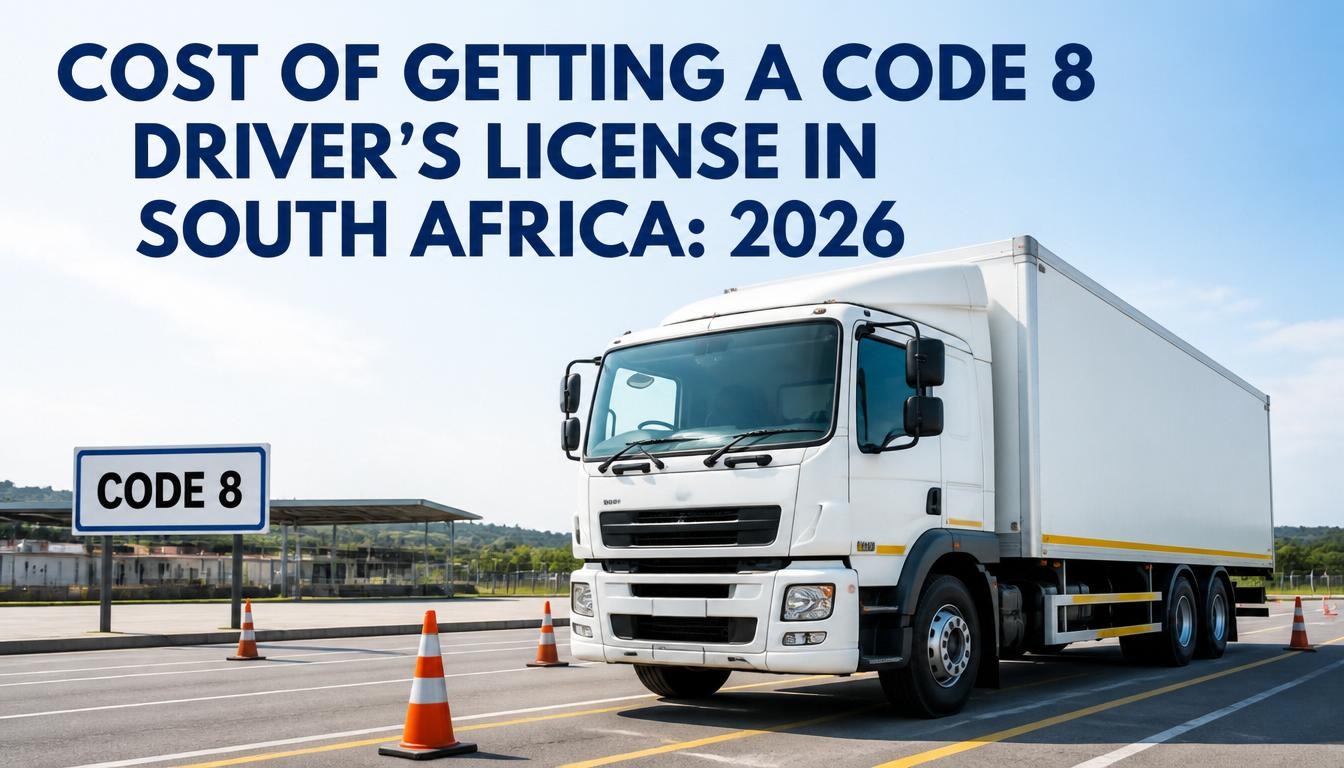
If you ask the Department of Transport or check official municipality portals, they will tell you that getting a Code 8 (light motor vehicle, now officially classified as Code B) driver’s license in South Africa costs less than R600.
When I sat down to calculate every single expense for my youngest sibling’s journey through the Driving Licence Testing Centre (DLTC) process, the final bank statement told a completely different story. Between driving lessons, application fees, eye tests, vehicle hire for test day, and those unexpected “re-test” buffers, getting a Code 8 driver’s license realistically costs between R3,800 and R8,500.
If you are budgeting based solely on government booking rates, you are setting yourself up for a nasty financial surprise.
This comprehensive guide breaks down every cent required to earn your Code 8 license in South Africa. From official provincial DLTC tariffs to driving school tricks, hidden test-day costs, and actionable advice to pass on your first try, here is everything you need to navigate the process smoothly.
1. The Official Government Fees vs. Real World Costs
To understand where your money goes, you have to separate statutory municipal and provincial DLTC fees from third-party operational costs like driving schools, photos, and transport.
Government fees pay for the administration, automated testing systems, examiner time, and card printing by the Driving Licence Card Account (DLCA). Third-party costs cover the actual skills required to keep you from rolling backwards on a hill start or knocking over a parking pole.
-
Total Realistic Budget: R3,800 – R8,500
-
Government & DLTC Fees Portion: R400 – R660 (Covers Learner’s booking/issue, Driver’s booking/issue, and plastic card printing)
-
Driving School & Extras Portion: R3,400 – R7,800 (Covers ID photos, eye test, 10-20 practical lessons, and test-day vehicle hire)
Provincial Government Tariff Variations
Government fees are not uniform across South Africa; each provincial legislature sets its own municipal tariffs. The Western Cape generally operates on the lower end of statutory fees, while Gauteng and KwaZulu-Natal sit slightly higher due to administrative overheads.
Here is what you will pay directly at the DLTC counter:
| Licensing Stage | Western Cape | Gauteng | KwaZulu-Natal | Eastern Cape |
| Learner’s Test Booking Fee | R68 – R75 | R108 – R150 | R100 – R140 | R90 – R130 |
| Learner’s License Issue Fee | R33 – R45 | R60 – R90 | R50 – R80 | R45 – R70 |
| Code 8 Test Booking Fee | R135 – R150 | R220 – R270 | R180 – R240 | R160 – R220 |
| Card Issuing Fee (On Passing) | R140 | R228 – R250 | R150 – R200 | R140 – R180 |
| Temporary License (If Needed) | R45 | R90 – R120 | R70 – R100 | R60 – R90 |
| Average DLTC Total | ~R420 | ~R650 | ~R530 | ~R480 |
Note: DLTC counters strictly prefer card payments (Debit/Credit) via NATIS systems, though select rural testing centres still accept cash. Always verify payment methods before standing in line.
2. Step-By-Step Cost Breakdown: From Zero to Card-In-Hand
Getting your driver’s license is a two-phase process: passing the theory Learner’s License exam and conquering the practical K53 Driving Test.
Phase 1: Obtaining Your Learner’s License (Theory)
Before you can legally touch the steering wheel on a public road, you need a valid Code 2 (light motor vehicle) Learner’s License.
Expenses for Phase 1:
-
Black-and-White / ID Photos: R50 – R80 for a set of 4. Take these beforehand at a local pharmacy or photo studio; DLTC camera booths are frequently offline.
-
Optometrist Eye Test Certificate: R0 – R150. While DLTC offices conduct free visual acuity tests, their equipment is often outdated or dirty. Visiting an optometrist like Spec-Savers for an official certificate saves time and avoids failing the screening due to poor lighting.
-
Study Material / Apps: R0 – R480. While you can read the official K53 manual for free online, interactive prep apps or theory classes significantly improve first-time pass rates.
-
DLTC Booking & Issuing Fees: ~R100 – R230.
Phase 1 Realistic Total: R300 to R800
Phase 2: Mastering the K53 Driving Test (Practical)
This is where the bulk of your money goes. Driving an instructor’s car isn’t just about fuel; it covers commercial insurance, dual-control pedal maintenance, and professional time.
-
Driving Lessons (10-15 hrs): Accounts for roughly 60% of Phase 2 spend.
-
Test-Day Car Hire: Accounts for roughly 20% of Phase 2 spend.
-
DLTC Test & Card Fees: Accounts for roughly 10% of Phase 2 spend.
-
Eye Test & Admin Extras: Accounts for roughly 10% of Phase 2 spend.
1. Practical Driving Lessons
Individual Code 8 driving lessons range between R250 and R450 per hour, depending on your location and vehicle transmission.
-
Manual Transmission: R250 – R350 per hour. Manual vehicles require more practice to master clutch control, incline starts, and gear matching.
-
Automatic Transmission: R300 – R450 per hour. Automatic lessons carry a higher hourly rate due to vehicle maintenance costs, but students usually require fewer lessons to become test-ready.
2. Driving Lesson Packages vs. Pay-As-You-Go
Almost every reputable driving school offers bundled packages. Buying in bulk brings down the hourly rate significantly:
-
5-Lesson “Brush-Up” Package: R1,200 – R1,800 (Ideal if you already know how to drive and only need to learn K53 testing procedures).
-
10-Lesson Package: R2,500 – R3,500 (Standard for learners with basic vehicle control experience).
-
15 to 20-Lesson Beginner Package: R4,200 – R6,500 (Recommended for absolute beginners starting from scratch).
3. Test-Day Vehicle Hire
You cannot use your own car for the K53 test unless it meets strict traffic department criteria (including functional handbrakes accessible from the passenger seat, working indicators, and no mechanical defects).
Most learners hire their instructor’s dual-control car for test day.
-
Standard Test-Day Car Hire Fee: R600 – R1,200.
-
What this includes: The instructor brings the car to the DLTC, provides a 30-to-45-minute “warm-up” lesson before your appointment, and lets you use the car during the yard and road test.
Phase 2 Realistic Total: R3,500 to R7,500
Every learner’s budget looks different based on prior experience and location. Here is a clear side-by-side comparison of three typical scenarios:
| Expense Item | Minimalist / Experienced Driver | Average Learner (10-15 Lessons) | Absolute Beginner (20+ Lessons) |
| Learner’s Prep & Photos | R100 | R250 | R450 |
| Learner’s DLTC Fees | R120 | R180 | R220 |
| Practical Driving Lessons | R1,400 (5 Lessons) | R3,200 (12 Lessons) | R5,500 (20 Lessons) |
| Pre-Test Mock Exam | R0 | R300 | R300 |
| Test-Day Vehicle Hire | R600 | R800 | R900 |
| Practical DLTC Booking Fee | R150 | R220 | R250 |
| License Card Issue Fee | R140 | R228 | R228 |
| Contingency / Re-test Buffer | R0 | R0 | R1,200 (1 Re-test) |
| TOTAL ESTIMATED COST | R2,510 | R5,178 | R9,048 |
When budgeting for your Code 8 license, standard pricing tables don’t always tell the whole story. Several unexpected fees can pop up along the way:
The Cost of Failing (The Re-Test Penalty)
The national pass rate for first-time K53 practical driving tests in South Africa hovers around 40% to 45%. Failing the test means re-paying the DLTC booking fee (R220+) and hiring the driving school vehicle again (R700+).
If you fail due to an immediate failure item (like rolling backwards, touching a line during alley docking, or mounting a curb):
-
You forfeit your booking fee.
-
You must pay R150 – R270 to re-book at the DLTC.
-
You must pay R600 – R1,000 again for vehicle hire on your second test date.
-
You will likely need 2 to 3 refresher lessons (R600 – R900) to fix the error.
A single failure adds roughly R1,500 to R2,200 to your total spending.
Online NATIS Booking Delays
If your learner’s license expires (it is valid for 24 months) while you are waiting for a practical slot on NATIS, you must restart Phase 1 entirely, re-paying all initial fees.
Unaccredited Driving “Fly-By-Nights”
Scam operators charge low rates upfront but fail to secure test slots, show up late, or provide unsafe, unroadworthy vehicles on test day that get rejected by the examiner.
Loss of Income & Travel Costs
Don’t forget the indirect costs. Booking a test date and sitting for the exam often requires spending two separate half-days at the DLTC. Factor in travel costs, parking fees, and potential time off work or university.
5. Manual vs. Automatic Code 8 License: Strategic Financial Choices
In South Africa, your choice of vehicle transmission directly impacts both your upfront costs and your future driving flexibility.
1. Manual License (Standard Code B)
-
Hourly Rate: Lower rates (R250 – R350 per hour).
-
Learning Curve: Takes more hours to master clutch control and incline starts.
-
Privileges: PERMITTED to drive both Manual AND Automatic cars on public roads.
2. Automatic License (Code B – Endorsed/Restricted)
-
Hourly Rate: Higher rates (R300 – R450 per hour).
-
Learning Curve: Takes fewer hours to pass (zero risk of stalling or rolling).
-
Privileges: RESTRICTED strictly to automatic cars. Driving a manual car with an automatic license renders your insurance null and void.
6. How to Avoid Driving School Scams in South Africa
The driving school industry in South Africa is largely unregulated, making scam operations common—especially in major metros like Johannesburg, Cape Town, and Durban.
Warning: The “Guaranteed Pass” Scam
If an instructor or school asks for an extra “guaranteed pass fee” or “coffee money” (typically R1,500 to R3,500) to pay off an examiner, walk away immediately. This is illegal under South African anti-corruption law. Examiners routinely catch fraudulent passes, leading to immediate license cancellation, criminal records, and bans from re-testing.
Checklist for Choosing a Legitimate Driving School:
-
Instructor Credentials: Ensure the instructor carries a valid Instructor’s Certificate issued by the Department of Transport (renewed annually) along with their Professional Driving Permit (PrDP).
-
Dual-Control Vehicles: Never take lessons in a standard private vehicle. Dual controls (passenger-side brake and clutch pedals) are essential for safety during early training.
-
Written Agreements: Avoid schools that demand full cash payment upfront without a written contract detailing lesson counts, cancellation policies, and test-day vehicle availability.
-
Clear Pricing Structure: Ensure the test-day car hire fee is clearly defined from day one, rather than inflated right before your test.
7. Actionable Tips to Pass First Time and Save Thousands
Saving money on your Code 8 license isn’t about cutting corners; it’s about optimizing your practice so you pass on your first attempt.
1. Master the Theory Before Starting Practical Lessons
Do not waste practical lesson time asking your instructor basic rules of the road. Learn road signs, markings, and basic vehicle controls using free K53 apps beforehand. Every minute spent learning signs inside a stationary tuition car is money down the drain.
2. Practice Private Incline Starts and Steering
If you have access to a family member or friend with an insured vehicle and a valid license, practice basic clutch control and observation routines in an isolated, legal space (like an empty parking lot). Use professional driving lessons specifically to fine-tune K53 rules, yard maneuvers, and road test protocols.
3. Take a “Mock Test”
Two lessons before your actual DLTC appointment, ask your instructor to perform a strict K53 mock test. Have them grade you strictly on:
-
360-degree blind-spot checks before indicating or moving.
-
Correct hand placement and mirror observations every 5–8 seconds.
-
Stopping fully behind the line at stop signs (count 1-2-3 silently).
-
Avoiding gear changes while turning corners.
Correcting these minor habits before test day can save you from a costly re-test.
8. Step-by-Step Overview of the K53 Practical Driving Exam
Understanding what happens on test day helps reduce anxiety and lowers the chance of costly mistakes.
Step 1: Pre-Trip Inspection
-
Exterior: Check under the vehicle for leaks, inspect wipers, tire tread, lights, and indicators.
-
Interior: Adjust seat and mirrors, check handbrake engagement, verify doors are closed, and ensure the cabin is clear of clutter.
Step 2: The Yard Test (Off-Road)
-
Incline Start: Move off on a steep gradient without rolling backwards.
-
Alley Docking: Reverse park the vehicle into a tight bay from both left and right sides without touching boundary poles.
-
Parallel Parking: Park between poles parallel to the curb within the allocated time limit.
-
Three-Point Turn: Turn the vehicle around in a narrow roadway using forward and reverse gears.
Step 3: The Road Test (Public Roads)
Drive a minimum 15-minute prescribed route on public roads. Examiners score on:
-
Mirror and blind-spot observation routines.
-
Lane discipline, speed control, and proper signaling.
-
Safe negotiation of intersections, traffic lights, and pedestrian crossings.
Interactive Discussion: What Was Your Licensing Experience?
Getting a driver’s license in South Africa involves unique experiences across different provinces. Sharing real-world feedback helps future applicants plan their budgets effectively:
-
Which DLTC did you use for your Code 8 test, and how was the service quality?
-
How many lessons did you end up taking before feeling fully confident?
-
If you used a driving school in Gauteng, Western Cape, or KZN, what was your total package price?
Drop your thoughts, questions, and advice in the comments below! If you are currently preparing for your test, let us know which maneuver gives you the most trouble so our community can share practical tips.

Joseph Mathebula is a consumer analyst and market researcher at Prices in South Africa. He specializes in tracking local service costs, retail pricing, and travel budgets, helping everyday shoppers navigate the market to secure the best value.