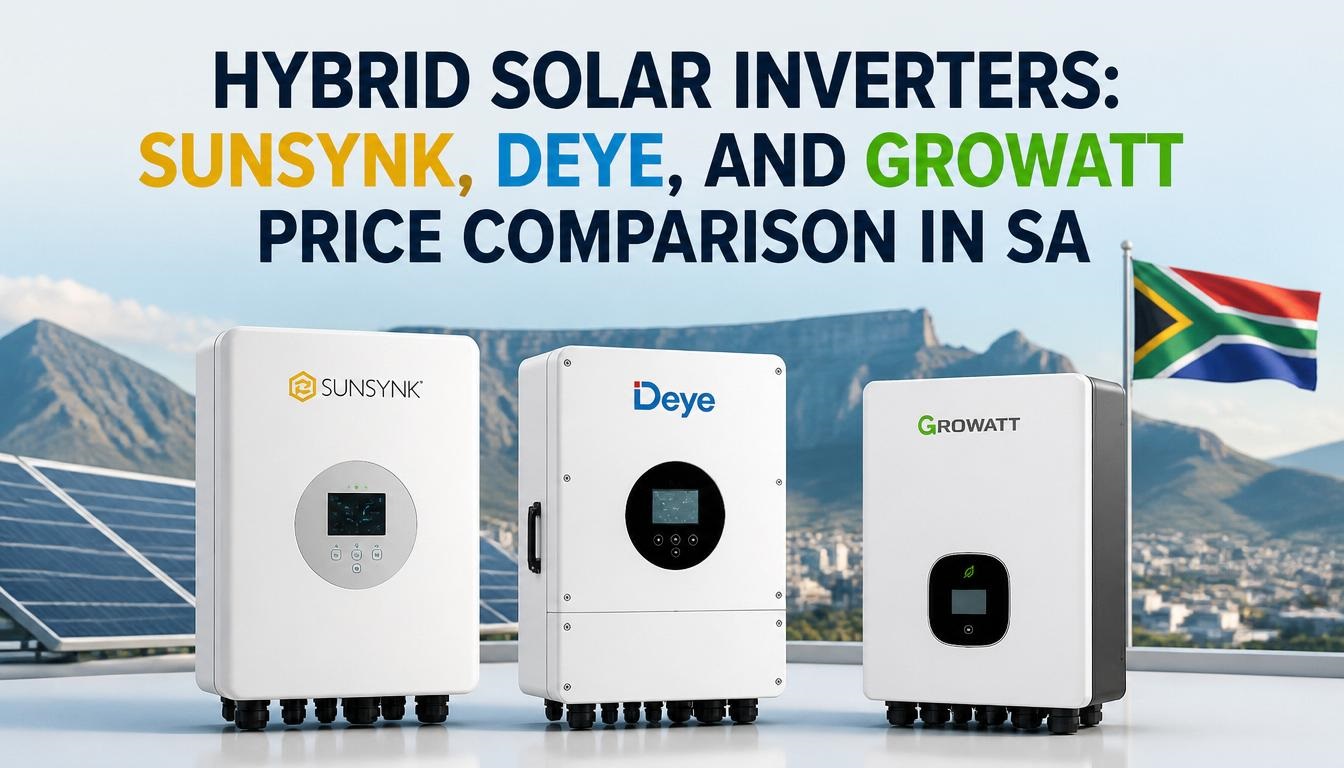
Ultimate Hybrid Solar Inverter Showdown in South Africa: Sunsynk vs. Deye vs. Growatt Price and Performance Guide
Navigating the South African energy landscape feels like a permanent high-stakes balancing act. Between unpredictable stage adjustments from Eskom, soaring municipal electricity tariffs, and the persistent threat of lightning storms frying delicate household electronics, investing in a residential solar setup is no longer just an eco-friendly luxury—it is absolute economic self-defense.
If you have spent more than ten minutes researching solar systems on local forums or chatting with installers in Johannesburg, Cape Town, or Durban, three heavy-hitting brand names dominate every conversation: Sunsynk, Deye, and Growatt. As someone who has spent years tracking tech trends, tearing down consumer hardware, and analyzing real-world solar telemetry data across South African households, I know that choosing between these three giants can paralyze even the most analytical homeowner.
This deep-dive guide strips away the marketing noise. We will analyze real-world user intent, current South African pricing structures, hardware reliability under harsh local grid conditions, and ecosystem flexibility to help you make a bulletproof investment for your home.
Why Choosing the Right Hybrid Inverter Matters in South Africa
The South African power grid presents unique engineering challenges that European or American-centric hardware designs often struggle to handle. We deal with volatile voltage spikes, dirty grid frequencies, frequent load-shedding switches that shock internal components, and rolling blackouts that demand lightning-fast UPS-grade transfer times.
A hybrid inverter acts as the literal brain and heart of your home energy ecosystem. It manages power generation from your photovoltaic (PV) panels, orchestrates safe charging and discharging cycles for your lithium-ion battery bank (such as Freedom Won, Pylontech, or Dyness), seamlessly blends grid power when needed, and keeps your Wi-Fi, fridge, and security systems humming during an outage. Pick the wrong unit, and you risk nuisance tripping, poor compatibility with local NRS-approved battery firmware, or worse, a fried motherboard during a highveld thunderstorm.
Brand Overview: The Contenders at a Glance
Before diving into the cold numbers, let us look at the market philosophy driving each brand in South Africa.
Sunsynk: The Gold Standard of Installer Trust
Sunsynk carved out its legendary status in South Africa by offering arguably the most intuitive touch screen interface, bulletproof local technical support, and seamless software integration. Installers love them because callbacks are rare, and homeowners love them because the mobile app and monitoring portal actually make sense without requiring an engineering degree. They sit comfortably in the premium tier.
Deye: The Powerhouse Innovator
Many people do not realize that Deye manufactures the underlying hardware architecture for several other major global brands. Deye units are renowned for exceptional value, incredible surge capacity, high maximum charging and discharging currents, and massive scalability. They have rapidly become the market-share darling for budget-conscious homeowners who refuse to compromise on heavy industrial-grade specifications.
Growatt: The Budget and Commercial Heavyweight
Growatt offers a massive footprint ranging from residential low-voltage systems to massive commercial three-phase solutions. While some of their older off-grid models lacked true hybrid flexibility, their modern hybrid lineups deliver dependable performance at aggressive price points. They are the go-to choice for cost-effective deployments where upfront capital expenditure is tightly constrained.
Current South African Pricing and Specification Comparison
Pricing in the South African solar market fluctuates based on import costs, rand-to-dollar exchange rates, and shipping logistics. However, based on current local supplier data, here is how the popular 5kW and 8kW single-phase hybrid models stack up head-to-head.
5kW Hybrid Inverter Comparison Table
| Feature / Metric | Sunsynk 5kW (Single Phase / LV) | Deye 5kW (Single Phase / LV) | Growatt SPH 5000 / SPF Series |
| Approximate Retail Price (Incl. VAT) | R17,500 – R21,000 | R14,500 – R15,700 | R7,000 (Off-grid/Hybrid mix) – R16,180 |
| Max DC Input Power | 6,500W | 6,500W | 3,200W – 5,000W+ |
| Max Charge/Discharge Current | 120A | 120A | 80A – 100A |
| Display Interface | 7-inch Color Touch LCD | Color Touch LCD | LED / Optional LCD Panel |
| Parallel Support | Up to 16 units | Up to 16 units | Limited / Model dependent |
| Standard Warranty | 5 Years (Extendable) | 5 to 10 Years | 5 Years |
8kW to 10kW Hybrid Inverter Comparison Table
| Feature / Metric | Sunsynk 8kW / 10kW Pro | Deye 8kW / 10kW Hybrid | Growatt High-Capacity Hybrid |
| Approximate Retail Price (Incl. VAT) | R24,000 – R38,000 | R22,000 – R28,000 | R16,000 – R35,000 |
| Battery Compatibility | Low Voltage (48V) | Low Voltage (48V) / HV Options | Low / High Voltage Options |
| IP Rating | IP65 (Indoor/Outdoor) | IP65 (Indoor/Outdoor) | IP65 / IP65-equivalent |
| Local Support & Repaires | Exceptional South African Hubs | Strong Local Distributor Backing | Established Regional Support |
Real Human Experience: What Installers and Users Actually See
Specifications on a glossy data sheet tell only half the story. When you talk to certified electricians crawling through roof spaces in Pretoria or maintenance teams managing commercial warehouses in Durban, real-world operational truths emerge.
The Sunsynk Experience
When installing a Sunsynk unit, the setup wizard walks you through battery matching and grid code selection with absolute clarity. During heavy winter loads when heaters, geysers, and kettles pull concurrent surges, Sunsynk handles transient spikes gracefully without dropping connection. The community support group on local forums is massive—if you run into an obscure error code, someone has already solved it. The main drawback? You pay a distinct brand tax upfront.
The Deye Experience
Deye units punch aggressively above their weight class. In testing, the switching speed between grid failure and backup battery power is virtually imperceptible to sensitive desktop computers or fiber routers. The dual-MPPT layout allows flexible string configurations if your roof faces multiple directions (e.g., East and North). Furthermore, Deye’s open-protocol communication makes pairing with diverse lithium battery brands smooth and hassle-free.
The Growatt Experience
Growatt remains a favorite for strict budget builds. If a household needs reliable load-shedding backup without expanding into complex multi-string commercial arrays immediately, Growatt gets the job done cleanly. However, users should pay close attention to model naming conventions: ensure you are purchasing a true hybrid model with integrated export limitation if you plan to feed excess solar back into municipal net-billing grids, rather than a basic off-grid inverter.
Key Decision Factors for South African Homeowners
When finalizing your shopping cart, weigh these four critical pillars against your household consumption profile:
-
Grid Code Compliance (NRS 097-2-1): Ensure your chosen model is explicitly approved by NRS requirements. Municipalities across South Africa (especially Cape Town and parts of Eskom-supplied areas) increasingly demand compliance certification before permitting grid-tied installations. Sunsynk and Deye lead heavily here with broad, hassle-free municipal acceptance lists.
-
Expandability: Your initial power needs tend to grow. If you start with a 5kW inverter and a single 5kWh battery, check whether your inverter allows parallel stacking down the road. Both Deye and Sunsynk excel by allowing you to scale up to 16 units in parallel.
-
App Monitoring and Data Logging: Load-shedding schedules change, and tracking your daily photovoltaic yield is addictive. Sunsynk and Deye offer robust Wi-Fi dongles feeding real-time cloud data dashboards, letting you monitor consumption down to the watt while sitting at the office.
-
After-Sales Support: Solar hardware operates under heavy thermal stress. Local repair turnaround times in South Africa matter immensely. Choose a supplier backed by established local warranty management networks to avoid waiting months for parts to ship from overseas.
Conclusion: Which One Should You Buy?
If budget is flexible and you want the smoothest user interface, stellar installer backing, and long-term peace of mind, Sunsynk remains the undefeated king of user experience.
If you want identical high-end performance, massive current handling, and robust build quality while keeping several thousand rand in your pocket, Deye represents the smartest value proposition on the South African market today.
If your primary objective is keeping initial capital expenditure low while still securing a reputable brand for essential load-shedding defense, Growatt provides a dependable entry point.
Join the Discussion
Which hybrid inverter brand currently powers your home setup, or are you still in the planning phase of escaping Eskom’s grid? Drop a comment below detailing your province, your current setup size, or any specific technical questions you have about pairing these inverters with local lithium batteries—let us compare notes and help each other build better solar systems!

Joseph Mathebula is a consumer analyst and market researcher at Prices in South Africa. He specializes in tracking local service costs, retail pricing, and travel budgets, helping everyday shoppers navigate the market to secure the best value.