Quick Market Snapshot & Buyer Summary
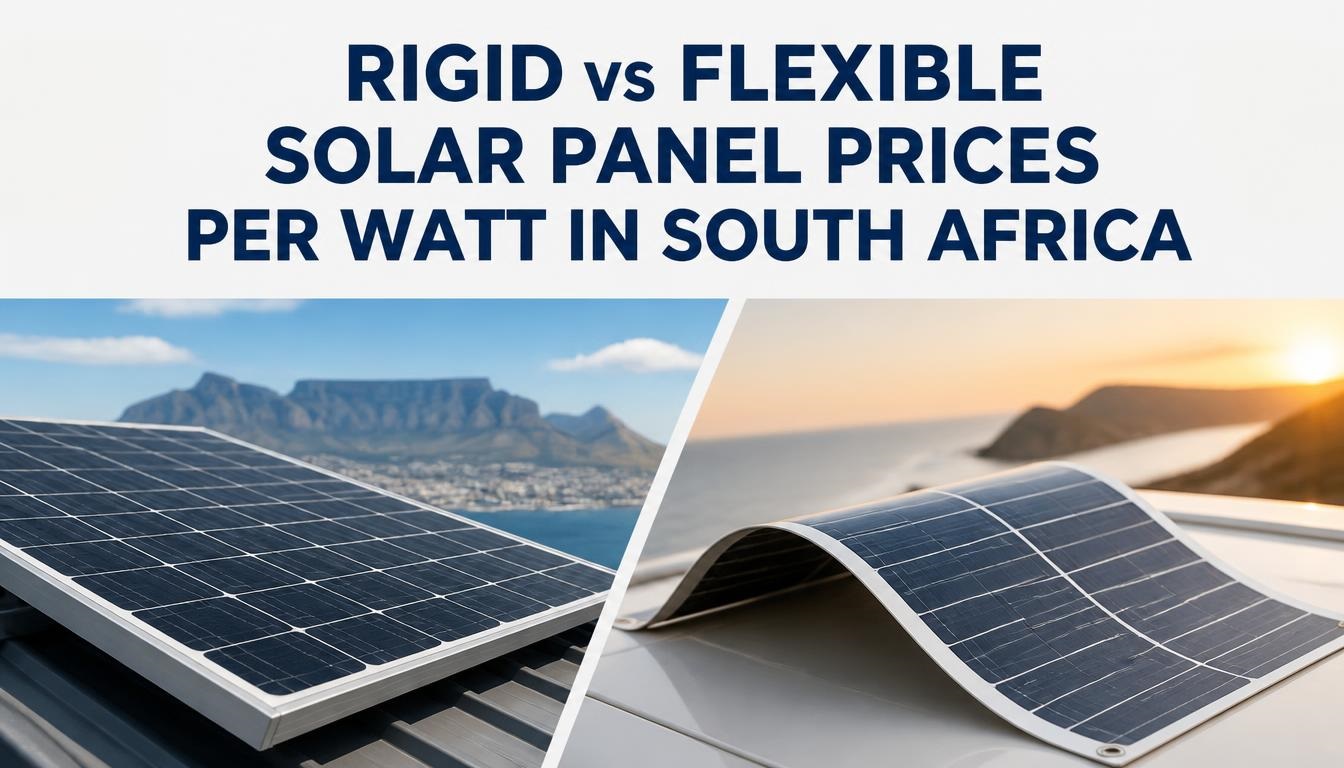
Every time Eskom hikes municipal tariffs or load-shedding shifts into higher stages, South African homeowners, 4×4 enthusiasts, and off-grid campers face the same critical choice: should you bolt down heavy, glass-fronted rigid solar panels or stick down sleek, lightweight flexible panels?
Marketing claims make flexible panels look like the ultimate hassle-free solution. They are light, paper-thin, and easy to mount on curved camper van roofs without drilling holes. But when you break down the actual financial metrics—specifically the ZAR price per Watt (R/W)—the numbers reveal a massive disparity between these two solar technologies.
Whether you are fitting out a Suburban Johannesburg home with a 5kW inverter system, powering a 12V dual-battery system for Kgalagadi overlanding, or lowering your monthly municipal electric bill, here is the raw, independent breakdown of rigid versus flexible solar panel pricing in South Africa.
The Real ZAR Cost: Price Per Watt Breakdown
To evaluate solar panel value, always look past the sticker price and measure the Rand per Watt (R/W) ratio. This levels the playing field across different sizes, outputs, and brands.
For example, to calculate the price per watt, divide the total panel price in ZAR (including VAT) by the rated output in Watts.
Rigid solar panels benefit from massive global manufacturing scale, making them exponentially cheaper per watt than their flexible counterparts. Flexible panels use specialized polymers, specialized ETFE (Ethylene Tetrafluoroethylene) lamination, and smaller production runs, which drives up production costs per watt.
2026 South African Solar Retail Price Comparison
The table below outlines real-world retail pricing across major South African outlets including Takealot, Makro, Builders, and specialized solar distributors.
| Panel Style | Wattage Rating | Retailer / Outlet | Average Retail Price (ZAR) | Price Per Watt (R/W) | Recommended Application | Direct SA Buy Option |
| Rigid Monocrystalline | 450W | Takealot | R1,699.00 | R3.77 / W | Residential Rooftops, Fixed Off-Grid | Check Price on Takealot |
| Rigid Monocrystalline | 550W Tier-1 | Builders Warehouse | R2,199.00 | R4.00 / W | Home System Upgrades, Load-Shedding Kits | View Deal at Builders |
| Rigid Bifacial N-Type | 605W–620W | Sustainable.co.za | R2,052.00 | R3.31 / W | High-Efficiency Home & Commercial PV | View Price at Sustainable.co.za |
| Flexible ETFE Mono | 100W | Makro | R1,899.00 | R18.99 / W | Camper Vans, Caravans, Boat Decks | Shop Flexible at Makro |
| Flexible ETFE Mono | 120W | Takealot | R2,299.00 | R19.15 / W | Mobile 12V Power, Curved Canopy Mounts | Check Deal on Takealot |
| Flexible ETFE Mono | 200W Semi-Flex | Leroy Merlin | R3,899.00 | R19.49 / W | Compact Off-Grid Solar Generators | Check Price at Leroy Merlin |
Why Flexible Panels Cost Up to 5x More Per Watt
When comparing a 450W rigid panel at R3.77 per watt to a 100W flexible panel at R18.99 per watt, flexible tech costs nearly 5 times more per unit of power produced. Understanding where that premium goes helps you determine if the expenditure is justified for your setup.
1. Materials and Lamination Tech
Rigid panels feature tempered glass sheets enclosed in heavy-duty anodized aluminum frames. These materials are inexpensive and widely produced globally. Flexible panels replace heavy glass with specialized plastic polymers like PET (Polyethylene Terephthalate) or ETFE.
-
PET Polymers: Cheaper, but prone to yellowing, clouding, and thermal degradation within 12 to 24 months under harsh South African UV exposure.
-
ETFE Coatings: Marine-grade, UV-stabilized, and scratch-resistant, but significantly more expensive to manufacture, driving up the retail cost per watt.
2. Physical Weight vs. Shipping Logistics
A standard 550W rigid panel weighs approximately 27kg to 29kg and measures over 2 meters in height. Shipping these panels across South Africa requires palletized freight through carriers like The Courier Guy or dedicated logistics networks.
By contrast, a 100W flexible panel weighs roughly 1.8kg to 2.2kg and can be shipped in standard flat-pack boxes via standard door-to-door delivery or collected at local Takealot Pickup Points and Pargo counters.
3. Structural Flexibility vs. Structural Protection
Flexible panels can bend up to 30 degrees, allowing them to conform seamlessly to curved roofs, pop-up tents, and teardrop trailers. However, bending places micro-stress on the internal silicon wafer cells. Rigid glass panels protect silicon cells from physical flexing, ensuring long-term durability over decades.
The South African Environment Test: Heat, Hail, and Load-Shedding
South African operating conditions subject solar hardware to extreme environmental factors. From summer temperatures exceeding 38°C in the Karoo to severe highveld hailstorms in Gauteng and North West, local conditions put both rigid and flexible designs to the test.
Rigid Panel Construction:
Features a tempered glass top layer, solar monocell layer, EVA encapsulant film, and an aluminum frame that leaves an air gap underneath. This airflow cools the cells and prevents fast degradation.
Flexible Panel Construction:
Features an ETFE or PET polymer top layer, solar monocell layer, and thin plastic backer applied directly to a surface with adhesive. This setup traps heat underneath, reducing power yield and causing faster cell degradation.
Thermal Efficiency and Temperature Coefficients
All solar PV cells lose efficiency as surface temperatures rise above 25°C. This impact is measured by the temperature coefficient of max power (typically -0.35% per degree Celsius).
-
Rigid Panels: Mounted on roof rails with an essential 75mm to 100mm air gap underneath. Air flows continuously beneath the panel, cooling the frame and maintaining peak power generation during blistering summer afternoons.
-
Flexible Panels: Glued directly onto roof surfaces using marine adhesives (such as Sikaflex). With no airflow underneath, roof heat transfers directly into the PV cells, causing surface temperatures to surge past 65°C. This leads to an immediate power yield loss of 15% to 30% during peak sun hours.
Hail Impact and Mechanical Endurance
Gauteng and Highveld hailstorms regularly drop golf-ball-sized hail.
-
Rigid Panels: Built with 3.2mm thick toughened tempered glass rated to withstand hail strikes traveling up to 80 km/h. They carry standard 10-to-12-year product warranties and 25-year performance warranties.
-
Flexible Panels: Soft polymer surfaces absorb initial light impacts, but lack structural protection against heavy hail hits. A direct hit can cause micro-cracks inside the silicon wafers without leaving visible external marks, permanently reducing panel output. Most flexible panels carry only a 12-to-24-month limited warranty.
ROI Analysis: Home Installations vs. Mobile 4×4 Off-Grid Setups
Choosing between rigid and flexible solar comes down to matching the technology to your specific use case.
Home / Commercial Rooftop Systems
-
System Specs: 5kW Inverter + Battery setup using roughly 8 x 550W Rigid Panels (4,400W total).
-
Estimated Panel Cost: ~R17,600 (Average cost per watt: R4.00/W).
-
Primary Benefit: Maximum return on investment.
4×4 / Overlanding / Boating Systems
-
System Specs: 12V Dual Battery Setup using 2 x 100W Flexible Panels (200W total).
-
Estimated Panel Cost: ~R3,800 (Average cost per watt: R19.00/W).
-
Primary Benefit: Low profile and ultra-lightweight.
Scenario A: Fixed Home or Business Rooftop Installation
If you are installing solar to beat Eskom rate hikes, mitigate load-shedding, or reduce municipal bills, rigid solar panels are the clear choice.
-
Cost for 4,000W Array (Rigid): ~R15,000 to R18,000 total panel cost.
-
Cost for 4,000W Array (Flexible): ~R72,000 to R80,000 total panel cost.
Beyond the initial panel cost, municipal SSEG (Small-Scale Embedded Generation) approvals and registration rules across City of Cape Town, City Power (Joburg), and eThekwini require NERSA-compliant equipment, COC (Certificate of Compliance) electrical sign-offs, and structural roof integrity certifications. Flexible panels are rarely approved for permanent grid-tied home installations.
Scenario B: 4×4 Overlanding, Caravans, and Boating
For off-road vehicles, pop-top camper roofs, and marine vessels, weight distribution and aerodynamic drag take priority over raw price-per-watt ratios.
-
Aerodynamics and Clearance: Rigid panels mounted on roof racks add 100mm of height and up to 30kg of top-heavy weight, increasing fuel consumption and clearance risks in low-overhead garages.
-
Stealth and Flexibility: A flexible panel glued flush to a rooftop box or aluminum canopy remains virtually invisible, reduces wind noise, adds negligible weight, and handles dynamic vehicle vibrations without shattering glass.
Local Buying Guide: Retailers, Warranties, and CPA Protections
When purchasing solar hardware in South Africa, navigating warranty claims and store protections is critical.
Retailer Loyalty Perks and Payment Options
-
Takealot: Excellent for single-panel purchases, offering 30-day hassle-free returns, eBucks integration, and flexible financing options like PayFlex or Mobicred.
-
Makro / Game (Massmart): Good bulk pricing options with payment flexibility through eBucks, Discovery Miles, and store credit lines.
-
Builders Warehouse: Ideal for in-person inspection of aluminum mounting brackets, MC4 connectors, cabling, and Tier-1 rigid panel stocks.
Consumer Protection Act (CPA) and Warranty Guarantees
Under Section 56 of the South African Consumer Protection Act (CPA), all goods carry an implied six-month warranty against manufacturing defects. If a panel fails due to faulty lamination or internal wiring within six months of purchase, you are legally entitled to a repair, replacement, or full refund.
-
Rigid Panel Warranties: Expect a 10-to-12-year product materials warranty and a 25-year linear power output guarantee (promising at least 80% output after 25 years) on Tier-1 brands like JA Solar, Canadian Solar, Jinko, and Longi.
-
Flexible Panel Warranties: Typically restricted to 12 to 24 months. Carefully verify whether the supplier honors warranties if the panel is permanently attached using adhesive glues.
Smart Buying Strategies to Maximize Solar Value
-
Avoid Generic Flexible Panels: Skip unbranded PET-coated flexible panels sold on online marketplaces. They often degrade under South African sunlight within two years. Look specifically for ETFE-laminated panels.
-
Combine Solar Sourcing with Inverter Kits: Sourcing rigid panels through accredited solar installers alongside an inverter and lithium battery setup can reduce your hardware costs to R3.20–R3.80 per watt.
-
Use Solar Charge Controllers Wisely: Flexible panels often have slightly non-standard voltage outputs. Always pair them with a high-efficiency MPPT (Maximum Power Point Tracking) charge controller rather than a cheap PWM controller to reclaim 20% to 30% of lost power yield.
-
Time Your Purchase Around Sales Cycles: Watch for major sales events, such as Black Friday, Payday promotions, and year-end inventory clearances at national retail chains to secure the lowest price per watt.
Frequently Asked Questions
Can I install flexible solar panels on my home roof to save on mounting bracket costs?
No, it is not recommended. Flexible panels cost significantly more per watt, have a much shorter lifespan (2 to 5 years compared to 25+ years for rigid panels), and experience reduced efficiency due to thermal buildup on home roof materials. Furthermore, standard home rooftop solar installations require NERSA and municipal COC compliance, which generally specifies Tier-1 rigid panels.
Why do flexible solar panels degrade faster in South Africa?
Flexible panels rely on plastic polymers (ETFE or PET) rather than toughened glass. Under intense UV radiation and extreme heat, these plastics can gradually oxidize, delaminate, or cloud over time. Direct contact with hot vehicle or roof surfaces also accelerates thermal breakdown of the internal solar cells.
Are flexible panels completely waterproof for marine and boat use?
Quality ETFE flexible panels feature an IP67 or IP68 ingress protection rating, making them fully waterproof and resistant to saltwater spray. However, you must ensure that all MC4 wire connections and junction boxes are properly sealed with marine-grade silicone or heat-shrink tubing to prevent corrosion.
How do I safely clean rigid vs flexible solar panels?
For rigid panels, use clean water, a soft microfiber squeegee, and mild soap if necessary—never clean them during peak sun hours when the glass is hot. For flexible panels, wipe down gentle debris using water and a non-abrasive soft cloth. Avoid harsh chemicals or stiff brushes that can scratch the protective ETFE surface.
Community Discussion & SA Price Tracker
Are you currently upgrading your off-grid 4×4 rig or installing a home inverter setup? Share your recent retailer quotes, real-world panel yields, and pricing finds in the comments below to help fellow South African buyers make informed decisions.
Disclaimer: Prices fluctuate and reflect independent market research at the time of publication. We may earn a small affiliate commission through retailer links at no extra cost to you.

Joseph Mathebula is a consumer analyst and market researcher at Prices in South Africa. He specializes in tracking local service costs, retail pricing, and travel budgets, helping everyday shoppers navigate the market to secure the best value.