Sitting in traffic on the N1 or waiting in a never-ending line at Home Affairs reveals a clear trend—nearly every third person is holding a Samsung A-series device. It has quietly become the unofficial national phone of South Africa because it offers exactly what we need: a reliable battery to survive sudden load-shedding blocks and a build tough enough to handle a rough drop onto the tar.
With the launch of the new Samsung Galaxy A37 5G, the stakes are much higher. As a local phone fan who has tracked these devices from the early days of the plastic A30 series, I wanted to see if this new model justifies spending your hard-earned Rands, or if Samsung is just coasting on its brand name while making your wallet lighter. Let’s skip the corporate marketing fluff and look at how this device actually holds up on South African streets.
Quick Takeaways: The Galaxy A37 at a Glance
-
Estimated SA Retail Price: Starts around R6,999 to R7,499 for the base model, climbing up to R8,999 for premium configurations depending on standard local tech markups and network carrier plans.
-
Standout Upgrades: A massive jump to a 6.7-inch Super AMOLED screen with an incredible 1900 nits peak brightness, 45W faster wired charging, and premium Gorilla Glass Victus+ on both the front and back.
-
The Catch: The microSD card slot is completely missing (a massive blow for offline storage) and no charging brick is included in the box.
-
Longevity Champion: Samsung promises a massive 6 major Android OS upgrades, running Android 16 with One UI 8.5 right out of the box.
The Ultimate Reality Check: South African Pricing & Availability
Let’s talk money first because that is what matters most when you’re balancing a monthly budget. Globally, the Galaxy A37 sits at an international baseline price of roughly $329.50. When you factor in South Africa’s 15% VAT, ad valorem customs duties, and the standard local tech markup, here is what you can expect on the shelves:
-
128GB Storage / 6GB RAM (Base Model): Expected cash price of R6,999 to R7,499.
-
256GB Storage / 8GB RAM (Upgraded Model): Expected cash price of R8,499 to R8,999.
If you are looking at contract options via local carriers like Vodacom, MTN, or Telkom, the base 128GB model is expected to slot into the R399 to R499 per month over 36 months tier.
Why the Local Price Matters: The Competition
At this exact price point, the Galaxy A37 faces stiff competition from brands like Xiaomi (Redmi Note series) and Oppo, which often throw in the charging bricks and free covers. However, Samsung claws back value through its massive local repair footprint and trade-in programs, which are incredibly easy to access at major shopping malls across Johannesburg, Cape Town, and Durban.
Design and Display: Built for Bright Sunshine
Living in South Africa means our phones spend a lot of time under harsh, direct sunlight—whether you are checking your navigation during a weekend road trip or trying to read a WhatsApp message while standing in a queue outside.
Samsung upgraded the screen to a 6.7-inch Super AMOLED display with a buttery-smooth 120Hz refresh rate. The big news here is the brightness capability: it hits up to 1200 nits under high brightness mode and peaks at a whopping 1900 nits. This means you will never have to squint or shade your phone with your hand just to read an email at midday.
Build Quality: Flagship Toughness Dropped to Mid-Range
One massive upgrade that adds real human value is the glass choice. Samsung has wrapped both the front and the back of this phone in Corning Gorilla Glass Victus+. If you accidentally drop your phone on harsh tar or concrete while rushing to plug it in before a power outage hits, this glass offers significantly better scratch and shatter protection than the cheap plastics used by competitors.
Furthermore, it keeps its IP68 dust and water resistance rating. If you get caught in a sudden Highveld thundershower or accidentally drop your phone into a pool, it can survive immersion in up to 1.5 meters of fresh water for 30 minutes. The frame is still plastic, but the glass back makes it look and feel remarkably like an S-series flagship.
Performance: Powered by the Exynos 1480
Under the hood, the Galaxy A37 runs on the 4-nanometer Exynos 1480 chipset paired with an Xclipse 530 GPU.
For daily tasks—scrolling through TikTok, managing banking apps, checking radar maps, and multi-tasking—this chip runs exceptionally cold and smooth. It does not stutter under normal loads, and the transition between heavy apps is seamless.
Is it a Gaming Beast?
If you are looking to play heavy mobile games like Call of Duty Mobile or PUBG at maxed-out graphic settings, you will experience occasional frame drops during intense matches. However, for casual gaming and medium graphics settings, the Xclipse 530 graphics processor handles things beautifully without turning the phone into a hand-warmer.
The Storage Heartbreak: No MicroSD Slot
This is where we need to give you some tough love. Samsung has officially removed the microSD card slot from the Galaxy A37. For years, South African users bought the base storage model and expanded it later with a cheap memory card to store thousands of offline music tracks and videos.
Because you cannot expand the storage later, we highly recommend stretching your budget to the 256GB version if you take a lot of photos or record videos in 4K. If you buy the 128GB version, you will likely find yourself constantly deleting apps or paying for cloud storage within a year or two.
Cameras: Solid 50MP Shooter with OIS
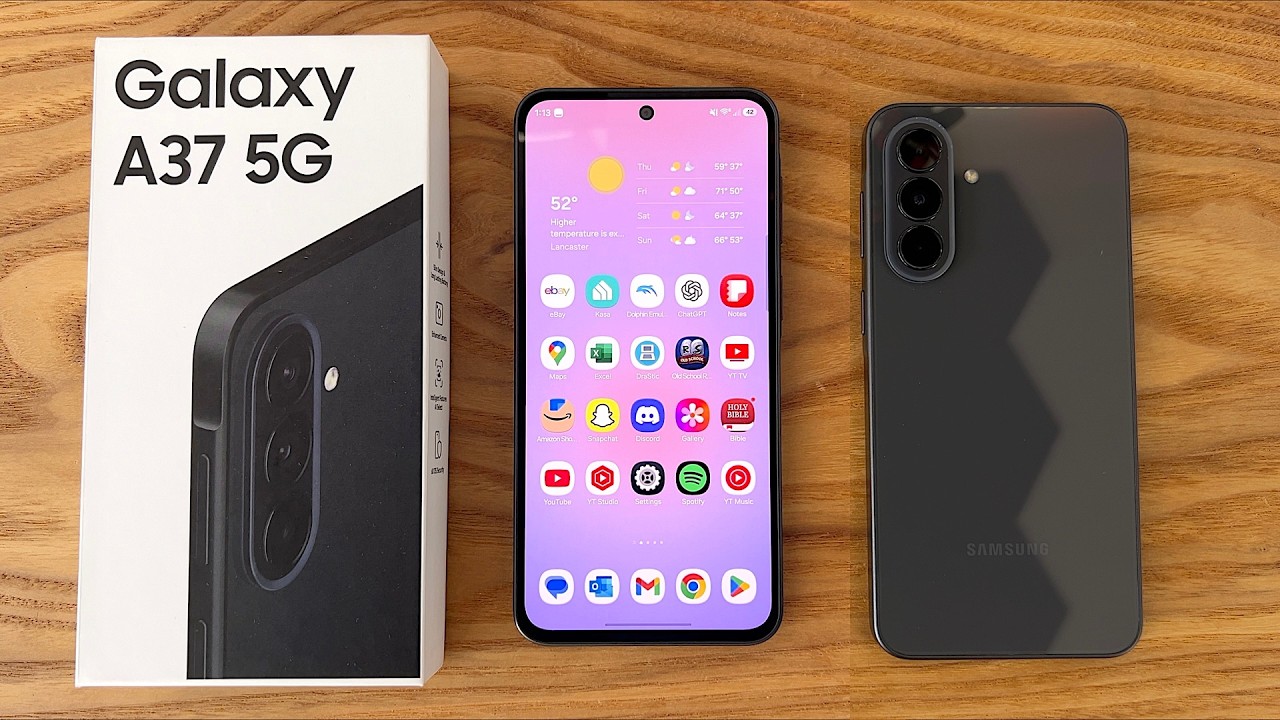
The rear camera layout retains Samsung’s classic minimal look, featuring three individual lenses vertically stacked on the back:
-
Main Camera: 50 MP, f/1.8 aperture with Phase Detection Autofocus (PDAF) and Optical Image Stabilization (OIS).
-
Ultra-wide Camera: 8 MP, f/2.2 for landscape and group shots.
-
Macro Camera: 5 MP, f/2.4 for close-up shots.
The star of the show is the 50MP main lens. Thanks to the inclusion of OIS (Optical Image Stabilization), the camera physically counteracts your hand shakes. This is a lifesaver for night photography or taking quick snapshots while walking.
Photos taken in daylight look rich, vibrant, and typically “Samsung”—meaning colors are punchy, skies are beautifully blue, and contrast is sharp. In low-light conditions, the dedicated Night Mode does a commendable job of cleaning up image grain, though details can get a little soft around the edges.
Video Performance
You can record video in 4K at 30 frames per second on both the main rear camera and the 12MP selfie camera. The video stabilization is incredibly reliable for vlogging or taking clips of your kids and pets, making it a great tool for local content creators starting out on a budget.
Battery and Charging: Welcome to 45W Speed
The Galaxy A37 packs a standard 5000 mAh battery. In real-world testing, this battery easily delivers a full day of heavy use or up to a day and a half of moderate use. If you are using your phone as a mobile hotspot during power outages, it handles the extra battery drain without leaving you stranded before bedtime.
The Big Upgrade: 45W Charging Support
For years, mid-range Samsung users were stuck with slow 25W charging. The Galaxy A37 finally steps up to 45W wired fast charging.
This change is incredibly practical. Instead of waiting nearly two hours for a full charge, you can juice up your battery significantly faster. If you only have a brief window of power to top up your device, you can get from empty to roughly 50% in under 30 minutes, provided you use a compatible Power Delivery (PD) charger.
Note: There is no charger in the box. You only get a USB-C to USB-C cable. If you do not already own a 45W fast-charging brick, you will need to spend an extra R350 to R500 on an official Samsung adapter or a certified third-party brick to make use of these faster speeds.
Detailed Specifications Comparison
To see exactly what you are paying for, let’s look at the complete, verified hardware breakdown of the Galaxy A37 5G:
| Feature | Specification Details |
| Network | 5G, 4G LTE, 3G, 2G (eSIM support included) |
| Dimensions | 162.9 x 78.2 x 7.4 mm |
| Weight | 196 grams |
| Display | 6.7-inch Super AMOLED, 120Hz, 1900 nits peak |
| Protection | Gorilla Glass Victus+ (Front & Back), IP68 Rating |
| OS | Android 16 with One UI 8.5 (6 years of major upgrades) |
| Chipset | Exynos 1480 (4 nm process) |
| Storage Options | 128GB / 256GB UFS 3.1 (No expandable storage) |
| RAM Options | 6GB / 8GB / 128GB variants |
| Main Camera | 50MP (OIS) + 8MP (Ultra-wide) + 5M (Macro) |
| Selfie Camera | 12MP with 4K video recording |
| Audio | Loud stereo speakers (No 3.5mm headphone jack) |
| Connectivity | Wi-Fi 6, Bluetooth 5.4, NFC, USB Type-C 2.0 |
| Battery | 5000 mAh with 45W fast wired charging |
Software Longevity: The Real Money Saver
Perhaps the biggest reason to drop your money on the Galaxy A37 instead of a cheaper alternative is the software commitment. Samsung promises 6 major Android OS upgrades and six years of security patches for this device.
Because it launches with Android 16, this phone will officially be supported all the way up to Android 22. If you are the type of person who likes to buy a phone cash and keep it for four to five years to maximize your investment, this long-term support makes the device incredibly cost-effective. You won’t have to worry about your banking apps losing security compatibility three years from now.
The Verdict: Should You Buy It?
The Samsung Galaxy A37 5G is a highly polished, durable mid-ranger that focuses heavily on daily usability. The display is phenomenally bright, the Gorilla Glass Victus+ offers top-tier ruggedness, and the jump to 45W charging fixes a long-standing community complaint.
However, if you are upgrading from an older device like the Galaxy A34 or A33, the total removal of the microSD card slot and the lack of an in-box charger are frustrating adjustments that add extra hidden costs to your purchase.
-
Buy it if: You want a phone that feels premium, has an amazing screen for outdoor use, offers long-term software support, and can handle accidental drops and splashes without dying.
-
Skip it if: You absolutely require physical expandable storage via a microSD card, or if you want top-tier mobile gaming performance at a cheaper price point.
Over to You: What Do You Think?
Let’s chat in the comments below: If you are shopping around for a phone in the R7,000 to R9,000 price range, does the lack of a microSD card slot break the deal for you, or are you happy to make the jump to cloud storage? Drop your thoughts and any questions you have about local carrier deals, and let’s discuss!

Joseph Mathebula is a consumer tech analyst and market researcher at Prices in South Africa. He specializes in tracking smartphone prices and consumer electronics, helping everyday shoppers navigate the market to secure the best value.