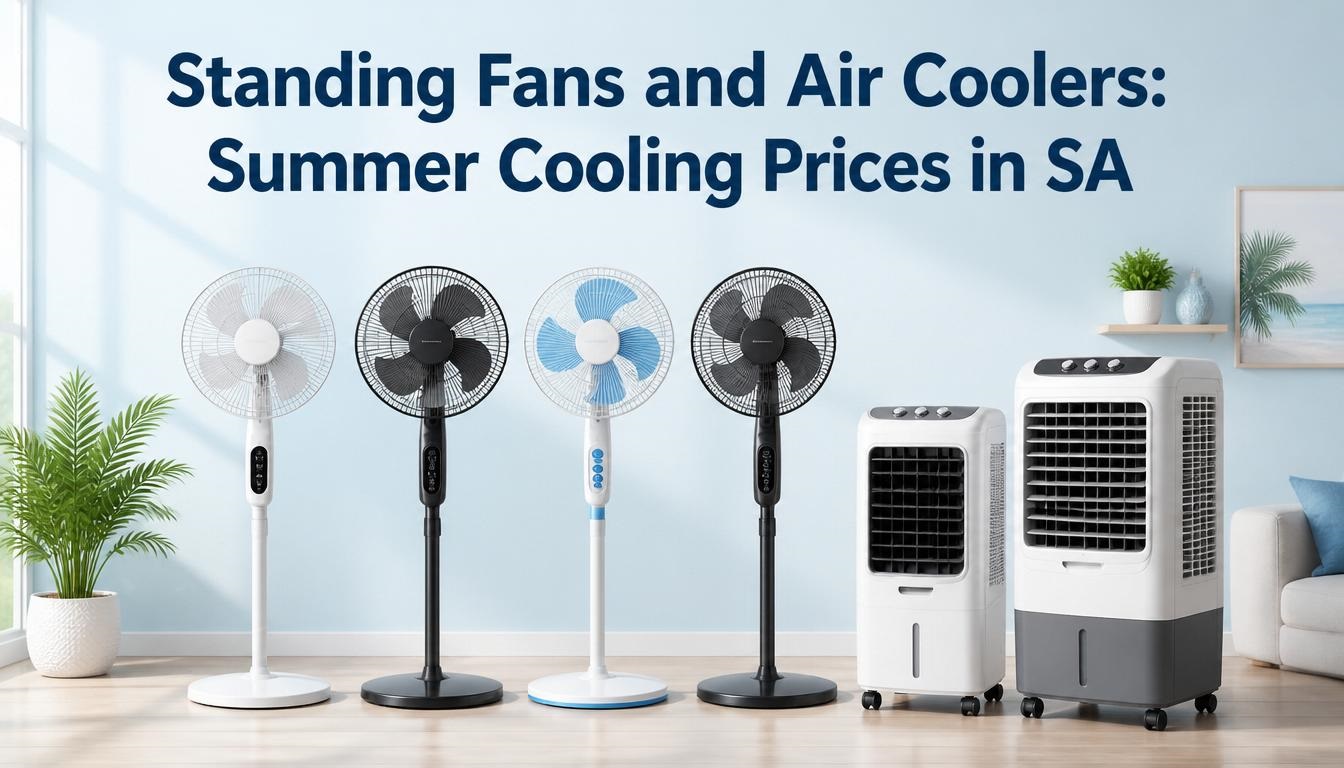
Ultimate South African Summer Cooling Guide: Standing Fans vs. Air Coolers and Exact Pricing
There is nothing quite like a searing Highveld summer afternoon in Johannesburg or a thick, humid heatwave rolling through Durban to make you deeply regret every single life choice that led to you sitting in a room without airflow. As someone who has spent years reviewing everything from high-end mobile tech to heavy-duty domestic appliances across South Africa, I have lived through the absolute agony of load-shedding stages hitting right when the mercury crosses 35 degrees Celsius.
We have all been there: staring blankly at a stagnant ceiling fan that is doing little more than shifting hot air around like an oven convection setting. When the heat turns unbearable, your choice usually boils down to two main budget-friendly paths: picking up a reliable standing fan or investing in an evaporative air cooler. But with Eskom tariffs climbing and household budgets tighter than ever, buying the wrong cooling unit means throwing money straight out of the window. Let us break down the real-world performance, precise current pricing for South Africa, and hidden operational costs so you can make an intelligent choice before the next heat wave strikes.
Understanding South African User Intents: Fans vs. Air Coolers
When South Africans head online to search for cooling solutions, their intent generally splits into two distinct categories based on geography, climate, and wallet size.
If you live in the dry inland regions like Gauteng, Pretoria, or Bloemfontein, your primary enemy is dry, baking heat. This environment is tailor-made for evaporative air coolers, which drop ambient temperatures by introducing moisture into the air. Conversely, if you live along the humid coast of KwaZulu-Natal or parts of the Western Cape, adding moisture via an air cooler will only make your living room feel like a tropical rainforest steam room. In coastal areas, a high-velocity standing fan that keeps air circulating actively is almost always the superior choice.
Key Buyer Intent Factors in SA:
-
Energy Efficiency & Load Shedding Compatibility: Units that draw low wattage (like standard 40W to 60W pedestal fans) can easily run off small backup power stations or inverter trolleys when the grid goes down.
-
Initial Capital Outlay vs. Long-term Value: Consumers want to know if a R1,500 fan will suffice or if a R4,000 air cooler is genuinely worth the extra cash.
-
Noise Levels: Crucial for remote workers taking Zoom calls or parents trying to cool down a baby’s nursery during scorching nights.
Standing Fans in South Africa: Types, Performance, and Current Prices
Standing fans, often called pedestal fans, remain the most popular cooling choice across Mzansi. They are portable, cheap to run, and require zero installation. However, not all standing fans are created equal.
1. Standard Plastic-Blade Pedestal Fans (Entry Level)
These are your classic 40cm to 45cm models found everywhere from Game and Makro to Takealot. Brands like Goldair, Russell Hobbs, and Eurolux dominate this space. They feature three speed settings, oscillation, and adjustable height.
-
Real-World Experience: They move decent air in small-to-medium bedrooms, but budget models can be quite noisy on high speed, often sounding like a small turboprop engine next to your bed.
-
Current Price Range: R450 to R900.
2. High-Velocity Metal Stand Fans and Industrial Units
Built with heavy-duty metal blades and robust copper-wound motors, brands like Alva and various industrial series are designed for larger spaces, open-plan kitchens, or small home offices.
-
Real-World Experience: These units pack a serious punch. If you are working in a stuffy garage or an uninsulated brick room, a metal velocity fan will drop the perceived temperature rapidly through sheer wind-chill factor. Be warned: they pull more power (around 100W to 120W) and can be loud.
-
Current Price Range: R1,100 to R2,200.
Equipped with modern BLDC motors and remote controls, brands like Solent and high-end Eurolux tower options represent the luxury tier of standing fans.
-
Real-World Experience: If you hate white noise and want whisper-quiet operation while sleeping, spending extra on a multi-blade DC motor fan is worth every cent. They offer granular speed controls and use up to 50 percent less electricity than standard AC fans.
-
Current Price Range: R1,300 to R2,800.
Air Coolers in South Africa: How Evaporation Changes the Game
An air cooler is not an air conditioner. It does not use compressors or chemical refrigerants (Freon). Instead, it draws warm air through wet cooling pads, causing water to evaporate and pumping out a crisp, chilled breeze.
What to Expect from Air Coolers:
-
The Climate Catch: They work exceptionally well in dry inland areas (Gauteng, Free State, Limpopo) where relative humidity is low. In Durban, they can increase indoor humidity uncomfortably.
-
Water Management: You have to manually top up water tanks, and adding frozen ice packs (usually provided with units like Milex or Mellerware) significantly boosts cooling performance.
-
Power Consumption: Typically ranging from 60W to 150W, they use a fraction of the electricity required by a portable or split-type air conditioner (which easily consume 1,000W to 2,500W).
Current Air Cooler Price Matrix in South Africa:
-
Compact Personal Coolers (7L to 10L tanks): Ideal for personal space cooling next to a desk or single bed. Brands like Milex retail around R1,190 to R1,999.
-
Medium Room Coolers (15L to 30L tanks): Suitable for living rooms or open-plan kitchens. Expect to pay between R3,500 and R5,000 depending on brand features and ice-compartment design.
Comparative Pricing and Specifications Table
To help you cross-reference features instantly, use the structured data table below outlining average specs, power draws, and current South African retail brackets.
| Cooling Category | Typical Power Draw | Best Suited Climate | Ideal Room Size | Average SA Price Range |
| Standard Pedestal Fan | 45W – 60W | Coastal & Inland | Small to Medium Bedroom | R450 – R950 |
| Industrial / Metal Stand Fan | 100W – 130W | Inland Workshops / Open Plan | Large Rooms / Offices | R1,100 – R2,200 |
| Premium DC Tower Fan | 25W – 50W | Bedrooms / Quiet Spaces | Medium Rooms | R1,200 – R2,800 |
| Personal Air Cooler (7L – 10L) | 65W – 80W | Dry Inland Regions Only | Small Office / Single Bed | R1,200 – R2,000 |
| Room Air Cooler (15L – 30L) | 100W – 150W | Dry Inland Regions Only | Lounge / Open Plan | R3,500 – R5,500 |
Real Expert Advice: Which One Should You Buy?
Having tested numerous cooling appliances during peak summer surges, my personal verdict depends entirely on three parameters: where you live, your tolerance for noise, and your backup power setup during power outages.
-
Go with a Standing Fan if: You live on the coast, you need maximum portability, your budget is under R1,000, or you rely on a modest battery inverter system where every watt counts. If you value low maintenance (no water tanks to clean or algae to scrub), a standard fan wins hands down.
-
Go with an Air Cooler if: You live in a dry inland province, suffer immensely from hot, dry air, and want something that feels significantly colder than a standard fan without paying R10,000+ for a proper split-system air conditioner installation.
Join the Conversation
Navigating South African summers takes a bit of strategy, and every home handles heat differently. Have you ever bought an air cooler only to realize it turned your coastal home into a sauna, or did you find a specific pedestal fan brand that survived years of load-shedding surges?
Drop a comment below with your city, your preferred cooling setup, and any questions you have about specific models. Let us help each other beat the heat this season!

Joseph Mathebula is a consumer analyst and market researcher at Prices in South Africa. He specializes in tracking local service costs, retail pricing, and travel budgets, helping everyday shoppers navigate the market to secure the best value.