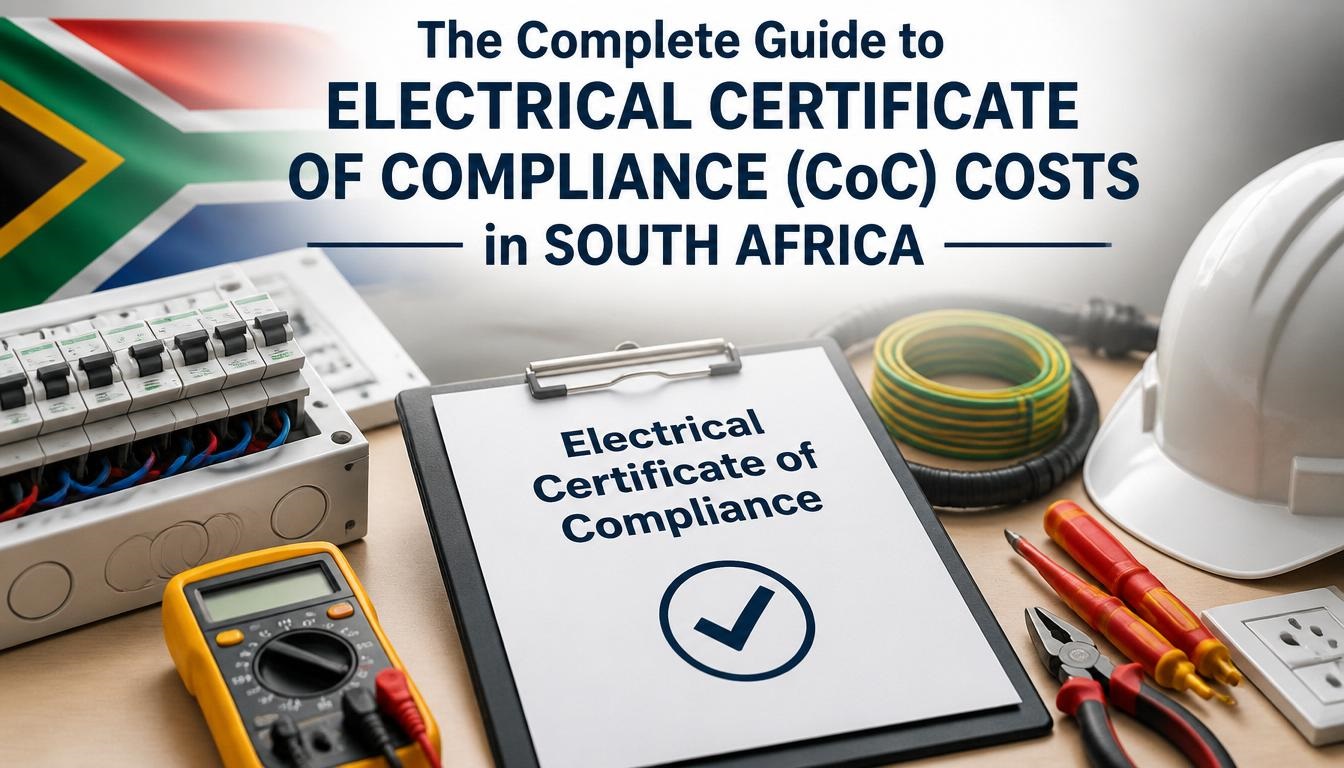
If you have ever bought, sold, or renovated a property in South Africa, you have likely encountered the term Electrical Certificate of Compliance (CoC). On paper, it sounds simple enough: a quick inspection to prove your home’s electrical system won’t shock anyone or catch fire. But when the electrician hands you the final bill, many property owners experience a severe bout of heart palpitation.
Why does one homeowner pay R900 for a CoC while their neighbor gets slapped with an invoice for R12,000?
The secret lies in the distinction between the inspection fee and the remedial repair work required to bring a non-compliant home up to standard. In this comprehensive pricing breakdown, we dive deep into current South African market rates, regional price variations, hidden repair expenses, and legal requirements, giving you the exact figures you need to budget accurately.
What Exactly Is an Electrical CoC and Why Is It Mandatory?
An Electrical Certificate of Compliance is an official, legally binding document verifying that all electrical installations in a building comply with the Occupational Health and Safety Act (OHSA) and the South African National Standards (SANS 10142-1 Wiring Code).
Without a valid CoC:
-
Property Sales Cannot Finalize: Conveyancing attorneys in South Africa will not transfer ownership of a property without a valid, signed-off CoC.
-
Insurance Claims Will Be Repudiated: If an electrical fire or surge damages your property and your CoC is expired or invalid, your short-term insurer can legally reject your claim.
-
Tenant Safety Is Compromised: Landlords are legally required under the Rental Housing Act to ensure that their rental properties maintain a safe electrical infrastructure throughout the tenancy.
Breakdown of Basic CoC Costs in South Africa
When budgeting for a CoC, you must divide your expenses into two distinct categories:
-
The Base Inspection Fee: The initial fee paid to a registered electrical contractor to conduct physical testing, hot-and-cold wiring checks, distribution board (DB) testing, and Earth Leakage verification.
-
Remedial Repairs: The cost of fixing non-compliant wiring, replacing faulty components, or upgrading illegal modifications.
Base Inspection Rates
For an issue-free property, the base inspection and certificate issuance fee typically ranges from R850 to R1,800. However, if the inspection reveals safety violations, you must pay for repairs before the electrician can lawfully issue the certificate.
| Property Type | Estimated Size | Base Inspection Fee | Average Total Cost (No Major Faults) |
| Studio / 1-Bedroom Flat | Under 60 m² | R700 – R900 | R700 – R1,100 |
| Standard 3-Bedroom House | 120 – 250 m² | R850 – R1,200 | R1,200 – R2,500 |
| Large / Multi-Story Home | 250 m² + (Multiple DBs) | R1,200 – R2,500 | R2,500 – R5,500 |
| Commercial / Industrial | Various | R1,600 – R3,500+ | R3,500 – R12,000+ |
Regional Price Variations Across South Africa
Labor rates and contractor competition vary significantly depending on where you live in South Africa. Metro areas with higher living costs, like Johannesburg Northern Suburbs or Cape Town Southern Suburbs, tend to sit on the higher end of the scale.
| Region / City | Base Call-Out / Inspection Fee | Standard Electrician Hourly Rate | Average CoC Total (Minor Repairs) |
| Johannesburg / Sandton | R850 – R1,200 | R550 – R750/hr | R1,500 – R3,500 |
| Pretoria / Centurion | R800 – R1,100 | R500 – R700/hr | R1,400 – R3,200 |
| Cape Town / Winelands | R900 – R1,300 | R600 – R850/hr | R1,800 – R4,000 |
| Durban / Kwazulu-Natal Coast | R750 – R1,050 | R450 – R650/hr | R1,300 – R3,000 |
| Rural / Outlying Towns | R950 – R1,500 (incl. travel) | R400 – R600/hr | R1,500 – R3,800 |
If an electrician conducts an inspection and finds zero faults, count yourself among the lucky few. In reality, roughly 70% to 80% of existing South African homes fail their initial CoC inspection, usually due to DIY electrical work, aged insulation, missing earth wires, or unbonded plumbing pipes.
Below is a cost comparison of the most common repairs required to clear a CoC inspection in South Africa:
| Common Remedial Work Item | Average Parts & Labour Cost | Why It Fails Compliance |
| Earth Leakage Replacement | R850 – R1,400 | The existing unit fails the trip test or is non-functional. |
| Replacing Light Switches / Sockets | R350 – R600 per point | Cracks, exposed wiring, ungrounded metal faceplates, or missing covers. |
| Geyser Earth Bonding & Isolator | R650 – R1,200 | Copper pipes are unbonded or missing a dedicated double-pole isolator switch within 1.5m. |
| Installing Distribution Board Covers / Blanks | R250 – R450 | Exposed live busbars inside the DB board present a direct shock hazard. |
| Light Fixture Earthing Upgrade | R500 – R1,500 | Metal light fittings mounted without proper earthing wires connected. |
| Rewiring Compromised Circuits | R1,500 – R6,000+ | Melted wires, DIY extension wiring inside roof spaces, or open junction boxes. |
Solar, Inverters, and Electric Fences: Supplementary CoCs
Modern South African homes frequently incorporate back-up power solutions and security systems. However, a standard house CoC does not automatically cover all auxiliary systems.
1. Solar & Inverter Systems (SANS 10142-1-2)
If you have an hybrid inverter, battery storage, or roof-mounted solar panels, they require a specific Solar / Embedded Generation CoC.
-
Cost: R1,500 to R3,500 for the inspection and supplemental certificate alone.
-
Key Requirements: Proper surge protection, DC isolators, dedicated changeover switches, and compliant earthing arrangement for solar panel frames.
2. Electric Fencing (SANS 10222-3)
By law, an Electric Fence Compliance Certificate (EFCOC) is separate from your main home electrical CoC.
-
Base Inspection & Certificate Cost: R550 to R850.
-
Common Repairs: Warning signs missing, earth spikes insufficient, or fence wire shorting against foliage or wall tops.
How to Avoid “CoC Scams” and Fake Certificates
Due to the cost pressures associated with property transfers, a dangerous grey market has emerged in South Africa: contractors offering “cheap R300 CoC certificates” without conducting a thorough physical inspection.
Danger Flags to Watch For:
-
The 15-Minute “Drive-By” Inspection: A legitimate residential inspection takes between 1 to 3 hours depending on property size. Anyone claiming to inspect a 3-bedroom house in 15 minutes is cutting corners illegal under OHSA guidelines.
-
Unregistered Contractors: Always demand to see the electrician’s Department of Employment and Labour (DoL) Registration Card. They must be registered as a Single Phase Tester, Installation Electrician, or Master Installation Electrician.
-
Refusing Itemized Repair Quotes: If an electrician informs you that your property failed compliance, they are obligated to provide a detailed report outlining which specific SANS code clauses were breached, along with an itemized breakdown for repairs. You are legally permitted to hire a different registered electrician to carry out the remedial work if the initial quote feels inflated.
Who Pays for the CoC in Property Sales?
In standard South African Deed of Sale agreements, the seller is responsible for arranging and paying for the CoC inspection and any necessary remedial repairs required to achieve compliance.
However, contractual terms can be negotiated. Buyers purchasing properties “voetstoots” or under specialized commercial agreements can contractually take on the financial responsibility for the CoC, provided both parties explicitly agree in writing.
How Long Is an Electrical CoC Valid?
-
For Property Transfers: An Electrical CoC must not be older than 2 years at the time of property transfer, provided that no alterations or additions have been made to the system during that period.
-
If Modifications Occurred: If you install a new air conditioner, replace a DB board, or add extra plug points, a new supplemental CoC must be issued specifically covering those modifications.
Community Discussion: What Has Been Your Experience?
CoC pricing remains one of the most debated topics among South African homeowners, buyers, and property investors.
Have you recently undergone an electrical CoC inspection in South Africa? What was your initial quote versus the final price after repairs? Drop your thoughts, questions, and contractor experiences in the comments below to help fellow homeowners navigate the process!

Joseph Mathebula is a consumer analyst and market researcher at Prices in South Africa. He specializes in tracking local service costs, retail pricing, and travel budgets, helping everyday shoppers navigate the market to secure the best value.