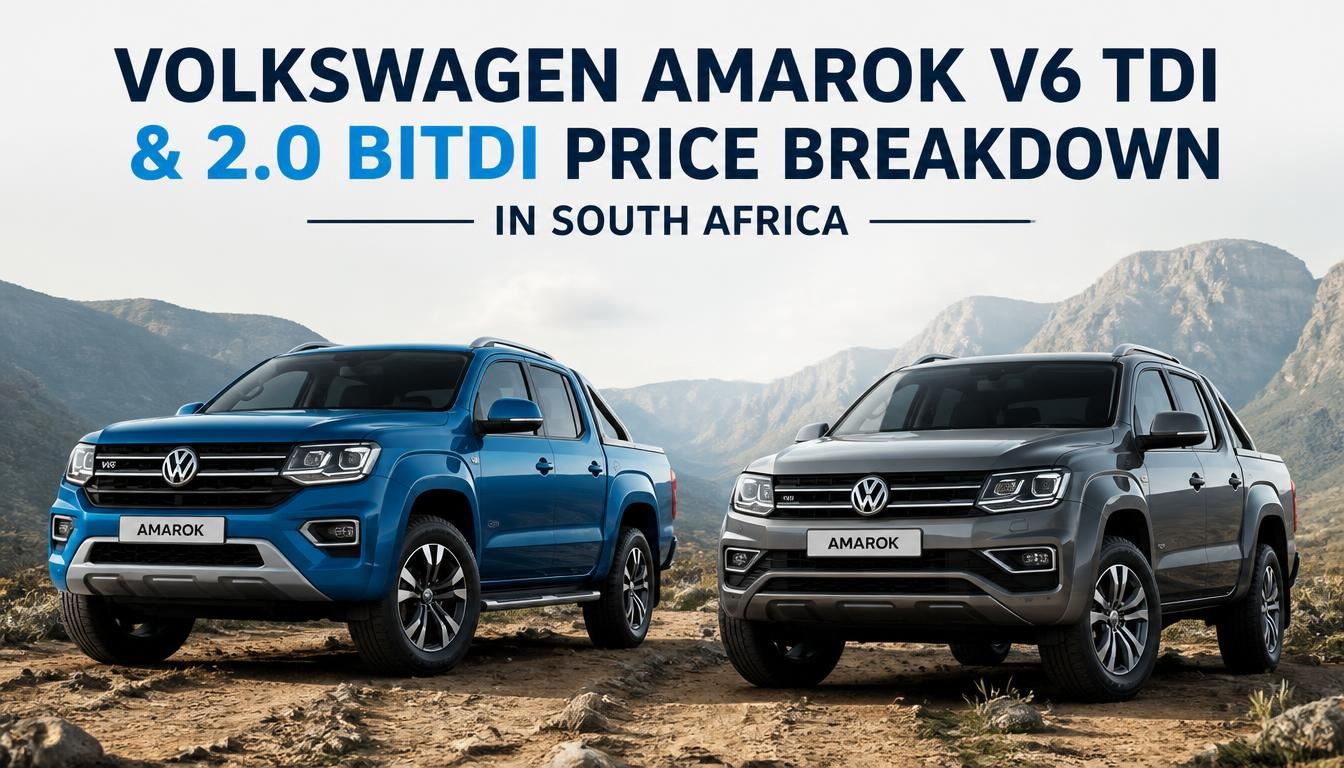
Current Market Rate: R596,800 – R1,259,700 (Variant & Trim Dependent)
Primary Powerplant Options: 2.0 BiTDI (154 kW / 500 Nm) & 3.0 V6 TDI (184 kW / 600 Nm)
Top Commercial & Leisure Sectors: Executive Fleet Management, Agriculture, Mining Operations, Heavy Towing Logistics
Vehicle Advisory Recommendation: Highline, Style, and PanAmericana derivatives hold the strongest residual value in the South African pre-owned market.
Vehicle Overview & Market Positioning
The Volkswagen Amarok remains one of South Africa’s most prominent double-cab bakkies, catering to both heavy commercial work requirements and luxury leisure travel. Built locally at Ford’s Silverton assembly plant following the global platform-sharing agreement between Volkswagen and Ford Motor Company, the second-generation Amarok delivers refined German interior styling paired with rugged utility capabilities.
Buyers in South Africa generally evaluate the double-cab range around two core diesel engine architectures: the efficient 2.0-litre BiTDI (twin-turbocharged four-cylinder) and the high-output 3.0-litre V6 TDI. Understanding the total cost of acquisition, trim variations, transmission choices, and performance trade-offs is essential for both individual buyers and fleet managers seeking optimal total cost of ownership (TCO).
| Derivative Category | Engine & Transmission | Power / Torque Output | Target Application |
| Base Workhorse | 2.0 TDI 6-Speed Manual / 10-Speed Auto | 110 kW – 125 kW / 350 – 405 Nm | Agriculture, Light Freight, Commercial Fleets |
| Mid-Tier All-Rounder (BiTDI) | 2.0 BiTDI 10-Speed Automatic 4Motion | 154 kW / 500 Nm | Site Management, Family Towing, Mixed Travel |
| Premium Performance (V6 TDI) | 3.0 V6 TDI 10-Speed Automatic 4Motion | 184 kW / 600 Nm | Heavy Towing, Long-Distance Touring, Executive |
2026 Volkswagen Amarok Official Pricing Structure
The Volkswagen Amarok lineup spans single-cab workhorses through to high-spec double-cab derivatives like the Dark Label, PanAmericana, and flagship Aventura. Below are the official retail prices across the 2026 South African range.
| Amarok Derivative & Trim | Drivetrain Configuration | Recommended Retail Price (ZAR) |
| Amarok Single Cab 2.0 TDI 6MT | 4×2 Rear-Wheel Drive | R596,800 |
| Amarok Single Cab 2.0 TDI 4Motion 6MT | Selectable 4WD | R669,800 |
| Amarok Double Cab 2.0 TDI 6MT | 4×2 Rear-Wheel Drive | R673,700 |
| Amarok Double Cab 2.0 TDI 10AT | 4×2 Rear-Wheel Drive | R693,800 |
| Amarok Double Cab Life 2.0 TDI 10AT | 4×2 Rear-Wheel Drive | R708,900 |
| Amarok Double Cab 2.0 TDI 4Motion 6MT | Selectable 4WD | R747,000 |
| Amarok Double Cab 2.0 TDI 4Motion 10AT | Selectable 4WD | R772,100 |
| Amarok Double Cab Life 2.0 TDI 4Motion 10AT | Selectable 4WD | R805,800 |
| Amarok Double Cab Style 2.0 BiTDI 4Motion 10AT | Permanent 4Motion 4WD | R902,000 |
| Amarok Double Cab Dark Label 2.0 BiTDI 4Motion 10AT | Permanent 4Motion 4WD | R937,200 |
| Amarok Double Cab Style 3.0 V6 TDI 4Motion 10AT | Permanent 4Motion 4WD | R1,083,000 |
| Amarok Double Cab Dark Label 3.0 V6 TDI 4Motion 10AT | Permanent 4Motion 4WD | R1,118,200 |
| Amarok Double Cab PanAmericana 3.0 V6 TDI 4Motion 10AT | Permanent 4Motion 4WD | R1,198,000 |
| Amarok Double Cab Aventura 3.0 V6 TDI 4Motion 10AT | Permanent 4Motion 4WD | R1,259,700 |
Technical Specifications & Engine Performance Comparison
Choosing between the twin-turbo 2.0-litre four-cylinder and the 3.0-litre V6 single-turbo diesel involves balancing upfront purchase price, fuel consumption, and required towing capability.
-
2.0 BiTDI (154 kW / 500 Nm): Focused on fuel efficiency, achieving an average 7.5 L/100 km combined cycle. Offers lower monthly maintenance costs, making it ideal for commercial fleets and daily commuter travel.
-
3.0 V6 TDI (184 kW / 600 Nm): Focused on maximum towing and heavy load capability, achieving an average 8.4 L/100 km combined cycle. Provides effortless overtaking power and comes integrated with premium luxury trim packages.
2.0 BiTDI Engine Dynamics
The 2.0-litre twin-turbo diesel produces 154 kW of power and 500 Nm of torque. Paired exclusively with the 10-speed automatic transmission, it manages gear changes smoothly across urban traffic and highway cruising. Twin sequential turbocharging eliminates turbo lag at lower RPMs, providing immediate low-end torque.
Fuel consumption on the 2.0 BiTDI averages 7.5 to 7.9 litres per 100 km in mixed driving cycles, making it a viable long-term option for owners watching running costs.
3.0 V6 TDI Engine Dynamics
The flagship 3.0-litre V6 turbodiesel delivers 184 kW at 3,250 RPM and 600 Nm of torque between 1,750 and 2,250 RPM. This engine is suited for heavy-duty applications, such as towing trailers, boats, or horseboxes up to the 3,500 kg maximum braked towing limit.
While fuel consumption rises to approximately 8.4 to 9.2 litres per 100 km, the V6 provides superior refined power delivery, reduced engine noise under load, and strong hill-climbing capability under full payload.
Fleet Operational Costs & 2026 Maintenance Frameworks
When acquiring an Amarok for commercial or private use in South Africa, secondary ownership costs heavily influence total expenditure.
Warranty & Service Plan Coverage
Every new Volkswagen Amarok sold in South Africa includes standard factory back-up:
-
Service Plan: 5-year / 100,000 km corporate service plan (covers routine maintenance items such as filters, lubricants, spark plugs, and fluid flushes).
-
Warranty: 4-year / 120,000 km mechanical warranty against manufacturing defects.
-
Anti-Corrosion Warranty: 12-year anti-perforation warranty.
-
Service Intervals: 15,000 km or 12 months (whichever occurs first).
Tyres and Wear-and-Tear Considerations
Higher trim levels like the Style, PanAmericana, and Aventura come fitted with 18-inch, 20-inch, or 21-inch alloy wheels. High-profile 18-inch wheels on the Life and Style trims offer lower replacement tyre costs (approximately R3,200 – R4,500 per tyre) and better absorption on gravel roads compared to 21-inch low-profile options on the Aventura (costing up to R5,800 – R7,200 per tyre).
Key Industry Sectors Driving Amarok Demand in South Africa
The Amarok operates across distinct commercial and consumer sectors in the South African economy:
-
Agricultural Operations & Estate Management: Farms in the Western Cape, Free State, and Mpumalanga utilize the 2.0 TDI and BiTDI 4Motion models for daily site transit, farm inspections, and light haulage due to lower fuel consumption.
-
Civil Engineering & Mining Contracting: Construction firms deploy the 2.0 BiTDI Style and Life 4Motion variants for site managers who need rough-terrain capability combined with a mobile office setup.
-
Leisure, Caravanning & Overland Travel: Private buyers consistently choose the 3.0 V6 TDI PanAmericana and Aventura for long-distance cross-border trips into Namibia, Botswana, and Mozambique, relying on the 80-litre fuel tank and 3.5-tonne towing capacity.
Strategic Purchasing & Financing Guidance for 2026 Buyers
Estimating Monthly Installments
When financing a vehicle in South Africa through major banking institutions (e.g., VW Financial Services, ABSA, WesBank, Standard Bank, Nedbank), key financial factors apply:
-
Interest Rate Benchmark: Prime Lending Rate (~11.75% base rate assumption).
-
Repayment Term: Standard 72-month contract.
-
Deposit: 10% cash down-payment recommended to avoid balloon payments.
Sample Monthly Repayment Calculations:
-
Amarok 2.0 BiTDI Style 4Motion (R902,000): With a 10% deposit (R90,200) at prime interest over 72 months, monthly payments average R15,100 – R16,200 per month (excluding mandatory comprehensive insurance).
-
Amarok 3.0 V6 TDI PanAmericana (R1,198,000): With a 10% deposit (R119,800) at prime interest over 72 months, monthly payments average R20,200 – R21,800 per month.
Insurance and Tracking Requirements
Due to high risk profiles for double-cab bakkies in South Africa, insurers mandate the installation of an approved, active VESA-certified tracking device (e.g., Tracker, Matrix, Cartrack) prior to delivery. Comprehensive monthly insurance premiums range from R1,800 to R3,800 depending on the driver’s risk profile, location, and storage security.
Frequently Asked Questions
What is the difference between the 2.0 BiTDI and the 3.0 V6 TDI Amarok?
The 2.0 BiTDI uses a 2.0-litre twin-turbocharged 4-cylinder engine generating 154 kW and 500 Nm, focusing on fuel economy. The 3.0 V6 TDI uses a single-turbo V6 engine producing 184 kW and 600 Nm, designed for heavy towing and maximum power output.
What is the towing capacity of the Volkswagen Amarok?
All 2.0 BiTDI and 3.0 V6 TDI 4Motion automatic derivatives feature a maximum braked towing capacity of 3,500 kg, alongside a towbar rating suitable for heavy caravans, utility trailers, and boat trailers.
Where is the Volkswagen Amarok manufactured for the South African market?
The second-generation Volkswagen Amarok sold in South Africa is produced locally at the Silverton Assembly Plant in Pretoria, Gauteng, alongside its platform relative, the Ford Ranger.
Does the Volkswagen Amarok 3.0 V6 use a lot of fuel?
The 3.0 V6 TDI has a claimed combined fuel consumption of 8.4 L/100 km. In real-world South African conditions (urban driving and highway cruising), average fuel usage typically ranges between 8.8 L/100 km and 10.2 L/100 km.
Which Amarok derivative holds the best resale value in South Africa?
Mid-to-high spec models featuring 4Motion all-wheel drive—specifically the 2.0 BiTDI Style and 3.0 V6 TDI PanAmericana—retain the highest trade-in and resale values on local pre-owned vehicle platforms.
Disclaimer: Salary figures, job requirements, vehicle pricing, and hiring indicators listed in this guide reflect real-world market averages and verified employer/manufacturer data at the time of publication. Actual compensation and vehicle retail prices may vary based on geographic location, candidate experience, dealer accessory fitment, and individual contract or vehicle finance negotiations. Always verify specific terms directly with the recruiting employer, authorized dealership, or official portal.
Evaluating the choice between the 2.0 BiTDI and 3.0 V6 TDI comes down to balancing upfront acquisition cost against your regular towing requirements. If you manage a commercial fleet or drive long daily commutes, the twin-turbo 2.0-litre engine provides a solid middle ground for fuel savings and everyday power. On the other hand, if you regularly tow heavy loads or travel long distances fully loaded, the extra power of the 3.0 V6 TDI makes the higher purchase price worthwhile over time.
What are your thoughts on the current Amarok range pricing? Have you driven both the 2.0 BiTDI and the V6 engine options? Share your driving experiences, ownership feedback, or questions about vehicle financing in the comments below!

Joseph Mathebula is a consumer analyst and market researcher at Prices in South Africa. He specializes in tracking local service costs, retail pricing, and travel budgets, helping everyday shoppers navigate the market to secure the best value.