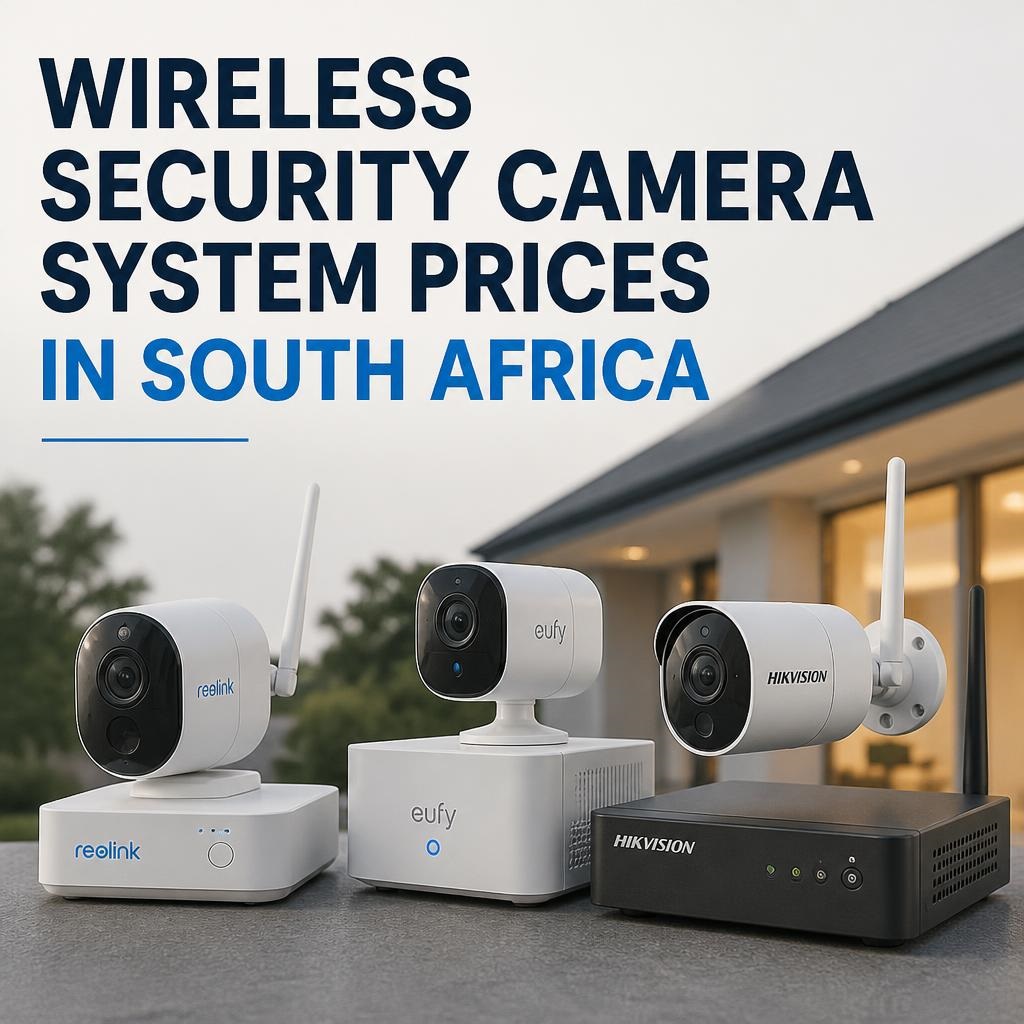
Between skyrocketing municipal suburban crime stats and escalating retail markups, protecting your home or business without overpaying has become a massive headache for South Africans. Buying a wireless security camera system isn’t just about picking a box off the shelf at Makro—it means calculating solar backup requirements, local cloud subscription costs, and whether your Wi-Fi will actually penetrate double-brick walls.
Quick-Answer Pricing Summary:
Retail Price Comparison: Popular Wireless Camera Brands in SA
Prices reflect local retail figures inclusive of 15% VAT. Shipping costs vary depending on whether you use direct delivery via Courier Guy, Pargo pickup points, or store click-and-collect.
| Brand & System Model | Current ZAR (R) Price | In Stock / Delivery Fee | VAT Included? | Overall Value | Direct Retailer Link |
| Eufy C220 2K Pan & Tilt (Indoor) | R699 – R899 | Stocked; Standard courier / Free over threshold | Yes (15%) | 4.8 / 5 | Builders – View Deal |
| Reolink Outdoor 4K / 5MP IP (Single) | R1,200 – R2,825 | Stocked; Store collect or delivery | Yes (15%) | 4.6 / 5 | Makro – View Deal |
| Eufy SoloCam S220 / S340 (Solar Wireless) | R1,495 – R3,995 | Stocked; Nationwide door-to-door courier | Yes (15%) | 4.9 / 5 | Takealot – View Deal |
| Eufy eufyCam 4-Cam Professional Kit | R6,995 – R7,995 | Specialized stock; Direct courier | Yes (15%) | 4.7 / 5 | Takealot – View Deal |
| Hikvision AcuSense 8-Ch Smart IP Kit | R17,999 – R19,999 | Heavy freight/Installer delivery | Yes (15%) | 4.4 / 5 | Makro – View Deal |
Note: Pricing subject to store promos, eBucks discounts, and Rand-Dollar exchange fluctuations.
Brand Breakdown: Reolink vs. Eufy vs. Hikvision
1. Eufy Security: The Subscription-Free Favorite
Eufy has captured a massive share of the South African DIY home security market for one primary reason: zero mandatory monthly cloud fees.
-
The Local Advantage: Most Eufy standalone solar units (like the SoloCam S220) or multi-camera kits come with local storage built directly into the camera or the HomeBase 3 hub.
-
Load-Shedding Fitness: Eufy’s integrated solar panels keep the internal lithium batteries topped up without needing external 220V plug points. As long as your Wi-Fi router is on a small mini-UPS, your security perimeter stays fully online during grid outages.
-
Pricing Expectation: Single solar cams start around R1,495 to R3,995, while full 4-camera HomeBase kits range from R6,995 to R11,000+.
2. Reolink: The Power-User Budget King
Reolink strikes an exceptional balance between high-end feature sets (4K optics, dual-lens zoom, local NVR integration) and aggressive pricing.
-
The Local Advantage: Reolink offers dedicated 4G LTE battery-powered models alongside standard Wi-Fi models—ideal for remote plot owners or small holdings where Wi-Fi range falls short. They support high-capacity MicroSD cards for local recording without forcing cloud accounts.
-
Load-Shedding Fitness: Excellent stand-alone solar panel add-ons. Their Wi-Fi range is strong, but thick double-brick walls (common in older SA suburban builds) may require a mesh Wi-Fi booster or powerline adapter.
-
Pricing Expectation: Wi-Fi/Solar standalone units sit comfortably between R1,200 and R3,200, making them significantly cheaper than comparable Eufy or Arlo setups.
3. Hikvision: The Commercial-Grade Heavyweight
Hikvision remains the gold standard for dedicated security installers, armed response integrations, and business premises.
-
The Local Advantage: Hikvision’s AcuSense and ColorVu technologies offer unparalleled night vision and AI human/vehicle discrimination. Most armed response companies in SA natively integrate with Hikvision DVR/NVR streams.
-
Load-Shedding Fitness: Standard Hikvision systems are hardwired (PoE or coaxial). They are not wireless in terms of power and require a dedicated inverter or battery backup system to run during power cuts.
-
Pricing Expectation: Full 4-to-8 channel AcuSense IP camera kits with NVRs run between R7,999 and R19,999+ excluding installation hardware and cable runs.
Buying the camera kit is only step one. To avoid unexpected hits to your budget, account for these frequently overlooked extras:
-
Cloud Subscriptions vs. Local Storage: Brands like Ring or Arlo require ongoing USD-denominated cloud subscriptions that quickly get expensive with Rand volatility. Eufy and Reolink save you thousands per year by prioritizing MicroSD or local HomeBase storage.
-
Router Backup Systems: A wireless camera cannot alert your phone if your Fibre ONT or Wi-Fi router drops power during stage 2 to 6 load-shedding. Budget R800 to R1,500 for a dedicated 12V mini-UPS (e.g., Ultralan, Gizzu, or Skey) to power your router continuously.
-
High-End MicroSD Cards: Don’t buy cheap dashcam-grade SD cards. Security cameras write continuously over older footage. Always opt for “High Endurance” MicroSD cards (Sandisk High Endurance or Samsung PRO Endurance) costing roughly R250 to R550 per 128GB/256GB card.
-
Installation & Mounting Hardware: While DIY battery cams only need two screws, mounting onto facebrick or concrete lintels requires a decent masonry drill bit, weather-rated junction boxes (roughly R45 to R80 each at Builders – View Supplies), and UV-resistant conduit if running backup power.
How to Save Money on Wireless Cams in SA
-
Leverage Retail Loyalty & Rewards: Check if you can clear your cart using eBucks on Takealot, Discovery Miles, or store rewards like Makro mCard. Purchasing high-ticket camera kits during bonus-earn promotions effectively trims 10% to 15% off the effective retail price.
-
Buy During Payday & Major Sales Cycles: Security camera pricing drops dramatically during quarterly retail events, particularly Black Friday, Cyber Monday, and Payday Deals late in the month.
-
Payment Splitting Options: If buying a multi-camera setup for R8,000+, major local retailers support interest-free installment options like PayFlex, PayJustNow, or Mobicred, allowing you to split payments across 3 to 4 months without extra finance charges.
South African Consumer Rights & Warranties
When purchasing security tech locally, ensure you are protected under the Consumer Protection Act (CPA):
-
1-to-2 Year Local Warranties: Always buy through official SA distributors or authorized stores like Takealot, Makro, or Builders to ensure a valid 12-to-24 month local repair/replacement warranty. Direct gray imports off international sites might be cheaper upfront, but returning a defective camera overseas will cost a fortune in courier fees and import taxes.
-
6-Month CPA Default Rule: Under the CPA, if your camera suffers a material manufacturing defect within the first 6 months, you have the legal right to insist on a repair, replacement, or full refund.
Frequently Asked Questions
Do solar wireless cameras work during prolonged cloudy days or Cape winters?
Yes, quality solar cameras (like the Eufy SoloCam or Reolink Solar models) only require about 1.5 to 2 hours of direct sunlight daily to maintain operating charge. Internal batteries are rated to run for 30 to 90 days on a single full charge even if sunlight is completely obstructed.
Will wireless cameras work without an internet connection?
Local recording to an NVR or MicroSD card will continue uninterrupted even if your Fibre/LTE internet drops out. However, you will not receive real-time push notifications or live remote app streaming until your router’s internet connection recovers.
What is the difference between “Wire-Free” and “Wireless”?
“Wire-Free” means the camera operates on internal battery/solar power with zero physical cords attached. “Wireless” usually means the camera transmits video over Wi-Fi, but still requires a continuous 12V or 220V power cord plugged into an electrical socket.
Join the SA Security Discussion
Have you recently installed a Eufy, Reolink, or Hikvision wireless camera system around your property? Share your local pricing finds, stock availability alerts, or signal range tips in the comments below!
Disclaimer: Prices fluctuate and reflect independent market research at the time of publication. We may earn a small affiliate commission through retailer links at no extra cost to you.

Joseph Mathebula is a consumer analyst and market researcher at Prices in South Africa. He specializes in tracking local service costs, retail pricing, and travel budgets, helping everyday shoppers navigate the market to secure the best value.