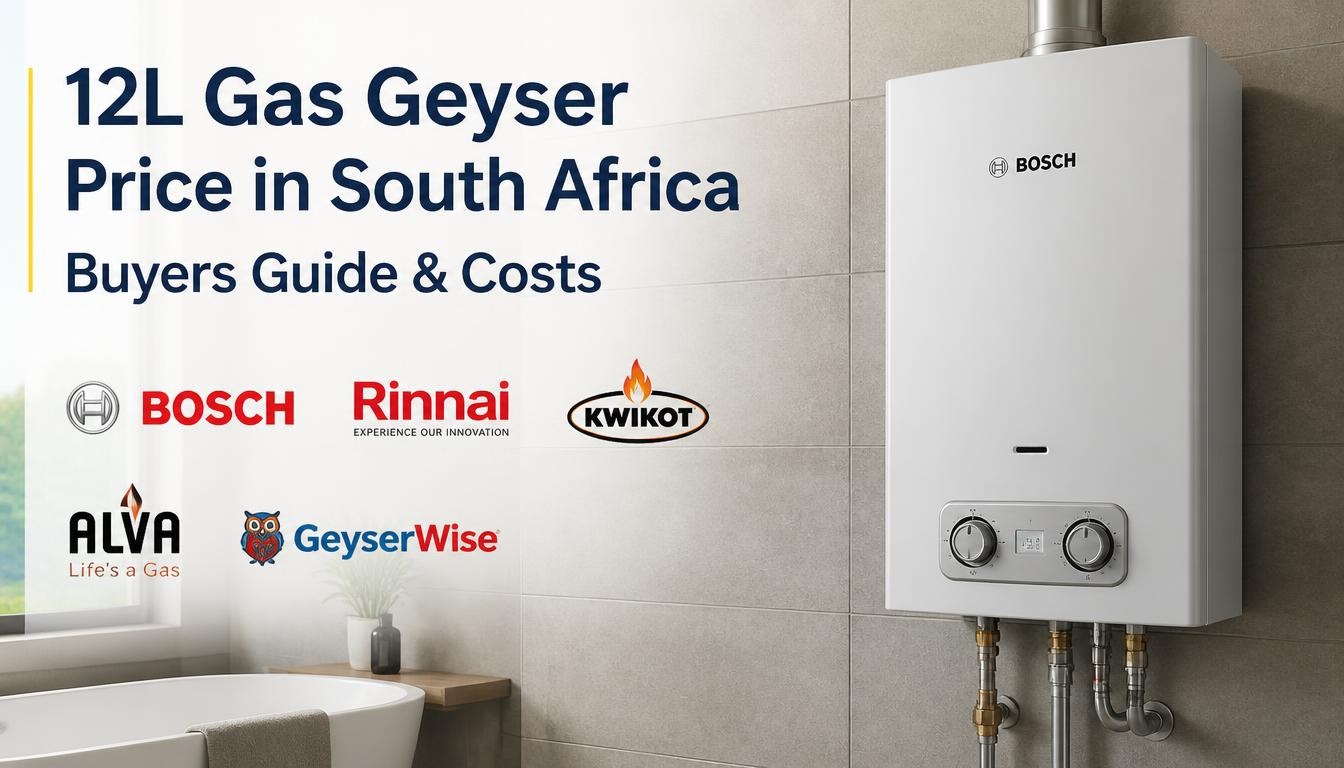
Switching to gas water heating has become one of the most practical financial upgrades for South African households looking to reduce monthly electricity bills and avoid load-shedding disruptions.
In South Africa, the average price of a 12L gas geyser ranges between R3,800 and R8,500+. Prices vary based on ignition type (battery ignition vs. fan-forced/forced-draft), water pressure capability, and brand features.
A 12-litre (12L) gas geyser delivers 12 litres of hot water per minute. This capacity is ideal for running one full shower or bathroom simultaneously with a kitchen sink, making it the most popular size for 2-to-3-bedroom homes and townhouses across SA.
Key Takeaways:
-
Unit Cost: R3,800 – R8,500+ (depending on low-pressure vs. electronic fan-forced models).
-
Professional Installation & CoC: R2,500 – R5,500 for labor, piping, and compliance certification.
-
Accessories & Cylinders: R3,000 – R5,000 (19kg gas bottle, regulator, cage, and copper piping).
-
Ideal Capacity: 1 Shower + 1 Kitchen Sink simultaneously.
12L Gas Geyser Comparative Price Guide (2026 Retail Averages)
Prices differ depending on whether you purchase from major retailers like Builders, Takealot, or specialized gas and solar distributors.
| Brand & Model Type | Estimated Price Range (ZAR) | Best Suited For |
| Zero 12L Standard LPG (Battery) | R3,800 – R4,200 | Budget-conscious buyers, basic off-grid setups |
| Alva 12L Low-Pressure Water Heater | R4,200 – R4,600 | Gravity-fed tanks, farmsteads, low water pressure areas |
| Totai 12L Standard Gas Geyser | R4,500 – R5,200 | Standard outdoor wall-mounted household setups |
| Dewhot 12L Eco-Flow (Low/High Pressure) | R4,800 – R5,800 | High efficiency, compatible with mixer taps & fluctuating pressure |
| Dewhot 12L Constant Temperature (Type B/D) | R6,100 – R6,900 | Precise temperature control, stable shower warmth |
| Totai / Dewhot 12L Fan-Forced (Indoor/Outdoor) | R7,200 – R8,500 | Indoor installations, high-spec modern homes, solar backup |
| Bosch / Rinnai High-Spec 12L Units | R8,500 – R12,000+ | Premium electronic water heaters with high energy ratings |
Low-Pressure vs. Fan-Forced 12L Geysers: What Is the Difference?
Understanding the technical category of geyser you need prevents wasted installation costs.
Standard / Low-Pressure Gas Geysers (R3,800 – R5,800)
-
How they work: Powered by standard D-cell batteries for ignition. They use natural water flow to ignite the gas burner.
-
Best used for: Outdoor wall installations, rural properties, gravity-fed water tanks, or municipal water connections.
-
Pros: Works 100% independently of Eskom electricity. Lower purchase price.
-
Cons: Sensitive to fluctuating municipal water pressure and cold winter winds if not fitted with a proper weather cover.
Fan-Forced / Constant Temperature Geysers (R7,000 – R8,500+)
-
How they work: Built with a micro-computer and an internal electric fan that controls the gas-to-air ratio for precise water temperature delivery.
-
Best used for: Complex indoor pipe routes, modern mixer taps, or systems paired with backup solar/UPS power.
-
Pros: Highly fuel-efficient, unaffected by wind, maintains exact water temperatures regardless of flow rate.
-
Cons: Requires a 220V power connection (plugged into a wall socket, solar inverter, or UPS) to power the internal fan and ignition board.
The price tag on the geyser box only accounts for part of your total investment. Under SANS 10087-1 regulations, gas geysers must be installed by a registered LPGas practitioner to issue a valid Certificate of Conformity (CoC).
-
Professional Labor & Fitting: R2,500 – R5,500 depending on pipe distances, drilling requirements, and site complexity.
-
Certificate of Compliance (CoC): R300 – R600 (often included in certified installers’ package quotes).
-
19kg LPG Gas Cylinder: R2,200 – R2,800 (Initial deposit + gas fill).
-
48kg LPG Gas Cylinder: R4,200 – R5,500 (Recommended for larger households).
-
Installation Hardware Kit: R1,500 – R3,000 (Pigtail hoses, high-capacity LPG regulator, copper piping, shut-off valves, and weather hood/cage).
Total Installed Cost Expectation: Expect a complete end-to-end setup (Geyser + Gas Bottle + Installation Hardware + CoC) to cost between R9,500 and R16,500.
Running Costs & Electricity Savings
Electric geysers account for roughly 30% to 50% of a South African household’s monthly Eskom bill.
A 12L gas geyser consumes approximately 1.6 kg to 1.8 kg of LPG per hour at full continuous burner capacity. However, because gas geysers only heat water instantly when a tap is opened (unlike electric geysers that heat a storage tank all day), actual usage is much lower.
-
Average Household Gas Consumption: A standard family of 3 to 4 using a 12L gas geyser for daily showers and dishwashing typically consumes one 19kg gas cylinder every 5 to 7 weeks.
-
Financial Payback Period: At current electricity tariffs, most South African households recoup their initial gas geyser installation investment within 14 to 22 months through electricity savings.
Frequently Asked Questions (FAQs)
How many taps can a 12L gas geyser run at once?
A 12L gas geyser can comfortably supply one full-flow shower or bath at a time, or one shower plus a kitchen sink running simultaneously. Opening a second shower while the first is running will reduce water pressure and temperature.
Do I need a CoC for a gas geyser installation in South Africa?
Yes. Under South African law, all permanent gas installations must be performed by a registered SAQCC Gas installer who must issue a Certificate of Conformity (CoC). Without a valid CoC, home insurance providers can reject building or fire damage claims.
How long does a 19kg gas bottle last on a 12L geyser?
A 19kg gas bottle provides approximately 10 to 12 hours of continuous burner time. For an average family taking daily 8-minute showers, a 19kg bottle lasts between 4 and 7 weeks.
Can a 12L gas geyser work during load-shedding?
Standard battery-ignited 12L gas geysers run on two D-cell batteries and work during power outages. Fan-forced/forced-draft models require a small amount of electricity to power the fan and digital thermostat, requiring a small solar system, UPS, or inverter during load-shedding.
Disclaimer: Prices listed in this guide are estimations based on average South African retail and installation rates. Actual costs may vary depending on retailer promotions, geographic location, fuel price fluctuations, and site-specific plumbing requirements. This article is for informational purposes only and does not constitute formal plumbing or gas fitting advice. Always consult a certified SAQCC LPGas installer for official site assessments and quotes.

Joseph Mathebula is a consumer analyst and market researcher at Prices in South Africa. He specializes in tracking local service costs, retail pricing, and travel budgets, helping everyday shoppers navigate the market to secure the best value.