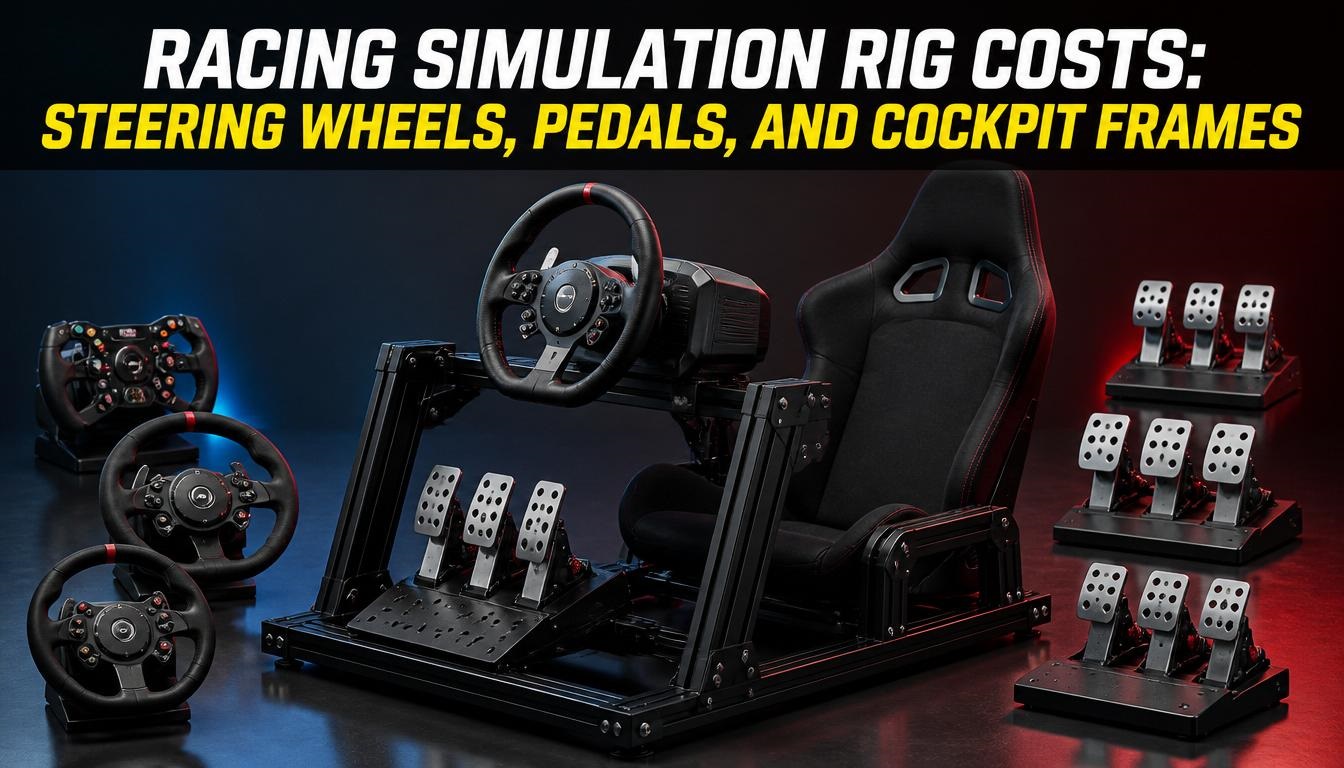
Building a sim racing setup in South Africa comes with a unique set of challenges. Import duties, shipping weight penalties, voltage spikes during load shedding, and the notorious “ZAR volatility tax” make planning a build tricky.
Whether you want to shave two seconds off your lap times at Kyalami or set up a professional drift rig in your living room, jumping straight in without a clear budget usually leads to two outcomes: overspending on the wrong components or buying flimsy gear that flexes under pressure.
This guide provides an authentic, real-world breakdown of build tiers, exact local pricing in South African Rand (ZAR), gear recommendations, and engineering realities.
1. Budget Tiers: Setup Categories and Total Landed Costs
Setting up a rig ranges from a simple desktop clamp to a full-motion direct drive cockpit. In South Africa, pricing is heavily dictated by distribution channels, local stock availability, and logistics fees.
Entry-Tier: “The Desktop Competitor” (R6,500 – R14,000)
This tier uses desk clamps or lightweight, foldable wheel stands. It relies on gear-driven or belt-driven wheel bases and standard potentiometer pedals.
-
Target Racer: Beginners, casual Assetto Corsa/F1 players, and gamers on a tight budget or with limited space.
-
Core Hardware: Logitech G29 / G923, Thrustmaster T128 / T248, or PXN V99.
-
Rig Solution: Heavy-duty desk, or entry wheel stands like the Next Level Racing Wheel Stand Lite or PXN A10/A11 foldable stands.
Mid-Tier: “The Direct Drive Sweet Spot” (R22,000 – R50,000)
This tier delivers optimal performance per Rand spent. Moving to entry-level Direct Drive (DD) wheelbases (5 Nm to 12 Nm) paired with Load Cell braking systems and rigid aluminium or tubular steel cockpits provides immediate improvements in lap consistency.
-
Target Racer: Competitive iRacing / GT World Challenge drivers, league racers, and dedicated enthusiasts.
-
Core Hardware: MOZA R5 / R9 V3 Bundles, Fanatec CSL DD, or PXN VD4/VD6.
-
Rig Solution: Playseat Trophy, Next Level Racing Wheel Stand 2.0, or entry 8040 aluminium profile rigs.
High-End & Professional Tier: “The Unlimited Performance Rig” (R65,000 – R180,000+)
This level uses commercial-grade components: high-torque Direct Drive bases (16 Nm to 25+ Nm), hydraulic or heavy-load-cell pedals, and rigid 8040/16040 extruded profile aluminium chassis with integrated triple-monitor mounts.
-
Target Racer: Real-world motorsport drivers, professional esports athletes, and sim racing purists.
-
Core Hardware: Simucube 2 Pro, MOZA R16/R21, Fanatec ClubSport DD+, Asetek Invicta, and Simagic Ultimate.
-
Rig Solution: Custom 8040 extruded profile rigs, Playseat Formula Intelligence, or motion-platform cockpits.
2. Steering Wheels & Wheelbases: Gear, Belt, and Direct Drive
The wheel base translates the physics of the simulator into forces you feel in your hands. Understanding force feedback (FFB) technology helps avoid unnecessary upgrades later.
Force Feedback Technology Precision Breakdown
-
Gear Drive: Low Cost, Loud, ‘Notchy’ Feel (5-8% Detail Precision)
-
Belt Drive: Smooth, Medium Cost, Thermal Throttling Risk (20-35% Detail Precision)
-
Direct Drive: Pure Motor Torque, Instant Detail, Highest Realism (95-100% Detail Precision)
Gear-Driven Systems
Gear systems use a small, high-speed motor multiplied through plastic or metal gears.
-
Pros: Highly accessible pricing, wide game compatibility out of the box, easy to mount on a desk.
-
Cons: Loud gear noise, a noticeable “deadzone” in the center, and a notched feeling when turning against force.
-
Local Market Standouts: Logitech G29/G920 (approx. R6,299) remain the go-to starting point on SA classifieds and retail stores.
Belt-Driven Systems
Belt systems use pulleys and rubber belts to dampen motor notched-ness, providing a smoother force feel than gears.
-
Pros: Smoother feedback, higher peak torque output than budget gear systems.
-
Cons: Belts stretch over time, and heat buildup inside the housing during long sessions (like a 2-hour endurance stint) can cause force feedback fading.
Direct Drive (DD) Systems
In a DD setup, the steering wheel connects directly to the shaft of an industrial servo motor. There are no gears or belts to delay signals or mask forces.
-
5 Nm – 8 Nm Range: Excellent entry into DD technology. Highly detailed road surface cues without tearing your wrists. MOZA R3 and R5 bundles cost roughly R9,800 to R12,500 locally.
-
9 Nm – 12 Nm Range: The ideal balance for most racers. High output, high speed, and minimal heat generation. MOZA R9 V3 bases sit around R8,800 to R11,999 (base only).
-
16 Nm – 25+ Nm Range: Industrial power capable of matching actual GT3 or Formula car steering resistance. Top-tier bases start around R20,000 and reach R50,000+ for standalone imported units.
Wheelbase Price & Spec Comparison (South African Rand)
| Wheelbase / Kit | Drive Type | Max Torque | Platform Support | Est. SA Price (ZAR) |
| Logitech G29 / G920 | Dual-Gear | ~2.1 Nm | PC / PS / Xbox | R6,000 – R7,500 |
| Thrustmaster T248 | Hybrid (Gear/Belt) | ~3.5 Nm | PC / PS / Xbox | R7,500 – R9,200 |
| PXN VD4 Bundle | Direct Drive | 4 Nm | PC | R6,500 – R7,900 |
| MOZA R3 Bundle | Direct Drive | 3.9 Nm | PC / Xbox | R8,900 – R9,900 |
| MOZA R5 Bundle | Direct Drive | 5.5 Nm | PC | R12,300 – R13,500 |
| MOZA R9 V3 (Base Only) | Direct Drive | 9 Nm | PC | R8,800 – R11,900 |
| Fanatec CSL DD (8Nm Ready) | Direct Drive | 8 Nm | PC / Xbox / PS | R14,500 – R18,500 (Imported/Landed) |
| Simucube 2 Sport | Direct Drive | 17 Nm | PC | R32,000 – R39,000 |
3. Pedals: Potentiometer vs. Hall Effect vs. Load Cell vs. Hydraulics
If a Direct Drive wheel makes you faster through feedback clarity, a Load Cell pedal set makes you faster through braking consistency.
1. Potentiometers (Distance-Based Braking)
Found on entry-level sets (Logitech G29 standard pedals). They calculate braking power based on how far you push the pedal.
-
The Problem: The human brain relies on muscle memory through pressure, not distance. Modulating 40% braking into Turn 1 at Kyalami on a soft pedal spring leads to frequent lockups or coasting.
2. Hall Effect Sensors (Magnet-Based Distance)
Hall sensors measure distance using magnetic fields rather than mechanical wiper contacts.
-
The Advantage: Highly durable and immune to dust, but they still rely on distance rather than foot pressure.
3. Load Cell Pedals (Force-Based Braking)
Load cells measure actual strain or force applied to a sensor, using heavy rubber elastomers to simulate the stiffness of a hydraulic brake pedal.
-
The Difference: Whether you push the pedal 1cm or 3cm doesn’t matter—what matters is that you applied 45 kg of pressure. Your leg muscles memorize force much faster than distance, leading to precise trail-braking.
4. Hydraulic Pedals
These use actual master and slave hydraulic cylinders filled with fluid to match real motorsport pedal feel.
-
The Catch: Premium pricing (R20,000 to R45,000+) and ongoing maintenance requirements (bleeding lines, replacing seals).
Pedal Unit Comparison
| Pedal System | Sensor Type | Primary Benefit | Typical Price Range (ZAR) |
| Standard Entry (Logitech/Thrustmaster) | Potentiometer | Included in basic bundles | R1,500 – R3,500 (If standalone) |
| MOZA SR-P / Lite Series | Hall / Load Cell Hybrid | Smooth, durable entry DD set | R3,600 – R5,500 |
| Fanatec CSL Pedals + Load Cell Upgrade | 60kg Load Cell | Great entry to true force braking | R7,500 – R10,500 (Imported bundle) |
| Heusinkveld Sim Pedals Sprint | 120kg Load Cell | Professional standard for precision | R18,000 – R24,000 |
| Asetek Invicta Hydraulic | Hydraulic Cylinder | Authentic race car pedal feel | R32,000 – R42,000 |
Pro Tip: Do not pair a 90kg Load Cell brake pedal with a standard office chair on wheels. Every time you stamp on the brake, your chair will roll backward across the tile floor. Upgrading to Load Cell pedals requires a rigid seating setup.
4. Cockpits & Framing: Wheel Stands, Steel Tubing, and Aluminium Extrusion
Flex is the enemy of sim racing precision. If your wheel deck moves up and down when you pull on the wheel, or your pedal tray flexes when you hit the brakes, energy is wasted and subtle force feedback detail is lost.
Cockpit Frame Categories
-
Desk Mount / Wheel Stand: Small Footprint | Prone to tipping or sliding under hard braking
-
Tubular Steel Frames: Clean aesthetic | Limited adjustability; can flex under greater than 10Nm DD torque
-
8040 Extruded Aluminium: Zero Flex | Unlimited modular expansion | Heavy and expensive to ship
Option A: Wheel Stands (R1,800 – R6,000)
Compact metal frames that hold your wheel and pedals while you sit in a standard gaming or desk chair.
-
Pros: Folds away into a cupboard or corner; affordable.
-
Cons: Your chair can still slide or rotate during heavy braking unless tied to the stand.
-
Examples: PXN A10 Stand (R1,800), Next Level Racing Wheel Stand 2.0 (R5,950).
Option B: Tubular Steel Cockpits & Bucket Seats (R9,000 – R18,000)
Complete integrated frames made from powder-coated steel tubes, complete with an attached racing bucket seat.
-
Pros: Aesthetic appeal, comfortable for longer sessions, all-in-one footprint.
-
Cons: Pre-drilled holes limit adjustability; heavy DD bases can cause wheel deck flex.
-
Examples: Playseat Evolution PRO (R9,180), Playseat Trophy (R16,500).
Option C: Aluminium Profile Rigs / “8040” Rigs (R12,000 – R35,000+)
Constructed from modular t-slot extruded aluminium (typically 80mm x 40mm or 160mm x 40mm profiles).
-
Pros: Completely rigid with zero flex under high torque or heavy braking. Modular design allows you to bolt on shifters, handbrakes, motion actuators, or keyboard trays anywhere along the frame.
-
Cons: Industrial look, heavy build weight, and higher local transport/shipping fees.
5. Local South African Realities: Import Duties, Shipping, and Power Backup
Buying gear in South Africa requires planning for extra local costs that buyers in the US or Europe don’t have to face.
Landed Cost Formula Structure
-
Base Item Cost (USD / EUR)
-
plus International Express Air Freight (Weight/Volumetric Fee)
-
plus Customs Duty Tax (15% to 20% depending on HS Code)
-
plus South African Import VAT (15%)
-
plus Clearance/Disbursement Fees (DHL / FedEx / UPS)
-
Equals Final Landed Cost in South Africa (ZAR)
1. Import Duties & Tariff Calculations
If you order directly from overseas brands (like Fanatec, Simucube, or Asetek) because local stock is unavailable:
-
Customs Duty: Computer peripherals often attract low duty, but gaming controllers or racing seats can be categorized under general toys/furniture, triggering 15% to 20% import duty rates.
-
Import VAT: SARS levies a flat 15% VAT on the Added Customs Value (ACV = Base Price + 10% markup + Insurance/Shipping).
-
Landed Cost Example: A $500 wheel base can easily turn into $850 – $900 (R15,000 – R16,000+) by the time it lands on your doorstep.
2. Sourcing Strategy: Local Distributors vs. Importing
| Local SA Distributors | Direct Overseas Importing |
| Local SA Warranty Protection | Access to New/Unstocked Models |
| Fast Courier Delivery (2-4 Days) | High Shipping Fees on Heavy Rigs |
| Clear ZAR Invoicing | Complex Returns/RMA Shipping Costs |
| Stock Availability Can Be Limited | Unpredictable Customs Clearance |
Whenever possible, purchasing through reputable South African vendors offers significant warranty advantages. If a direct drive motor fails or a load cell amplifier burns out, handling an RMA locally is far cheaper than shipping a 12kg motor back to Europe or Asia out of pocket.
3. Load Shedding & Power Protection (UPS Requirements)
Grid instability can pose risks to expensive sim hardware. Sudden power cuts while a high-torque Direct Drive motor is under load can corrupt firmware or damage power supplies.
-
Minimum Protection: A Pure Sine Wave Line-Interactive UPS (1500VA / 900W minimum).
-
Crucial Rule: Avoid cheap simulated sine-wave UPS units. High-end Direct Drive power supplies (which often draw peak bursts of 350W to 700W) can shut down or suffer damage on dirty wave power.
-
Surge Protection: Always run your entire rig—PC, monitors, and wheelbase—through a surge protector with a guaranteed joule rating.
6. Complete Rig Build Blueprint: 3 Recommended Setups
Here are three complete, balanced setups tailored to different budgets, built with parts accessible in the South African market.
-
The Budget Racer: Logitech G29/G923 + Heavy Desk / Foldable Stand
-
The Competitive Speedster: MOZA R9 DD + Load Cell Pedals + Rigid Frame
-
The Ultimate Sim Rig: Simucube 2 + Heavy Load Cell + 8040 Aluminium Rig
Build A: “The Budget Racer” (Total Budget: ~R12,500)
-
Wheel & Pedal Base: Logitech G29 / G923 or Thrustmaster T248 (R6,300 – R7,500)
-
Mounting: Next Level Racing Wheel Stand Lite or PXN A10 Stand (R1,800 – R3,200)
-
Display: Existing 27″ Gaming Monitor / TV (R0)
-
Seating: Existing Office Chair with caster wheel stops (R200)
-
Target Games: Assetto Corsa, F1 25, EA Sports WRC, Forza Horizon.
Build B: “The Competitive Speedster” (Total Budget: ~R38,000)
-
Wheelbase: MOZA R9 V3 Direct Drive Base (R8,800)
-
Steering Wheel: MOZA ES / KS Formula Steering Wheel (R4,500 – R6,000)
-
Pedals: MOZA SR-P Load Cell Pedal Set (R3,600)
-
Cockpit Frame: Playseat Trophy or local 8040 Profile Rig without seat (R14,000 – R16,500)
-
Seat: Local Real-Car Reclaimer Bucket Seat or Sports Seat (R2,500)
-
Target Games: iRacing, Automobilista 2, Assetto Corsa Competizione.
Build C: “The Ultimate Sim Rig” (Total Budget: ~R115,000)
-
Wheelbase: Simucube 2 Pro or MOZA R21 DD Base (R22,000 – R38,000)
-
Steering Wheel: Custom Wireless Carbon Formula Wheel (R12,000)
-
Pedals: Heusinkveld Sprint or Asetek Invicta Hydraulic Set (R22,000 – R34,000)
-
Cockpit: Heavy-Duty 16040 Aluminium Profile Rig + Integrated Triple Mount (R22,000)
-
Seat: FIA-Approved Sparco / OMP Fixed Bucket Seat (R8,500)
-
Power Protection: 2000VA Pure Sine Wave UPS (R6,500)
-
Target Games: Professional Esports League Racing, Real-World Driver Training.
7. Key Takeaways & Community Advice
-
Prioritize pedals over steering wheels if your primary goal is lower, more consistent lap times.
-
Avoid mounting high-torque Direct Drive bases (greater than 8 Nm) to thin desks or lightweight folding stands. Structural flex degrades the small force feedback details you paid to feel.
-
Factor in shipping and import taxes when buying overseas. A deal that looks cheap in Dollars or Euros often becomes more expensive once landed in South Africa than buying locally.
-
Protect your investment with a quality Pure Sine Wave UPS to safeguard electronics during power interruptions.
Interactive Discussion: What’s Your Current Rig Setup?
Building the ultimate sim setup is a continuous process of tweaking, upgrading, and customizing. We want to hear from the local South African sim racing community:
-
What setup are you currently running? Are you still holding down a desk clamp with a trusty Logitech G29, or have you made the jump to Direct Drive?
-
For DD owners: Did upgrading your wheelbase or moving to Load Cell pedals make a bigger difference in your lap times?
-
Local Rig Builders: Have you built your own DIY 8040 aluminium profile frame using local extrusion suppliers, or did you buy a pre-packaged imported cockpit?
Drop your comments, questions, and rig photos below! If you need advice on matching specific components or checking mounting plate compatibility, ask away.

Joseph Mathebula is a consumer tech analyst and market researcher at Prices in South Africa. He specializes in tracking smartphone prices and consumer electronics, helping everyday shoppers navigate the market to secure the best value.
Post Disclaimer
Prices and availability are subject to change without notice and may vary by store or region. pricesinsouthafrica.co.za is an independent informational platform; we do not sell products directly, nor are we responsible for third-party pricing errors.