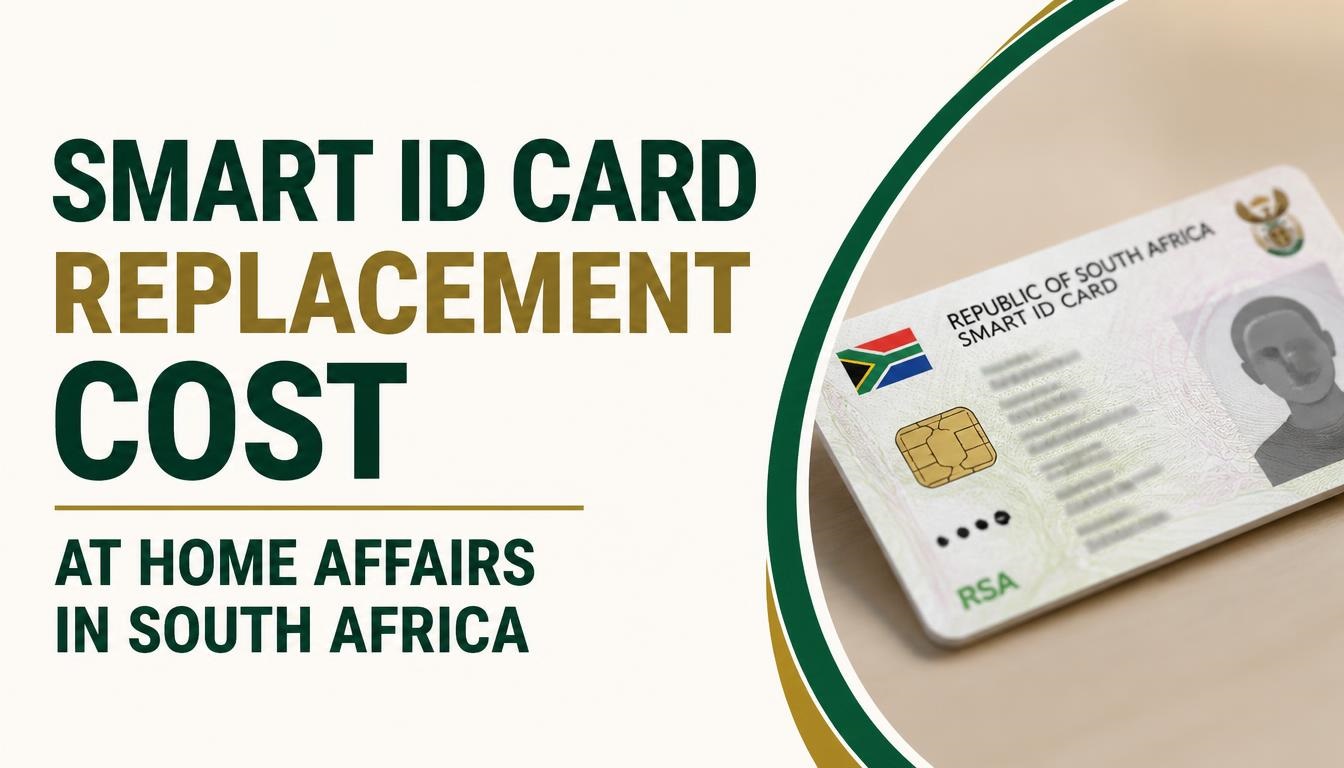
Losing a South African identity document triggers an instant administrative standstill. Whether your card was stolen during a mugging, misplaced during a residential move, or damaged beyond recognition, the inability to verify your identity halts daily life across Mzansi. From locked banking applications and failed RICA mobile verifications to blocked credit applications and delayed employment checks, a missing ID card demands immediate replacement. Navigating the Department of Home Affairs (DHA) requires a clear understanding of official government tariffs, payment systems, booking portals, and partner retail bank branches. This comprehensive pricing guide breaks down the exact replacement fees, hidden ancillary costs, step-by-step re-issuance procedures, and tactical booking strategies so you can replace your Smart ID card efficiently without overpaying or wasting hours in standing queues.
Quick Price Summary: SA Smart ID Replacement Fees
Replacing a lost, stolen, or damaged South African Smart ID card at the Department of Home Affairs or through an eHomeAffairs partner bank branch carries a standard re-issue fee of R140. First-time applicants aged 16 and older pay R0, while a Temporary Identity Certificate (TIC) costs R70.
-
First-Time Smart ID (Citizens 16+ or first-time senior upgrade from Green ID): R0 (Free)
-
Replacement Smart ID Card (Lost, stolen, damaged, or name change re-issue): R140
-
Temporary Identity Certificate (TIC, valid for 2 months): R70
-
Official SAPS Police Affidavit (Mandatory for lost/stolen IDs): R0 (Free at any police station)
-
eHomeAffairs Online Portal Booking Fee: R0 (Standard bank transaction rules apply)
At a Glance: ZAR Price Breakdown & Retail Bank Partner Matrix
While the baseline tariff charged by the Department of Home Affairs is uniform across the country, where and how you complete your biometric capture impacts convenience, processing time, and total expenditure. The rollout of live-capture processing inside major commercial bank branches offers a streamlined alternative to traditional municipal Home Affairs offices.
| Service Outlet / Facility | Application Method | Base DHA Fee (ZAR) | Booking System | Average Turnaround |
| Standard DHA Local Office | Walk-in or BABS Appointment | R140 (Free for first-time 16+) | BABS / Queueing | 14 to 28 Business Days |
| FNB Partner Branches | eHomeAffairs Portal | R140 | eHomeAffairs Appointment | 7 to 14 Business Days |
| Standard Bank Partner Branches | eHomeAffairs Portal | R140 | eHomeAffairs Appointment | 7 to 14 Business Days |
| Absa Partner Branches | eHomeAffairs Portal | R140 | eHomeAffairs Appointment | 7 to 14 Business Days |
| Nedbank Partner Branches | eHomeAffairs Portal | R140 | eHomeAffairs Appointment | 7 to 14 Business Days |
| Discovery Bank Partner Branches | eHomeAffairs Portal | R140 | eHomeAffairs Appointment | 7 to 14 Business Days |
| Investec Partner Branches | eHomeAffairs Portal | R140 | eHomeAffairs Appointment | 7 to 14 Business Days |
| Mobile DHA Trucks (Outreach) | Scheduled Community Visits | R140 (Fee waivers during specific drives) | On-site Walk-in | 21 to 30 Business Days |
Step-by-Step Buyer Guide: How to Replace Your Smart ID
Replacing your identity card requires completing specific legal prerequisites before stepping into a Home Affairs office or logging onto the national digital portal. Following a structured procedure prevents administrative rejections and repeat visits.
Step 1: Obtain an Official SAPS Affidavit
If your Smart ID card was lost or stolen, you must visit your nearest South African Police Service (SAPS) station before initiating your Home Affairs application. Request a sworn affidavit declaring the loss or theft of your identity document. Ensure the police officer stamps the document clearly and records your exact ID number, full names, and the circumstances surrounding the loss. There is zero charge for this service at any SAPS station. Keep the original stamped affidavit, as Home Affairs officials will scan and archive it during your biometric processing.
Step 2: Choose Between eHomeAffairs and Direct DHA Branch Visit
Determine whether you qualify to use the eHomeAffairs online portal or need to visit a physical Home Affairs office directly. The eHomeAffairs portal allows South African-born citizens to register online, upload required detail verification, pay the R140 fee via integrated online banking, and book a dedicated biometric capture appointment at selected bank branches. If you are a naturalized citizen, permanent resident permit holder, or live far from a participating bank branch, you must visit a local Department of Home Affairs office equipped with Live Capture technology.
Step 3: Register and Pay via the eHomeAffairs Portal
If using the digital portal, visit the official eHomeAffairs website and create a profile using your 13-digit identity number. Select the option for an ID card replacement. The portal prompts you to select your preferred bank for payment. Log into your online banking app (Absa, FNB, Nedbank, Standard Bank, Discovery, or Investec) to authorize the pending payment request of R140. Once authorized, navigate back to the eHomeAffairs portal to select an available time slot at a partner bank branch.
Step 4: Attend Your Biometric Capture Appointment
Arrive at your chosen location 15 minutes before your scheduled appointment time. Bring your original SAPS affidavit (if replacing a lost/stolen card), proof of residence (if updating address details), and your existing green barcoded ID book or damaged Smart ID card (if replacing a damaged unit). At smart offices and bank branches, digital photos, fingerprints, and electronic signatures are captured live on-site. You do not need to bring printed physical photographs unless you are applying for a paper Temporary Identity Certificate (TIC).
Step 5: Collect Your Smart ID Card
When your card is manufactured at the central print facility in Pretoria and dispatched to your collection branch, Home Affairs will send an automated SMS notification. Return to the exact branch where you completed your biometrics. You must present yourself in person because identity verification via a live fingerprint scan is strictly required before the operator will release the physical Smart ID card to you.
Value Rating: Direct DHA Walk-In vs Bank Branch Booking
Deciding where to complete your replacement application involves balancing financial cost against time efficiency, queuing conditions, and system stability. The breakdown below compares the practical value of processing your replacement at a standard Department of Home Affairs office versus a partner retail bank branch.
Standard DHA Municipal Office
-
Cost Rating: 5 / 5 (Standard baseline fee of R140)
-
Processing Efficiency: 2 / 5 (High queue volumes, potential system outages, long waiting times)
-
Accessibility: 5 / 5 (Widespread national footprint across urban and rural municipalities)
-
Biometric Quality: 4 / 5 (Standardized live capture booths)
-
Overall Value Index: Moderate. Suitable for citizens without online banking access, naturalized citizens, or those living outside major metros.
eHomeAffairs Partner Bank Branch
-
Cost Rating: 5 / 5 (Standard baseline fee of R140, no additional bank admin surcharges)
-
Processing Efficiency: 5 / 5 (Strict appointment slots, minimal queuing, air-conditioned comfortable environments)
-
Accessibility: 3 / 5 (Limited primarily to major metropolitan centers in Gauteng, Western Cape, KwaZulu-Natal, and Eastern Cape)
-
Biometric Quality: 5 / 5 (Modernized dedicated workstations with dedicated power backup)
-
Overall Value Index: Superior. Highly recommended for any citizen residing near a participating bank branch who holds an account with Absa, FNB, Nedbank, Standard Bank, Discovery Bank, or Investec.
While the official tariff for replacing a Smart ID card is fixed at R140, real-world applications frequently incur secondary expenses that buyers must factor into their overall budget. Failing to plan for these hidden overheads can significantly inflate the total cost of securing your new identification card.
1. Temporary Identity Certificate (TIC) Surcharge
If your ID is lost or stolen and you urgently require proof of identity for banking, writing matric exams, collecting SASSA grants, or domestic flight travel, you will need a Temporary Identity Certificate. The DHA charges R70 for a TIC. Unlike the Smart ID process, a TIC requires two physical, color passport-sized photos. Local retail photo studios and printing kiosks typically charge between R50 and R90 for a set of printed ID photos, raising your interim documentation expenses to R120–R160 before paying for the actual replacement card.
2. Transport and Parking Costs
Visiting a Home Affairs office often requires multiple journeys: the initial application visit and the final collection visit. In major urban nodes like Johannesburg, Cape Town, and Durban, municipal parking meters or shopping center parking garages charge between R15 and R40 per visit. If traveling via public transport (minibus taxi or Gautrain), budget R40 to R120 in round-trip fares across both visits.
3. SMS Tracking Fees
Home Affairs offers an SMS status tracking system where applicants text the word ID followed by their 13-digit identity number to 32551. Each SMS sent to this premium rate line is charged at R1.00. While minor, multiple balance checks over a four-week processing window add to the cumulative expense.
4. Lost Work Hour Costs
For self-employed individuals, hourly contractors, or workers without paid leave flexibility, standing in a standard Home Affairs queue for four to six hours represents a substantial indirect opportunity cost. Choosing an eHomeAffairs bank appointment slashes this downtime from a full workday to under 30 minutes.
SA Retail & Banking Analyst Deal Insights
“The true cost of a Home Affairs transaction isn’t the R140 state fee—it is the lost productivity of standing in unpredictable municipal queues. South Africans who leverage eHomeAffairs to book bank branch slots effectively buy back three to five hours of their time. Furthermore, always verify that your name matches your birth register exactly before submitting payment, as any administrative correction required post-issue triggers an additional R140 re-issuance fee.”
Frequently Asked Questions
Can I replace my lost Smart ID card for free if it was stolen during a crime?
No. The Department of Home Affairs does not waive the R140 replacement fee for stolen cards, even if you present an official SAPS crime case number or police affidavit. The free issuance policy strictly applies to first-time applicants aged 16 and older, or seniors upgrading from the old green barcoded ID book for the very first time.
How long does it take for a replacement Smart ID card to be processed?
Applications completed at eHomeAffairs partner bank branches typically take between 7 and 14 business days from the date of biometric capture to collection notification. Standard Home Affairs offices average 14 to 28 business days, though rural offices or periods with high system downtime can extend turnaround times to 6 weeks.
Can I pay cash for my Smart ID card replacement at Home Affairs?
Yes, traditional Department of Home Affairs offices accept cash payments at dedicated cashier counters. Many modern offices also feature card payment terminals accepting Visa and Mastercard debit or credit cards. However, if you apply via the eHomeAffairs online portal for a bank branch appointment, payment must be processed online via your bank’s integrated payment portal prior to booking.
Do I need to bring physical photographs when applying for a replacement Smart ID card?
No physical photographs are needed for a standard Smart ID card replacement at live-capture Home Affairs offices or bank branches. High-definition digital camera equipment captures your photo, fingerprints, and digital signature directly at the counter. You only need physical color passport photos if you are simultaneously applying for an interim paper Temporary Identity Certificate (TIC).
Community Price & Experience Discussion
Have you recently replaced a lost or stolen Smart ID card at Home Affairs or an eHomeAffairs partner bank branch? How long did your application take from biometric capture to collection, and did you experience any unexpected fees or booking delays in your area? Share your real-world turnaround times, branch recommendations, and queue-busting tips in the comments below to help fellow South Africans navigate the process smoothly.
Pricing & Independent Review Disclaimer
This article is an independent consumer guide created solely for educational and informational purposes for South African citizens. Official fees, application tariffs, eHomeAffairs features, and participating bank branch locations are established by the South African Department of Home Affairs and are subject to official government gazette adjustments or policy updates. While every effort is made to ensure all ZAR pricing figures and procedural instructions are accurate at the time of publication, readers are advised to confirm current tariffs directly with the official Department of Home Affairs portal (dha.gov.za) or their respective banking institutions prior to submitting applications.

Joseph Mathebula is a consumer tech analyst and market researcher at Prices in South Africa. He specializes in tracking smartphone prices and consumer electronics, helping everyday shoppers navigate the market to secure the best value.
Post Disclaimer
Prices and availability are subject to change without notice and may vary by store or region. pricesinsouthafrica.co.za is an independent informational platform; we do not sell products directly, nor are we responsible for third-party pricing errors.