With South African motorists facing relentless petrol price volatility at the pumps—where 95 Unleaded routinely hovers near record highs—the monthly cost of commuting between Johannesburg, Cape Town, and Durban has become a staggering burden on household budgets. Add to this the cascading expenses of general inflation, Eskom tariff increases, and vehicle maintenance, and it becomes clear why bakkie owners, fleet managers, and daily commuters are actively seeking lower-cost alternatives. Converting a standard petrol engine to run on Liquefied Petroleum Gas (LPG)—a process known as bi-fuel or Autogas conversion—has rapidly transitioned from a niche modification into a mainstream financial strategy.
While the promise of slashing monthly fuel bills by up to 40% to 50% sounds alluring, the upfront financial commitment is substantial. Understanding the precise breakdown of installation expenses, component quality, tank sizing, and long-term return on investment (ROI) is crucial before handing over your car keys to an fitment centre. This comprehensive guide evaluates real-world market rates across Gauteng, the Western Cape, and KwaZulu-Natal, detailing what you will pay, how the technology functions under South African driving conditions, and whether switching to gas makes genuine financial sense for your vehicle.
At a Glance: ZAR Gas Conversion Price Breakdown
To give you an immediate benchmark before diving into component specifics and installation nuances, here is the current average cost outline for converting a petrol-powered passenger car or light commercial bakkie to LPG in South Africa:
-
Basic 4-Cylinder Sequential Conversion: R25,000 to R29,500 including VAT, components, tank, and labour.
-
Premium 4-Cylinder Conversion (Direct Injection / Prins Kit): R32,000 to R35,500 including VAT, calibration, and warranty.
-
6-Cylinder / V6 Conversion: R34,000 to R41,000 depending on manifold complexity and tank capacity.
-
8-Cylinder / V8 Engine Conversion: R42,000 to R52,000 for high-displacement SUV or heavy commercial applications.
-
LPG Pump Price Advantage: LPG currently retails between R12.00 and R13.50 per litre in South Africa, compared to petrol at R22.50 to R26.00+ per litre, generating immediate per-kilometre operational savings.
Detailed Price & Retailer Comparison Matrix
Selecting the right conversion system involves balancing kit quality, installer reputation, and long-term warranty backup. Below is an evaluation of approved fitment offerings, kit tiers, and estimated pricing across leading South African Autogas specialists and commercial partners.
| Installer / Brand Partner | Kit Tier & Engine Compatibility | Estimated ZAR Price Range (Incl. VAT) | Tank Capacity Options | Warranty & Value Score |
| Isinkwe Energies / Prins Autogas | Premium Sequential & Direct Injection (4-Cyl) | R32,500 – R35,500 | 45L Toroidal / 70L Cylindrical | 5/5 (OEM Grade, European Certified) |
| Drive LP AutoGas (Kempton Park) | Standard Sequential Injection (4-Cyl) | R26,500 – R29,900 | 42L Spare Wheel / 60L Cylinder | 4.5/5 (Excellent Local Support) |
| Car Gas Conversions (Pretoria North) | Economy Bi-Fuel Kit (4-Cyl Petrol) | R25,000 – R28,500 | 40L to 65L Customized | 4/5 (High Budget Accessibility) |
| Gaztron Fleet Solutions | Commercial Bakkie & Fleet Sequential (4-Cyl) | R28,000 – R33,000 | Heavy-Duty Underbody Bakkie Tank | 4.8/5 (Optimized for CPK Reduction) |
| DFSK SA Official Conversion | Factory-Approved Commercial Panel Van / Bakkie | R33,200 – R34,500 | Integrated Commercial Cylinder | 4.7/5 (Maintains Vehicle Warranty) |
| Custom V6 / V8 Specialist Fitment | High-Displacement Performance Kit (6 & 8 Cyl) | R38,000 – R52,000 | Dual Toroidal / 90L Heavy Tank | 4.2/5 (Requires Advanced Tuning) |
Understanding the Technology: How LPG Car Conversion Works
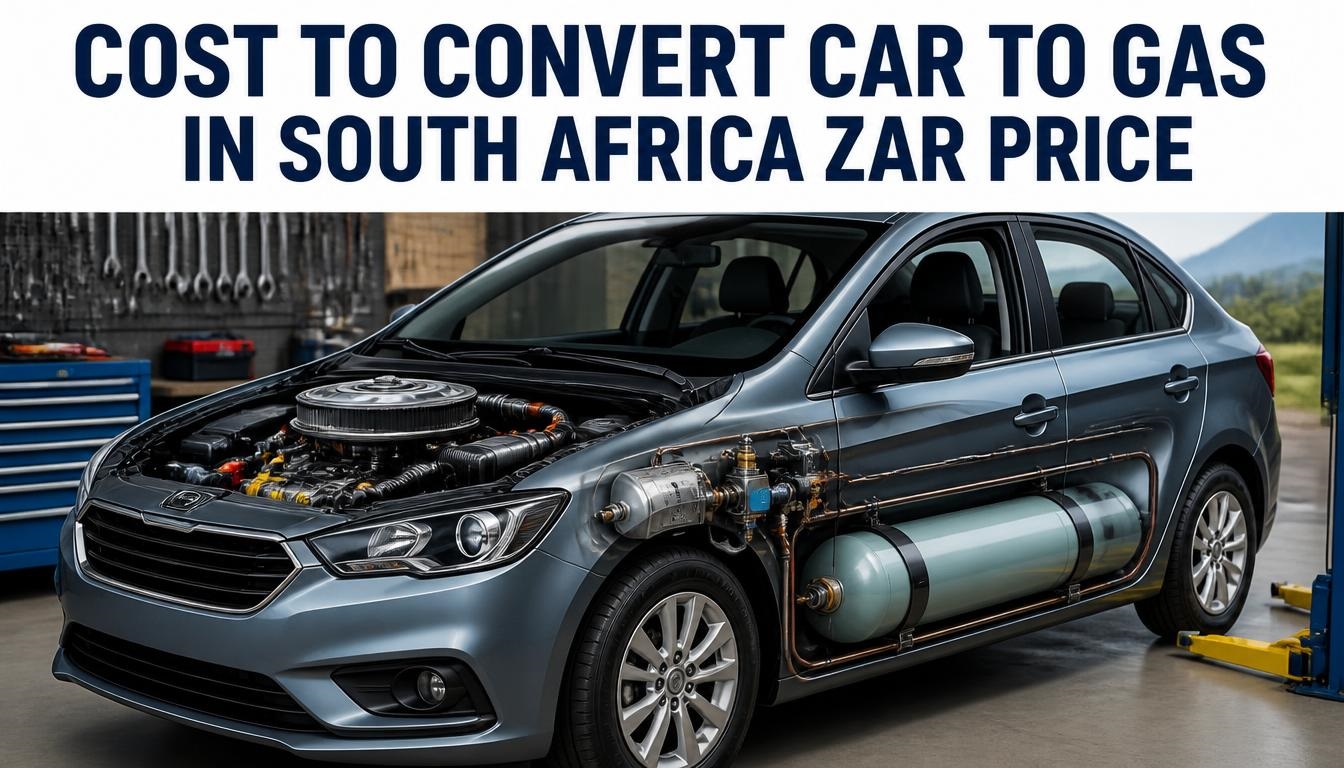
A modern gas conversion does not replace your car’s original petrol engine. Instead, it converts your vehicle into a bi-fuel system. This means your car retains its standard petrol tank, fuel pump, and original engine management system, while gaining an entire secondary fuel system dedicated to LPG.
The driver receives a tiny, unobtrusive selector switch installed on the dashboard. This switch displays the remaining gas level via LED indicators and allows you to toggle seamlessly between petrol and gas, even while driving at highway speeds along the N1.
Key Components Installed Under the Hood and Body
-
LPG Storage Tank: Constructed from heavy-gauge steel (significantly thicker than standard plastic petrol tanks), mounted either in the spare wheel well (toroidal donut tank) or against the back wall of a bakkie load bed or boot (cylindrical tank).
-
Multivalve and Refuelling Port: A brass safety unit fitted to the tank that regulates pressure, includes an 80% automatic stop fill valve to prevent overpressurisation, and connects to an external brass filling nozzle installed next to your petrol cap or under the rear bumper.
-
Evaporator / Reducer (Vaporiser): Plumbed directly into the engine’s coolant circuit. It takes liquid LPG stored under pressure in the tank and uses engine heat to convert it into gas vapor at a stable working pressure.
-
Gas ECU (Electronic Control Unit): A dedicated secondary computer that intercepts signals from your car’s main petrol ECU and calculates the exact timing and volume of gas required for optimum combustion.
-
High-Speed Gas Injectors: Solenoid valves mounted on the intake manifold that spray vaporised LPG directly into the engine cylinders.
Because the system starts on petrol to warm up the reducer before automatically switching to gas once the engine coolant reaches approximately 35°C to 40°C, the transition is virtually imperceptible to the driver.
Cost vs. Performance Breakdown
A common concern among South African motorists considering the switch is how gas affects engine output, fuel efficiency, and long-term component wear. Because LPG has a lower energy density by volume than petrol, volumetric fuel consumption increases slightly (typically by 10% to 15%). However, because LPG costs roughly half the price of petrol per litre, the net financial saving per kilometre driven remains dramatic.
Financial and Operational Performance Analysis
-
Entry-Level 1.2L to 1.6L Hatchbacks (e.g., VW Polo Vivo, Toyota Etios, Hyundai i20):
-
Conversion Cost: R25,000 – R28,500
-
Petrol Consumption: 6.5 Litres / 100 km (Cost: ~R162 / 100 km at R25/L)
-
LPG Consumption: 7.5 Litres / 100 km (Cost: ~R94 / 100 km at R12.50/L)
-
Net Savings: ~R68 per 100 km driven
-
Worth It Index: High for daily ride-hailing (Uber/Bolt) drivers or commuters covering over 2,500 km per month.
-
-
Mid-Size 2.0L to 2.5L Sedans & Compact SUVs (e.g., Toyota RAV4, Mazda CX-5, Nissan X-Trail):
-
Conversion Cost: R29,000 – R33,500
-
Petrol Consumption: 8.8 Litres / 100 km (Cost: ~R220 / 100 km at R25/L)
-
LPG Consumption: 10.1 Litres / 100 km (Cost: ~R126 / 100 km at R12.50/L)
-
Net Savings: ~R94 per 100 km driven
-
Worth It Index: Excellent balance of comfort and rapid payback for suburban families and inter-city travelers.
-
-
Commercial Bakkies & Delivery Vans (e.g., Toyota Hilux 2.7 VVTi, Isuzu D-Max Petrol, DFSK, Nissan NP200):
-
Conversion Cost: R28,000 – R34,500
-
Petrol Consumption: 11.5 Litres / 100 km (Cost: ~R287 / 100 km at R25/L)
-
LPG Consumption: 13.2 Litres / 100 km (Cost: ~R165 / 100 km at R12.50/L)
-
Net Savings: ~R122 per 100 km driven
-
Worth It Index: Maximum ROI. Delivery fleets often recover the full conversion capital within 8 to 12 months.
-
-
High-Displacement V6 & V8 Vehicles (e.g., Jeep Grand Cherokee, Toyota Land Cruiser Prado 4.0 V6, Ford F-150):
-
Conversion Cost: R38,000 – R52,000
-
Petrol Consumption: 15.0 Litres / 100 km (Cost: ~R375 / 100 km at R25/L)
-
LPG Consumption: 17.2 Litres / 100 km (Cost: ~R215 / 100 km at R12.50/L)
-
Net Savings: ~R160 per 100 km driven
-
Worth It Index: Outstanding relative savings, turning historically expensive utility vehicles into manageable daily drivers.
-
Step-by-Step Buyer’s Decision Framework
Deciding to invest R30,000 or more into an aftermarket fuel system requires a methodical approach to ensure you extract maximum value without jeopardising vehicle safety or reliability. Follow this five-step evaluation framework before signing an installation contract.
Step 1: Calculate Your Annual Kilometre Threshold
The fundamental equation governing LPG conversions is simple: the more kilometres you drive, the faster you recover your capital outlay.
-
Take your average monthly petrol expenditure (e.g., R4,000 per month).
-
Calculate your annual distance driven. If you cover fewer than 12,000 km per year, it may take 2.5 to 3 years to break even, making the conversion less compelling unless you plan to keep the vehicle long-term.
-
If your annual distance exceeds 20,000 km (typical for commercial reps, fleet vehicles, or long-distance commuters), your break-even point drops to approximately 10 to 14 months, after which every kilometre driven puts pure cash back into your pocket.
Step 2: Determine Engine Compatibility and Valve Protection Requirements
Not all internal combustion engines react identically to gas combustion. LPG burns cleaner than petrol—leaving virtually zero carbon deposits on spark plugs and oil—but it burns at a slightly higher dry temperature.
-
Hydraulic Lifters: Vehicles equipped with hydraulic valve lifters handle LPG effortlessly with negligible wear.
-
Mechanical / Solid Lifters: Certain Japanese and Asian engines with soft valve seats require a valve saver fluid injection kit (such as Flashlube or Valve-Protect). Ensure your installer assesses whether your engine requires an automated micro-dosing lubrication unit, which adds roughly R1,500 to R2,200 to the total fitment price.
-
Direct Injection vs Multi-Point Injection: Direct injection engines (such as VW TSI, Ford EcoBoost, or Audi TFSI) require specialized high-pressure LPG kits that periodically inject small amounts of petrol alongside gas to cool the OEM petrol injectors. Confirm that the fitment centre utilizes software specifically calibrated for your engine code.
Step 3: Choose the Right Tank Configuration for Your Boot Space
Sacrificing cargo capacity is one of the main practical trade-offs when switching to gas. Evaluate your lifestyle requirements before selecting a tank design:
-
Toroidal (Donut) Tank: Fits directly inside the spare wheel well under the boot floor. You retain 100% of your luggage space, but you must carry a puncture repair spray kit or secure your spare tire elsewhere in the boot during long road trips. Typical capacities range from 38 to 52 usable litres.
-
Cylindrical Tank: Mounted horizontally behind the rear seat bench or inside a bakkie cargo bed. Offers larger usable capacities (60 to 90+ litres), granting a total dual-fuel range exceeding 1,000 km when combined with your petrol tank, but reduces overall boot depth.
Step 4: Verify Installer Certification and SANS Standards
In South Africa, gas installations are strictly governed by safety standards under SANS 10087-6 (Handling, Storage, and Distribution of LPG in Domestic, Commercial, and Industrial Installations – Part 6: Automotive LPG installations).
-
Never permit an uncertified mechanic to install a grey-import gas kit.
-
Demand proof that the fitment centre is registered with relevant South African LPG industry bodies.
-
Ensure the installer provides a formal Certificate of Conformity (CoC) upon completion. This certificate is required to keep your comprehensive vehicle insurance policy valid.
Step 5: Explore Financing and Payment Options
If paying R30,000 upfront strains your cash flow, several South African retailers and fitment centres offer flexible financing structures:
-
Fintech Buy-Now-Pay-Later (Payflex / Float): Allows you to split the cost across interest-free installments if offered by the workshop portal.
-
Revolving Credit / Mobicred: Accepted by select automotive service providers, allowing monthly repayments that can be partially offset immediately by your monthly petrol bill savings.
-
Commercial Asset Finance / Lease Add-On: Fleet operators converting bakkies can frequently integrate conversion costs directly into vehicle lease agreements or business credit facilities through major financial institutions like WesBank or Absa Vehicle Finance.
While the headline price tag covers the primary kit and installation, several ancillary expenses and operational considerations can impact your total cost of ownership in South Africa.
1. Annual LPG System Maintenance Services
Just like your standard engine oil service, an LPG system requires routine preventative maintenance. Every 15,000 km or 12 months, the system requires:
-
Replacement of the liquid phase filter and vapor phase filter (costs approximately R650 to R1,200 including labour).
-
Computer diagnostic check to verify injector calibration, fuel trims, and pressure regulator stability.
2. Vehicle Insurance Policy Updates
Failing to notify your auto insurer about an LPG conversion can lead to claim repudiations in the event of an accident. While most major South African insurers (such as Discovery Insure, Santam, OUTsurance, and MiWay) readily cover gas-converted vehicles, they require a copy of the installer’s Certificate of Conformity. Some insurers may adjust your monthly premium slightly (typically by R50 to R150 per month) to account for the increased replacement value of the vehicle due to the R30,000 aftermarket hardware.
3. Refuelling Infrastructure Accessibility
While the LPG refueling network in South Africa is expanding steadily across major metros (Gauteng, Cape Town, Durban, Pretoria, and Gqeberha), it is not yet as dense as conventional petrol stations.
-
Drivers must map out local filling points, which include dedicated Autogas sites, commercial gas depots, and select retail service stations.
-
However, because your vehicle remains bi-fuel, you are never at risk of being stranded. If your gas tank runs completely dry, the system automatically switches back to petrol on the fly without any engine stutter.
4. Resale Value and Warranty Implications
Fitting an aftermarket gas kit to a vehicle currently under a factory warranty or motor plan may void the manufacturer’s powertrain warranty unless the conversion is formally endorsed by the OEM (such as approved commercial conversions offered on select bakkie models). For older or out-of-warranty vehicles, a high-quality LPG system installed with full documentation often enhances resale appeal among budget-conscious second-hand buyers.
Expert Deal Commentary & Industry Insights
“The true financial value of an LPG conversion in South Africa isn’t determined at the point of fitment, but at the 20,000-kilometre mark,” notes automotive energy analyst and commercial fleet consultant. “With petrol price fluctuations constantly squeezing operational margins, businesses running light commercial delivery fleets are seeing payback periods shorten dramatically. The key for private consumers is selecting high-grade sequential injection systems like Prins or AC Stag fitted by accredited technicians. Avoid cheap, non-regulated mixer kits—modern engine electronics demand precision mapping to safeguard engine valves and deliver genuine 45% fuel bill reductions.”
Frequently Asked Questions
Is converting a car to run on gas safe in a road accident?
Yes, modern automotive LPG systems are engineered to stringent international and South African safety standards (SANS 10087-6). The steel gas storage tanks are constructed from 3mm to 4mm thick high-tensile steel, making them up to twenty times more puncture-resistant than standard plastic petrol tanks. Additionally, tanks feature automatic shut-off multivalves, excess-flow check valves, and pressure-relief devices that instantly seal the gas supply if a fuel line is severed during an impact.
How long does the installation process take at a workshop?
A professional fitment centre typically requires two to three business days to complete a conversion. This timeline includes the physical mounting of the tank and underbody fuel lines, engine bay plumbing, electrical wiring of the gas ECU, pressure testing, and extensive real-world road calibration to optimize air-fuel ratios under varying driving loads.
Can I transfer my LPG conversion kit to another car later?
Yes, major core components such as the gas computer, reducer, injectors, and tank can be uninstalled and transferred to another compatible petrol vehicle if you decide to sell your current car. However, you will incur labour charges for removal and re-installation (usually around R6,000 to R9,000), and certain vehicle-specific mounting brackets or pipe lengths will need to be replaced.
Will converting to gas reduce my engine’s power output?
With modern 4th-generation and 5th-generation sequential gas injection systems, any power loss is minimal—typically between 2% and 5%—which is virtually unnoticeable during daily city driving or highway cruising. Advanced systems calibrate gas injection curves to match factory performance profiles precisely.
Have you recently converted your personal vehicle or business bakkie to LPG in South Africa? Or are you currently weighing up quotes from fitment centres in Johannesburg, Cape Town, or Durban?
We invite you to join the community discussion below. Share the exact installation prices you were quoted, the engine type and tank size you selected, your real-world fuel savings per month, and any refuelling tips in your area. Your real-world feedback helps fellow South African drivers navigate fuel costs and make smart, budget-friendly automotive choices.
Important Price & Independent Review Disclaimer
This publication is an independent consumer guide and market evaluation intended strictly for educational and informational purposes. Gas conversion prices, installation charges, and LPG pump rates in South Africa fluctuate based on crude oil benchmarks, local currency exchange rates, fuel levies, and fitment center promotions. All prices cited in South African Rand (ZAR) reflect current average retail estimates at the time of publication and are subject to change without notice. Vehicle owners should obtain a formal, personalized quote and safety evaluation from an accredited, certified LPG fitment center before undertaking any mechanical alterations.

Joseph Mathebula is a consumer tech analyst and market researcher at Prices in South Africa. He specializes in tracking smartphone prices and consumer electronics, helping everyday shoppers navigate the market to secure the best value.
Post Disclaimer
Prices and availability are subject to change without notice and may vary by store or region. pricesinsouthafrica.co.za is an independent informational platform; we do not sell products directly, nor are we responsible for third-party pricing errors.