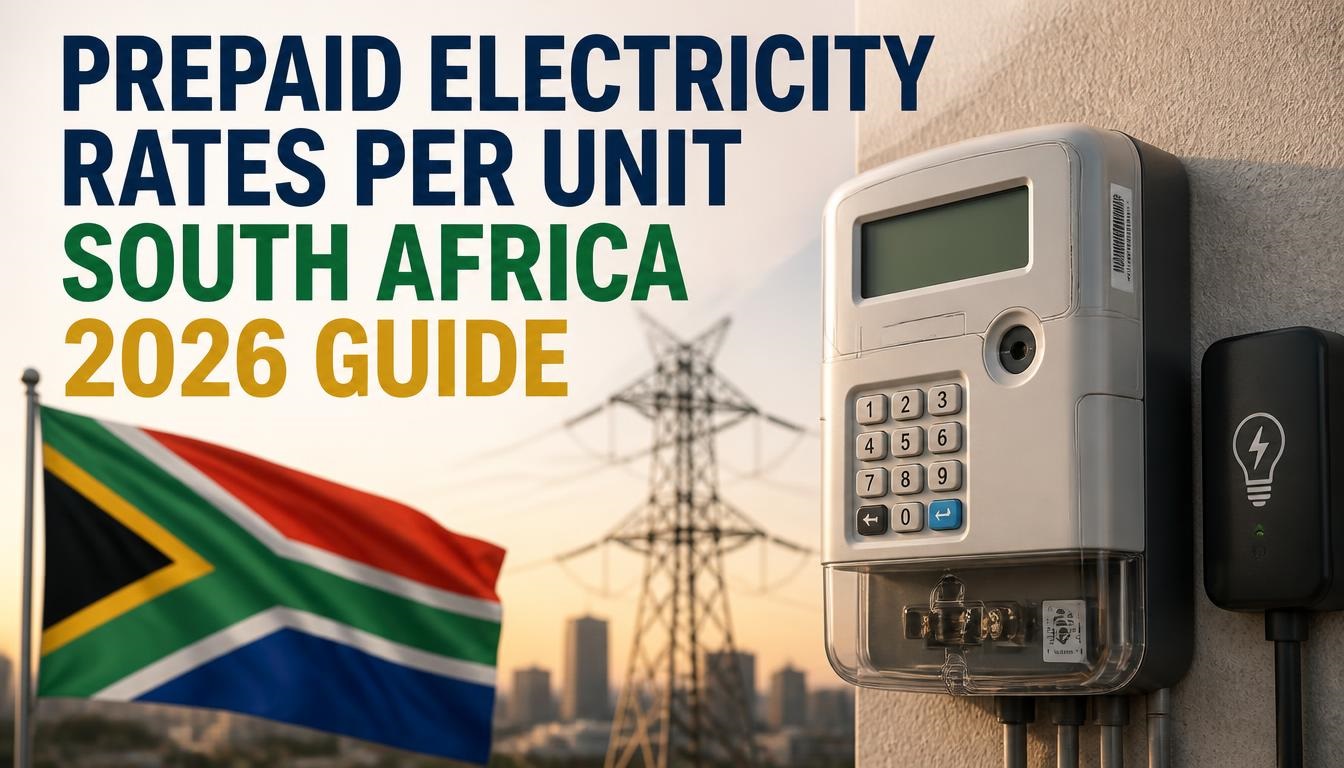
When buying R200 of prepaid electricity in South Africa, receiving drastically different unit quantities depending on whether you purchase on the 1st or the 28th of the month is a reality that frustrates millions of households. As NERSA-approved municipal tariff hikes compound year after year—pushing national residential tariffs well above R2.70 to R5.10 per kWh—navigating South Africa’s fragmented electricity landscape has become essential for household budgeting. Between Eskom Direct tariffs, complex municipal Incline Block Tariffs (IBT), monthly basic capacity charges in metros like Johannesburg and Cape Town, and hidden vendor processing fees, calculating the true price per kilowatt-hour (kWh) requires a clear breakdown.
As an independent retail data analyst and consumer electronics specialist tracking South African utility pricing, this guide cuts through confusing municipal schedules to provide an empirical analysis of prepaid electricity rates across Eskom and major South African metros. Below is a comprehensive breakdown of current per-unit costs, hidden vendor deductions, monthly reset mechanics, and actionable strategies to maximize your token yield every month.
At a Glance: ZAR Price Breakdown
Across South Africa, prepaid electricity is not sold at a uniform national price. Instead, rates vary based on your electricity distributor, your monthly consumption bracket, and whether your local municipality levies fixed daily or monthly service surcharges.
-
Eskom Direct (Homelight 20A Tariff): R2.71 per kWh (incl. 15% VAT) flat rate for direct Eskom-supplied residential customers.
-
City Power Johannesburg (Prepaid High): R3.34 per kWh for Block 1 (0–350 kWh), rising to R3.83 per kWh for Block 2 (351–500 kWh) and R4.37 per kWh for Block 3 (501+ kWh), plus a compulsory R241.50 per month fixed service/capacity surcharge.
-
City of Cape Town (Home User Tariff): R3.43 per kWh for Block 1 (0–600 kWh) and R4.56 per kWh for Block 2 (601+ kWh), accompanied by a R424.30 per month fixed service charge for properties valued above R1 million.
-
City of Tshwane (Pretoria): R3.73 per kWh for Block 1 (0–100 kWh), R4.36 per kWh for Block 2 (101–450 kWh), R4.75 per kWh for Block 3 (451–650 kWh), and R5.12 per kWh for Block 4 (650+ kWh).
-
eThekwini Municipality (Durban): R4.17 per kWh flat residential rate with zero Incline Block Tariff scaling and zero fixed daily service charges.
Major Metro & Utility Tariff Comparison Matrix
Understanding where your municipality ranks in terms of per-unit energy costs, block structures, and mandatory basic fees is crucial when budgeting for home power. The table below outlines the current residential prepaid electricity rates across South Africa’s primary distribution regions.
| Utility / Municipality | Tariff Classification | Block 1 Rate (incl. VAT) | Block 2 / Higher Rate (incl. VAT) | Fixed Monthly Fee (incl. VAT) | Annual Value Rating |
| Eskom Direct | Homelight 20A Prepaid | R2.71 / kWh (0+ kWh flat) | N/A (Flat Rate) | R0.00 | Exceptional Value |
| City Power Johannesburg | Residential Prepaid High | R3.34 / kWh (0–350 kWh) | R3.83 / kWh (351–500 kWh) / R4.37 / kWh (501+ kWh) | R241.50 | Moderate / Fee Heavy |
| City Power Johannesburg | Residential Prepaid Low (Indigent) | R3.34 / kWh (0–350 kWh) | R3.83 / kWh (351–500 kWh) / R4.37 / kWh (501+ kWh) | R0.00 | Excellent (Low Income) |
| City of Cape Town | Domestic User (Standard) | R3.43 / kWh (0–600 kWh) | R4.56 / kWh (601+ kWh) | R0.00 | High Overall Value |
| City of Cape Town | Home User (Valuation > R1M) | R2.88 / kWh (0–600 kWh) | R3.98 / kWh (601+ kWh) | R424.30 | Good for High Usage |
| City of Cape Town | Lifeline Tariff (Subsidised) | R2.27 / kWh (0–350 kWh) | R2.27 / kWh (350+ kWh) | R0.00 | Exceptional (Subsidised) |
| City of Tshwane (Pretoria) | Residential IBT Prepaid | R3.73 / kWh (0–100 kWh) | R4.36 / kWh (101–450 kWh) / R5.12 / kWh (650+ kWh) | R0.00 | Premium Per-Unit |
| eThekwini (Durban) | Single-Phase Residential | R4.17 / kWh (Flat Rate) | N/A (Flat Rate) | R0.00 | Fair / Predictable |
| Nelson Mandela Bay | Residential IBT | R3.28 / kWh (0–350 kWh) | R4.12 / kWh (351+ kWh) | R0.00 | Balanced Value |
| Mangaung (Bloemfontein) | Centlec Residential | R3.62 / kWh (0–300 kWh) | R4.48 / kWh (301+ kWh) | R0.00 | Standard Municipal |
Purchasing electricity in South Africa involves more than simply multiplying your Rand value by the advertised unit cost. Several hidden structural mechanics frequently cause consumers to receive far fewer units than anticipated.
1. Incline Block Tariff (IBT) Escalation Traps
The Incline Block Tariff structure was designed by NERSA to encourage energy conservation and cross-subsidize low-income households. Under IBT, the price per unit increases as your cumulative purchases cross predefined monthly kilowatt-hour thresholds.
If you purchase R1,000 worth of electricity on the 1st of the month, all units are billed at the lower Block 1 rate. However, if you top up with another R1,000 on the 20th of the month after consuming 500 kWh, your second purchase crosses into Block 2 or Block 3. At this higher tier, the exact same R1,000 spend delivers up to 25% to 35% fewer units.
2. Automatic Municipal Basic Fee Deductions
If your municipality levies a fixed monthly service or network access fee (such as Johannesburg’s R241.50 Prepaid High surcharge or Cape Town’s R424.30 Home User charge), this amount is automatically deducted from your very first electricity token purchase of the calendar month.
If you buy a R250 token in Johannesburg at the start of the month:
-
Statutory fixed charge deducted: R241.50 (incl. VAT)
-
Remaining balance for energy units: R8.50
-
Units issued: Approximately 2.5 kWh
This automated deduction often leads consumers to believe they have been defrauded by the token vendor, when in reality their municipality has recovered its monthly administrative baseline fee.
3. Third-Party Vendor Administration Convenience Fees
While major banking applications (such as FNB, Capitec, Standard Bank, Nedbank, and Absa) and major supermarket Money Market counters (Shoprite, Checkers, Pick n Pay) issue tokens without added service markups, informal spaza shop terminals, unverified online portals, and emergency SMS top-up services often add hidden convenience charges ranging between R2.50 and R15.00 per transaction, or deduct a percentage convenience fee directly from your token value.
4. Municipal Debt Recovery and Arrears Deductions
Under South African municipal bylaws, local councils are legally permitted to link municipal rates, water arrears, refuse collection debts, or historical traffic fines directly to your prepaid electricity meter software. If your account holds outstanding municipal debt, systems in cities like Tshwane, Ekurhuleni, or City Power will automatically deduct between 30% and 50% of every prepaid token purchase to service that debt before converting the remainder into electricity units.
Step-by-Step Unit Optimization Framework
To get maximum value out of every Rand spent on prepaid electricity, you need to understand how municipal metering algorithms calculate purchases. Following this strategic framework will help keep your energy costs as low as possible.
Step 1: Calculate Your Household’s Monthly Baseline Consumption
Before buying electricity tokens, determine your family’s actual monthly energy usage in kilowatt-hours rather than in Rand values. Look at your previous meter tokens or smart meter history over a 90-day period.
-
Small Household (1–2 People): Average consumption sits between 150 kWh and 300 kWh per month.
-
Medium Household (3–4 People): Average consumption sits between 350 kWh and 600 kWh per month.
-
Large Household (5+ People / Heavy Appliances): Average consumption typically exceeds 650 kWh per month.
Step 2: Time Your Token Purchases on the 1st Day of the Month
Because all municipal IBT systems reset their consumption counters back to zero at 00:01 on the first day of every calendar month, your initial purchase of the month always secures the absolute lowest unit rate (Block 1). Never buy large top-up tokens on the 28th, 29th, or 30th of a month if you can avoid it, as those purchases will be processed at higher IBT rates. Instead, buy only what is necessary to bridge the gap until the 1st of the next month.
Step 3: Implement Strategic Split-Purchasing (The Batch Strategy)
Rather than buying a single R2,000 token at the beginning of the month, split your purchases into smaller batches aligned with your municipality’s block tiers.
For example, in a municipality with a 350 kWh Block 1 limit priced at R3.34 per kWh:
-
Calculate the exact Rand value required to reach 350 kWh: 350 kWh multiplied by R3.34 equals R1,169.00.
-
Purchase exactly R1,169.00 on the 1st of the month to maximize your cheap Block 1 allocation.
-
Track your meter carefully. Only buy your next token when your physical balance runs low. This prevents prematurely pushing your monthly token tally into expensive higher tiers before you actually need the power.
Step 4: Audit Your Meter Tariff Categorization
Contact your local municipality or check your token printout to verify whether your property is correctly classified. If you are a low-income household earning under your municipality’s social threshold, ensure you are registered on the Indigent / Prepaid Low Tariff. This simple verification can exempt you from monthly fixed fees worth R2,800+ per year and grant you access to free basic electricity (FBE) allocations ranging from 50 kWh to 100 kWh per month.
Monthly Budget vs. kWh Yield Breakdown
To illustrate how far your money actually goes across different spending levels, the table below maps common monthly prepaid spending tiers against the approximate kilowatt-hours delivered across Eskom Direct, City Power Johannesburg, and the City of Cape Town.
| Monthly Budget (ZAR) | Eskom Direct Yield (kWh Delivered) | City Power Joburg Yield (Prepaid High) | City of Cape Town Yield (Domestic Standard) | Real-World Household Usability Level |
| R100 | 36.9 kWh | 0.0 kWh (R100 absorbed by basic fee) | 29.2 kWh | Emergency lighting & phone charging for 3 days |
| R300 | 110.7 kWh | 17.5 kWh (After R241.50 basic fee) | 87.5 kWh | Ultra-lean single person / studio apartment |
| R500 | 184.5 kWh | 77.4 kWh (After R241.50 basic fee) | 145.8 kWh | Basic 1-2 person energy-conscious household |
| R1,000 | 369.0 kWh | 227.1 kWh (Enters Block 2 at 350kWh) | 291.5 kWh | Standard 3-person family household requirement |
| R1,500 | 553.5 kWh | 362.4 kWh (Crosses into Block 2) | 437.3 kWh | Full family home with electric geyser & cooking |
| R2,500 | 922.5 kWh | 591.3 kWh (Crosses into Block 3) | 701.8 kWh (Crosses into Block 2) | Large family home with pool pump & air conditioning |
Real-World Expert Deal Commentary & Purchasing Strategy
Expert Insider Tip for South African Consumers: “The most common financial mistake South Africans make with prepaid meters is buying large ‘buffer’ electricity tokens at the end of the month when they receive their salary around the 25th. Buying R1,500 worth of units on the 25th forces your purchase directly into higher IBT penalty blocks if you have already consumed your monthly allocation.If you get paid on the 25th, buy just enough electricity—say R100 or R200—to safely carry your home through to the 1st day of the new month. On the morning of the 1st, when your municipal block counter automatically resets back to zero, buy the rest of your monthly supply. That simple habit shift can save a medium-sized household between R150 and R400 every month without reducing energy consumption by a single watt.”
Eskom Direct vs. Municipal Supply: What You Really Pay Per Unit
A major source of confusion for South African property buyers, tenants, and landlords is the massive price gap between customers supplied directly by Eskom Distribution and those supplied by Local Municipal Distributors.
-
Eskom Direct (Homelight 20A): Flat R2.71 per kWh with zero fixed monthly service charges.
-
Municipal Distributors (e.g. Joburg, Cape Town, Tshwane): Ranging up to R5.12 per kWh plus fixed monthly fees reaching up to R424.30 per month.
Why Does This Massive Price Difference Exist?
-
Bulk Purchasing & Distribution Markups: Municipalities purchase bulk electricity from Eskom under National Energy Regulator of South Africa (NERSA) Megaflex wholesale rates. Municipalities then add distribution markups to cover local grid maintenance, cable theft repairs, transformer replacements, and administrative operational costs.
-
Municipal Revenue Cross-Subsidization: In almost all South African local councils, electricity sales serve as a primary revenue generator used to subsidize non-revenue-generating municipal services, such as public road repairs, park maintenance, and free basic services for indigent communities.
-
Infrastructure Maintenance Fees: Metros with aging infrastructure frequently introduce fixed monthly service and capacity charges to finance capital restoration projects. This is why a resident in Sandton on City Power pays significantly more per unit overall than a rural resident in the Eastern Cape billed directly on Eskom Homelight.
Third-Party Vendors, Banking Apps & Transaction Surcharges
Where you buy your electricity token impacts both convenience and security. Below is an analysis of the primary purchasing channels in South Africa:
1. Major Banking Apps (FNB, Capitec, Standard Bank, Nedbank, Absa, Discovery Bank)
-
Transaction Fee: R0.00 (Zero fee on primary banking apps).
-
Reliability: High (Direct API connection to municipal vending servers).
-
Advantages: Instant token history tracking, automated monthly scheduled top-ups, and direct meter validation.
-
Limitations: Municipal server downtime during high-traffic windows (such as the 1st day of the month between 17:00 and 20:00) can occasionally delay token delivery via SMS or app notification.
2. Retail Supermarket Counters (Shoprite, Checkers, Pick n Pay, Spar, Usave)
-
Transaction Fee: R0.00 (Zero markup).
-
Reliability: High (Utilize enterprise vending networks such as EasyPay and PrePaidWorld).
-
Advantages: Allows cash transactions, physical printed paper slips (useful for backing up key numbers), and integration with store loyalty rewards programs (e.g., Smart Shopper, Xtra Savings).
-
Limitations: Requires physical queueing in-store.
3. Informal Spaza Shop Terminals & Third-Party Aggregators (Kazang, Flash, UniPin)
-
Transaction Fee: R0.00 to R5.00 depending on vendor setup.
-
Reliability: Moderate to High.
-
Advantages: Convenient neighbourhood access in townships and rural areas where formal bank branches or supermarkets are absent.
-
Limitations: Certain terminal operators apply unauthorized manual service surcharges at checkout. Always check your receipt against the cash handed over.
Frequently Asked Questions
Why did I get fewer units for the exact same amount of money this week?
Getting fewer units for the same Rand amount usually happens for one of two reasons: either your cumulative purchases for the current calendar month crossed an Incline Block Tariff (IBT) threshold into a more expensive pricing block, or your municipality deducted its monthly fixed basic service charge (e.g., City Power’s R241.50 or Cape Town’s R424.30) from your first token purchase of the month.
Do prepaid electricity tokens expire if I don’t input the code into my meter immediately?
Prepaid electricity tokens generated via South African vending systems (KMN/STs standard) do not strictly expire within 24 hours. However, tokens are bound to the specific meter number entered during purchase. It is strongly recommended to enter the 20-digit token code into your keypad UI unit immediately, as lost tokens require an administrative reprint request through your bank or vendor. Additionally, global KMS meter updates require older tokens to be loaded sequentially before new ones will be accepted.
Can I change my meter from a Municipal Prepaid meter to Eskom Direct to get cheaper rates?
No. You cannot arbitrarily switch your distributor. Your electricity provider is determined strictly by geographic and electrical infrastructure distribution rights granted under NERSA licenses. If your residential property falls within a municipal supply zone, your meter must run on that municipality’s approved tariff schedule. You cannot request an Eskom Direct connection if the local distribution grid is owned and maintained by your municipal council.
What happens if I make a mistake and enter the wrong meter number on my banking app?
Prepaid electricity vending systems validate meter numbers against municipal registries before processing payment. If you enter an invalid meter number, the transaction will fail and your funds will be reversed. However, if you accidentally enter a valid meter number belonging to a neighbor or another household, the token will be generated for that external meter. Because electricity tokens are cryptographically generated specifically for a single meter number, those units cannot be transferred to your meter, and banks generally cannot reverse successfully issued digital tokens. Always double-check your 11-digit or 13-digit keypad meter number before confirming payment.
Community Price Reviews
Sharing real-world pricing experiences helps other South African households audit their utility bills and spot hidden charges.
-
How many units does R500 buy on your local meter this month?
-
Has your municipality added new basic service fees or arrears deductions to your token purchases?
-
Which banking application or vending platform do you find most reliable when municipal servers experience high traffic on the 1st of the month?
Leave your municipality, tariff bracket, and recent token yields in the comments section below to contribute to our national consumer pricing database.
Important Price Notice
Disclaimer: This article serves strictly as an independent consumer review, pricing analysis, and educational guide for South African households. Electricity tariffs, Incline Block Tariff thresholds, and municipal basic charges are subject to annual revisions approved by the National Energy Regulator of South Africa (NERSA), effective on April 1st for Eskom Direct customers and July 1st for municipal customers under local MTREF budgets. While every effort is made to maintain absolute data precision using live municipal schedules, readers should verify their specific meter category and account status directly with their local distributor (e.g., City Power, City of Cape Town, City of Tshwane, eThekwini, or Eskom) before making major financial decisions.

Joseph Mathebula is a consumer tech analyst and market researcher at Prices in South Africa. He specializes in tracking smartphone prices and consumer electronics, helping everyday shoppers navigate the market to secure the best value.
Post Disclaimer
Prices and availability are subject to change without notice and may vary by store or region. pricesinsouthafrica.co.za is an independent informational platform; we do not sell products directly, nor are we responsible for third-party pricing errors.