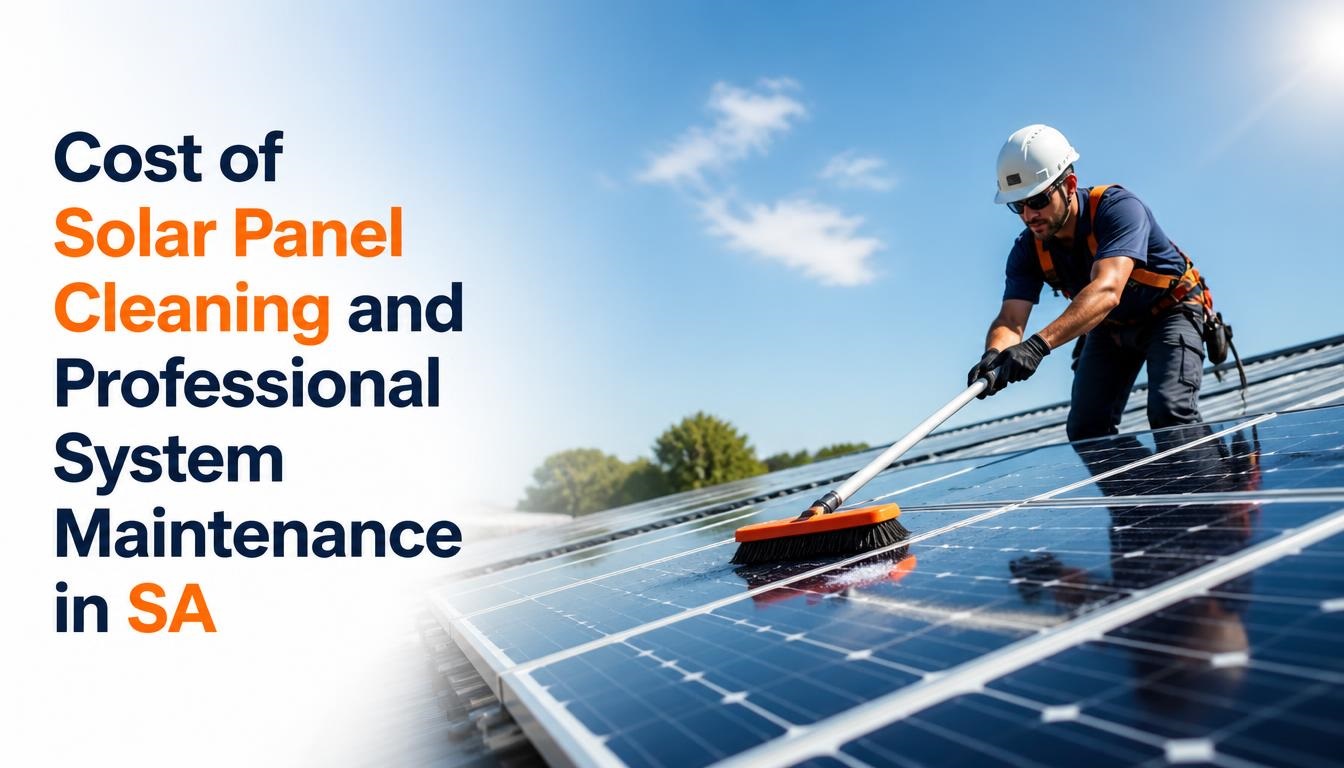
2026 Outlay Overview: R450 – R2,800 per service visit (depending on panel count, roof height, and thermal imaging demands)
Primary Surcharge Factor: Site accessibility, roof incline, and water filtration requirements (deionised/purified water systems)
Lowest-Cost Route: DIY maintenance using specialized non-abrasive telescopic wash poles (R899 at Builders) vs basic call-outs (R420 + R35/panel)
Consumer Recommendation: Schedule professional cleaning twice yearly (post-pollen spring and late winter) combined with an annual electrical thermographic audit to maintain warranty compliance and optimize yield.
2026 Photovoltaic Maintenance and Upkeep Landscape in South Africa
The rapid adoption of residential and commercial rooftop solar installations across South Africa—driven by grid instability and rising municipal tariffs—has shifted focus toward post-installation operational efficiency. While solar PV arrays have no moving mechanical parts, environmental factors specific to Southern Africa significantly impact power generation. Airborne dust across the Highveld, coal ash in Mpumalanga, coastal salt spray in KwaZulu-Natal and the Western Cape, and urban soot accumulate rapidly on solar glass.
Accumulated dirt creates sub-optimal operating conditions known as “soiling loss.” Field studies across Gauteng and Western Cape installations show that heavy soiling reduces power output by 12% to 28% over six months. Because solar strings operate sequentially, a single heavily soiled or bird-dropping-covered panel drags down the total amperage of the entire string, resulting in noticeable generation losses.
Proper maintenance extends beyond spray-washing with tap water. South African municipal water contains high concentrations of dissolved minerals (TDS). Washing panels with unfiltered municipal water leaves calcium and lime deposits that permanently etch into solar glass, creating micro-reflections that decrease long-term light conversion. Professional servicing incorporates deionised pure-water filtration systems, non-abrasive telescopic brush gear, and electrical diagnostics to preserve manufacturer warranties from Tier-1 brands like Canadian Solar, JA Solar, Longi, and SunSynk.
Complete ZAR Cost Matrix for Solar Servicing and DIY Equipment
| Service Category / Equipment Item | Scope / Specification | Average Local Price (ZAR incl. VAT) | Stockist / Provider Type |
| Standard Call-Out Base Fee | Greater Joburg, Pretoria, Cape Town urban zones | R420.00 – R650.00 | Regional Solar Service Specialists |
| Per-Panel Residential Cleaning Fee | Ground level / Standard pitched roof (1–20 panels) | R35.00 – R60.00 per panel | Dedicated Solar Cleaners |
| Commercial Per-Panel Tier Rate | Medium arrays (50–100 panels) | R25.00 – R30.00 per panel | Commercial Facility Maintenance |
| Large Commercial/Industrial Array | High-volume arrays (1,000+ panels) | R10.00 – R15.00 per panel | Industrial Solar Operations |
| Full Diagnostic & Cleaning Combo | Thermal imaging, torque checks, array wash (12 panels) | R1,450.00 – R2,200.00 | Certified Master Electricians / PV Installers |
| Inverter & Battery Annual Audit | Firmware updates, terminal retightening, SOC checks | R850.00 – R1,500.00 | Registered SAPVIA PV GreenCard Technicians |
| Telescopic Water-Fed Solar Pole (6m) | Aluminum, internal hose, soft boar-bristle head | R1,299.00 – R1,850.00 | Builders Warehouse / Leroy Merlin |
| Deionising Resin Water Filter Vessel (12.5L) | Produces 0-TDS pure water to prevent limescale | R2,499.00 – R3,400.00 | Takealot / Specialist Irrigation Outlets |
| Biodegradable Neutral Solar Cleaner (5L) | Non-abrasive, static-reducing cleaning agent | R280.00 – R450.00 | Makro / Online Direct |
Detailed Financial Breakdown of Solar System Servicing Operations
Understanding standard industry billing structures helps homeowners and estate managers avoid unexpected call-out charges. Most South African solar maintenance companies structure their invoices using a two-tier model: a fixed baseline call-out charge plus a variable per-panel fee.
Formula:
Total Service Cost = Base Call-Out Fee + (Per-Panel Rate × Panel Count) + Access/Height Surcharges
1. Residential Array Pricing Models
For a standard South African household operating an 8-panel to 14-panel system on a single-story roof, total costs typically range between R700.00 and R1,250.00 per visit.
-
Small Suburban System (6 to 10 Panels): R450 base call-out + (R40 × 8 panels = R320) = R770.00 incl. VAT.
-
Medium Suburban System (12 to 20 Panels): R500 base call-out + (R35 × 16 panels = R560) = R1,060.00 incl. VAT.
-
Large Estate Installation (24 to 40 Panels): R650 base call-out + (R30 × 32 panels = R960) = R1,610.00 incl. VAT.
2. Comprehensive Annual Preventive Maintenance
Pure cleaning removes surface soil, but electrical safety checks address potential fire risks and yield issues. Premium service providers offer combined packages that include thermal imaging and system inspection alongside panel washing.
-
Thermographic Inspection (FLIR Thermal Imaging): Identifies micro-cracks, damaged bypass diodes, and dangerous cell hotspots invisible to the naked eye. Expect to pay a R650.00 to R1,100.00 add-on fee for a complete thermographic report.
-
Electrical Safety & Torque Audit: Technicians use torque wrenches to check mounting rail clamps, inspect MC4 connector seals for water ingress, verify isolator switches, and run voltage-open-circuit ($V_{oc}$) tests on each string. This comprehensive service typically costs R1,850.00 to R2,800.00 total for a residential setup.
Field Observations and Hands-On Technical Insights
Evaluating solar maintenance across various South African environments highlights several critical technical factors:
-
Tap Water Washing: High Mineral Content (TDS) $\rightarrow$ Limescale Crust $\rightarrow$ Permanent Loss of Transparency
-
Filtered Deionised Water: Zero Minerals $\rightarrow$ Dries Spot-Free $\rightarrow$ Optimal Irradiance Conversion
The Pitfalls of Tap Water and High-Pressure Washing
A common mistake among home users is cleaning panels with a standard garden hose or pressure washer during sunny afternoons.
-
Thermal Shock Risk: Solar panel glass operating under midday South African sunshine reaches temperatures between $55^\circ\text{C}$ and $75^\circ\text{C}$. Blasting cool tap water ($18^\circ\text{C}$) onto hot tempered glass causes rapid thermal contraction, shattering or micro-fracturing the surface layer. This immediately voids manufacturer warranties.
-
Pressure Damage: High-pressure washers force water past the IP67/IP68 rubber gaskets on the panel frame edges or into backsheet junction boxes, leading to earth-leakage trips on your inverter. Pressure levels should never exceed 35 bar, and water must be applied with soft-bristle brushes.
-
Hard Water Scaling: Tap water in regions like Tshwane, Ekurhuleni, and parts of the Western Cape carries high mineral levels. As water evaporates off hot glass, white calcified spots remain. Over 12 to 18 months, this scale builds up at the lower aluminum lip of the panel, trapping dirt and blocking lower cell strings.
Regional Contamination Profiles
-
Highveld & Inland (Gauteng, Free State): Fine red dust accumulation peaks between July and October during dry, windy winter months. Combined with morning frost, this forms a thin clay-like film that requires gentle, specialized neutral detergents to dissolve.
-
Coastal Regions (Durban, Port Elizabeth, Cape Peninsula): Salt mist binds with ambient humidity to form a sticky film. Rain does not wash this away; instead, it bakes the salt into the glass. Coastal arrays require quarterly cleaning to prevent frame corrosion and preserve light penetration.
-
Agricultural & Bushveld Areas: Pollen and bird droppings are the primary issues here. Bird droppings cause severe “hotspotting” by completely obscuring individual cells. This forces current around the blocked cell, causing extreme localized heating that can burn through the rear backsheet.
Frequently Asked Questions
How often should solar panels be cleaned in South Africa?
For most urban residential setups, cleaning panels twice per year is sufficient—ideally in late autumn (after bird-nesting season) and early spring (after winter dust accumulation). Coastal areas or properties near high-dust dirt roads, industrial sites, or agricultural zones may require quarterly maintenance.
Will rain wash my solar panels sufficiently?
Rain removes loose surface dust, but it cannot dissolve stubborn contaminants like bird droppings, soot, salt crust, or tree sap. Heavy rains often leave dirty residue rings along the bottom frame edges, which can shadow lower cell rows and drop overall string output.
Does cleaning solar panels void the manufacturer warranty?
Inappropriate cleaning methods will void your warranty. Using abrasive chemical cleaners, harsh scrubbing pads, tap water that leaves mineral deposits, or high-pressure sprayers can void guarantees from brands like Canadian Solar or JA Solar. Always use pure deionised water and soft brush systems.
Can I clean my solar panels myself to save money?
Yes, if you can access your roof safely with appropriate fall protection gear. Invest in a dedicated telescopic extension pole equipped with a soft brush and an inline water filter kit (available at Builders or Takealot for R1,200–R2,500 total). Never step directly on panels or lean heavily against their frames.
What causes an inverter to trip after panel cleaning?
Inverter earth-leakage trips occur when water penetrates damaged MC4 wire connectors, compromised junction boxes, or improperly sealed isolator enclosures. Professional technicians inspect these seals before washing to prevent moisture ingress.
Local Retailers and Service Providers Comparison
DIY Supply Chains (Hardware & Outlets)
-
Builders Warehouse: Stocks telescopic cleaning poles (4m–6m options ranging from R899.00 to R1,499.00), soft boar-bristle brush heads, and non-conductive extension ladders.
-
Takealot: Offers imported 12-liter deionising resin vessels (R2,499.00 – R3,200.00) alongside specialized concentrated solar washing solutions.
-
Leroy Merlin: Sells complete water-fed pole cleaning kits, roof safety harnesses, and specialized pressure regulators suitable for low-bar solar washing.
Service Providers & Contractors
-
Specialist Solar Cleaning Agencies: Dedicated local companies (e.g., Solar Clean Cape, Panel Boys, Gauteng Solar Shine) charge R35.00 to R60.00 per panel. They bring pure-water filtration rigs mounted on bakkies, ensuring a spot-free finish without using house electricity or tap water.
-
Certified PV GreenCard Installers: High-end maintenance contractors offer full structural, thermal, and electrical audits starting from R1,500.00 per visit. These services are ideal for maintaining commercial compliance and insurance requirements.
Practical Cost-Reduction and System Management Strategies
-
Install Anti-Soiling Hydrophobic Coatings: Professional application of a nano-ceramic hydrophobic coating (costing roughly R80.00 to R130.00 per panel) alters the surface tension of the glass. Water beads off instantly, carrying dirt with it and reducing cleaning frequency from twice a year to once every 18 months.
-
Fit Clip-On Water Drain Clips: Small plastic drainage clips (costing R12.00 to R25.00 each at solar trade outlets) snap onto the bottom frame lip of each panel. They drain standing water via capillary action, preventing dirty water from pooling and forming hard-water lines along the bottom row of solar cells.
-
Consolidate Service Calls with Neighbors: Service providers often waive or split their fixed R450–R650 call-out fees when multiple houses in the same street or residential estate schedule cleaning on the same day.
-
Prune Nearby Overhanging Trees: Overhanging branches contribute to soiling by dropping sap and providing perches for birds. Trimming trees reduces shading and cuts down on localized contamination.
Disclaimer: Prices listed in this guide reflect real-world retail rates and verified shelf prices at the time of publication. Actual store rates may fluctuate due to regional store promotions, stock availability, or installer call-out charges. Always confirm final figures directly with your preferred retailer or service provider before purchasing.
Maintaining clean, damage-free solar panels is key to maximizing energy yield and protecting your renewable energy investment. Whether you choose to assemble a pure-water DIY pole kit from local hardware outlets or hire a certified regional service team, keeping your array clean directly boosts daily kilowatt-hour production.
Have you recently had your home solar system serviced or noticed generation dips from dust accumulation? Share your experience, ask technical questions, or drop your local retailer quote details in the comments below to help fellow South African homeowners make informed choices.

Joseph Mathebula is a consumer analyst and market researcher at Prices in South Africa. He specializes in tracking local service costs, retail pricing, and travel budgets, helping everyday shoppers navigate the market to secure the best value.