Current Market Assessment: R1,800 – R3,800 (Standalone Inspection & Certificate Issuance)
Primary Cost Determinant: System Capacity (kW), Sub-DB Configuration & Pre-Existing SANS 10142-1 Non-Compliance
Most Affordable Verification Route: Turnkey Solar Installation Bundles (COC included at zero separate surcharge)
Expert Buying Guidance: Never separate your main general distribution board COC from your solar PV supplement; ensure your electrician holds a valid Department of Employment and Labour (DoEL) Wireman’s License with a Specialised Electrical Installations endorsement (Master Electrician / Registered Person).
Real-World Solar PV Certificate Compliance Rates in South Africa
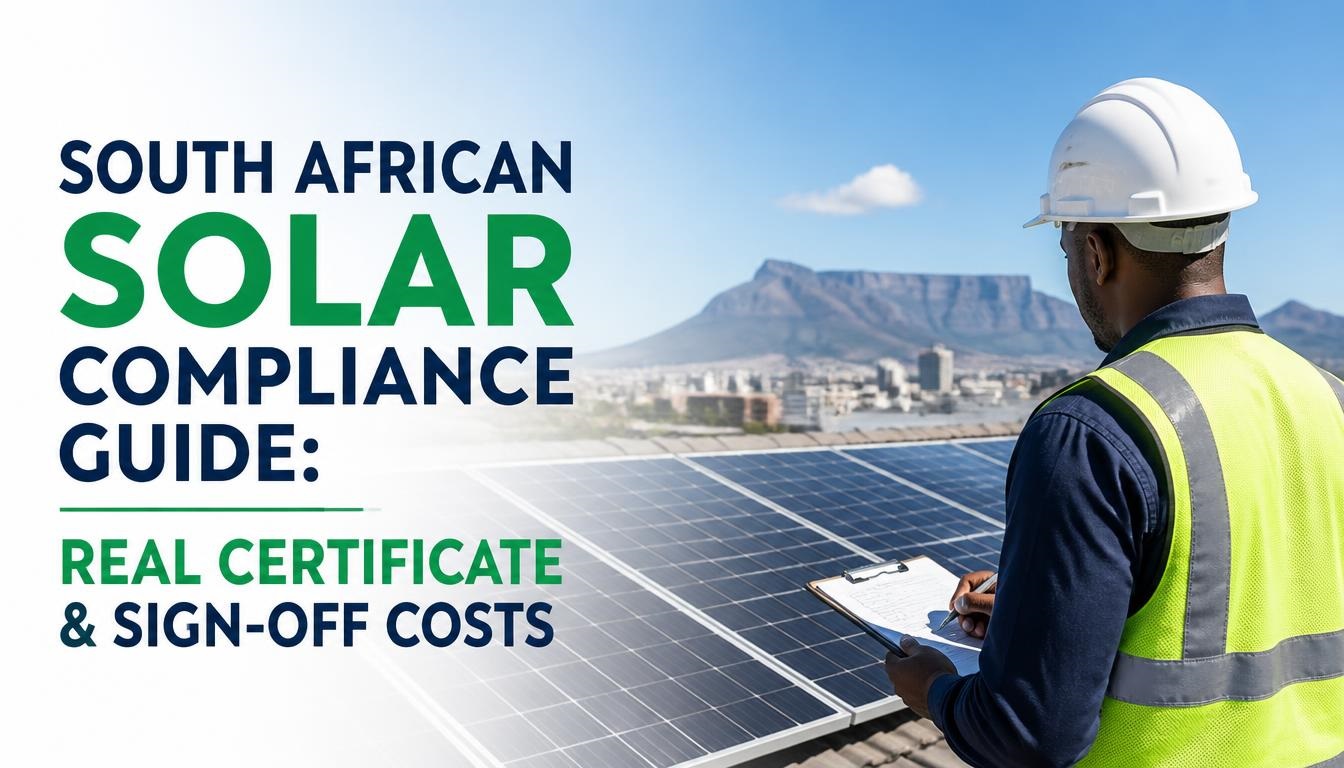
Securing a legitimate Solar Certificate of Compliance (COC) is the ultimate legal gateway for any rooftop solar PV, hybrid inverter, or battery backup system operating across South African residential properties. Under the Occupational Health and Safety Act (OHSA) and the Electrical Installation Regulations of 2009, a standard general electrical COC does not legally validate a solar installation. Homeowners require a dedicated SANS 10142-1 Annexure 1 supplementary certificate issued specifically for alternative energy systems.
Without this document, home insurance policies are instantly voided in the event of an electrical fire, municipal grid interconnection approvals (such as City of Cape Town SSEG or City Power Johannesburg registration) are rejected, and property sales cannot proceed past conveyancing attorneys.
| Service Category | Tariff Range (ZAR / R) |
| Basic Solar Inspection Call-Out Fee (1-2 Hours) | R750 – R1,200 |
| Standalone Solar PV COC Issuance (Standard Single-Phase) | R1,800 – R2,800 |
| Complex Three-Phase / Multi-Inverter Solar COC | R2,800 – R4,500 |
| Mandatory Earth Spike & Neutral-Earth Bond Retrofit | R1,200 – R2,500 |
| Surge Protection Device (SPD) Class II Installation | R1,500 – R2,800 |
| SSEG Municipal Grid Application & Engineering Sign-Off | R2,500 – R6,500 |
When an accredited electrician steps onto your property, they are taking on personal civil and criminal liability for the safety of your installation. Consequently, the price you pay for a Solar COC isn’t just a piece of paper—it covers the physical testing, insulation resistance checks, earth loop impedance measurements, and regulatory filing required by law.
Hands-On Field Observations During Solar COC Site Audits
Having evaluated dozens of domestic solar retrofits across Gauteng, the Western Cape, and KwaZulu-Natal, compliance failure on first inspection is extraordinarily high. Roughly 65% of existing solar setups installed by unregistered “fly-by-night” handymen fail their initial inspection, leading to unforeseen remediation bills before a COC can be lawfully signed off.
Common Solar Non-Compliance Failures & Repair Costs
-
Inadequate Isolation (DC/AC Disconnects): R850 – R1,800 Repair
-
Missing Earth Spike / Neutral-Earth Relay: R1,200 – R2,200 Repair
-
Incorrect Cable Sizing / Trunking & Conduit: R950 – R2,500 Repair
Critical Verification Checkpoints Every Inspector Evaluates
-
The Neutral-Earth (N-E) Bond Relay: During load shedding, a hybrid inverter disconnects from the Eskom or municipal grid and enters islanding mode. SANS 10142-1 mandates an automated neutral-earth bonding contactor to ensure that your home’s Earth Leakage protection continues to function while running on battery power. Missing N-E relays are the single most common reason for an immediate COC failure.
-
DC Isolator Placement & Enclosures: Solar PV panels generate lethal high-voltage direct current (up to 500V DC on long strings). Inspectors require rotary DC isolators within physical line-of-sight of the inverter, housed in UV-resistant, IP65-rated weatherproof enclosures. Cheap AC circuit breakers inappropriately used on DC circuits are immediately flagged for hazardous non-compliance.
-
Galvanised Earth Rod Installation: Even if your main DB board has an earth connection, solar PV arrays mounted on timber or steel roof trusses require a dedicated copper-clad earth spike driven deep into the ground (achieving an earth resistance reading strictly below 10 Ohms).
-
Mandatory Warning Labels & Signage: SANS 10142-1 requires clear, UV-stable red-and-yellow safety notices affixed to the main distribution board, sub-boards, and inverter points warning emergency personnel that dual power sources exist on site.
Direct Service Outlays Across Accredited South African Service Outlets
If you hire an independent registered electrician rather than utilizing a turnkey solar installer, inspection rates, hourly labor fees, and certificate issuing charges vary across service channels. Below is a snapshot of verified market costs across major metropolitan regions.
| Compliance Provider Category | Geographic Coverage | Average Call-Out Fee | Standalone COC Fee | Typical Remediation Cost Overhead |
| Independent Master Electricians | Nationwide | R650 – R950 | R1,800 – R2,500 | Variable (R1,200 – R3,500) |
| Turnkey Solar EPC Contracting Firms | Major Metros (JHB, CPT, DBN) | Included in quote | R0 (Bundled in System Cost) | Included in initial project proposal |
| ECA-SA / ECB Registered Inspectors | Gauteng & KZN | R850 – R1,200 | R2,200 – R3,200 | Inspection only (3rd party repairs required) |
| Real Estate Conveyancing Inspection Teams | Western Cape & Eastern Cape | R750 – R1,100 | R2,000 – R2,800 | High (often mark up emergency repair rates) |
Detailed Financial Breakdown: Base Inspection vs. Remediation Surcharges
To fully budget for your solar compliance exercise, you must separate the Inspection & Signing Fee from the Remedial Repairs Fee. An electrician is strictly prohibited from issuing a compliance certificate on a dangerous or non-compliant installation.
-
Initial Audit Path: A successful initial audit leads directly to Solar COC Issuance (R1,800 – R2,800).
-
Failed Audit Path: An initial audit failure requires a Remediation Quote (R1,500 – R5,000) followed by a mandatory re-inspection before final sign-off.
1. The Core Testing & Certification Fee (R1,800 – R2,800)
This baseline charge covers the registered electrician’s travel, professional indemnity insurance risk, physical deployment of specialized test instruments (Megger insulation testers, earth loop impedance meters), and administrative submission of official paperwork to the Electrical Contracting Board (ECB) or Department of Employment and Labour (DoEL).
2. Specialized DC Sub-DB Panel Integration (R1,500 – R3,200)
A compliant solar PV system cannot simply tap directly into your main house circuit breakers without dedicated protection. An accredited setup requires a dedicated Solar Sub-DB housing:
-
Type 2 Surge Protection Devices (SPD) for DC strings (R850 – R1,600).
-
Correctly rated DC Fuses/Miniature Circuit Breakers (R350 – R750).
-
Bi-directional AC circuit breakers for inverter output (R400 – R850).
3. Engineering Sign-Off & SSEG Municipal Registration (R2,500 – R6,500)
In municipalities like the City of Cape Town, Drakenstein, or Stellenbosch, a Solar COC alone is insufficient to keep your power turned on. You are legally mandated to register your Small-Scale Embedded Generation (SSEG) system. If your inverter is not on the municipal approved equipment list, or if your system exceeds 4.6kW single-phase capacity, a registered Professional Engineer (Pr.Eng) must physically review the single-line diagram (SLD) and sign off on the installation, adding R2,500 to R4,500 in professional engineering fees.
Smart Cost-Saving Tactics for South African Homeowners
-
Demand a Turnkey Quote Including Final COC: Never sign a solar installation agreement that lists the COC as an “optional extra” or “to be quoted separately upon completion.” Ensure the binding quote explicitly states: “Includes final SANS 10142-1 Annexure 1 Certificate of Compliance issued by a Department of Labour registered person.”
-
Verify the Electrician’s Department of Labour Card: Before allowing an inspector onto your roof, request their DoEL registration card (popularly known as the “Wireman’s License”). Ensure their category states Registered Person – Specialised Electrical Installations or Installation Electrician. A standard “Single Phase Tester” cannot legally sign off a solar inverter or battery installation.
-
Pre-Audit Your System Installation Visually: Inspect your own installation prior to the paid electrician visit. Are all cables enclosed in PVC conduit or trunking? Are the inverter and batteries mounted on non-combustible surfaces (like brick or cement board, not raw timber)? Fixing obvious mechanical flaws before the electrician arrives saves costly re-inspection fees.
-
Combine Your General Home Electrical COC with Your Solar COC: If you are selling your property, ask the electrician to conduct the general electrical inspection and the solar supplementary audit simultaneously. Bundling both certificates during a single site visit typically saves between R800 and R1,500 in dual call-out and administrative overheads.
Frequently Asked Questions
Can any registered electrician issue a Solar Certificate of Compliance?
No. Standard single-phase electrical testers are not legally authorized to certify alternative power sources like solar PV systems, hybrid inverters, or generators. The electrician must be registered with the Department of Employment and Labour as an Installation Electrician or Master Electrician, holding valid credentials to sign off SANS 10142-1 Annexure 1 documentation.
How long does a Solar COC remain legally valid in South Africa?
A Solar COC remains valid indefinitely for the specific installation certified, provided no structural alterations, inverter replacements, or additional solar panel strings are added to the system. However, if you sell your property, the conveyancing attorneys require an electrical compliance certificate that is not older than 2 years.
What happens if I operate my solar system without a valid COC?
Operating an uncertified solar PV installation creates major legal liabilities. Your property insurance provider will repudiate claims related to electrical fires, lightning strikes, or power surges. Additionally, your local municipality or Eskom can levy heavy fines or disconnect your grid supply for operating an unregistered grid-tied system.
Is a separate COC required if I only install a battery backup without solar panels?
Yes. Installing an inverter and lithium battery backup system connects an alternative power supply directly to your home’s electrical distribution network. Under SANS 10142-1 regulations, any fixed alternative supply installation mandates a supplementary Certificate of Compliance to certify safe isolation, neutral bonding, and earthing.
Disclaimer: Prices listed in this guide reflect real-world retail rates, verified electrician tariffs, and standard regulatory compliance fees at the time of publication. Actual service charges may fluctuate based on regional labor rates, property complexity, sub-DB configurations, or necessary remedial electrical work. Always confirm final binding quotes directly with a Department of Employment and Labour registered electrical contractor prior to commissioning work.
Navigating solar compliance doesn’t need to be an overwhelming financial surprise. By understanding the core testing parameters, ensuring your installer uses top-tier protection components, and verifying credentials up front, you secure both the legal integrity of your home and the long-term safety of your power system.
Have you recently completed a solar compliance inspection or faced unexpected remediation fees during a property sale? Drop your experiences, cost breakdowns, or questions in the comments below to help fellow South African homeowners make informed solar investments!

Joseph Mathebula is a consumer analyst and market researcher at Prices in South Africa. He specializes in tracking local service costs, retail pricing, and travel budgets, helping everyday shoppers navigate the market to secure the best value.