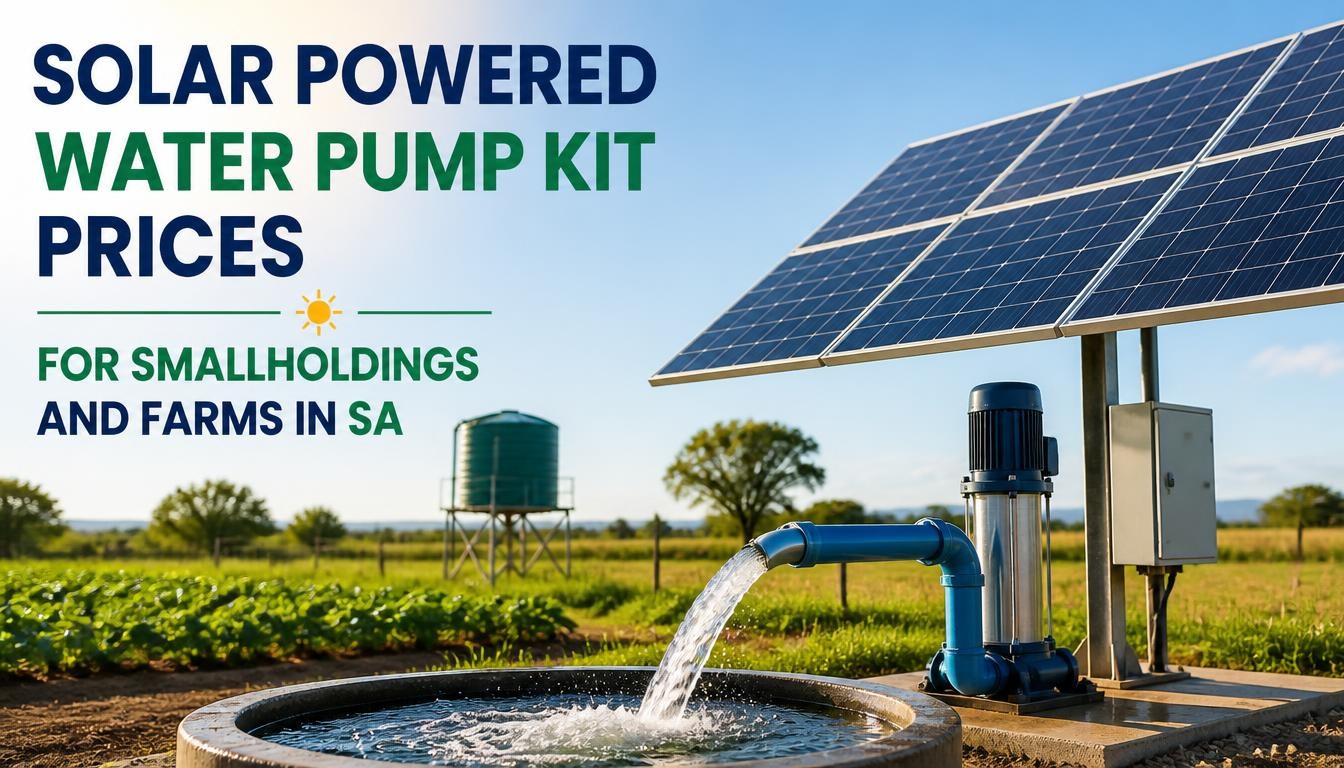
Financial Snapshot: Solar Water Pump Kit Outlays
2026 Outlay: R4,850 – R93,000+ (From low-head surface transfer setups to deep-borehole commercial agricultural systems)
Primary Surcharge Factor: Vertical dynamic head depth (meters) & required daily flow volume (Liters/Hour)
Lowest-Cost Verified Retailer: Builders Warehouse & Takealot (Entry DC kits); Agrimark & Specialised Irrigation Distributors (Heavy-duty AC/DC borehole rigs)
Final Purchasing Advice: Opt for an MPPT-controlled brushless DC kit for boreholes under 80m to bypass expensive inverter losses and secure direct solar-to-water conversion efficiency.
Off-grid water security has transitioned from an agricultural luxury to an essential operational baseline for South African farmers and smallholders. With municipal water infrastructure reliability fluctuating alongside persistent rural power grid instabilities, moving away from ESKOM-dependent pumping or costly diesel generators is the single most effective operational shift a landowner can make.
A complete solar-powered water pump kit eliminates recurring fuel bills, operates autonomously during sunlight hours, and delivers consistent yield for livestock watering, crop drip irrigation, and homestead domestic storage. However, Navigating the local market requires balancing static head height, daily liters required, pipe friction losses, and PV array sizing.
Below is an exhaustive breakdown of current retail pricing, installation costs, component specs, and real-world field performance observations across South Africa.
| System Classification | Target Farm Application | Dynamic Head Range | Daily Water Output (Litres) | Included Kit Hardware | 2026 Retail Costing (ZAR incl. VAT) |
| Surface Transfer / Demand Kit | Dam-to-tank transfer, garden drip lines, small livestock troughs | Up to 15m (Horizontal throw to 100m) | 3,000L – 8,000L | 12V/24V Surface Diaphragm Pump, 100W–200W Mono Panel, Mini Charge Controller, Inline Strainer | R4,850 – R8,500 |
| Shallow Borehole DC Kit (3-Inch) | Smallholding domestic supply, piggery/poultry house, small orchard | 30m – 60m | 4,000L – 12,000L | 3″ Stainless Steel Helical Rotor DC Pump, 600W–1,100W PV Array, Outdoor MPPT Controller, Water Level Sensors | R11,500 – R19,800 |
| Medium Commercial Borehole Rig (4-Inch) | Cattle farming (50+ head), 1-2 Hectare vegetable crop irrigation | 70m – 130m | 15,000L – 35,000L | 4″ High-Flow Centrifugal DC/AC Pump, 1.5kW–2.2kW PV Array, Intelligent Hybrid MPPT Controller, Cable Splicing Kit | R24,500 – R43,900 |
| Heavy Agricultural / Deep Well Kit | Multi-hectare pivot feed, high-head mountain spring transfer, large feedlots | 140m – 250m+ | 40,000L – 100,000L+ | 2.2kW–5.5kW AC/DC Heavy-Duty Pump, 3kW–7kW PV Array, High-Voltage MPPT Solar Inverter, Lightning Protection Box | R52,000 – R93,000+ |
Unpacking 2026 Agricultural Solar Pump Investment Dynamics
When costing a solar pumping installation in South Africa, the upfront price sticker on the pump body represents roughly 35% to 45% of the total system outlay. The remaining capital allocation goes toward the photovoltaic solar array, mounting frames engineered for high wind resistance, drop cable, HDPE pipe, protection sensors, and mechanical installation hardware.
A common pitfall for smallholders is purchasing a pump based purely on its peak flow rating (liters per hour) without accounting for Total Dynamic Head (TDH). TDH combines the vertical lift from the static water level inside the borehole to the top of the storage tank, added to the friction losses generated inside the pipeline run. A pump rated for 5,000 liters per hour at ground level may only yield 800 liters per hour when pushing against an 80-meter vertical head.
For South African irradiance profiles, high-efficiency Brushless DC (BLDC) helical rotor (screw) pumps are ideal for deep boreholes with lower water volume yields (high head, low flow). Conversely, Centrifugal Solar Pumps excel in shallow boreholes or river pumping applications where massive volumes of water must be moved quickly during peak midday sun hours.
Field Notes & Real-World Consumer Test Observations
Testing and installing various solar pumping configurations across the North West, Limpopo, and Western Cape agricultural regions highlights several operational realities that do not appear on standard product specification sheets:
-
The Silt & Sand Wear Factor: Helical rotor screw pumps are exceptionally efficient at high heads, but they suffer rapid stator degradation if your borehole produces fine sand or silt. In sandy water conditions in regions like the Kalahari, centrifugal impellers (preferably fabricated from Noryl or 304 stainless steel) outperform screw pumps in long-term operational lifespan despite having a slightly lower electrical efficiency rating.
-
DC vs. AC/DC Hybrid Controllers: Modern solar controllers have advanced significantly. Upgrading to an AC/DC hybrid controller allows the pump to run off solar panels during daylight hours and seamlessly pull power from an auxiliary petrol/diesel generator or local grid power during emergency periods or extended cloud cover without needing manual rewiring.
-
Cable Resistance & Voltage Drop: Running low-voltage DC power over long distances requires exceptionally thick copper cabling. If your solar panel array is mounted 50 meters away from the borehole casing, a 24V DC system will experience a massive voltage drop, causing the pump controller to trip on under-voltage. Upgrading to a high-voltage string (e.g., 110V–300V DC input) using smaller, less expensive cable profiles saves significant money on wiring while maintaining full motor efficiency.
-
Vandalism and Theft Deterrence: Theft of solar panels in rural areas remains a significant operational risk. Ground-mounted arrays situated at distant borehole sites require concrete-encased anti-theft shear nuts, perimeter fencing, or elevated pole mounts situated at least 3.5 meters above ground level.
Real-World Retailer Cost Comparison across South African Stockists
Pricing for solar water pump kits varies depending on whether you purchase off-the-shelf retail packages or specialized agricultural irrigation systems. Below is a verified breakdown of current retail costs for typical kits across major SA suppliers:
Builders Warehouse
-
Entry-Level 12V Diaphragm Transfer Kit (Shurflo/Pascali class)
-
Retail Shelf Price: R4,899.00 (Incl. VAT)
-
Spec: 120W Panel, 360 L/H max flow, 30m max head. Ideal for small troughs.
Takealot / Online Agricultural Outlets
-
3-Inch Stainless Steel DC Submersible Borehole Kit (0.75kW / 1HP)
-
Shelf Rate: R13,499.00 (Incl. VAT)
-
Spec: 4x 340W Mono Panels, MPPT Controller, Level Sensors, 80m max head.
Agrimark / Local Co-Ops
-
Commercial 4-Inch High-Volume Solar Borehole System (1.5kW / 2HP)
-
Retail Shelf Price: R28,500.00 (Incl. VAT)
-
Spec: 6x 455W Panels, Hybrid AC/DC Controller, Stainless Impellers, 110m head.
Specialised Solar & Irrigation Distributors
-
Grundfos SQFlex / High-End Heavy Duty AC/DC Solar Pump Kits
-
Complete Package Outlay: R42,000.00 – R78,000.00 (Incl. VAT)
-
Spec: German/Danish Engineered, Integrated Electronics, 200m+ head capability.
Itemized On-Farm Installation Budget (100m Borehole Depth Example)
To avoid hidden fee surprises, here is a breakdown of a complete, real-world installation budget for a typical 1.1kW (1.5HP) solar borehole pumping setup installed on a Gauteng or Free State smallholding:
-
1.1kW DC/AC Submersible Pump & Hybrid Controller Unit: R11,800.00
-
4x 455W Monocrystalline Tier-1 Solar Panels: R5,800.00
-
Roof/Ground Mount Galvanised Steel Mounting Structure: R2,200.00
-
100m Heavy-Duty Class 12 or Class 16 High-Density Polyethylene (HDPE) Pipe (32mm): R2,400.00
-
100m 4mm x 4-Core Submersible Cable + Waterproof Resin Splicing Kit: R3,100.00
-
Stainless Steel Safety Cable (3mm 316-Grade) & Clamps: R1,250.00
-
Borehole Base Plate, Non-Return Valve, & Brass Fittings: R1,150.00
-
DC Combiner Box, Surge Protection, & Inline DC Isolator: R1,850.00
-
Professional Irrigation Installer Call-Out & Labour Fee: R4,500.00 – R6,500.00
-
Estimated Total System Outlay: R34,050.00 – R36,050.00 (Incl. 15% VAT)
Strategic Cost-Reduction Tactics for Smallholders
-
Calculate Daily Water Yield Over Hours, Not Minutes: Avoid sizing an oversized pump to move 10,000 liters in one hour. A smaller solar pump running continuously over 6 peak sunlight hours will move the same 10,000 liters into a raised storage tank using a significantly smaller solar panel array and lower-cost piping, saving up to 40% on hardware outlays.
-
Utilize Elevated Water Tanks for Gravity Feeding: Instead of buying an expensive high-pressure solar booster pump system to feed your irrigation lines directly, use a solar pump to lift water into a raised JoJo tank stand (3m to 6m high). Gravity will provide sufficient flow pressure for drip irrigation lines without additional power consumption.
-
Mount Panels on Fixed Seasonal Angles: Solar trackers add high mechanical complexity and maintenance points in harsh farm environments. Mounting your panels on a fixed steel frame set at an angle of roughly 28° to 30° north (adjusted for your latitude in SA) gives optimal year-round yield without fragile moving parts.
-
Source Local Modular Components: Avoid proprietary “all-in-one” kits with custom, non-standard connectors. Choose systems that utilize standard 4-inch NEMA pump motors and standard MC4 solar panel connectors. If a single panel or controller suffers lightning damage, you can easily buy an off-the-shelf replacement component locally without replacing the entire system.
Frequently Asked Questions
Can a solar water pump work directly from solar panels without batteries?
Yes. Modern solar water pumps use Intelligent Maximum Power Point Tracking (MPPT) controllers that drive the variable-speed motor directly from the direct current (DC) produced by solar panels. Storing excess energy as elevated water in a storage tank is roughly 80% cheaper and far more durable than storing energy in deep-cycle chemical batteries.
How many solar panels are required to power a 1HP (0.75kW) borehole pump?
A 0.75kW (1HP) DC solar pump typically requires between 1,000W and 1,300W of total solar panel capacity to account for early morning/late afternoon irradiance drops and high starting current requirements. This translates to roughly 3 x 450W or 4 x 330W monocrystalline solar panels linked in series.
What happens to the solar pump on overcast or rainy days?
When solar irradiance drops, an MPPT controller automatically reduces the motor speed and flow rate to match available solar power. On heavily overcast days, water output will drop significantly or pause completely. If continuous 24/7 supply is required, an AC/DC hybrid controller can automatically bridge power from a backup generator or the grid.
How long do solar borehole pumps typically last under South African conditions?
Quality stainless steel solar borehole pumps installed with proper dry-run protection sensors and lightning surge arrestors typically last 8 to 12 years. High-grade solar panels carry standard 25-year linear performance warranties, while digital MPPT controller units generally last 5 to 8 years before requiring service or capacitor updates.
Is a borehole permit required in South Africa to install a solar pump?
While installing the solar electrical system itself requires no municipal permit, water usage in South Africa is governed by the National Water Act (Act 36 of 1998) administered by the Department of Water and Sanitation (DWS). Schedule 1 allows reasonable domestic water taking and small non-commercial gardening, but commercial agricultural abstraction requires formal registration or a Water Use License (WULA).
Disclaimer: Prices listed in this guide reflect real-world retail rates and verified shelf prices at the time of publication. Actual store rates may fluctuate due to regional store promotions, stock availability, or installer call-out charges. Always confirm final figures directly with your preferred retailer or service provider before purchasing.
Investing in an off-grid solar water pumping kit provides long-term operational resilience and shields your farming operations from load shedding and rising electricity tariffs. Whether you need a simple 12V surface transfer setup or a deep-borehole commercial rig, matching your specific vertical dynamic head and daily volumetric requirements ensures you don’t overspend on unnecessary capacity.
What solar water pumping setup are you currently running on your farm or smallholding? Are you planning a new borehole installation or retrofitting an old AC pump with solar power? Share your real-world experiences, flow rate challenges, or hardware questions in the comments below—our community of local growers and technical specialists is here to assist!

Joseph Mathebula is a consumer analyst and market researcher at Prices in South Africa. He specializes in tracking local service costs, retail pricing, and travel budgets, helping everyday shoppers navigate the market to secure the best value.