Top Callout Summary
-
Verified Market Compensation Matrix: R450,000 – R850,000+ per annum (Automotive Fleet Specialists & Technical Specialists)
-
Primary Entry Threshold: Trade Test Certificate / National Diploma in Automotive Engineering / Fleet Management Certification
-
Top Hiring Sectors in SA: Fleet Operations, Automotive Logistics, Transport Management, Government & Utility Fleet Services
-
Final Career Advisory Recommendation: Target 2.8 GD-6 expertise for heavy-commercial utility operations, or specialize in 2.4 GD-6 fleet cost optimization to maximize marketability across South African corporate logistics providers.
Toyota Fortuner GD-6 Fleet & Market Performance Overview
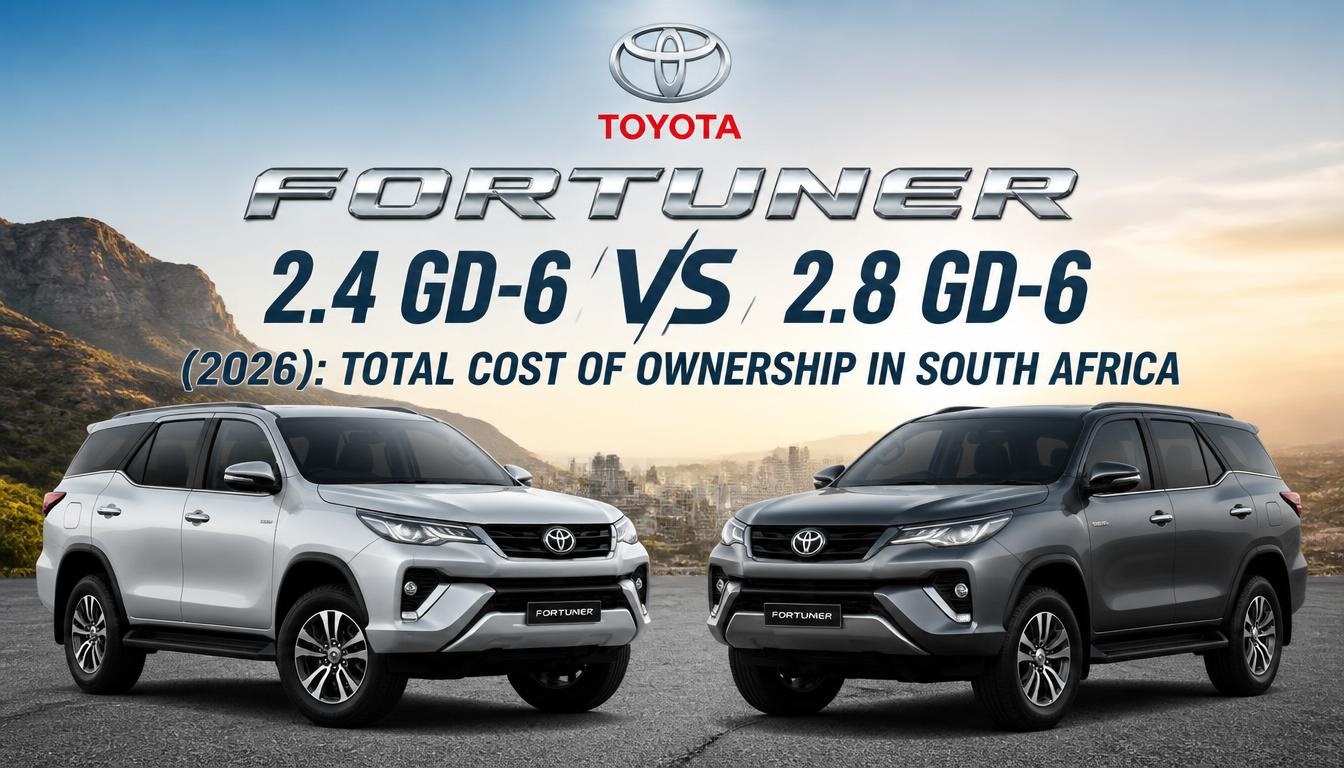
The Toyota Fortuner remains the undisputed market leader in South Africa’s medium SUV and commercial fleet support segments. Driven primarily by the 2.4-litre (2.4 GD-6) and 2.8-litre (2.8 GD-6) Global Diesel engine variants, this platform dominates both private ownership circles and corporate fleet deployments across the country. Understanding the precise financial dynamics, mechanical nuances, and total cost of ownership (TCO) between these two engine variants is essential for fleet managers, automotive technicians, procurement specialists, and private buyers evaluating long-term operational viability.
Both engines utilize Toyota’s ESTEC (Economy with Superior Thermal Efficient Combustion) technology, featuring variable nozzle turbochargers, common-rail direct injection, and robust cast-iron block designs. However, the operational demands placed on these vehicles differ significantly depending on the engine capacity, torque delivery profile, and associated drivetrain components. While the 2.4 GD-6 (2GD-FTV) targets fuel efficiency and moderate payload duties, the 2.8 GD-6 (1GD-FTV) delivers heavy-duty towing capacity, advanced electronic terrain management, and higher torque output tailored for rugged regional transport corridors.
Evaluating these vehicles involves analyzing initial capital expenditure, routine service schedules, preventative maintenance costs, wear-and-tear replacement items, and insurance risk profiles within the South African market. Below is a direct mechanical and baseline financial comparison between the two variants.
| Performance & Operational Spec | 2.4 GD-6 Variant (2GD-FTV) | 2.8 GD-6 Variant (1GD-FTV) |
| Engine Displacement | 2,393 cc | 2,755 cc |
| Power Output | 110 kW @ 3,400 rpm | 150 kW @ 3,000 – 3,400 rpm |
| Torque Output | 400 Nm @ 1,600 – 2,000 rpm | 500 Nm @ 1,600 – 2,800 rpm |
| Transmission Options | 6-Speed Manual / 6-Speed Automatic | 6-Speed Automatic |
| Braked Towing Capacity | 2,500 kg | 3,300 kg |
| Average Fuel Consumption | 6.8 – 7.2 L/100 km | 7.9 – 8.4 L/100 km |
| Primary Deployment | Corporate Fleets, Daily Commuting, Moderate Payload | Heavy Towing, Executive Transport, Cross-Border Logistics |
2026 Price Structure & Acquisition Cost Analysis
Acquiring a Fortuner in the 2026 South African automotive market requires assessing both new vehicle list prices from authorized dealerships and high-volume pre-owned values across verified platforms such as Cars.co.za and AutoTrader SA. The pricing differential between the 2.4 GD-6 and 2.8 GD-6 models stems not only from engine output but also from interior specification tiers, electronic driver-assist systems, and differential lock capabilities.
The entry point for a brand-new 2.4 GD-6 4×2 starts at approximately R670,000, whereas the flagship 2.8 GD-6 4×4 VX variant exceeds R950,000. On the pre-owned market, the 2.4 GD-6 retains exceptional residual value, making it an attractive option for corporate fleet leasing models where predictable depreciation schedules are required.
| Model Variant | Estimated Market Value (ZAR) |
| New 2.4 GD-6 4×2 Raised Body Manual | R673,100 |
| New 2.4 GD-6 4×2 Raised Body Auto | R696,400 |
| New 2.4 GD-6 4×4 Auto | R774,900 |
| New 2.8 GD-6 4×2 Auto | R842,800 |
| New 2.8 GD-6 4×4 Auto | R926,100 |
| New 2.8 GD-6 4×4 VX Auto | R961,800 |
| Pre-Owned 2.4 GD-6 (2021 – 2023) | R420,000 – R530,000 |
| Pre-Owned 2.8 GD-6 (2021 – 2023) | R540,000 – R680,000 |
Residual Value Drivers in South Africa
The South African pre-owned market heavily favors the 2.4 GD-6 for its lower running costs and wider buyer demographic. However, the 2.8 GD-6 commands higher resale figures in coastal regions and agricultural hubs where 4×4 capabilities and heavy towing are mandatory requirements. Fleet operators typically plan for a 3-year or 120,000 km turnover cycle to maximize capital recovery under trade-in agreements.
2026 Comprehensive Maintenance & Servicing Cost Breakdown
Maintaining a Toyota Fortuner in South Africa requires adherence to Toyota’s official service intervals of 10,000 km or 12 months, whichever comes first. Both variants are sold with a standard 9-service / 90,000 km Service Plan and a 3-year / 100,000 km Warranty. Once these service plans expire, out-of-warranty maintenance costs diverge significantly based on component specifications.
Routine minor services (oil change, oil filter, sump washer, basic safety check) are relatively uniform across both engines. However, major service intervals—occurring every 40,000 km or 80,000 km—introduce cost variations due to fluid capacities, fuel filter specifications, and transmission servicing schedules.
| Maintenance Category | 2.4 GD-6 (ZAR / R) | 2.8 GD-6 (ZAR / R) | Service Frequency |
| Minor Service (Out-of-Warranty) | R2,200 – R2,800 | R2,500 – R3,200 | 10,000 km / 12 Months |
| Major Service (Out-of-Warranty) | R4,800 – R6,500 | R5,600 – R7,800 | 40,000 km / 4 Years |
| Front Brake Pads Replacement | R2,100 – R2,600 | R2,400 – R2,900 | Wear Dependent (~45,000 km) |
| Brake Discs (Front Pair) | R3,500 – R4,200 | R3,800 – R4,600 | Wear Dependent (~90,000 km) |
| Timing Chain Assembly Check | Inspected | Inspected | 150,000 km Interval |
| Fuel Filter Replacement | R650 – R850 | R750 – R950 | 20,000 km Interval |
| Automatic Transmission Fluid Flush | R3,200 – R4,000 | R3,500 – R4,500 | 80,000 km Interval |
| Set of All-Terrain Tyres (4 Units) | R11,000 – R14,500 | R14,000 – R18,500 | Wear Dependent (~60,000 km) |
Mechanical Wear Components & Common Failure Points
-
Injector Wear & Fuel Quality Sensitivity: Both the 2GD-FTV and 1GD-FTV feature high-pressure common-rail systems operating up to 2,200 bar. Ingesting dirty or high-sulfur diesel (above 50ppm, though 10ppm is recommended) accelerates injector tip erosion. A full set of OEM replacement injectors costs between R28,000 and R36,000 excluding labor.
-
Diesel Particulate Filter (DPF) Maintenance: Post-2020 face-lift models include DPF systems to comply with stricter emissions targets. Urban driving cycles with short stop-start runs prevent passive regeneration, leading to soot accumulation. Manual regeneration or workshop cleaning costs around R2,500, while complete DPF replacement exceeds R22,000.
-
Brake Wear Differences: The 2.8 GD-6 carries a higher gross vehicle mass (GVM) and higher overall performance capabilities, leading to accelerated wear on front brake pads and ventilated discs compared to the 2.4 GD-6 variant under identical driving conditions.
-
Tyre Cost Variance: The 2.4 GD-6 standard models fit 17-inch alloy wheels (265/65 R17), whereas the 2.8 GD-6 variants utilize 18-inch wheels (265/60 R18). Replacing 18-inch rubber incurs a 20% to 30% cost premium per tyre across premium brands like Bridgestone, Continental, and Michelin.
Practical Workplace Observations & Field Insights
Recruiters, technical evaluators, and automotive workshop managers in South Africa regularly analyze the operational realities of these platforms. When managing fleet technicians or specialized mechanics responsible for maintaining GD-6 engines, specific field insights emerge:
Field Advisory: When inspecting pre-owned or fleet-returned GD-6 models, always check for timing cover oil seeps and inspect the drive belt tensioner assembly. On early 2.8 GD-6 models (2016–2019), dust bypass past the air filter housing was a known issue before Toyota updated the airbox seal design. Ensure the intake tract is free from fine particulate accumulation.
Labour Laws and Fleet Compliance in South Africa
For corporate entities operating Fortuner fleets, driver management and vehicle maintenance must align with South African labor regulations and safety standards:
-
Basic Conditions of Employment Act (BCEA) & Driver Hours: Drivers operating company transport must adhere to strict shift limits. Prolonged driving without required rest periods jeopardizes safety and violates occupational health compliance frameworks.
-
National Road Traffic Act (NRTA) Compliance: Fleet managers must ensure all 2.8 GD-6 models pulling heavy equipment or trailers remain strictly within the legal towing limits (3,300 kg braked capacity) and that drivers hold valid Code EB or Code EC1 driving licenses.
-
CCMA Risks in Fleet Disciplinary Actions: Mismanagement of company vehicles, unauthorized fuel consumption anomalies, or failure to perform daily pre-trip inspections must be governed by a clearly defined, fair company vehicle policy to stand up under CCMA scrutiny during disciplinary procedures.
Major SA Employers & Fleet Management Roles
The widespread adoption of the Toyota Fortuner platform across South Africa drives consistent demand for qualified automotive specialists, fleet administrators, and logistics managers. Large corporate entities, mining houses, and security firms maintain extensive fleets requiring dedicated technical oversight.
| Employer Sector / Entity | Typical Role & Designation |
| Mining & Exploration (e.g., Anglo) | Field Logistics Coordinator |
| Fleet Management (e.g., Avis, EQSTRA) | Fleet Technical Specialist |
| Automotive Retail (e.g., Barloworld) | Master Diagnostic Technician |
| Security & Patrol Services | Operations Fleet Supervisor |
| Public Sector / Municipalities | Fleet Workshop Foreman |
Compensation Benchmarks for Automotive Professionals
-
Junior Automotive Technician (Trade Tested): R18,000 – R25,000 per month
-
Senior Diagnostic Master Technician: R32,000 – R45,000 per month
-
Corporate Fleet Manager (100+ Vehicles): R48,000 – R72,000 per month
-
Logistics & Maintenance Director: R75,000 – R105,000 per month
Career Progression Strategies for Automotive Specialists
For technicians, mechanics, and fleet managers working within the South African automotive and transport landscape, building specialized expertise around Toyota’s GD-series platforms opens significant career growth pathways:
-
Apprentice / Trainee Technician
-
Trade Tested Diesel/Automotive Mechanic
-
Specialized GD-6 Diagnostic Technician / Master Tech
-
Fleet Workshop Foreman / Service Manager
-
Regional Fleet Operations Director
-
Obtain Official MERSETA Accreditation: Ensure your trade test qualification is fully recognized by the Manufacturing, Engineering and Related Services SETA (MERSETA). This provides the formal foundation required for high-paying dealership and corporate fleet positions.
-
Master Electronic Common-Rail Diagnostics: Invest in training for specialized diagnostic software (such as Toyota Techstream). Modern GD-6 engines rely heavily on electronic sensor networks, ECU mapping, and DPF regeneration cycles; diagnostic expertise commands premium pay rates.
-
Pursue Fleet Management Certifications: Transition from purely hands-on wrenching into administrative management by completing certifications through bodies like the Chartered Institute of Logistics and Transport (CILT) or local university short courses in fleet management.
-
Develop Risk & Insurance Optimization Skills: Learn how to analyze telematics data, manage vehicle downtime, and mitigate hijack/theft risks—a major operational cost factor for Fortuner fleets in high-density regions like Gauteng and KwaZulu-Natal.
Frequently Asked Questions
What is the actual fuel consumption difference between the 2.4 GD-6 and 2.8 GD-6?
In real-world South African conditions, the 2.4 GD-6 averages between 7.2 L/100 km and 7.8 L/100 km in mixed driving cycles. The 2.8 GD-6 consumes slightly more, averaging between 8.2 L/100 km and 9.1 L/100 km, depending heavily on payload, driving style, and terrain.
Is the 2.4 GD-6 powerful enough for long-distance towing?
Yes, the 2.4 GD-6 delivers 400 Nm of torque, making it fully capable of towing trailers, small boats, and lightweight caravans up to its 2,500 kg rating. However, for heavy off-road trailers or maximum capacity towing (up to 3,300 kg), the 2.8 GD-6 with its 500 Nm torque output provides superior hill-climbing power and engine braking performance.
How often should the diesel fuel filter be changed on a Fortuner GD-6?
Toyota recommends changing the fuel filter every 20,000 km. However, if operating in remote areas or using diesel of uncertain quality, replacing the filter every 10,000 km alongside routine oil services is highly recommended to protect the high-pressure common-rail injectors.
Are Fortuner GD-6 insurance costs higher than other SUVs in South Africa?
Yes, the Toyota Fortuner carries a high risk rating with South African insurers due to elevated theft and hijacking statistics. Installing secondary aftermarket tracking units, gear locks, or keyless entry signal blockers is often a mandatory underwriting requirement to lower monthly premiums.
Does the 2.8 GD-6 timing belt need periodic replacement?
No, both the 2.4 GD-6 (2GD-FTV) and 2.8 GD-6 (1GD-FTV) engines utilize a timing chain rather than a rubber timing belt. Timing chains are designed to last the lifetime of the engine, provided oil change intervals are strictly observed to prevent chain stretch and hydraulic tensioner wear.
Disclaimer: Salary figures, job requirements, maintenance costs, and hiring indicators listed in this guide reflect real-world market averages and verified employer data at the time of publication. Actual compensation and vehicle service costs may vary based on geographic location, candidate experience, company size, dealership labour rates, and individual contract negotiations. Always verify specific job terms directly with the recruiting employer or official automotive service center.
Deciding between the 2.4 GD-6 and 2.8 GD-6 ultimately comes down to balancing initial capital outlay against long-term operational demands. For corporate fleets and everyday commuters focused on fuel economy and low maintenance overheads, the 2.4 GD-6 offers an unmatched cost-to-benefit ratio. Conversely, for heavy utility applications, long-distance towing, and maximum resale strength, the 2.8 GD-6 justifies its higher price tag.
If you are an automotive technician, fleet manager, or vehicle specialist working with these engines in South Africa, we encourage you to share your real-world maintenance experiences, workshop repair insights, or salary benchmarks in the comments section below to help strengthen our local career community.

Joseph Mathebula is a consumer analyst and market researcher at Prices in South Africa. He specializes in tracking local service costs, retail pricing, and travel budgets, helping everyday shoppers navigate the market to secure the best value.