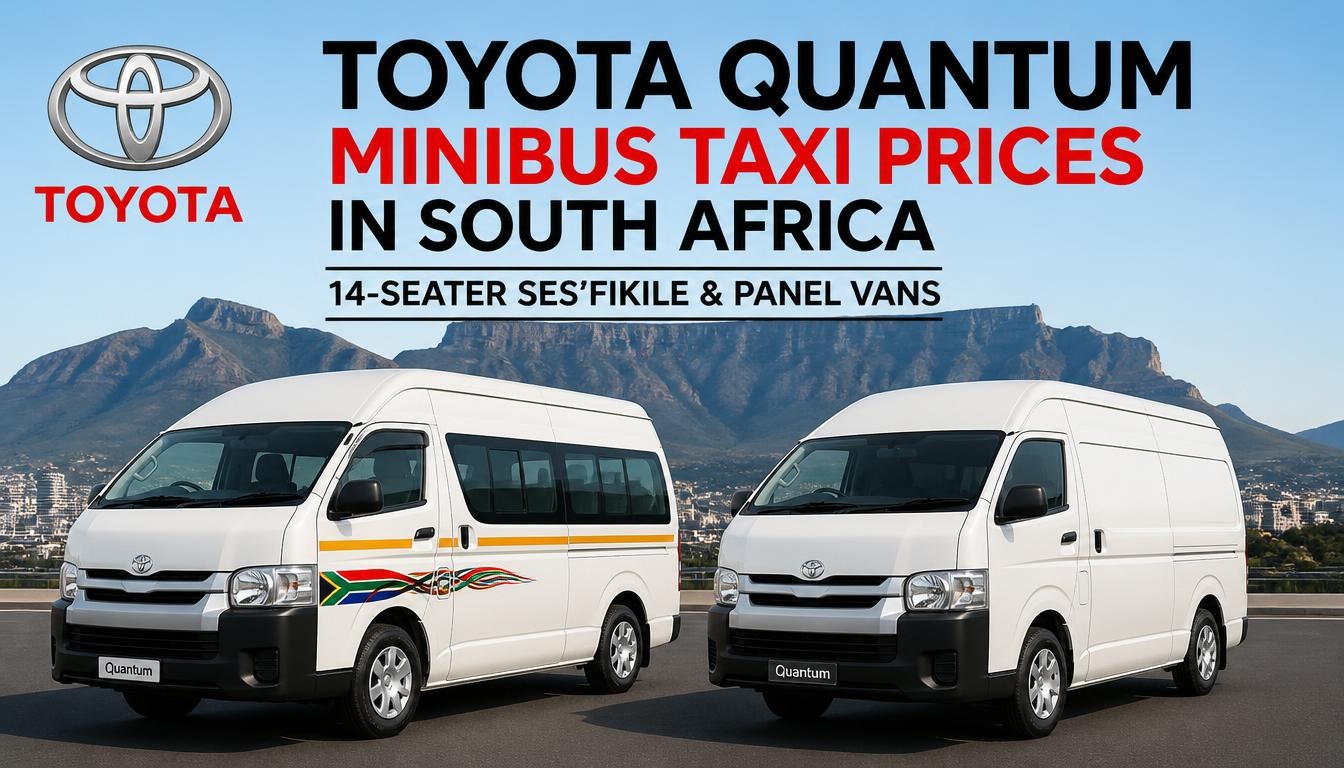
Commercial Vehicle Fleet Snapshot
Verified Retail Price Band: R550,000 – R829,000 (Excl. VAT / Model Dependent)
Primary Fleet Entry Requirement: Code 8 (B) or Code 10 (C1) Driver’s Licence with valid PrDP (Public Driving Permit)
Top Hiring & Operations Sectors: Public Transport Industry, Logistics & Courier Networks, Private Shuttle Operations
Fleet Investment Advisory: Prioritise the 2.5D-4D diesel variant for long-distance taxi routes due to lower operational torque consumption, while reserving 2.8 GD-6 panel vans for high-payload express courier logistics.
Toyota Quantum & Hiace Fleet Market Overview
The South African taxi industry and courier logistics sector rely heavily on the Toyota Quantum platform. Whether operated as the high-capacity Hiace Ses’fikile 16-seater minibus taxi or deployed as a long-wheelbase (LWB) panel van for express cargo, the Quantum remains the benchmark for commercial durability, high resale value, and parts availability across South Africa.
Navigating the commercial vehicle market requires distinguishing between the legacy-body Hiace Ses’fikile (built specifically for passenger transport at Toyota’s Prospecton plant in Durban) and the modern New Generation Quantum range (which includes 11-seater, 14-seater GL buses, and high-roof panel vans). For transport entrepreneurs, taxi association members, and logistics fleet directors, evaluating capital outlay against expected yield is the core metric for sustainable fleet management.
2026 Toyota Quantum & Hiace Retail Price Index
Vehicle acquisition costs vary based on body configuration, engine displacement, and seating capacity. Below is the verified market pricing structure for new and demo models across South African Toyota dealerships.
| Vehicle Variant | Engine & Transmission | Seating / Payload Capacity | Retail Price (Incl. VAT) | Estimated Monthly Finance Installment |
| Hiace Ses’fikile 2.7 Petrol | 2.7L 4-Cyl Petrol (5-Speed Manual) | 16-Seater Minibus | R545,900 | R10,200 pm |
| Hiace Ses’fikile 2.5 D-4D | 2.5L Turbo Diesel (5-Speed Manual) | 16-Seater Minibus | R583,599 | R10,850 pm |
| Quantum 2.8 GD-6 LWB Panel Van | 2.8L GD-6 Turbo Diesel (6-Speed Manual) | 2-Seater / LWB Cargo | R649,450 | R11,580 pm |
| Quantum 2.8 GD-6 LWB Crew Cab | 2.8L GD-6 Turbo Diesel (6-Speed Auto) | 6-Seater / Cargo Combo | R767,600 | R13,686 pm |
| Quantum 2.8 GD-6 GL Bus | 2.8L GD-6 Turbo Diesel (6-Speed Manual) | 14-Seater GL Bus | R829,000 | R14,750 pm |
Finance calculations based on a standard 72-month commercial asset contract at prime interest rate, with a 10% deposit and zero balloon payment.
Practical Workplace Observations & Field Insights
Managing a commercial fleet in South Africa involves operational realities that go beyond the showroom price. Fleet operators and transport managers should account for several key factors:
-
Insurance & Tracking Requirements: Due to high risk profiles in urban commuter corridors, SA underwriters mandate dual tracking units (combination of active GPS tracking and early-warning recovery systems) for all 16-seater Ses’fikile units prior to policy activation.
-
Driver Licensing Compliance: Drivers operating the 14-seater GL or 16-seater Ses’fikile must possess a valid Code 8 (B) or Code 10 (C1) licence accompanied by an active Public Driving Permit (PrDP) issued by the Department of Transport.
-
Maintenance & Service Intervals: The 2.5 D-4D and 2.8 GD-6 diesel engines require strict 10,000 km oil service intervals under severe operating conditions (stop-and-go taxi routes) to protect the turbocharger assembly and common-rail injectors.
-
Bargaining Council & Sectoral Rules: Commercial drivers operating panel vans for logistics firms fall under the National Bargaining Council for the Road Freight and Logistics Industry (NBCRFLI), governing minimum wage brackets, overtime rates, and mandatory Provident Fund contributions.
Engine Specifications & Fuel Efficiency Comparison
Selecting between petrol and turbodiesel powertrains directly affects operating costs per kilometer. The table below outlines key technical metrics for fleet management planning.
| Specification Metric | 2.7L Petrol (Ses’fikile) | 2.5L D-4D Diesel (Ses’fikile) | 2.8L GD-6 Diesel (Quantum) |
| Power Output | 111 kW @ 4800 rpm | 75 kW @ 3600 rpm | 130 kW @ 3400 rpm |
| Torque Rating | 241 Nm @ 3800 rpm | 260 Nm @ 1600–2400 rpm | 420 Nm @ 1400–2600 rpm |
| Claimed Fuel Consumption | 14.3 L / 100 km | 9.9 L / 100 km | 8.7 L / 100 km |
| Real-World Route Average | 15.5 L / 100 km (Urban Taxi) | 10.8 L / 100 km (Urban Taxi) | 9.4 L / 100 km (Freight/Cargo) |
| Recommended Application | Short-distance urban routes | High-mileage commuter transport | Intercity logistics & express courier |
Key Operating Sectors & Fleet Demand in South Africa
Commercial demand for Toyota Quantum variants spans across major industries:
-
Minibus Taxi Industry (SANTACO & Regional Associations): The 16-seater Ses’fikile dominates local commuter networks, long-distance taxi routes, and scholar transport services due to its high passenger density and widespread availability of replacement body panels.
-
Third-Party Logistics (3PL) & Courier Services: Express parcel delivery companies utilize the 2.8 GD-6 LWB Panel Van for its enclosed cargo space, high payload capacity, and accessibility in congested city centers.
-
Private Tourism & Shuttle Operators: Hospitality groups favor the Quantum 2.8 GL 14-seater bus for airport transfers, corporate transport, and game reserve shuttle routes due to its superior passenger comfort and safety features.
-
Government & Municipal Services: Departmental fleets routinely procure Quantum panel vans for mobile health units, maintenance crews, and forensic service conversions.
Commercial Financing & Fleet Ownership Strategies
Acquiring commercial vehicles requires a clear understanding of cash flow management and financing terms:
-
Operating Leases vs. Instalment Sales: Private courier contractors often use Full Maintenance Leases (FML) to offload maintenance risk, whereas taxi operators typically choose traditional instalment sale agreements to retain asset equity.
-
Taxi Choice Financing (Santam & SA Taxi): Specialized financiers offer tailored asset backing for taxi operators, integrating insurance premiums and tracking fees directly into weekly or monthly repayment structures.
-
Depreciation & Asset Life: A well-maintained Toyota Quantum retains 55% to 65% of its initial retail value after three years of intensive operation, outperforming rival commercial transport platforms in resale value.
Frequently Asked Questions
What is the difference between a Toyota Hiace Ses’fikile and a Toyota Quantum?
The Hiace Ses’fikile uses the previous-generation Quantum body shape and is built locally in South Africa specifically for the 16-seater taxi market. The New Generation Toyota Quantum features a modern front-engine design with updated safety systems, available in 11-seater, 14-seater, and panel van configurations.
What licence code is required to drive a 16-seater Toyota Ses’fikile?
Drivers need a minimum of a Code 8 (B) or Code 10 (C1) driver’s licence along with a valid Public Driving Permit (PrDP), as the vehicle is categorized as a passenger-carrying commercial transport vehicle.
What is the average fuel consumption of a Toyota Quantum 2.5 D-4D taxi?
Official figures rate the 2.5 D-4D diesel engine at 9.9 L/100 km. In real-world urban taxi conditions with full passenger loads, fuel consumption averages between 10.5 L and 11.2 L per 100 km.
Does Toyota offer a factory warranty on commercial Quantum models?
Yes, new Toyota Quantum and Hiace Ses’fikile models come with a standard 3-year/100,000 km manufacturer warranty and a 6-service/60,000 km service plan.
Disclaimer: Salary figures, vehicle retail prices, finance estimates, and commercial indicators listed in this guide reflect real-world market averages and verified dealer data at the time of publication. Actual acquisition costs may vary based on geographic location, dealership add-ons, interest rates, and corporate fleet discounts. Always verify specific terms directly with an authorized Toyota dealership or commercial finance provider.
Investing in a commercial fleet requires careful calculation of acquisition costs, route revenue potential, and long-term maintenance budgets. Share your experiences with fleet reliability, maintenance tips, or commercial financing questions in the comments below to join the discussion with other transport owners and logistics professionals across South Africa.

Joseph Mathebula is a consumer analyst and market researcher at Prices in South Africa. He specializes in tracking local service costs, retail pricing, and travel budgets, helping everyday shoppers navigate the market to secure the best value.