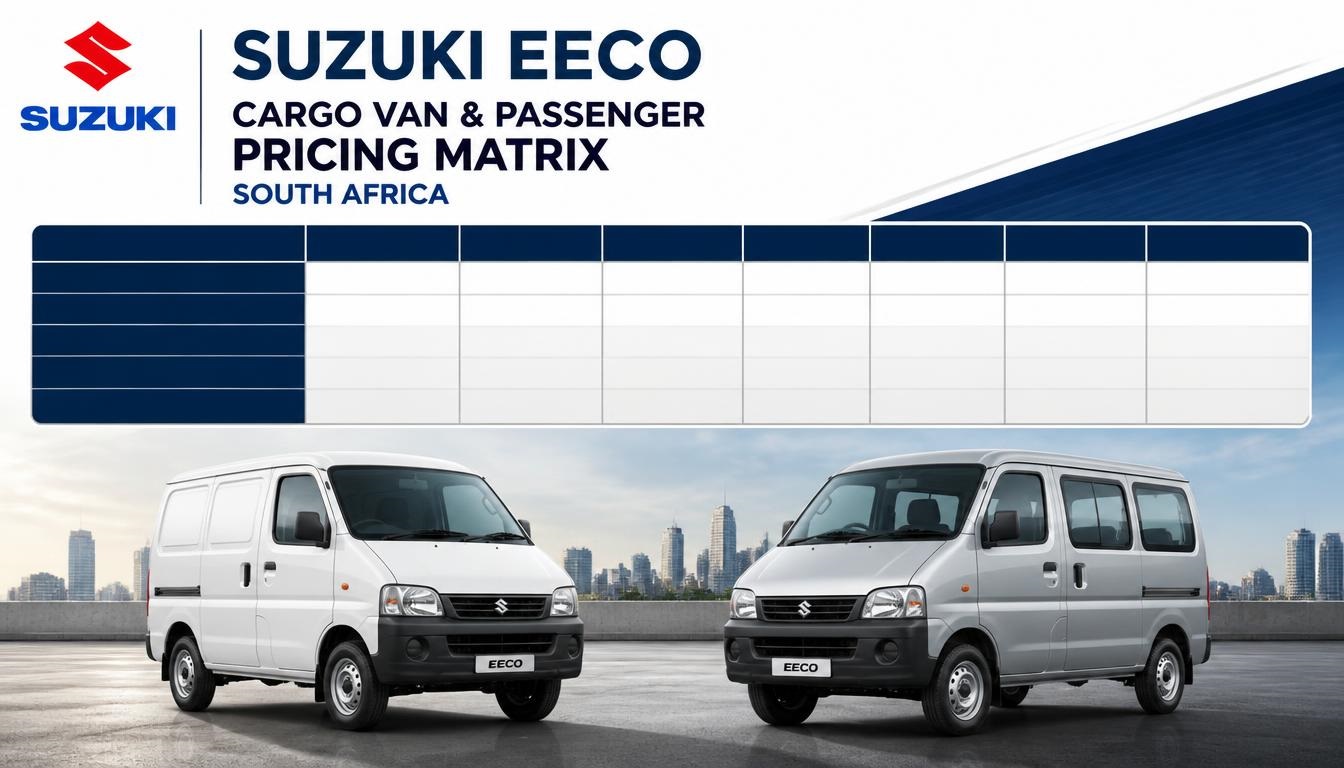
Commercial Fleet Snapshot:
Verified Market Price: R231,900 (Panel Van Base Retail)
Primary Entry Requirement: Code 8 (B) Driver’s Licence & Active SARS Commercial Fleet Registration
Top Hiring / Usage Sectors: Last-Mile Logistics, SME Trades, Courier Services, Retail Supply Chains
Strategic Investment Recommendation: Ideal entry-level commercial asset for fleet operators requiring maximum load volume (617kg payload) with ultra-low operating expenditure.
Commercial Transport Overview
The South African commercial transport market relies heavily on cost-effective, high-volumetric last-mile delivery solutions. The entry of purpose-built light commercial vehicles (LCVs) has redefined fleet logistics across major urban hubs like Gauteng, the Western Cape, and KwaZulu-Natal. Operating a commercial delivery fleet requires a careful balance between upfront acquisition costs, fuel consumption metrics, and durability on challenging road surfaces.
Small-to-Medium Enterprises (SMEs), courier firms, and independent contractors face increasing pressures from rising fuel costs and maintenance overheads. Choosing the right utility vehicle impacts operational margins directly. Within South African transport law and corporate tax structures, acquiring a registered panel van allows businesses to claim input VAT (15%) under specific conditions, provided the vehicle qualifies as a strict commercial workhorse rather than a passenger vehicle.
Commercial fleet managers must evaluate capacity against total cost of ownership (TCO). Vehicles in this category undergo continuous multi-drop urban cycles, requiring mechanical simplicity, readily available parts, and straightforward maintenance protocols.
2026 Price Structure & Commercial Financial Breakdown
Understanding the baseline pricing, financing structures, and ongoing operational budgets is critical for fleet acquisition in 2026. The baseline retail price for a brand-new panel van derivative sits at R231,900, offering one of the lowest entry points for a Japanese-engineered commercial vehicle in South Africa.
| Asset Parameter | 2026 Commercial Baseline | Operational Notes |
| Recommended Retail Price (Excl. Extras) | R231,900 | Standard white/silver commercial trim |
| Estimated Monthly Finance Installment | ~R3,850 – R4,200 pm | Based on 11.5% prime, 60 months, 10% deposit |
| Payload Capacity | 617 kg | Optimized for multi-drop light goods |
| Engine Output & Torque | 59kW @ 6,000 rpm / 104Nm | 1.2-litre 4-cylinder naturally aspirated petrol |
| Claimed Fuel Consumption | 5.4 L / 100 km | Combined cycle under standard testing |
| Standard Warranty | 5-Year / 200,000 km | Covers major mechanical defects |
| Service Intervals | 10,000 km / 12 Months | Ideal for heavy commercial urban usage |
From a cash-flow perspective, fleet buyers utilizing asset finance usually negotiate customized residual structures or balloon payments depending on annual kilometer projections. With a modest 10% deposit, monthly repayments hover near the R4,000 mark, making fleet expansion accessible for growing businesses.
Practical Workplace Observations & Field Insights
Deploying light commercial vans in daily operations reveals distinct functional realities that do not show up on standard specification sheets. Field tests and fleet manager feedback across South African industrial zones highlight key performance characteristics:
-
Urban Maneuverability & Loading Access: Dual rear sliding doors paired with a high-opening tailgate allow rapid loading in tight alleyways and busy loading bays across central business districts.
-
Suspension & Payload Dynamics: The rigid rear axle and heavy-duty leaf spring setup are tuned for carrying capacity rather than plush passenger comfort. Driving the vehicle empty results in a firmer ride, but stability improves noticeably once loaded close to its 617kg rating.
-
Driver Cabin Mechanics: The cabin prioritizes utility over luxury. Easy-to-clean vinyl flooring and durable seat upholstery resist daily wear, dust, and spills from drivers and crew members.
-
Pothole Resilience: A 170mm ground clearance provides essential protection against rim damage and underbody scrapes on deteriorating regional roads.
The urban delivery cycle relies on direct transitions:
-
Warehouse Loading: Streamlined by dual sliding doors and a low sill height.
-
Short-Haul Transit: Powered by an efficient 1.2L engine navigating 170mm ground clearance obstacles.
-
Multi-Drop Deliveries: Simplified through rear camera visibility and easy cabin access.
From an HR and fleet control angle, drivers require minimal adjustment time when transitioning to this platform. The raised driving position provides clear visibility in urban traffic, while basic analogue controls ensure fewer electrical failures over extended service periods.
Major SA Employers & Hiring Sectors
Demand for light commercial vehicles correlates directly with the growth of specific industries in South Africa. The versatility of a compact cargo footprint makes it a primary asset across several commercial sectors:
-
E-Commerce & Courier Logistics: Companies operating last-mile delivery networks (e.g., Takealot delivery partners, local courier franchises) rely heavily on high-volume, low-fuel vans to service residential suburbs.
-
Artisans & Skilled Trades: Electricians, plumbers, air-conditioning technicians, and security system installers use the open cargo area to fit custom shelving units, tool racks, and ladders.
-
FMCG & Fast-Food Distribution: Bakery distributors, fresh produce suppliers, and catering businesses utilize the rear compartment for hygienic, temperature-managed cargo transport.
-
Pharmaceutical & Medical Supplies: Pathology laboratories and medical distributors leverage small vans for secure, rapid dispatch of samples and supplies between clinics and central facilities.
When recruiting commercial drivers for these vehicles, employers typically require a valid Code 8 (Class B) driver’s licence, a clear driving record, and a basic understanding of route planning and smartphone-based delivery apps.
Career Progression & Fleet Management Strategies
For professionals entering the transport and logistics field, mastering light commercial fleet operations serves as a strong stepping stone to senior roles. Understanding vehicle mechanics, route optimization, and operating costs opens several career pathways:
-
Commercial Fleet Driver: Initial entry role focusing on safe vehicle operation, schedule adherence, customer service, and daily vehicle pre-trip inspections (checking fluid levels, tyre pressures, and load security).
-
Route Planner / Logistics Coordinator: Transitioning from the road to the depot to manage delivery schedules, optimize fuel consumption through GPS tracking, and oversee driver assignments.
-
Fleet Supervisor / Operations Manager: Overseeing total fleet performance, negotiating service maintenance contracts, managing vehicle insurance claims, ensuring compliance with SA Road Traffic Act regulations, and managing asset depreciation.
A standard career pathway moves progressively through these stages: Fleet Driver → Route Coordinator → Fleet Supervisor → Logistics Manager.
Drivers and logistics personnel who actively track fuel efficiency metrics and maintain zero-accident records advance rapidly into supervisory positions, where managing operating budgets becomes a primary key performance indicator (KPI).
2026 Total Cost of Ownership (TCO) Analysis
When evaluating commercial transport options, the purchase price represents only a fraction of the total expenditure over a 3-to-5-year operational lifecycle. A detailed breakdown of running costs helps fleet operators forecast true profitability.
-
Fuel Expenditure: At an average real-world urban consumption of 6.5L to 7.2L/100km under partial load conditions, a vehicle running 3,000 km per month consumes roughly 200 to 215 litres of 95 Unleaded petrol.
-
Preventative Maintenance: Scheduled 10,000 km service intervals cost between R1,200 and R2,500 at authorized service centers, depending on whether standard oil changes or major spark plug/filter replacements are due.
-
Insurance Benchmarks: Commercial insurance premiums for small delivery vans generally range from R1,100 to R1,800 per month, heavily influenced by the driver’s age profile, tracking unit installations, and geographic risk zones.
-
Tyre Replacement: Fitting standard commercial-grade tyres (155 R13 C) remains exceptionally affordable, costing significantly less than standard passenger SUV tyres when replacements are required every 45,000 to 60,000 km.
Frequently Asked Questions
What driver’s licence class is required to operate a small panel van in South Africa?
A standard Code 8 (Class B) driver’s licence is fully sufficient to drive light commercial panel vans, as their Gross Vehicle Mass (GVM) remains well under the 3,500 kg threshold. Professional Driving Permits (PrDP) are generally not required unless transporting passengers for reward or carrying hazardous goods.
Can businesses claim input VAT on the purchase of a panel van?
Yes, registered VAT vendors can typically claim back the 15% input VAT on a purpose-built commercial panel van with fixed metal side panels and no rear seats. Always consult a registered SARS tax practitioner to confirm specific compliance under the Value-Added Tax Act.
What is the real-world payload capacity for urban delivery?
The factory-rated payload capacity is 617 kg. This includes the weight of the driver, passenger, and cargo. For long-term mechanical reliability, fleet operators usually cap daily cargo loads around 500 kg to minimize wear on suspension and clutch components.
How do maintenance costs compare to traditional single-cab bakkies?
Maintenance costs are noticeably lower due to the simple naturally aspirated 1.2-litre engine design and mechanical 5-speed manual gearbox. The absence of complex turbochargers or high-pressure diesel injection systems significantly reduces long-term maintenance risks.
Does the vehicle come with standard safety features for commercial drivers?
Modern commercial panel vans sold in South Africa come equipped with essential safety systems including dual front airbags, Anti-lock Braking System (ABS), electronic brakeforce distribution (EBD), and rear parking sensors to assist drivers in tight loading areas.
Disclaimer: Salary figures, vehicle pricing matrix data, job requirements, and hiring indicators listed in this guide reflect real-world market averages and verified employer/dealer data at the time of publication. Actual compensation and vehicle retail terms may vary based on geographic location, candidate experience, company size, dealer-specific charges, and individual contract negotiations. Always verify specific job terms and vehicle pricing directly with official recruiting employers or authorized dealership networks.
Investing in a compact commercial fleet asset requires balancing immediate capital outlay with long-term reliability and fuel efficiency. For small business owners and fleet managers alike, selecting a straightforward, durable utility vehicle ensures low cost per kilometer and maximum operational uptime. Have questions about commercial fleet financing, logistics driver requirements, or managing transport operating costs? Join the discussion in the comments section below, or share your own fleet management insights with our growing professional community.

Joseph Mathebula is a consumer analyst and market researcher at Prices in South Africa. He specializes in tracking local service costs, retail pricing, and travel budgets, helping everyday shoppers navigate the market to secure the best value.