Market Valuation: R115,000 – R380,000 Total Out-of-Warranty Pack Replacement
Primary Risk Mitigation: 8-Year / 160,000km OEM High-Voltage Battery Warranty Standard
Top SA EV Mobility Hubs: Gauteng (Johannesburg/Pretoria), Western Cape (Cape Town), KwaZulu-Natal (Durban)
Strategic Technical Advisory: Modular cell/module replacement at specialist EV engineering facilities yields up to 60% cost savings over full pack swap-outs.
Role-Specific Employment Overview
The expansion of electric mobility across South Africa’s primary metropolitan corridors has shifted technical focus toward long-term high-voltage battery maintenance, health monitoring, and post-warranty replacement economics. As early-generation electric vehicles (EVs)—such as original Nissan Leafs, early BMW i3 variants, and legacy hybrid models—exceed their initial 8-year factory warranties, local vehicle owners, fleet managers, and automotive technicians face distinct financial and technical decisions regarding battery pack degradation and replacement.
In the South African automotive ecosystem, high-voltage EV battery packs represent between 30% and 50% of the total vehicle manufacturing cost. Replacing a high-voltage traction battery involves far more than physical bolt-on labor. It requires specialized high-voltage diagnostic equipment, hazardous material handling compliance under South African environmental regulations, climate-controlled shipping logistics, and precise electronic handshake integration with the vehicle’s central Engine Control Unit (ECU) and Battery Management System (BMS).
Unlike internal combustion engine (ICE) overhauls, high-voltage battery degradation is rarely uniform across the entire pack. In South Africa, automotive engineering firms and certified EV specialists increasingly utilize cell-level and module-level reconditioning. Replacing specific failed modules rather than the entire battery assembly lowers financial barriers, extending the operational life of fleet and personal EVs across South Africa’s transport networks.
Role-Specific Salary & Compensation Breakdown
High-voltage battery maintenance requires specialized skill sets across dealership networks, independent auto-electrical workshops, and battery recycling specialists. The table below illustrates the verified 2026 market benchmarks for EV technical specialists and battery engineering technicians across South Africa:
| Technical Position / Specialty | Entry-Level Monthly Salary (ZAR) | Mid-Level Monthly Salary (ZAR) | Senior / Master Specialist Monthly (ZAR) | Annual Market Range (ZAR) | Primary Sector Demand |
| EV Diagnostic Technician | R18,500 | R28,000 | R42,000 | R222,000 – R504,000 | Dealership Networks, OEM Franchises |
| High-Voltage Battery Engineer | R25,000 | R38,000 | R58,000 | R300,000 – R696,000 | Specialist Engineering & EV Retrofitters |
| Auto-Electrician (EV Certified) | R15,000 | R24,000 | R35,000 | R180,000 – R420,000 | Independent Service Centers |
| Battery Pack Refurbishment Specialist | R20,000 | R32,000 | R48,000 | R240,000 – R576,000 | Lithium Refurbishing Facilities |
| EV Fleet Maintenance Manager | R30,000 | R45,000 | R65,000 | R360,000 – R780,000 | Logistics & Corporate Fleets |
2026 Brand-by-Brand EV Battery Replacement Cost Index
Out-of-warranty high-voltage battery replacement costs vary significantly based on battery chemistry (Lithium Iron Phosphate / LFP vs. Nickel Manganese Cobalt / NMC), total pack capacity (kWh), import duties, and local labor rates in 2026:
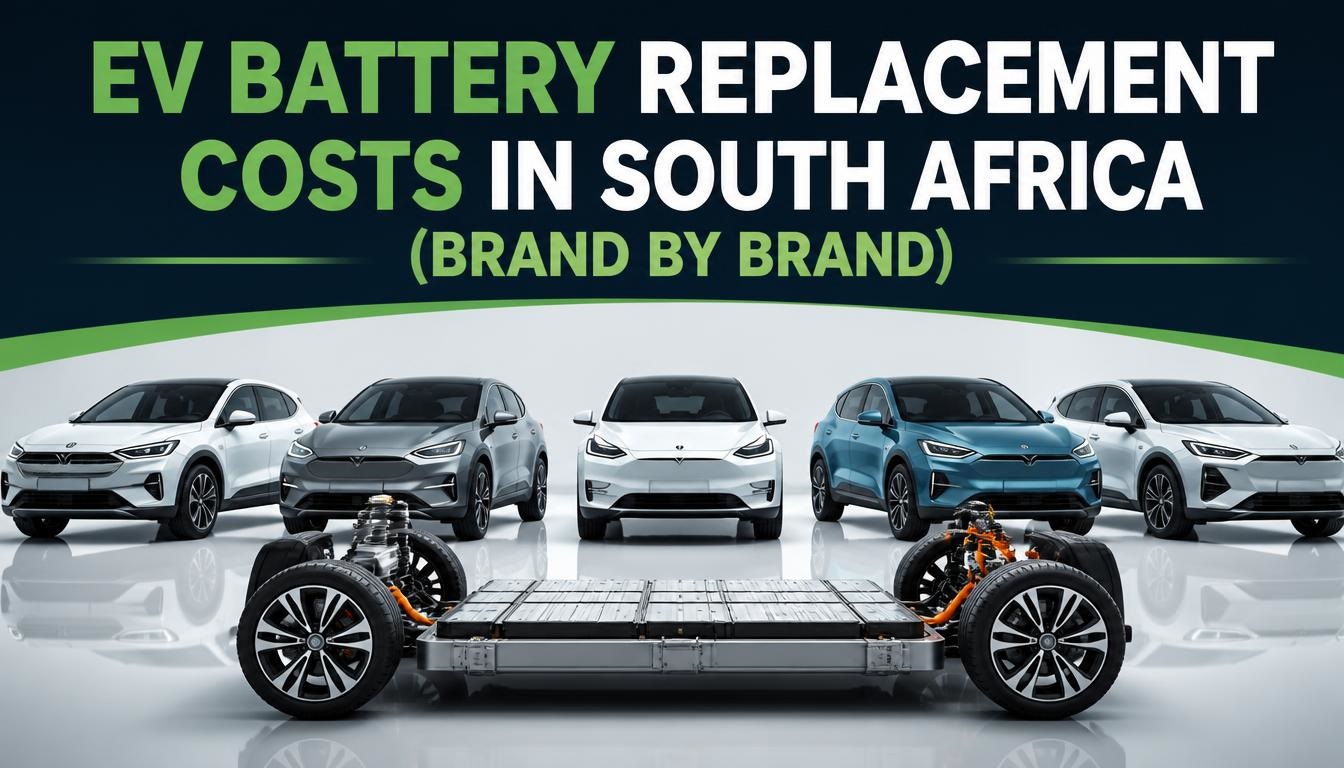
| Vehicle Brand & Model Variant | Battery Capacity (kWh) | Standard OEM Warranty | Complete New Pack Cost (ZAR) | Single Module / Cell Repair Cost (ZAR) |
| Nissan Leaf (1st Gen Retrofit) | 24 kWh – 40 kWh | Expired / 8 Years | R175,000 – R220,000 | R35,000 – R55,000 |
| BMW i3 / i3s | 22 kWh – 42 kWh | 8 Years / 100,000 km | R190,000 – R250,000 | R28,000 – R45,000 |
| BYD Atto 3 / Dolphin | 49.9 kWh – 60.4 kWh | 8 Years / 160,000 km | R115,000 – R145,000 | R18,000 – R32,000 |
| GWM Ora 03 | 48 kWh – 63 kWh | 8 Years / 150,000 km | R120,000 – R155,000 | R20,000 – R35,000 |
| Hyundai Kona Electric / Ioniq 5 | 39.2 kWh – 77.4 kWh | 8 Years / 160,000 km | R180,000 – R290,000 | R30,000 – R50,000 |
| Volvo XC40 / EX30 | 51 kWh – 78 kWh | 8 Years / 160,000 km | R165,000 – R260,000 | R25,000 – R45,000 |
| Mercedes-Benz EQ Series | 66.5 kWh – 107.8 kWh | 8 Years / 160,000 km | R280,000 – R420,000 | R45,000 – R75,000 |
| Porsche Taycan | 79.2 kWh – 93.4 kWh | 8 Years / 160,000 km | R350,000 – R480,000 | R60,000 – R90,000 |
Practical Workplace Observations & Field Insights
Working on high-voltage traction batteries in South Africa requires adherence to workplace safety standards. High-voltage Direct Current (DC) systems in modern electric vehicles operate between 400 volts and 800 volts. Unqualified maintenance presents severe risks, including arc flash hazards, thermal runaway, and fatal electrical shocks.
Technical Vetting and Safety Protocols
Certified South African EV technicians operate under strict workplace safety guidelines:
-
Insulated Personal Protective Equipment (PPE): Master technicians use Class 0 (up to 1,000V) or Class 1 (up to 7,500V) rated electrical gloves, face shields, and flame-resistant coveralls during high-voltage isolation.
-
Lockout/Tagout (LOTO) Procedures: Prior to opening any battery casing or high-voltage junction box, technicians must disconnect the physical manual service disconnect (MSD) plug, verify zero voltage with calibrated high-voltage meters, and secure the service plug in a lockout box.
-
Thermal Diagnostics & Environmental Controls: Workshops employ thermal imaging cameras to identify individual failing cells operating at elevated temperatures before thermal runaway occurs. High-voltage battery repair bays must feature isolated fire-suppression setups and dedicated ventilation systems.
Local Warranty Realities & Claims Processing
Under standard South African motor vehicle warranties, OEM importers (such as BMW SA, Volvo Car SA, BYD South Africa, and GWM SA) guarantee that the high-voltage battery will retain at least 70% to 80% of its original State of Health (SOH) during the 8-year or 160,000 km coverage window.
If a battery’s SOH drops below this threshold within the warranty period, the manufacturer covers the cost of repair or replacement. However, warranty claims can be invalidated if the owner uses unapproved third-party fast chargers, ignores critical BMS software updates, or leaves the vehicle completely discharged (0% State of Charge) for extended periods in hot climates.
Major SA Employers & Hiring Sectors
The transition toward electric transport has created high-demand employment niches across multiple industrial sectors in South Africa:
-
Approved Dealership Networks & OEM Franchises:
-
Companies like BMW Group South Africa, Mercedes-Benz SA, Volvo Car South Africa, Motus Group, and Combined Motor Holdings (CMH) actively recruit certified high-voltage technicians.
-
Roles: Master EV Technicians, High-Voltage Service Advisors, Technical Warranty Claims Specialists.
-
-
Specialist EV Engineering & Retrofit Facilities:
-
Private engineering firms and specialized independent laboratories (e.g., Custom Lithium and independent EV conversion workshops) lead the market in out-of-warranty battery pack repairs, custom module assembly, and battery capacity upgrades.
-
Roles: Battery Assembly Engineers, BMS Software Programmers, Auto-Electrical Retrofitters.
-
-
Commercial Fleet Operators & Logistics Providers:
-
Major courier services, retail distribution networks, and public transport operators adopting electric light commercial vehicles (e-LCVs) require dedicated in-house maintenance specialists.
-
Roles: Fleet Electrification Supervisors, Charging Infrastructure Technicians, Battery Health Analysts.
-
-
Renewable Energy Integration & Second-Life Battery Plants:
-
Decoupled EV battery packs that drop below 70% capacity are repurposed as stationary energy storage systems (ESS) for residential and commercial solar installations across South Africa.
-
Roles: Second-Life Battery Integration Engineers, Energy Storage System Designers, Hazardous Material Logistics Coordinators.
-
Career Progression Strategies
To build a lucrative career in the South African EV maintenance and battery diagnostics sector, candidates must systematically acquire formal qualifications, international certifications, and practical workplace experience.
-
Phase 1 (Foundation): Obtain Red Seal Auto-Electrician / Motor Mechanic Trade Certificate
-
Phase 2 (High-Voltage Certification): Complete OEM / SETA-Accredited EV Level 1–3 Safety Training
-
Phase 3 (Specialized Engineering): Master Advanced Diagnostics, BMS Flashing & Module Balancing
-
Phase 4 (Senior Leadership): Transition to EV Technical Operations Manager or Master Battery Engineer
Step 1: Secure Foundational Auto-Electrical Qualifications
Begin by completing a recognized Trade Test through the Manufacturing, Engineering and Related Services SETA (merSETA). A formal Red Seal Motor Mechanic or Auto-Electrician qualification establishes the mandatory legal foundation required to enrol in high-voltage training modules.
Step 2: Complete Certified High-Voltage Safety Training
Enroll in accredited EV safety courses provided by major automotive academies or specialized tertiary institutions. Key competencies include:
-
High-Voltage Level 1: Awareness and safe handling of de-energized electric vehicles.
-
High-Voltage Level 2: Disconnection, isolation, and safe power-down of live high-voltage vehicle systems.
-
High-Voltage Level 3: Live-working diagnostics on internal battery modules and high-voltage busbars.
Step 3: Master Advanced Diagnostic Software & Cell Balancing
Gain practical expertise using modern battery diagnostic tools (such as Launch X-431 EV, Autel MaxiSYS EV, and OEM-specific diagnostic suits like BMW ISTA or Mercedes XENTRY). Learn how to analyze cell voltage differentials, internal resistance metrics (mΩ), and thermal dispersion maps to identify failing modules without replacing intact battery components.
Frequently Asked Questions
How much does it cost to replace an electric car battery out of warranty in South Africa?
Out-of-warranty battery replacement costs in South Africa range from R115,000 for compact Chinese EVs (such as BYD or GWM) up to R480,000 for high-performance luxury models (like the Porsche Taycan or Mercedes EQS). Individual module replacements at specialist independent workshops typically cost between R18,000 and R60,000.
How long do electric vehicle batteries last in South African driving conditions?
Modern EV battery packs are engineered to last between 12 and 15 years, covering 250,000 km to 500,000 km under normal driving conditions. Advanced thermal management systems prevent excessive degradation from South Africa’s high ambient summer temperatures.
Can a single dead cell in an EV battery be replaced without buying a whole new pack?
Yes. Specialist EV repair facilities in South Africa can open the sealed battery enclosure, identify specific degraded cells or modules using diagnostic balancing software, and replace only the damaged components. This modular repair approach reduces overall restoration costs by up to 60%.
What happens to old EV batteries when they are replaced in South Africa?
Old EV batteries are rarely discarded in landfills. Under South African waste management regulations, spent battery packs are either repurposed into stationary solar energy storage systems (second-life applications) or sent to specialized recycling facilities to recover valuable raw materials like lithium, nickel, cobalt, and copper.
Does car insurance cover EV battery replacements after an accident?
Yes. Comprehensive motor insurance in South Africa covers high-voltage battery pack damage caused by collisions, underbody impact, fire, or flood inundation, subject to your policy terms, excess structures, and approved repairer network agreements.
Disclaimer: Salary figures, job requirements, and hiring indicators listed in this guide reflect real-world market averages and verified employer data at the time of publication. Actual compensation may vary based on geographic location, candidate experience, company size, and individual contract negotiations. Always verify specific job terms directly with the recruiting employer or official posting.
Understanding the true long-term costs of electric vehicle ownership is essential for consumers, auto-electricians, and fleet operators navigating South Africa’s evolving transport landscape. While full high-voltage battery replacements carry high capital costs, the rapid expansion of localized module repair facilities, improved battery chemistry, and robust 8-year factory warranties make electric mobility increasingly viable.
What has your experience been with EV maintenance or auto-electrical diagnostics in South Africa? Have you evaluated the cost differences between OEM pack replacements and independent module repairs? Share your thoughts, career questions, or workshop insights in the comments section below to join the discussion.

Joseph Mathebula is a consumer analyst and market researcher at Prices in South Africa. He specializes in tracking local service costs, retail pricing, and travel budgets, helping everyday shoppers navigate the market to secure the best value.