The global revolution in handheld PC gaming has hit South Africa hard. Mobile-first gamers and PC enthusiasts across Mzansi are increasingly choosing portable hardware over traditional desktop setups or dedicated home consoles. Whether you are battling commuting fatigue, killing time on campus, or looking to keep your campaign going during local power outages, handheld PCs have become a staple in the local market.
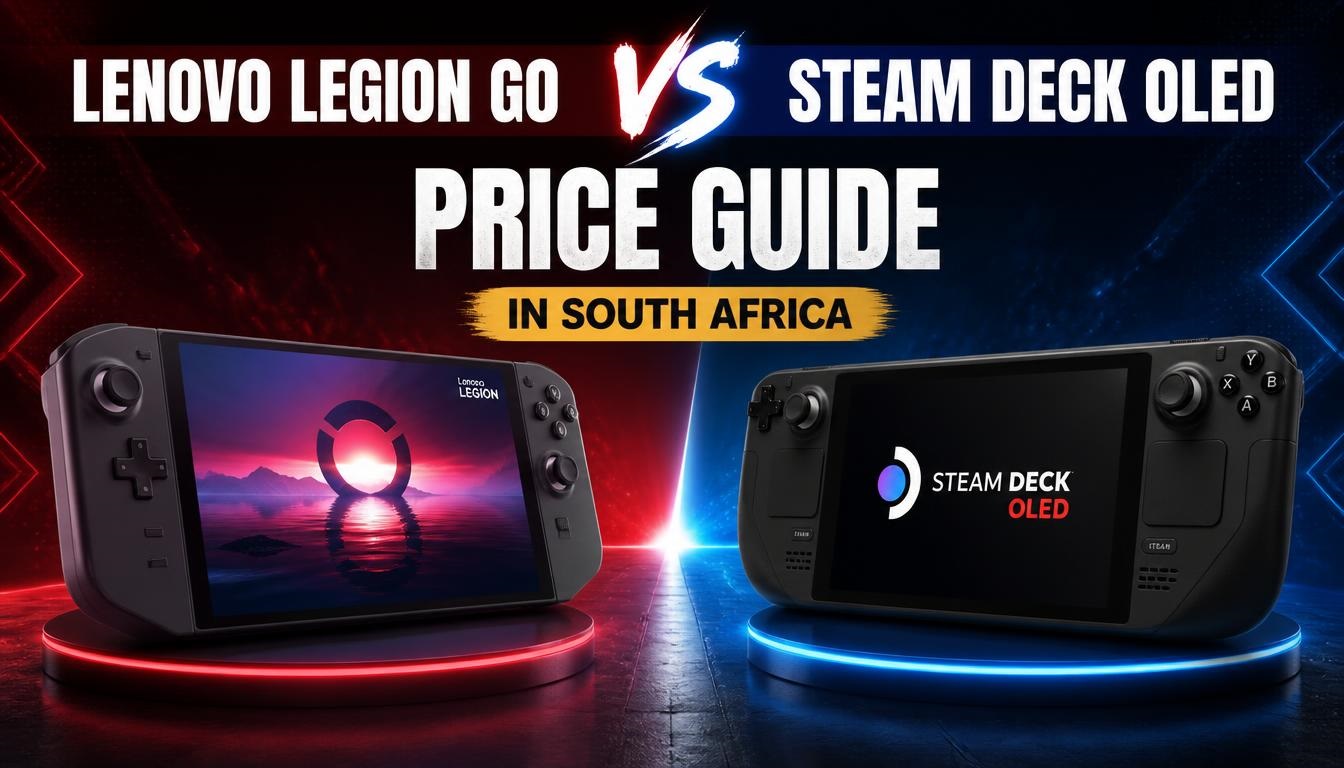
Two titans currently dominate the high-end landscape in 2026: the Lenovo Legion Go and the Steam Deck OLED. On one side sits Lenovo’s feature-packed Windows powerhouse, sporting a massive 144Hz display, detachable controllers, and raw desktop versatility. On the other is Valve’s refined masterpiece, driven by a custom Linux-based SteamOS, hyper-efficient hardware, and a mesmerizing 90Hz HDR OLED panel.
For South African gamers looking to spend their hard-earned Rand, choosing between these two involves more than just reading synthetic benchmarks on international forums. You must factor in parallel import dynamics, local retailer warranties, exchange rate volatility, and battery performance under load. This comprehensive price and buying guide breaks down which handheld offers the absolute best value per Rand in South Africa today.
Price Breakdown & Availability in South Africa (2026)
Navigating the local retail landscape requires understanding how both consoles reach South African shores. Lenovo enjoys official local distribution channels through Lenovo South Africa, giving the Legion Go standardized retail pricing and direct manufacturer backing.
Conversely, Valve does not sell hardware directly in South Africa. As a result, every Steam Deck OLED in the country is a parallel (grey market) import. Specialized tech importers and major local marketplaces source these units internationally, passing on shipping costs, import tariffs, and risk premiums to the consumer.
Estimated Retail Price Range Comparison (ZAR)
| Storage Variant | Lenovo Legion Go (Official Local Channel) | Steam Deck OLED (Parallel Import Channel) |
| 512GB NVMe SSD | R13,999 – R16,999 | R17,999 – R20,000 |
| 1TB NVMe SSD | R16,999 – R19,199 | R22,950 – R24,699 |
| Primary Retailers | Evetech, Computer Mania, Takealot, Makro, Lenovo Online | Game4U, Evetech, Takealot (3rd-party sellers), Tech Warehouse |
| Warranty Terms | 12 to 24-Month Official Lenovo SA Warranty | 12-Month Store-Backed / Importer Warranty |
Official Warranty vs. Parallel Import Risks
-
Lenovo Legion Go: Backed by official Lenovo South Africa service centers. If an analog stick develops drift, a button fails, or the mainboard experiences a defect, repairs or replacements are handled locally through authorized channels like Evetech or Computer Mania without extended international turnaround times.
-
Steam Deck OLED: Because Valve has no direct RMA infrastructure in Mzansi, your warranty is entirely reliant on the retailer who imported the unit (e.g., Game4U, Tech Warehouse). If an issue occurs, the store must either repair the unit locally via third-party technicians or ship it back overseas, which can leave you without a device for several weeks. Importers also price in currency fluctuation risks (ZAR/USD), which explains why the Steam Deck OLED carries a higher markup locally despite having a lower MSRP in overseas markets.
Core Specifications & Real-World Gaming Performance
| Feature / Spec | Lenovo Legion Go | Steam Deck OLED |
| Processor (APU) | AMD Ryzen Z1 Extreme (8C/16T, Zen 4) | Custom AMD “Sephiroth” (4C/8T, Zen 2) |
| Graphics (iGPU) | AMD Radeon 780M (12 RDNA 3 CUs) | Custom RDNA 2 (8 CUs) |
| RAM | 16GB LPDDR5X (7500 MHz) | 16GB LPDDR5 (6400 MHz) |
| Display | 8.8″ QHD+ (2560×1600) IPS, 144Hz, 500 nits | 7.4″ HDR OLED (1280×800), 90Hz, 1000 nits Peak |
| Operating System | Windows 11 Home | SteamOS 3 (Linux/Arch-based) |
| Weight | 854g (with controllers attached) | 640g |
| Unique Feature | Detachable controllers (FPS Mouse Mode), Kickstand | Dual Haptic Trackpads, Premium HDR OLED panel |
Operating System Experience: Windows 11 vs. SteamOS
The operating system experience is the defining operational difference between these two devices.
-
Lenovo Legion Go (Windows 11): Operates as a full PC. Native Windows 11 allows you to download Xbox Game Pass titles locally, run EA App, Epic Games Store, Battle.net, and anti-cheat heavy multiplayer games like Valorant, Call of Duty: Warzone, and EA Sports FC without workaround hacks. However, navigating Windows 11 on an 8.8-inch touchscreen can feel clunky, requiring reliance on Lenovo’s overlay software (Legion Space) or external inputs.
-
SteamOS (Steam Deck OLED): Delivers a refined, console-like user interface. It features an instant sleep/resume function that allows you to pause demanding AAA titles mid-game and resume hours later without draining your battery or crashing the system. Game compatibility is clear thanks to Valve’s “Steam Deck Verified” badge system. However, games requiring kernel-level anti-cheat (like Fortnite or Warzone) will not run unless you go through the complex process of dual-booting Windows.
Resolution & Performance Scaling
The Legion Go’s AMD Ryzen Z1 Extreme offers substantially higher raw compute power. It easily drives games at 1080p or upscaled 1600p at 20W–30W TDP modes. It shines on demanding modern titles when plugged into power or paired with AMD FSR upscaling.
The Steam Deck OLED focuses on target efficiency. Operating within a 4W–15W envelope, its 800p resolution screen requires significantly less graphical throughput. Games running at 800p on a 7.4-inch OLED panel look remarkably sharp, with rich infinite contrast levels and true blacks that make colors pop beyond what the Legion Go’s IPS panel can match.
Battery Life & Portability (The SA Loadshedding / Travel Factor)
Power management remains a key consideration for South African users. When playing through load shedding slots or traveling across country, battery capacity and energy efficiency dictate how long your session lasts.
Battery Longevity Comparison (Hours of Gameplay):
-
Steam Deck OLED (50Whr Battery): 3 to 12 Hours
-
Lenovo Legion Go (49.2Whr Battery): 1.5 to 4.5 Hours
-
Steam Deck OLED (50Whr): Thanks to the efficient 6nm APU architecture and low-power OLED display, energy consumption is minimal. Indies and lighter titles can stretch battery life up to 8–10 hours. Demanding AAA games (Cyberpunk 2077, Elden Ring) run comfortably for 2 to 3.5 hours at a locked 30–45 FPS.
-
Lenovo Legion Go (49.2Whr): Driving an 8.8-inch 1600p IPS display at 144Hz alongside a high-draw Ryzen Z1 Extreme chip consumes substantial power. Even with settings tuned down, expect 1 hour to 1.5 hours of gaming in AAA titles under Performance Mode (20W+ TDP). You can push this to ~3.5 hours in low-power Quiet Mode (8W TDP) for basic 2D titles, but it lags behind Valve’s efficiency.
Power Bank Requirements
If you intend to game through prolonged grid outages, you will need a heavy-duty portable power bank:
-
For Steam Deck OLED: Requires a Power Delivery (PD 3.0) bank capable of outputting at least 45W via USB-C.
-
For Lenovo Legion Go: Requires a Power Delivery (PD 3.0) bank outputting at least 65W to 100W. Standard 15W/20W phone power banks will not charge the Legion Go while it is running under full load.
Pros and Cons Matrix
| Device | Pros | Cons |
| Lenovo Legion Go |
• Official local warranty & retail availability in SA
• Higher raw performance (Z1 Extreme) & 1600p 144Hz display
• Native Windows 11 plays Game Pass & anti-cheat games
• Versatile detachable controllers with FPS vertical mouse mode
• Built-in kickstand and dual USB-4 ports
|
• Poor battery life under high TDP settings
• Heavy (854g) and bulky for smaller hands
• Windows 11 UI navigation can feel clunky on handhelds
• IPS panel lacks the deep blacks of OLED
|
| Steam Deck OLED |
• Stunning 90Hz HDR OLED screen with incredible contrast
• Exceptional battery efficiency (up to 2–3x longer than Legion Go)
• Polished, friction-free SteamOS software experience
• Ergonomic, lighter design (640g) with precise trackpads
• Seamless sleep/resume game system
|
• Higher local retail markup due to parallel import costs
• Warranty reliant on local importers, not direct manufacturer support
• Lower raw compute horsepower (720p/800p focus)
• Cannot play Windows anti-cheat games natively (CoD, Valorant)
|
Final Verdict: Which Should You Buy in South Africa?
Both machines offer impressive engineering, but they serve different player priorities and budgets in the South African market.
Decision Matrix:
-
Priority: Official Warranty + Xbox Game Pass + Raw Specs→ Buy Lenovo Legion Go (Best ZAR Value per Raw Performance)
-
Priority: Long Battery + Console Simplicity + Vibrant OLED Display→ Buy Steam Deck OLED (Best Handheld User Experience)
Buy the Lenovo Legion Go if:
-
You want local peace of mind: You prefer buying through established local retailers (Evetech, Computer Mania, Takealot) with official Lenovo SA warranty backing.
-
Xbox Game Pass is essential: You rely on an active PC Game Pass subscription and want to install games directly without streaming setup steps.
-
You play competitive shooters: You need a device capable of running anti-cheat protected titles like Call of Duty, Fortnite, or Apex Legends.
-
You value hardware versatility: You want a giant 8.8″ screen, detachable controllers, and a device that doubles as a desktop PC replacement when docked.
Buy the Steam Deck OLED if:
-
You want pick-up-and-play simplicity: You prefer a console-like experience where games download, auto-configure, and pause instantly with a press of the power button.
-
Battery life is your priority: You need extended gaming time during load shedding or travel without tethering yourself to a wall socket.
-
Visual fidelity trumps resolution: You value deep blacks, vibrant HDR colors, and fast response times over raw resolution counts.
-
Your library centers on Steam: The majority of your catalog is already on Steam and categorized as Deck Verified.
Disclaimer & Disclosure
Pricing & Availability: All prices, exchange rates, and stock availability mentioned in this guide are accurate as of the date of publication and are subject to change without notice. PricesInSouthAfrica.co.za does not sell products directly. We track and aggregate pricing data from verified South African retailers and distributors.
Affiliate & Third-Party Disclosure: PricesInSouthAfrica.co.za is an independent publisher. We may include links to third-party retailers. Clicking these links or purchasing products through them may generate a referral commission at no additional cost to you. This does not influence our editorial independence, price comparisons, or product evaluations.
Trademarks: All product names, logos, brands, and registered trademarks belong to their respective owners (Lenovo Group Ltd., Valve Corporation, Microsoft Corp., etc.).

Joseph Mathebula is a consumer analyst and market researcher at Prices in South Africa. He specializes in tracking local service costs, retail pricing, and travel budgets, helping everyday shoppers navigate the market to secure the best value.