Selecting high-speed satellite connectivity in remote regions of Southern Africa requires balancing initial capital expenditure against long-term operational costs. SpaceX’s Starlink constellation provides high-throughput, low-latency broadband to enterprises, safari lodges, mining sites, and maritime operators.
Selecting hardware involves evaluating fixed-site Business deployment versus offshore Marine hardware. Hardware tiers, projected South African Rand (ZAR) costs, data tier options, and deployment parameters differ significantly between stationary land setups and in-motion sea applications.
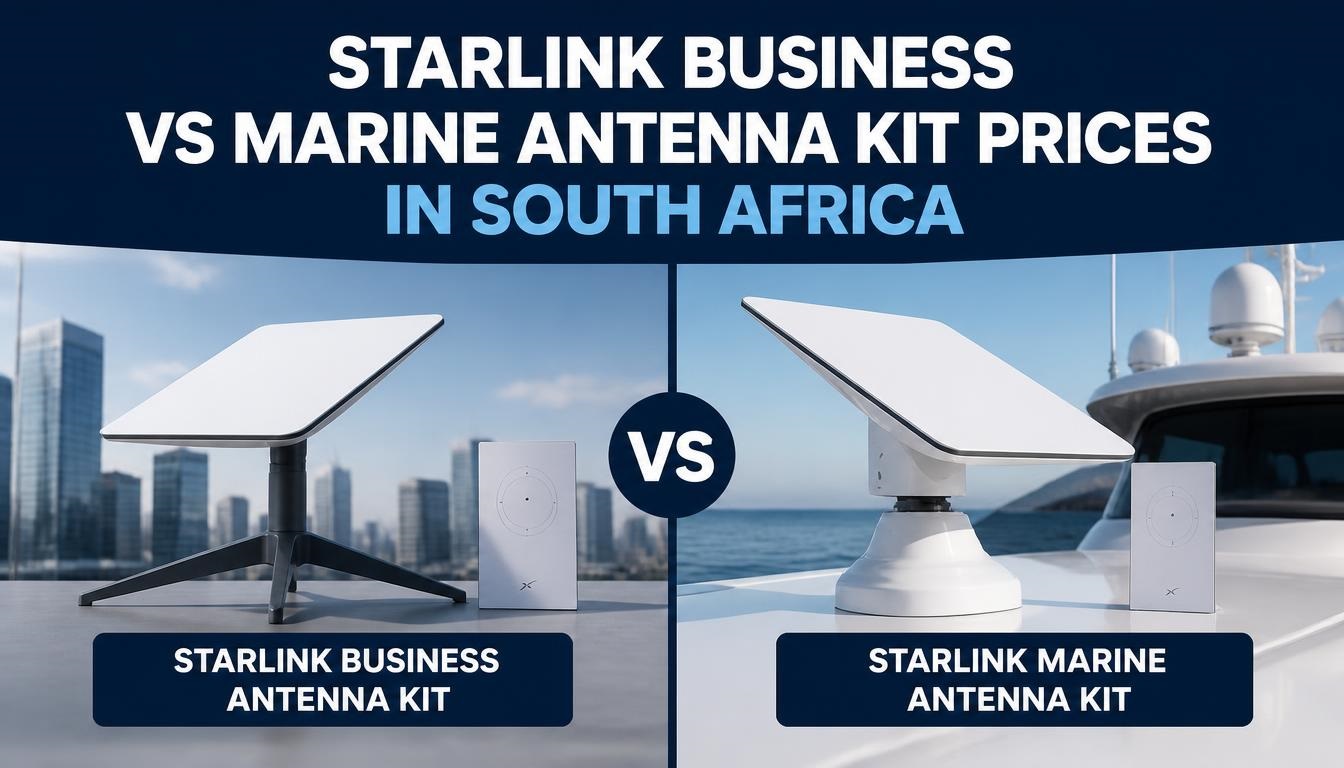
Hardware Overview: Fixed Enterprise vs. In-Motion Marine
Starlink separates its high-demand users into two terminal categories:
-
Fixed Enterprise (Business): Designed for stationary locations like farms, game lodges, mines, and remote offices. It typically uses the Standard Actuated terminal or the Enterprise (Flat High Performance) array mounted in a fixed position.
-
Maritime / Off-Shore (Marine): Employs the Flat High Performance Kit. This terminal features a wide field of view, internal GPS-assisted beam steering, and a ruggedized build designed for vessel movement and salt-fog conditions.
Core Hardware Comparison
| Feature / Spec | Business (Standard / Enterprise) | Marine (Flat High Performance) |
| Primary Target Use Case | Fixed land-based enterprises, lodges, commercial sites | Offshore vessels, commercial ships, yachts, mobile platforms |
| Hardware Form Factor | Standard Actuated or Flat High Performance (Fixed Mount) | Flat High Performance (Wedge/Deck Mount) |
| Estimated Kit Cost (USD) | ~$550 – $2,500 | ~$2,600 |
| Estimated Kit Cost in ZAR (Incl. Import/VAT) | R12,500 – R48,000 | R48,000 – R58,000 |
| Weather/IP Rating | IP56 (Standard) to IP56/IP67 | IP56 / Environmental Salt-Fog Rated |
| Field of View (FoV) | 100° – 110° | 140° (Maximum sky visibility) |
| In-Motion Capabilities | Non-operational while moving (fixed policy) | Fully approved for high-speed sea/land motion |
| Average Operational Latency | 25ms – 40ms | 25ms – 40ms (Stabilized) |
Note: ZAR calculations reflect approximate import duties, shipping clearing costs, and dynamic USD/ZAR exchange rates.
Monthly Service Plan Breakdown
Starlink segregates billing into Priority Land Data (Fixed Sites) and Mobile Priority Data (Offshore/Oceanic).
Priority Land Data Plans (Business & Enterprise)
Designed for fixed businesses, this plan grants top-tier priority access on the terrestrial network ahead of standard residential subscribers.
-
50 GB Priority Data: ~R2,200/month ($110–$120/mo baseline)
-
1 TB Priority Data: ~R4,800/month ($250–$280/mo baseline)
-
2 TB Priority Data: ~R9,500/month ($500/mo baseline)
-
Post-Cap Behavior: Uncapped basic land data at reduced priority speeds without complete cutoff.
Mobile Priority Data Plans (Maritime & Vessel Operations)
Marine users operating beyond territorial waters require Mobile Priority Data to connect to inter-satellite optical laser links when out of range of ground stations.
-
50 GB Mobile Priority Data: ~R4,800/month ($250/mo baseline)
-
1 TB Mobile Priority Data: ~R19,000/month ($1,000/mo baseline)
-
5 TB Mobile Priority Data: ~R95,000/month ($5,000/mo baseline)
-
Post-Cap Behavior: Standard ocean data drops to lower priority or requires purchasing additional per-GB top-ups to maintain offshore access.
Key Technical Differences Explained
1. In-Motion Tracking and Pitch/Roll Stabilization
Marine units operate on dynamic platforms subject to pitch, roll, and yaw. The Flat High Performance Kit replaces mechanical motors with a wide phased-array antenna field of view (140°). It tracks multiple Low Earth Orbit (LEO) satellites simultaneously across the horizon without physical rotation.
Standard actuated land kits rely on internal motors to lock into a single vector orientation; attempting to use them on a moving vessel leads to rapid signal lock failures and motor gear wear.
2. Salt-Fog and Thermal Management
The maritime antenna enclosure uses materials designed to resist salt spray, high humidity, and extreme solar heating. Internal heating systems automatically melt ice build-up in high-latitude sea routes, while heat sinks keep internal phased-array amplifiers cool under direct tropical sunlight.
3. Business Kit Performance for Fixed Rural Sites
For fixed operations—such as safari lodges in the Mpumalanga bushveld, agricultural facilities in the Free State, or mining infrastructure in the Northern Cape—a fixed Business configuration offers cost advantages. The terminal prioritizes line-of-sight signal acquisition, processing higher concurrent bandwidth (up to 350+ Mbps download) to support multi-user corporate networks.
Installation & Setup Considerations in South Africa
Mounting & Power Delivery
-
Marine Installations: Require an angled wedge mount bolted directly to an unshaded radar arch, flybridge, or mast top. High-performance units draw peak power loads (up to 110W–150W average), requiring stable power via dedicated marine inverters or direct 24V/48V DC power convertors.
-
Business Fixed Installations: Require line-of-sight elevation using roof-ridge mounts or high-grade pole clamps to bypass tree canopies and structural obstructions.
South African Regulatory Status (ICASA Context)
Understanding local compliance is essential when acquiring hardware:
-
Current Status: As of 2026, the Independent Communications Authority of South Africa (ICASA) requires formal Individual Electronic Communications Network Service (I-ECNS) and spectrum licensing for direct local retail operations.
-
Enterprise Operations: Many remote operators access services via authorized global enterprise distributors or international roaming/cross-border accounts while regulatory frameworks evolve. Ensure corporate compliance policies align with current ICASA guidelines regarding non-geostationary satellite orbit (NGSO) equipment usage within South African domain boundaries.
Buyer’s Guide: Which Kit Fits Your Operation?
Fixed Site / Land Deployment
-
1 to 15 Users: Standard Kit with Priority Land Plan.
-
15 to 100+ Users (High Volume): Enterprise Kit with Priority Land Plan.
In-Motion / Maritime Deployment
-
Inshore, Coastal, or Trans-Oceanic (Boats, Yachts, Vessels): Flat High Performance Kit with Mobile Priority Plan.
Frequently Asked Questions
Can I use a standard Starlink Business dish on my boat to save money?
Using a standard stationary dish on a moving vessel is not recommended. Mechanical actuated dishes rely on a fixed position to align with satellites. Vessel movement disrupts this orientation, causing signal drops and potential motor damage. SpaceX may also limit offshore data access for stationary dishes.
How much does the Flat High Performance Starlink cost in SA Rand?
The hardware costs approximately $2,600 USD. After accounting for international shipping, clearing charges, and South African import VAT, the landed cost typically ranges between R48,000 and R58,000 ZAR.
Do I need a separate router for a corporate network installation?
While Starlink kits include a Wi-Fi router, enterprise installations typically place the Starlink system into Bypass Mode. This connects the feed via Ethernet directly into professional network hardware (such as Mikrotik, Ubiquiti UniFi, or Fortinet systems) to manage bandwidth distribution and VLANs.
What happens when I exceed my monthly Priority Data allocation?
When priority allocation exhausts on a land plan, connection access continues on standard uncapped land data without complete disconnection. On Maritime/Mobile plans, exceeding Mobile Priority data drops open-ocean connectivity unless additional priority gigabytes are purchased through the management console.
Disclaimer: PricesInSouthAfrica.co.za is an independent pricing evaluation platform and is not directly affiliated with Starlink or SpaceX. Satellite hardware prices, international shipping fees, import duties, and monthly subscription tiers fluctuate based on exchange rates (USD to ZAR) and regional availability. All prices quoted in this guide are estimates for research and planning purposes. Always verify live pricing and regulatory compliance directly with Starlink or an authorized regional distributor before purchasing.

Joseph Mathebula is a consumer analyst and market researcher at Prices in South Africa. He specializes in tracking local service costs, retail pricing, and travel budgets, helping everyday shoppers navigate the market to secure the best value.