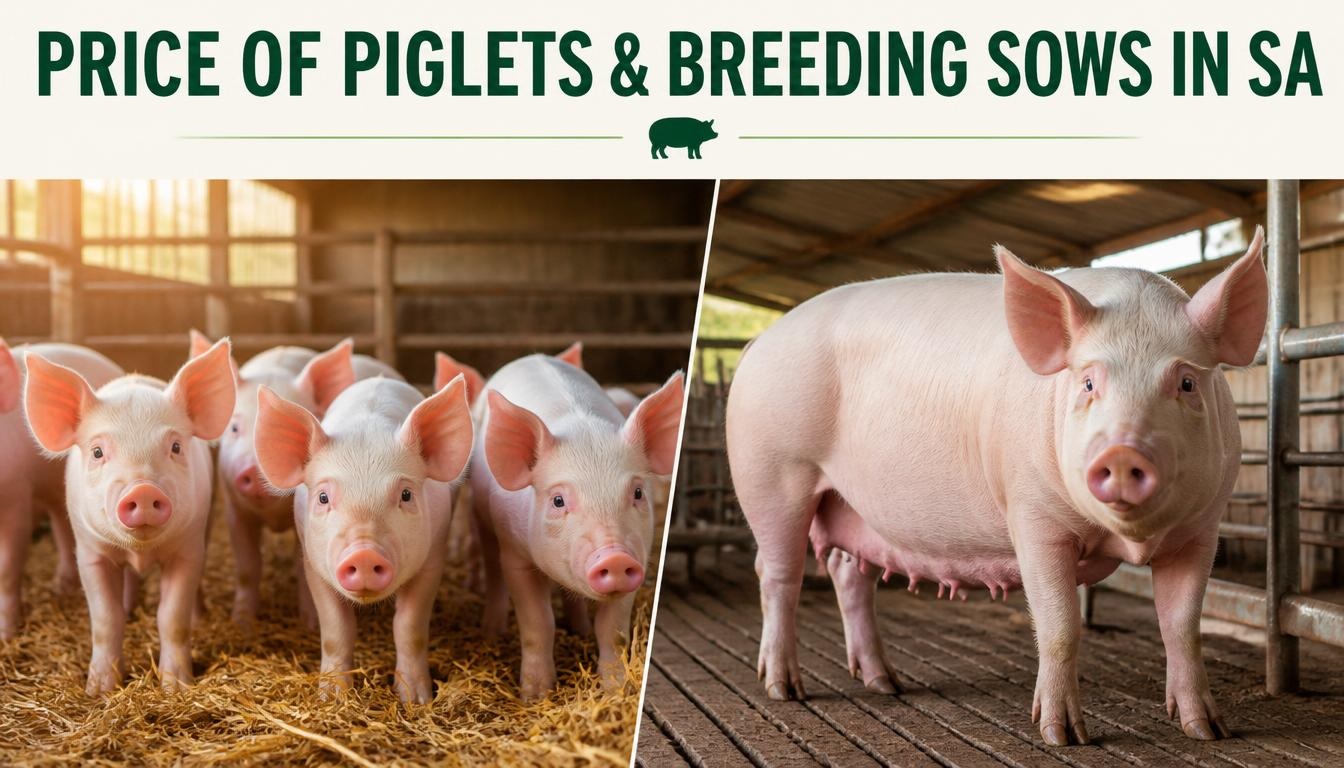
If you step onto a livestock auction floor anywhere from Delmas to Moorreesburg today, you will notice a stark reality: the South African pork sector is running on razor-thin margins, demanding absolute precision from farm owners.
Between volatile yellow maize benchmarks on SAFEX, fluctuating diesel tariffs, and the constant threat of African Swine Fever (ASF), buying your breeding stock at the wrong price point will kill your cash flow before your first litter even clears the farrowing house.
Whether you are looking to purchase 8-week-old post-weaning piglets to grow out for the abattoir, or sourcing elite certified F1 Camborough breeding gilts to build a 50-sow herd, knowing current market rates prevents costly mistakes.
Below is a complete, real-world breakdown of current prices for piglets, pregnant gilts, and mature breeding sows across South Africa—along with the hidden costs most sellers leave out.
Current Market Prices: Piglets, Gilts, and Sows (ZAR)
Livestock pricing fluctuates weekly based on local porker/baconer carcass spot prices, grain input costs, and genetic purity. The figures below represent average commercial market rates across Gauteng, Free State, North West, and the Western Cape.
Piglet and Breeding Stock Price Breakdown
| Stock Category | Weight / Age | Average Price (Excl. VAT) | Elite / Stud Genetics | Target Purpose |
| Weaner Piglets | 6–8 weeks (10–15 kg) | R550 – R850 | R950 – R1,200 | Grow-out to Porker/Baconer |
| Feeder Piglets | 9–12 weeks (18–25 kg) | R900 – R1,350 | R1,450 – R1,800 | Fast-track finishing |
| Open Gilts (Unbred) | 5–6 months (60–80 kg) | R3,500 – R4,800 | R5,000 – R6,200 | Future herd breeding stock |
| Pregnant Gilts (In-Pig) | 7–9 months (100–130 kg) | R5,500 – R7,500 | R8,000 – R10,500+ | Immediate litter production |
| Second/Third Parity Sows | 12–18 months (150–180 kg) | R4,500 – R6,500 | R7,000 – R8,500 | Proven working mother stock |
| Cull Sows (Sausage Pigs) | 200kg+ | R30.00 – R34.00 / kg live weight | N/A | Abattoir process meat |
Piglet Cost Breakdown: What Determines the Price?
Buying a piglet isn’t as simple as picking the cheapest animal on a classifieds site. A R500 piglet can easily become a financial sinkhole if it lacks growth genetics or carries subclinical infections.
Core Valuation Metrics for Piglets
-
Health & Vaccination Status: Piglets fully vaccinated against Mycoplasma hyopneumoniae and PCV2 command an added value of R80 to R150 per head.
-
Genetic Lineage: Purebred or top-tier hybrid crosslines (Large White, Landrace, Duroc) carry higher upfront costs but lower grow-out risks.
-
Feed Conversion Ratio (FCR): Target stock should hit an FCR between 2.4 and 2.8 for efficient mass gain.
-
Real Commercial Value: High-performing, fully vaccinated weaners typically settle at R750+.
1. Weaners (10 kg to 15 kg)
-
Price Range: R550 to R850
-
Market Dynamics: These are newly weaned animals, usually around 6 to 8 weeks old. They carry the highest mortality risk due to weaning stress, gut flora disruption, and temperature sensitivity. Buying at this stage requires heated nursery pens during South African winter nights.
2. Feeders / Growers (18 kg to 25 kg)
-
Price Range: R900 to R1,350
-
Market Dynamics: These piglets have passed the fragile weaning window and are transitioning aggressively onto grower rations. Small-scale farmers prefer feeder piglets because they carry significantly lower mortality rates and reach market weight faster.
Field Tip: Always verify if the piglet price includes primary vaccinations—specifically Mycoplasma hyopneumoniae and PCV2 (Porcine Circovirus). Skipping these to save R40 per piglet often leads to severe respiratory losses during the grower stage.
Sows & Breeding Stock: Gilts vs. Pregnant Sows
If you are setting up a commercial breeding enterprise, choosing the right breeding female dictates your farm’s throughput.
Unbred Gilts (Open Females)
-
Price Range: R3,500 – R5,500
-
Unbred gilts are young females selected for superior structural soundness, teat count (minimum 14 well-placed teats), and strong maternal traits.
-
The Drawback: You will feed and house this animal for 2 to 3 months before she reaches breeding weight (130–140 kg), which adds roughly R1,200 to R1,800 in feed costs before she is even covered. Total investment effectively reaches R5,000 – R7,000 with a slower initial cash flow return.
Pregnant Gilts (In-Pig)
-
Price Range: R5,500 – R8,500 (Commercial) | R9,000+ (High-Health Top Genetics)
-
Buying a verified pregnant gilt accelerates your farm’s cash flow. You are buying an animal that is 40 to 90 days into her 114-day gestation period. Within weeks of arrival, she farrows, yielding an immediate return of 10 to 14 piglets worth around R7,000 in immediate litter value.
Top Commercial Breeds in South Africa
-
Large White: Known for exceptional mothering ability, large litter sizes, and high milk yield.
-
SA Landrace: Valued for long body conformation, deep hams, and calm mothering temperament.
-
Duroc: Primarily used as terminal boars to pass down rapid growth rates, thick loin muscles, and drought/heat resilience.
-
Commercial F1 Hybrids (e.g., PIC Camborough): The industry gold standard for commercial operations. These crossbred lines optimize hybrid vigor, delivering higher litter index numbers and lower feed conversion ratios.
Real Startup Economics: The 10-Sow Model
To understand how individual livestock pricing translates to actual capital outlay, look at a standard 10-Sow commercial starting model operating in 2026.
Recommended Startup Budgeting Ratios
-
Livestock (Sows & Boar): R75,000 (41.6%)
-
3-Month Feed Reserve: R60,000 (33.3%)
-
Biosecurity & Housing: R30,000 (16.7%)
-
Health & Contingency: R15,000 (8.4%)
-
Total Estimated Startup Capital: R180,000 (100%)
Estimated Financial Breakdown
| Item / Resource | Description | Estimated Outlay (ZAR) |
| 8 x Pregnant Gilts | Commercial F1 lines @ R7,000 average | R56,000 |
| 2 x Open Young Gilts | Replacement stock pipeline @ R4,000 | R8,000 |
| 1 x Terminal Working Boar | Registered Duroc / Pietrain line | R11,000 |
| Feed Buffer (3 Months) | Gestation, Lactation & Creep feed reserve | R60,000 |
| Basic Housing Setup | Farrowing crates, nipple drinkers, concrete flooring | R30,000 |
| Veterinary & Biosecurity | Vaccines, dips, footbaths, disinfectant | R15,000 |
| Total Capital Required | Minimum recommended starting buffer | R180,000 |
4 Critical Rules Before Buying Any Pig Stock
1. Dematerialize “Swill Feeding” Expectations
With current commercial pig creep and grower feeds averaging between R5,500 and R7,200 per tonne depending on your province, a common temptation is to rely on local restaurant waste or vegetable swill.
In South Africa, feeding untreated swill is illegal under animal health regulations due to African Swine Fever risks. Beyond biosecurity risks, swill feeds yield unpredictable growth rates, pushing your time-to-market from 18 weeks out to 28+ weeks, eating away any upfront savings.
2. Inspect the “14-Teat Rule”
When buying young open gilts, physically count and inspect every teat. You need a minimum of 14 functional, evenly spaced teats (7 pairs) extending well forward toward the front legs. Expect a minimum of 7 balanced teat pairs running from front to rear legs. Reject any females showing blind, inverted, or damaged teats—she will fail to nurse a large 12+ piglet litter properly.
3. Account for Biosecurity Zones
Never buy livestock from an area actively quarantined for African Swine Fever. Always ask the breeder for a movement permit issued by a local state veterinarian if livestock is crossing municipal or provincial lines. Transporting pigs without official clearance can result in livestock confiscation and heavy state fines.
4. Weigh the Animals Directly
Never purchase pigs based on visual weight estimates alone. Always insist on using a livestock crate scale or suspended harness scale. Paying for a “15kg weaner” that actually weighs 10kg means spending weeks using expensive creep feed just to bring the animal up to its starting baseline.
Let’s Discuss
If you are currently farming pigs or preparing to purchase your first breeding herd in South Africa:
-
What are weaners or pregnant gilts currently selling for in your specific region or local auction?
-
Are higher feed prices driving you toward crossbreeding for better feed conversion ratios?
Drop your thoughts, current local prices, and questions in the comments below!

Joseph Mathebula is a consumer analyst and market researcher at Prices in South Africa. He specializes in tracking local service costs, retail pricing, and travel budgets, helping everyday shoppers navigate the market to secure the best value.