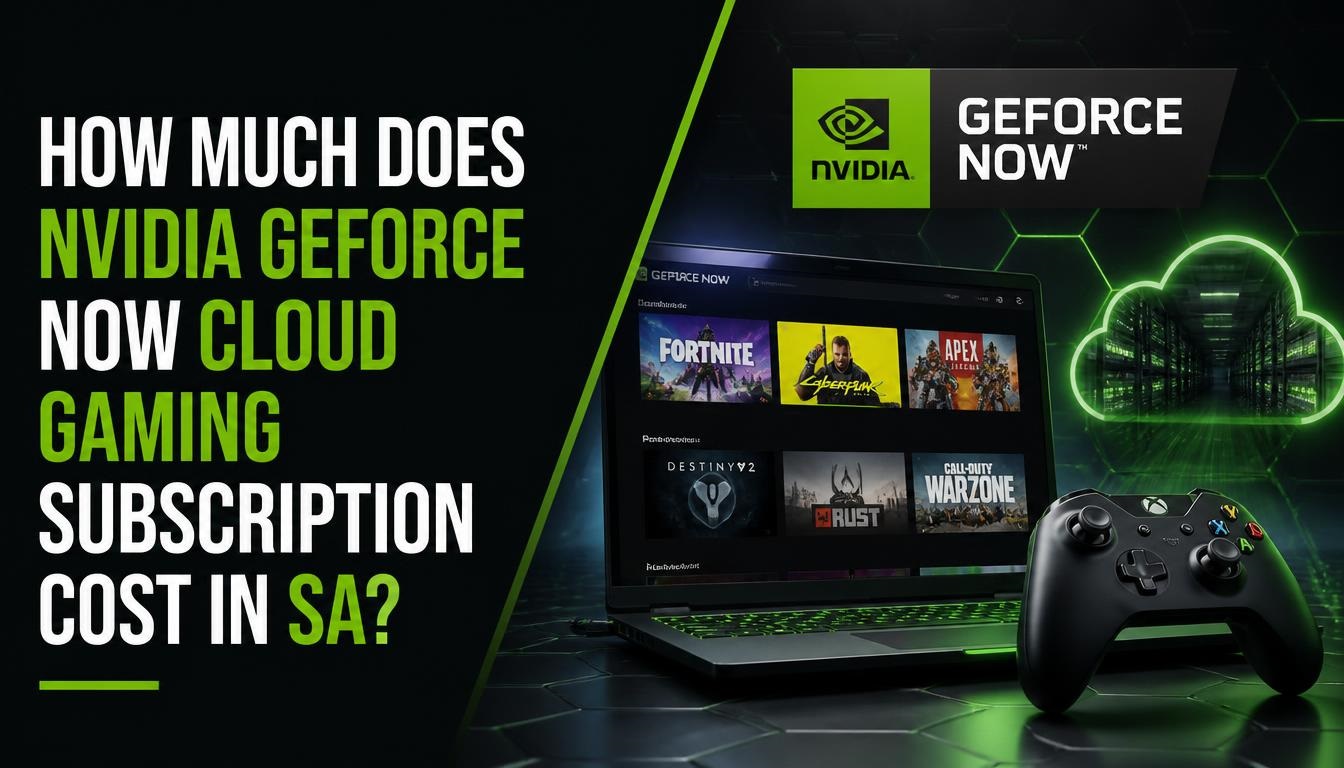
With mid-tier graphics cards sitting around R12,000 to R18,000 at local tech outlets, running high-end PC games without breaking the bank feels nearly impossible in South Africa. The idea of streaming AAA titles straight to your sub-par laptop or smart TV via Nvidia GeForce Now for a fraction of that cost sounds like an immediate win. But between local server limits, variable 5G coverage, and hidden game ownership costs, is it actually worth dropping your hard-earned cash monthly?
Quick-Answer Pricing Overview
The True Cost of Cloud Gaming in South Africa
Before diving into the local pricing structure, let’s address the elephant in the room: subscription stacking. When you subscribe to Nvidia GeForce Now Powered by Rain, your monthly fee grants you access to top-tier cloud hardware (RTX-enabled servers located inside South Africa). It does not unlock a library of free games.
If you don’t already have an extensive digital library on Steam or Epic Games, you will need to factor in additional costs, such as pairing the service with PC Game Pass (~R250/mo). That brings your total cloud gaming outlay to around R410 to R450 per month. That’s still dramatically lower than financing a gaming rig, but it’s a vital distinction to understand before adding your credit card details.
-
GeForce Now Priority (Rain Subscriber): R160 / month
-
GeForce Now Priority (Standard User): R200 / month
-
PC Game Pass (Optional Library Add-on): ~R250 / month
-
Total Real Monthly Cost: R410 to R450 / month
Breakdown of South African Subscription Tiers
Rain operates the official local alliance servers for Nvidia GeForce Now across Mzansi. Prices are split based on target resolution, frame rates, and whether you use Rain as your Internet Service Provider (ISP).
| Service Plan / Tier | Standard ZAR Price (VAT Inc.) | Rain ISP Discount Price | Max Session Length | Target Specs & Resolution | Direct Access Link |
| Priority / Performance | R200 / month | R160 / month | 3 Hours per session | 1080p–1440p @ 60 FPS (RTX 3060 rig class) | View Priority Plan on Rain |
| Ultra Tier | R400 / month | R320 / month | 8 Hours per session | 4K @ 60 FPS / 1440p @ 120 FPS (RTX 3080 rig class) | Check Ultra Tier on Rain |
Local Conditions Test: Load-Shedding, Fibre vs 5G, and Latency
Running cloud services in South Africa comes with unique infrastructure hurdles. Here is how Nvidia GeForce Now handles actual local conditions:
1. Latency & Server Proximity
Because Rain hosts local edge servers in South Africa, latency is typically low (around 10ms to 25ms on decent Fibre connections). This makes single-player titles like Hogwarts Legacy, Cyberpunk 2077, or Indiana Jones and the Great Circle feel virtually identical to playing on local hardware. Fast-paced competitive shooters (Valorant, Apex Legends), however, might still reveal minor control input lag if your Wi-Fi drops frames.
2. Data Usage & Capped Package Traps
Never try to run cloud gaming on capped mobile data bundles.
-
1080p at 60 FPS: Uses ~7GB to 10GB per hour.
-
1440p / 4K: Uses ~12GB to 18GB per hour.
If you are on an uncapped Fibre or 5G connection (e.g., Rain 5G, Vodacom Fibre, or Openserve via Webafrica), you’re safe. But if you’re attempting to stream over standard mobile data bundles from MTN or Vodacom, a single afternoon session will drain a 50GB bundle completely.
3. Load-Shedding & Power Outage Resilience
One massive advantage over a power-hungry 750W desktop PC is power management during load-shedding. A 750W gaming desktop requires a massive, expensive UPS or inverter system (costing upwards of R8,000 to R15,000 at outlets like Builders – View Power Systems or Makro – Check Inverters).
With GeForce Now, you only need to power your Fibre router and a low-power laptop, tablet, or smart TV. A small R900 mini-DC UPS keeps your router alive, allowing you to game uninterrupted through Stage 4 load-shedding cuts.
Retailers, Hardware Deals, and Loyalty Points Optimization
While the subscription is billed directly by Rain, setting up your cloud gaming station offers several ways to maximize local consumer rewards:
-
eBucks & Discovery Miles: If you purchase controller hardware, smart TV streaming sticks (like the Xiaomi TV Box S or Apple TV 4K), or mechanical keyboards, buy them through Takealot – View Tech Deals using eBucks or Discovery Miles to offset your out-of-pocket costs.
-
Flexible Payments: If you need a decent client device—such as an entry-level laptop or tablet—retailers like Incredible Connection – View Laptops and Game – Check Electronics support pay-later platforms like PayFlex, PayJustNow, and Mobicred, letting you split payments interest-free over 3 or 4 installments.
-
Rain One Bundles: If you are already looking for home internet, opting for a RainOne home 5G package automatically unlocks the 20% recurring discount on your GeForce Now subscription, dropping the entry price from R200 down to R160/mo.
Frequently Asked SA Consumer Questions
What happens under the Consumer Protection Act (CPA) if the service lags?
Under the South African Consumer Protection Act (CPA), digital services billed on a month-to-month basis can be cancelled without severe penalty. Since Rain operates GeForce Now on a contract-free, month-to-month billing model, you can cancel at any time prior to your next renewal date via your online profile if your home connection isn’t performing adequately.
Can I use GeForce Now without a Rain SIM card?
Yes. The service is open to all South Africans regardless of their ISP (e.g., Coolmarket, Vox, Telkom, Afrihost). Non-Rain users simply pay the standard rate of R200/mo for Priority or R400/mo for Ultra, whereas Rain clients get a discounted rate.
What is the minimum internet speed needed for buffer-free gaming?
You need a stable minimum connection speed of 15 Mbps for 720p at 60 FPS, 25 Mbps to 35 Mbps for 1080p at 60 FPS, and at least 50 Mbps to 100 Mbps for smooth 1440p/4K streaming. Crucially, connect via an Ethernet cable or 5GHz Wi-Fi band to prevent local packet loss.
South African Gaming Community Discussion
Have you tested GeForce Now over local 5G or Fibre in your neighborhood? Are you seeing smooth frame rates in Johannesburg, Cape Town, or Durban, or dealing with queue times during peak evening hours?
Drop your local ping results, internet setup, and recent game experiences in the comments section below!
Disclaimer: Prices fluctuate and reflect independent market research at the time of publication. We may earn a small affiliate commission through retailer links at no extra cost to you.

Joseph Mathebula is a consumer analyst and market researcher at Prices in South Africa. He specializes in tracking local service costs, retail pricing, and travel budgets, helping everyday shoppers navigate the market to secure the best value.