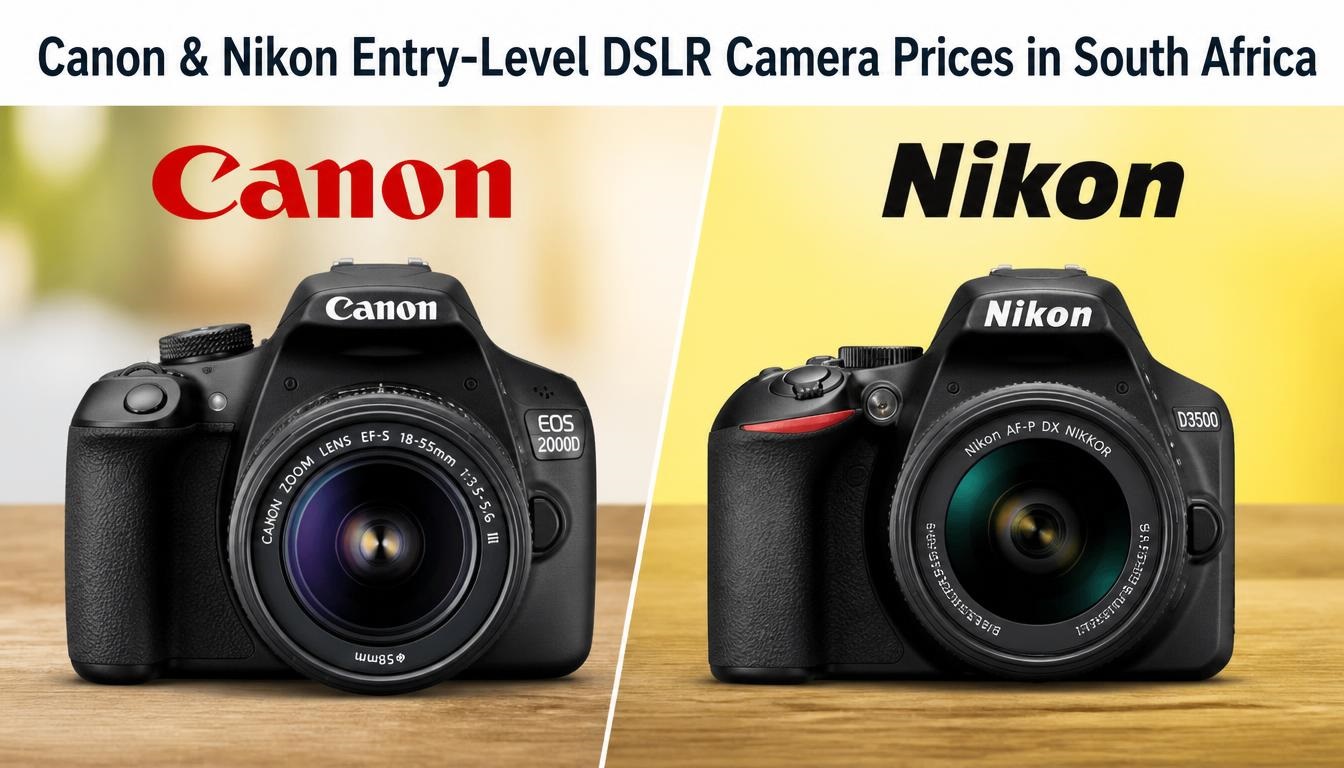
The camera market in South Africa has shifted heavily toward mirrorless systems, but traditional entry-level Digital Single-Lens Reflex (DSLR) cameras remain the most practical gateway for beginner photographers, film students, and budget-conscious creators. While mirrorless bodies command steep price tags for newer electronic viewfinders and autofocus algorithms, traditional DSLRs continue to offer unmatched mechanical reliability, ergonomic handling, and exceptional value per Rand.
Whether you are enrolling in a photography course at Vega or MUT, or looking to move beyond smartphone photography, Canon and Nikon entry-level DSLRs offer native optical viewfinders, long battery performance, and access to thousands of affordable secondary lenses in the South African pre-owned market.
Key Price Summary Table
Note: Retail pricing fluctuates based on import tariffs and local exchange rates. Prices reflect average South African market values across major retailers (such as Orms, Takealot, Makro, and Incredible Connection) alongside verified second-hand trade figures.
| Camera Model | Body-Only Price (ZAR) | Kit Lens Bundle Price (18-55mm) | Key Highlight | Best For |
| Canon EOS 4000D | R 4,500 – R 5,500 | R 6,999 – R 8,499 | Ultra-budget, lightweight plastic mount | Absolute beginners on a strict budget |
| Nikon D3500 | R 5,500 – R 6,500 (Pre-owned focus) | R 7,500 – R 9,200 | Class-leading 1,550-shot battery life | Travel & everyday photography |
| Canon EOS 2000D | R 6,200 – R 7,500 | R 8,999 – R 11,500 | 24.1MP APS-C sensor with metal mount | Photography students & hobbyists |
| Nikon D5600 | R 8,500 – R 9,800 | R 11,500 – R 13,500 | 39-point AF system & vari-angle touch screen | Creative stills & intermediate shooters |
| Canon EOS 250D | R 11,000 – R 12,500 | R 14,500 – R 18,999 | Lightweight body with 4K video & Dual Pixel AF | Content creators & video-first beginners |
In-Depth Model Breakdown
1. Canon EOS 4000D
-
Estimated SA Retail Price: R 6,999 – R 8,499 (Kit) | R 3,900 – R 5,500 (Pre-Owned)
-
Core Specs: 18.0 MP APS-C CMOS Sensor | DIGIC 4+ Processor | 9-Point AF System | ~500 Shots per charge
-
Real-World Analysis: Designed specifically to lower the cost of entry, the EOS 4000D strips away non-essential hardware. It provides clean 1080p video recording and direct Wi-Fi connectivity via the Canon Camera Connect app.
-
Pros: Highly affordable; lightweight construction; simple interface layout.
-
Cons: Plastic lens mount; small 2.7-inch rear LCD screen; limited burst shooting speed.
-
Key Trade-off: Uses a polycarbonate plastic lens mount instead of metal. Rough lens switching can cause wear over time.
2. Nikon D3500
-
Estimated SA Retail Price: R 7,500 – R 9,200 (Kit) | R 5,000 – R 6,500 (Pre-Owned)
-
Core Specs: 24.2 MP DX-Format Sensor | EXPEED 4 Processor | 11-Point AF System | 1,550 Shots per charge
-
Real-World Analysis: The Nikon D3500 features a deep grip and clean ergonomics. By omitting the optical low-pass filter, the sensor extracts exceptional detail from raw files, outperforming many competitors in its tier.
-
Pros: Outstanding battery endurance; sharp 24.2MP output; built-in Guide Mode for beginners.
-
Cons: Non-touchscreen LCD; no 4K recording; discontinued new production (primarily available secondhand or refurbished).
-
Key Trade-off: Lacks an internal focus motor, requiring AF-S or AF-P lenses for autofocus function.
3. Canon EOS 2000D
-
Estimated SA Retail Price: R 8,999 – R 11,500 (Kit Bundle)
-
Core Specs: 24.1 MP APS-C Sensor | DIGIC 4+ Processor | 9-Point AF System | ~500 Shots per charge
-
Real-World Analysis: Sitting directly above the 4000D, the 2000D returns to a standard metal lens mount, a larger 3.0-inch LCD display, and a higher-resolution 24.1MP sensor. It is one of the most widely stocked starter models across South African retail outlets.
-
Pros: Standard hot-shoe sync pin for studio flash setups; durable metal mount; reliable color rendition.
-
Cons: Dated DIGIC 4+ processor limits low-light performance; slow continuous shooting (3 fps).
-
Key Trade-off: Standard 9-point autofocus system requires reliance on focus-and-reframe techniques for off-center subjects.
4. Nikon D5600
-
Estimated SA Retail Price: R 11,500 – R 13,500 (Kit) | R 7,500 – R 9,000 (Pre-Owned)
-
Core Specs: 24.2 MP DX-Format Sensor | EXPEED 4 Processor | 39-Point AF System | ~820 Shots per charge
-
Real-World Analysis: A significant step up for users needing advanced compositions. The fully articulating 3.2-inch touchscreen makes shooting from high or low angles straightforward, while its 39-point autofocus grid tracks moving subjects far better than entry-level alternatives.
-
Pros: Versatile vari-angle touchscreen; accurate 39-point AF grid; SnapBridge Bluetooth transfer.
-
Cons: Higher cost; menus require adjustment for complete beginners.
-
Key Trade-off: Lacks secondary control dials found on enthusiast bodies, requiring menu toggles for shutter/aperture changes in manual mode.
5. Canon EOS 250D
-
Estimated SA Retail Price: R 14,500 – R 18,999 (Kit)
-
Core Specs: 24.1 MP APS-C Sensor | DIGIC 8 Processor | Dual Pixel CMOS AF | ~1,070 Shots per charge
-
Real-World Analysis: Marketed as the world’s lightest DSLR with a movable screen, the 250D features Canon’s Dual Pixel autofocus system for Live View shooting. It provides fast Eye-AF tracking during video recording and supports 4K footage.
-
Pros: Excellent Dual Pixel AF for video; 4K video support; high battery endurance.
-
Cons: 4K video introduces a heavy frame crop; center point AF only when using the optical viewfinder.
-
Key Trade-off: 4K video mode disables Dual Pixel AF, falling back to contrast-detect autofocus.
Buying Guide & Value Analysis
Why Buy a DSLR in 2026?
-
Cost-to-Performance Ratio: Equivalent mirrorless setups (such as the Canon EOS R50 or Nikon Z30) cost considerably more once spare batteries and native lenses are included.
-
Lens Ecosystem: South Africa’s pre-owned market is saturated with compatible F-mount (Nikon) and EF/EF-S (Canon) glass. Prime lenses like a 50mm f/1.8 can be acquired second-hand for a fraction of their mirrorless equivalents.
-
Battery Endurance: DSLRs use optical viewfinders instead of electronic displays, allowing them to average 500 to 1,500 shots per charge—making them well-suited for long field days without continuous access to power outlets.
Where to Buy Safely in South Africa
-
New Retailers: Orms Direct, Takealot, Camera Stuff, and Incredible Connection offer official local warranties (Canon SA / Flash-Graphics Nikon distributions).
-
Verified Pre-Owned Specialist Outlets: Outlets like Outdoorphoto, Kameraz, and Urban Cameras conduct mechanical testing and typically offer 3- to 6-month store warranties on second-hand gear.
-
Peer-to-Peer Marketplaces: When using platforms like Facebook Marketplace or Gumtree, always arrange safe meetups in public spaces or secure police station parking zones. Test the sensor for dust spots at f/22, verify shutter counts, and inspect the lens mount for contact wear.
When calculating your setup budget, keep these necessary accessories in mind:
-
SD Memory Cards: Budget R 250 – R 500 for a 64GB or 128GB UHS-I Class 10 SD card (SanDisk Extreme or Lexar).
-
Spare Batteries: Original Canon LP-E10 or Nikon EN-EL14a batteries cost roughly R 650 – R 950, while third-party variants (Jahwa / SmallRig) run R 350 – R 500.
-
Protective Gear: A padded shoulder bag or backpack ranges from R 450 to R 1,200.
Frequently Asked Questions
1. Is it worth buying a DSLR camera in South Africa in 2026?
Yes. For beginners and students on a budget, entry-level DSLRs offer stronger value per Rand than equivalent mirrorless systems. They deliver proper manual exposure controls, interchangeable lens access, and exceptional battery life without requiring high initial investment.
2. Which is cheaper in SA: Canon or Nikon entry-level cameras?
Canon maintains a lower barrier to entry for brand-new equipment due to models like the EOS 4000D and 2000D. However, Nikon often leads in overall value on the second-hand market, with models like the D3500 offering higher dynamic range and battery performance per Rand.
3. What is the best budget camera for photography students in South Africa?
The Canon EOS 2000D and Nikon D3500 are the standard recommendations for students. Both feature 24MP APS-C sensors, full manual exposure controls, and standard hot-shoe mounts required for studio lighting modules in coursework.
4. Where can I buy second-hand Canon and Nikon DSLRs safely in SA?
Established camera retailers with pre-owned departments—such as Orms, Outdoorphoto, and Kameraz—provide audited second-hand equipment with short warranty coverage. For private sales, use platforms with buyer protections or meet at safe public locations to inspect hardware thoroughly before payment.

Joseph Mathebula is a consumer analyst and market researcher at Prices in South Africa. He specializes in tracking local service costs, retail pricing, and travel budgets, helping everyday shoppers navigate the market to secure the best value.