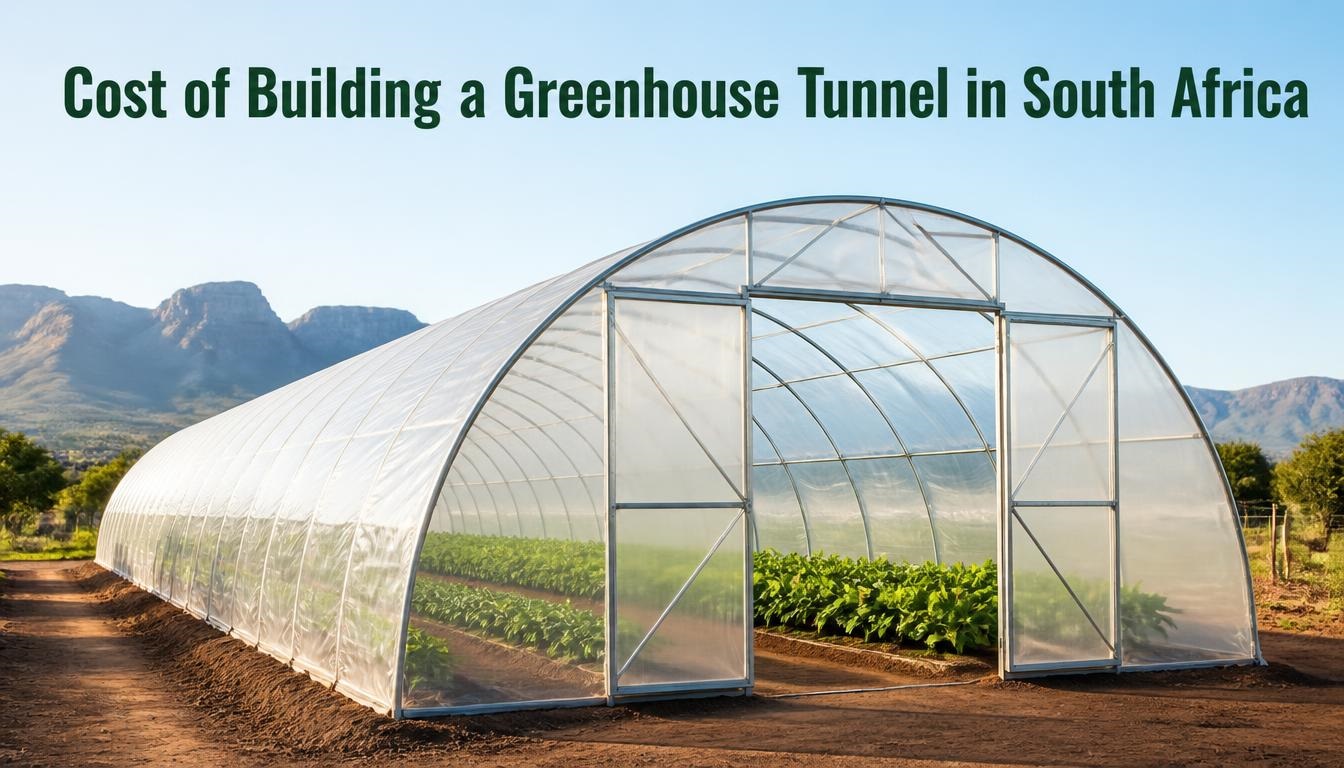
Before spending a single Rand on your agricultural setup, beware of cheap imported kits that collapse under Highveld hailstorms or shred during a Western Cape winter north-westerly gale. Evaluated properly, the actual cost of building a greenhouse tunnel in South Africa ranges from budget backyard DIY configurations to multi-bay commercial steel installations, with hidden costs like UV-stabilized plastic replacement, anchors, and site prep catching many first-time buyers off guard.
Quick Market Price Summary (ZAR – 15% VAT Included):
Retail Price Comparison: Greenhouse Tunnels Across South Africa
To save you hours of cross-tabulating websites, here is an objective cost breakdown across leading South African retail channels and specialist agricultural suppliers.
| Supplier / Provider | Product / Specifications | ZAR Price (R) | VAT Included? | Stock & Delivery Notes | Overall Value Rating | Direct Purchase Link |
| Bell & Paton | 6m x 3m x 2m Walk-In Galvanized Tunnel | R9,699.00 | Yes (15%) | Direct courier nationwide; lead times apply | 4.9 / 5.0 | Check Price at Bell & Paton |
| Takealot | Standard 4m x 3m x 2m Backyard Tunnel Kit | R5,399.00 | Yes (15%) | Free delivery; Takealot Pickup Point eligible | 4.2 / 5.0 | View Deal on Takealot |
| Makro | Sosolar 2-Tier Portable Walk-In (Small Scale) | R1,999.00 | Yes (15%) | In-store pickup or home delivery via Courier Guy | 3.8 / 5.0 | Check Deal at Makro |
| Growing Tech SA | IGT 10m x 3m x 2.5m Heavy Duty Tunnel | R12,399.00 | Yes (15%) | Freight delivery extra based on province | 4.7 / 5.0 | View Deal at Growing Tech SA |
| Aquaponics Direct | Semi-Commercial DIY Kit (6m x 6m Steel Frame) | R15,500.00 | Yes (15%) | Special order freight; heavy cargo delivery | 4.5 / 5.0 | Check Price at Aquaponics Direct |
| Builders Warehouse | Custom Timber/PVC DIY Raw Materials (4m x 3m) | R3,200.00 – R4,500.00 | Yes (15%) | In-store pickup; localized regional delivery | 3.5 / 5.0 | Order Materials at Builders |
The True Breakdown of Building Costs: Pre-Fabricated Kit vs DIY
When deciding whether to buy a pre-packaged tunnel kit or build one from scratch using raw materials from Builders Warehouse, costs vary based on longevity and wind resistance.
-
Frame & Cover: Accounts for roughly 60% of total expenses.
-
Anchoring & Base Prep: Accounts for roughly 20% of total expenses.
-
Irrigation & Ventilation: Accounts for roughly 20% of total expenses.
1. Pre-Fabricated Galvanized Steel Kits
Pre-fabricated kits from specialists like Bell & Paton or Growing Tech SA come with pre-bent galvanized steel poles, dual zips, roll-up side windows with mosquito netting, and PE covers.
-
Average Cost: R250 to R450 per square metre for basic home setups.
-
Assembly Time: 2 to 4 hours with two adults.
-
Why it’s worth it: No specialized bending tools needed. Frame components snap or bolt together seamlessly.
2. The Custom DIY Route (PVC Pipes or Timber Framing)
If you decide to buy 32mm Class 6 PVC pipes or treated CCA Pine poles from Builders along with agricultural sheeting:
-
Structure & Framing: R1,200 to R2,200 (depends on timber vs PVC).
-
200-Micron UV-Treated Plastic: R25.60 to R35.00 per m².
-
Anti-Hail / 40% Shade Netting: R20.00 to R45.00 per m².
-
Total Estimated DIY Build: R3,200 to R4,800 for a 4m x 3m footprint.
-
The Catch: Without engineered curves, wind pocketing degrades cheap PVC quickly in coastal area gusts.
Buying the structure is only step one. Local weather conditions create hidden costs that buyers often fail to factor into their initial budget:
-
Anchor Kits & Concrete Footers: R450 to R1,200 (essential for Highveld storms and Western Cape winds).
-
200-Micron Plastic Replacement: R1,500 to R3,500 required every 3 to 5 years.
-
Gravity Drip Irrigation System: R650 to R2,200 for off-grid, non-electric watering setups.
-
Ground Weed Barrier Fabric: R350 to R900 per 10m roll to suppress native weed growth.
High-Wind and Storm Anchoring
A basic kit pegged with standard tent pegs will end up in your neighbor’s yard during an August storm. Secure earth anchors, storm straps, or concrete corner footings cost an extra R500 to R1,200.
Heat Management & Load-Shedding Proofing
Temperatures inside a sealed plastic tunnel can easily exceed 45°C during a Karoo or Limpopo summer. Ventilation requires:
-
Passive Roll-Up Sides: Included in mid-tier kits, or R400 for extra clamps/curtain tracks on DIY builds.
-
Off-Grid Solar/Battery Circulation Fans: Since load-shedding can cut power to traditional fans, a 12V solar fan setup will run you R850 to R1,800.
Local Conditions Test: How Tunnels Fare in South Africa
South Africa poses distinct environmental challenges for protected cropping:
-
Extreme Sun Exposure (UV Degradation): Low-grade polyethylene degrades quickly under intense local UV levels. Standard greenhouse plastic splits without UV3 or UV4 stabilization. Always verify that replacement film carries a 3-to-5-year warranty.
-
Highveld Hailstorms: Summer hailstorms in Gauteng and Mpumalanga can puncture standard plastic within seconds. Fitting a 40% shade net layer over the tunnel structure acts as a buffer, costing roughly R4,500 to R6,000 for a complete shade net conversion frame.
-
Pest Control under the CPA: Cheap zips break quickly, letting whiteflies and red spider mites breach the perimeter. Ensure netting windows use mesh sizes smaller than 0.6mm.
Savvy Buyer’s Guide: Payment Plans & Sales Cycles
Given current economic pressures, taking advantage of local rewards programs and seasonal sales makes a substantial difference to your final outlay:
-
Black Friday & Spring Sales: Retailers like Takealot and Makro regularly drop entry-level tunnel kit prices by 15% to 30% between late August (early planting season) and late November.
-
Buy-Now-Pay-Later (BNPL): Services such as PayJustNow and PayFlex allow you to split a R9,000 tunnel purchase over 3 interest-free installments, helping preserve working capital for seeds and fertilizers.
-
Loyalty Points Redemption: You can clear substantial portions of your bill by spending eBucks on Takealot, or applying Discovery Miles and Makro mCard cash-back rewards towards structural gear.
Frequently Asked Questions
Do I need municipal planning permission to erect a greenhouse tunnel in South Africa?
For temporary shade-cloth or steel-hoop structures without permanent concrete foundations under 40m², municipal approval is generally not required. However, if you are building a permanent structure with brick footings or an extensive commercial footprint, consult your local municipality under NBR (National Building Regulations) guidelines.
What protection do I have under the Consumer Protection Act (CPA) if my kit arrives damaged?
Under Section 56 of the South African Consumer Protection Act, goods carry an implied 6-month warranty of quality. If your kit arrives with defective welds, torn covers, or missing connectors, you are legally entitled to demand a full refund, repair, or replacement from local retailers like Takealot or Makro.
How long does a 200-micron UV-stabilized plastic cover actually last in SA?
High-quality 200-micron thermal agricultural plastic rated for Southern Africa typically lasts 3 to 5 years. Cheap non-UV-treated plastics sold on unverified import sites often deteriorate within 6 to 12 months.
Community Discussion: What Are You Paying in Your Province?
Have you recently purchased or built a tunnel setup in South Africa? Whether you picked up a discount deal from Builders, had a kit delivered via Courier Guy, or constructed a 30m commercial high-tunnel from scratch, drop your pricing and tips in the comments below! Share your location, structure size, and cover performance to help fellow local growers avoid retail markup traps.
Disclaimer: Prices fluctuate and reflect independent market research at the time of publication. We may earn a small affiliate commission through retailer links at no extra cost to you.

Joseph Mathebula is a consumer analyst and market researcher at Prices in South Africa. He specializes in tracking local service costs, retail pricing, and travel budgets, helping everyday shoppers navigate the market to secure the best value.