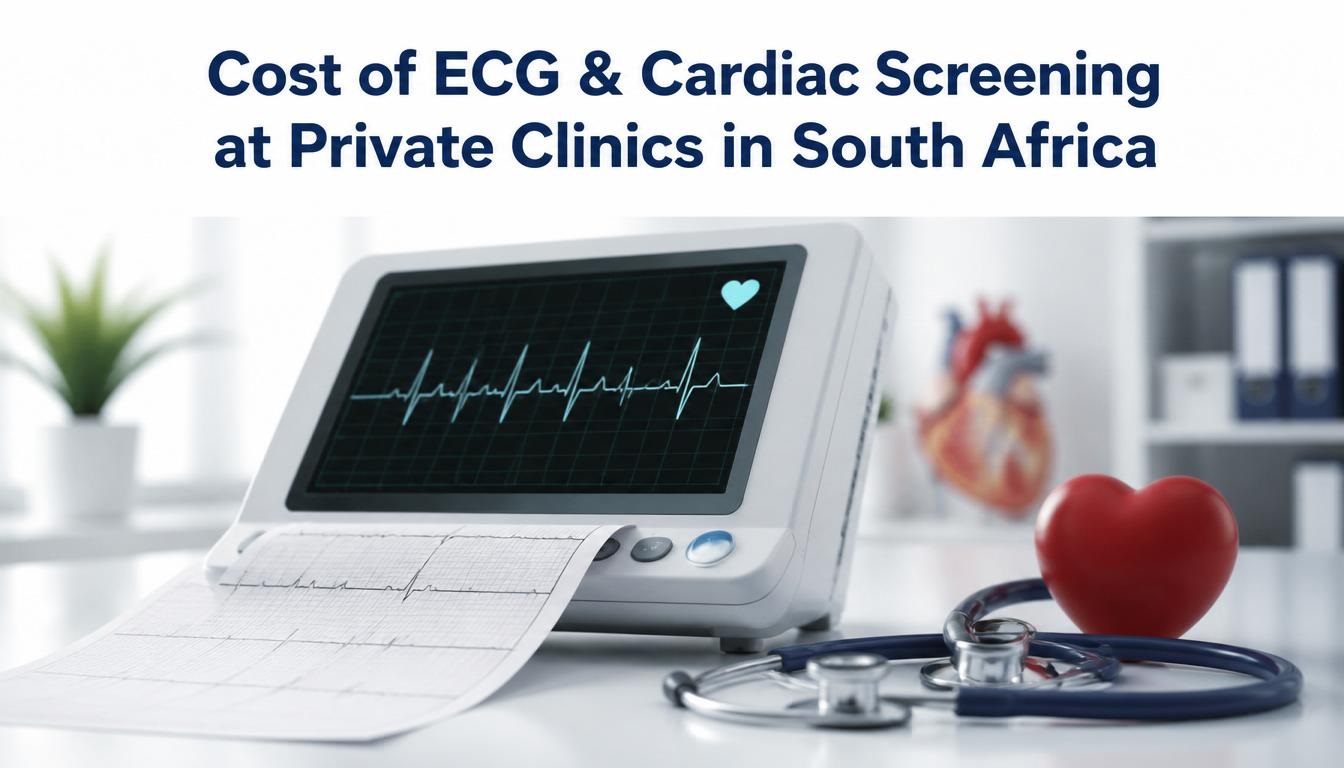
Navigating private healthcare in South Africa when dealing with heart health can feel like walking through a financial maze. Whether you are experiencing sudden palpitations, preparing for a routine executive health check, or managing a family history of cardiovascular disease, understanding the out-of-pocket costs before walking into a clinic is crucial.
Private medical fees in South Africa vary significantly depending on where you go—from primary retail clinic suites (like Clicks or Dis-Chem) to general practitioner (GP) surgeries and specialist cardiology suites at Netcare, Mediclinic, or Life Healthcare hospitals.
This comprehensive guide breaks down the real, current 2026 costs of electrocardiograms (ECGs) and full cardiac screenings in South African private clinics, explains how medical aid schemes cover these tests, highlights hidden costs, and reveals how to avoid unexpected co-payments.
Real-World Overview: What Does a Cardiac Test Cost Out-of-Pocket?
If you are paying cash or haven’t met your medical aid day-to-day savings threshold, private cardiac diagnostic costs can range from R350 for a basic primary care resting ECG up to R8,500+ for a comprehensive specialist screening involving an echocardiogram and 24-hour Holter monitoring.
The exact price depends on three main factors:
-
The Practitioner’s Level: A GP charge is vastly different from a private sub-specialist cardiologist charging private cash rates.
-
The Type of Procedure: A basic resting ECG takes 10 minutes, whereas a stress/treadmill ECG or 24-hour Holter monitor requires specialized equipment and technical interpretation.
-
The Facility Tier: Standalone day clinics and GP rooms generally cost less than hospital-attached specialist consulting rooms.
2026 Price List: ECG & Cardiac Screening Tests in South Africa
The table below outlines current average cash rates across private primary clinics, GP practices, and specialist cardiology clinics in South Africa.
| Procedure / Test Type | Retail / Nurse Clinic (e.g., Clicks, Dis-Chem) | GP Practice / Day Clinic | Private Specialist Cardiologist Suite |
| GP / Specialist Consultation Fee | R250 – R400 (Nurse/Wellness) | R650 – R950 | R2,200 – R2,850 |
| Resting 12-Lead ECG | R350 – R450 | R500 – R650 | R800 – R1,200 |
| Stress / Treadmill ECG | N/A | R750 – R1,100 | R1,500 – R2,400 |
| Echocardiogram (Cardiac Ultrasound / Echo) | N/A | R1,000 – R1,500 | R2,500 – R4,200 |
| 24-Hour Holter ECG Monitoring | N/A | R850 – R1,400 | R2,000 – R3,500 |
| 24-Hour Ambulatory Blood Pressure Monitor | R450 – R600 | R600 – R850 | R1,200 – R1,800 |
| Full Executive Cardiac Package (Consult + ECG + Echo + Stress) | N/A | R2,500 – R3,800 | R5,500 – R8,500+ |
Note on Private Specialist Rates: Private cardiologists in South Africa frequently charge above standard National Health Reference Price List (NHRPL) rates—often between 200% and 400% of the medical aid base rate. If you consult a private specialist directly, expect to pay the consultation upfront unless pre-authorized.
Breakdown of Key Cardiac Diagnostic Tests
Understanding what happens during each diagnostic test helps clarify why pricing differs so dramatically between procedures.
1. Resting 12-Lead Electrocardiogram (ECG)
-
Average Cash Cost: R500 – R800
-
Duration: 10 to 15 minutes
-
What it does: Small adhesive sensors (electrodes) are placed on your chest, arms, and legs to record the electrical signals generated by your heart while you lie completely still.
-
When it’s needed: Used as an initial line of inquiry for chest discomfort, unexplained fatigue, pre-operative clearances, routine medicals, or screening for high blood pressure and arrhythmia.
2. Stress / Treadmill Exercise ECG
-
Average Cash Cost: R750 – R2,200
-
Duration: 30 to 45 minutes
-
What it does: Electrodes remain attached to your chest while you walk on a treadmill or ride a stationary bike, with speed and gradient increasing incrementally.
-
When it’s needed: Resting ECGs frequently miss coronary artery blockages because the heart isn’t working hard. A stress test reveals how your heart performs under physical demand, detecting inducible ischemia (restricted blood flow) or exercise-induced abnormal rhythms.
3. Echocardiogram (Echo / Cardiac Sonar)
-
Average Cash Cost: R1,000 – R3,500
-
Duration: 30 to 60 minutes
-
What it does: An ultrasound probe is placed over the chest wall to create live 2D and 3D moving images of the heart chambers, valves, and surrounding blood vessels.
-
When it’s needed: While an ECG checks electrical health, an Echo evaluates structural health. It measures ejection fraction (pumping efficiency), valve regurgitation or stenosis, and heart muscle thickening caused by long-term hypertension.
4. 24-Hour Holter ECG Monitoring
-
Average Cash Cost: R850 – R3,000
-
Duration: 24 to 48 hours continuous wear
-
What it does: A small, battery-operated portable recorder is strapped to your waist with lead wires attached to your chest. You wear it home while keeping a symptom diary.
-
When it’s needed: Arrhythmias (like atrial fibrillation or skipped beats) are often intermittent. If symptoms don’t happen during a 10-minute clinic visit, a Holter monitor captures electrical activity across a full day and night.
An ECG alone rarely gives the full picture. During a cardiac assessment, your clinician will usually order blood work to evaluate metabolic risk factors or rule out active cardiac muscle damage. These are billed separately by pathology laboratories like Ampath, Lancet Laboratories, or PathCare.
| Laboratory Test | Purpose | Average Cash Price (SA Pathology Labs) |
| Lipid Profile (Full) | Measures Total Cholesterol, HDL, LDL, and Triglycerides | R280 – R420 |
| High-Sensitivity C-Reactive Protein (hs-CRP) | Checks for arterial inflammation and vascular risk | R220 – R350 |
| HbA1c (Glycated Hemoglobin) | Screens for diabetes/insulin resistance affecting blood vessels | R200 – R320 |
| Troponin T / I (High Sensitivity) | Identifies acute heart muscle injury or heart attack | R450 – R700 |
| NT-proBNP / BNP | Biomarker for heart failure and fluid overload assessment | R850 – R1,300 |
Medical Aid Coverage & Prescribed Minimum Benefits (PMBs)
Understanding how South African medical schemes handle cardiac testing can save you thousands of Rands.
1. Screening from Wellness Benefits
Major schemes—such as Discovery Health, Bonitas, Momentum Health, and Bestmed—cover routine preventative screening tests (including basic cholesterol, glucose, and blood pressure checks) from your scheme’s Preventative Care / Wellness Benefit. This does not deduct from your personal Medical Savings Account (MSA) or day-to-day limit.
However, a formal diagnostic resting ECG ordered by a GP typically comes out of your Medical Savings Account or day-to-day benefit unless you have reached your threshold.
2. Prescribed Minimum Benefits (PMBs)
Under South African law (Medical Schemes Act 131 of 1998), certain cardiac conditions qualify as Prescribed Minimum Benefits (PMBs). These include:
-
Acute myocardial infarction (heart attack)
-
Unstable angina
-
Severe heart failure
-
Life-threatening cardiac arrhythmias
If your clinician suspects or diagnoses an active PMB condition, diagnostic workups (including ECGs, Holter monitoring, bloods, and emergency echocardiograms) must be covered in full by your medical scheme, even if your day-to-day savings are completely depleted.
Crucial Tip for Claims: To qualify for PMB funding, the healthcare provider must submit the claim using the correct ICD-10 diagnostic code (for example,
I20.0for unstable angina orI48.0for atrial fibrillation) alongside the procedure tariff code. If billed under a generic administrative code, your scheme will default to paying from your savings account.
GP vs. Specialist: Step-by-Step Patient Pathway
Choosing where to start your cardiac check-up impacts both the cost and the speed of treatment.
-
Step 1: Primary Screening (Retail Nurse Clinic or GP)
-
Estimated Cost: R350 – R950
-
Action: Initial check of blood pressure, baseline vitals, and wellness metrics at primary healthcare facilities like Clicks, Dis-Chem, or a GP office.
-
-
Step 2: Diagnostic Evaluation (GP Practice / Day Clinic)
-
Estimated Cost: R800 – R1,800
-
Action: A GP performs a 12-lead resting ECG and orders necessary pathology blood tests (such as a lipogram or hs-CRP).
-
Outcome A (Normal Results): Annual follow-ups with your GP.
-
Outcome B (Abnormal Signals): Formal referral to a cardiologist for specialized investigation.
-
-
Step 3: Advanced Cardiology Investigation (Specialist Suite)
-
Estimated Cost: R3,500 – R8,500+
-
Action: Specialist consultation with advanced non-invasive testing, including stress ECG, echocardiogram, or continuous 24-hour Holter monitoring.
-
Starting with a GP or primary care clinic is recommended for baseline checks, executive health routine clearances, or mild symptoms. A GP can perform a 12-lead ECG and basic blood work for a fraction of a specialist’s fee. Direct self-referrals to hospital cardiologists often incur higher co-payments and out-of-pocket consultation gaps.
5 Practical Ways to Lower Your Out-of-Pocket Cardiac Costs
-
Utilize Designated Service Providers (DSPs): Check if your medical aid option requires you to use network GPs, network cardiologists, or network pathology labs (e.g., Ampath vs Lancet). Going out of network triggers co-payments ranging from 20% to 50%.
-
Ask for the Cash Rate: If you are uninsured or paying out-of-pocket, ask the clinic receptionist for their “upfront cash rate.” Many practices offer discounts of 10% to 25% for instant settlement at the counter versus delayed billing.
-
Verify Tariff Gap Cover: If you are admitted to a hospital or seeing a specialist whose rate is 300% or 400% of NHRPL rates, standard medical aid options leave a large shortfall. Having private Gap Cover in South Africa ensures these specialist diagnostic gaps are reimbursed.
-
Combine Wellness Incentives: Programs like Discovery Vitality or Momentum Multiply offer free annual health checks. Completing these checks unlocks points while providing baseline screening numbers for blood pressure and glucose.
-
Get Pre-authorization for Extended Monitoring: If your doctor prescribes a 24-hour Holter monitor or cardiac CT scan, obtain pre-authorization from your medical scheme first to ensure it’s paid from risk rather than savings.
Community Discussion: What Has Been Your Experience?
Have you recently undergone an ECG or cardiac check-up at a private clinic or hospital in South Africa?
-
How much did your doctor or clinic charge out-of-pocket?
-
Did your medical aid cover the full cost, or were you hit with unexpected specialist co-payments?
Share your experience and price quotes in the comments below to help fellow South Africans navigate private healthcare costs!

Joseph Mathebula is a consumer analyst and market researcher at Prices in South Africa. He specializes in tracking local service costs, retail pricing, and travel budgets, helping everyday shoppers navigate the market to secure the best value.