Having spent over twelve years walking dust-coated auction rings from Vryburg and Mokopane to the rolling green pastures of the Free State, I can tell you one thing with complete certainty: buying cattle in South Africa is as much an emotional chess game as it is a financial investment.
Whether you are looking to restock a commercial beef enterprise after a seasonal drought, venture into small-scale livestock farming, or source top-tier stud genetics to boost weaning weights, understanding real-time market value is the difference between making a healthy profit and watching your hard-earned capital bleed out on feed bills.
The South African beef market is dynamic and influenced by fluctuating grain prices, climate conditions, export demands, and localized outbreaks of Foot-and-Mouth Disease (FMD).
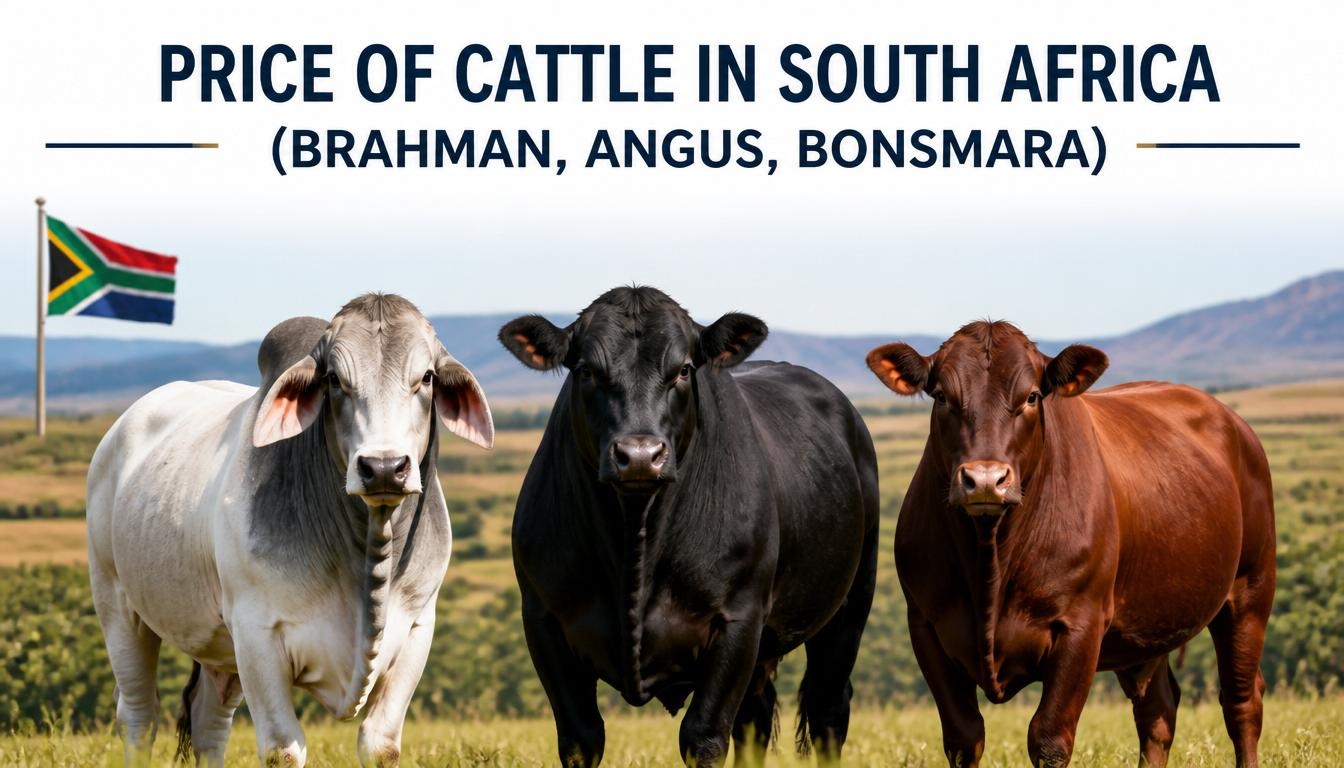
In this comprehensive market report and buyer’s guide, we will break down current baseline cattle prices across South Africa, with an in-depth look at three of the country’s dominant beef breeds: the heat-tolerant Brahman, the high-marbling Angus, and South Africa’s homegrown masterpiece, the Bonsmara.
1. Executive Summary: Current South African Livestock Market Overview
Before diving into breed-specific characteristics and stud pricing, it helps to understand the baseline market rates established by major industry bodies like the Red Meat Producers’ Organization (RPO) and auction houses such as Vleissentraal, BKB, and Hobson & Co.
Meat prices in South Africa operate on two distinct pricing systems: live weight (R/kg on the hoof) and carcass weight (R/kg hanging weight at the abattoir).
Current Market Price Averages
| Meat / Livestock Category | Grade / Weight Class | Average Price Range (ZAR) | Pricing Metric |
| Beef Carcass (Class A2/A3) | Premium young beef, light cover | R66.00 – R68.50 | Per kg hanging weight |
| Beef Carcass (Class B2/B3) | Medium-age cattle | R60.00 – R63.00 | Per kg hanging weight |
| Beef Carcass (Class C2/C3) | Mature cows/bulls | R57.00 – R61.50 | Per kg hanging weight |
| Weaner Calves (Bulls/Steers) | 180kg – 240kg live weight | R43.00 – R48.50 | Per kg live weight |
| Commercial Heifers | 200kg – 280kg live weight | R38.00 – R44.00 | Per kg live weight |
| Commercial Slaughter Cows | Lean to medium condition | R22.00 – R29.50 | Per kg live weight |
| Commercial Breeding Cows | Pregnant / With calf | R12,000 – R22,000 | Per head |
| Registered Stud Bulls | Certified breeding age | R45,000 – R150,000+ | Per head (Auction) |
Real-World Note for Buyers: When buying at local farmgate auctions, remember that live weight does not equal carcass yield. Standard beef breeds typically dress out at 54% to 62% of their total live weight depending on fill, finish, and breed genetics.
2. In-Depth Analysis: The Three Heavyweights of SA Beef
Breed 1: The Brahman (The Rugged Survivor)
Origin & Adaptation
Originally developed in the United States from Indian Bos indicus cattle, the Brahman has earned its place as the backbone of hot, semi-arid, and bushveld farming regions across Limpopo, Mpumalanga, Northern Cape, and North West.
Recognizable by its distinct shoulder hump, loose folded skin, drooping ears, and thick sweat glands, the Brahman is built for harsh environments.
Why Farmers Choose Brahman
-
Heat & Parasite Resistance: Their dark pigment protects against eye cancer and sun scalding, while their tight hair coat and active skin muscles make them naturally resistant to ticks and flies.
-
Exceptional Foraging Ability: Brahmans can walk long distances between water points and make efficient use of coarse, dry veld grass that European breeds refuse to eat.
-
Crossbreeding Powerhouse: When crossed with British or European breeds, the Brahman produces incredible hybrid vigor (heterosis), yielding calves with boosted growth rates and hardiness.
Drawbacks & Practical Realities
Brahmans require patient, calm handling. If you handle them with aggressive dogs or high-stress stock whips, they can become high-strung and dangerous in close quarters.
Additionally, purebred Brahman meat can sometimes dress out with slightly lower marbling compared to taurine breeds, though their growth rate and hardiness offset this for commercial farmers.
Current Brahman Price Table
| Brahman Category | Average Live Weight | Estimated Price Range (ZAR) | Key Price Drivers |
| Weaner Calves (Bull) | 190kg – 230kg | R8,500 – R11,000 | Veld condition, weaning status |
| Commercial Open Heifer | 250kg – 320kg | R10,500 – R14,500 | Framework, fertility markers |
| Pregnant Commercial Cow | 450kg – 550kg | R15,000 – R21,000 | Stage of pregnancy, bull genetics |
| Stud Breeding Bull | 650kg – 950kg | R55,000 – R160,000+ | Pedigree, fertility index, hump size |
Breed 2: The Angus (The Red & Black Quality Leader)
Origin & Adaptation
Hailing from the cold, rainy highlands of Scotland, the Aberdeen Angus (Bos taurus) is world-renowned for its carcass quality and tender, heavily marbled beef.
In South Africa, both Black Angus and Red Angus thrive in temperate farming zones such as the Free State, KwaZulu-Natal Midlands, Highveld, and Eastern Cape. Red Angus is particularly popular in hotter regions due to its lighter coat reflecting solar heat better than its black counterpart.
Why Farmers Choose Angus
-
Unmatched Carcass Premiums: Feedlots and high-end butchers actively seek Angus calves because they finish quickly in feedlots and achieve top carcass grading with high marbling scores.
-
Polled Advantage: Angus cattle are naturally polled (hornless), saving farmers the time, labor, and animal stress of dehorning calves.
-
Early Sexual Maturity: Angus heifers mature rapidly, often calving successfully at 24 months, which speeds up herd expansion and capital return cycles.
Drawbacks & Practical Realities
Angus cattle are more susceptible to tick-borne diseases (such as redwater and gallsickness) and severe heat stress if placed in hyper-arid bushveld conditions without dipping regimes and shade management. They also require higher quality nutritional intake than native or zebu-cross breeds to reach their full genetic potential.
Current Angus Price Table
| Angus Category | Average Live Weight | Estimated Price Range (ZAR) | Key Price Drivers |
| Weaner Calves (Feeder) | 200kg – 250kg | R9,500 – R12,200 | Feedlot demand, coat uniformity |
| Commercial Breeding Cow | 480kg – 580kg | R16,000 – R23,500 | Age, calving history, udder status |
| Stud Registered Bull | 700kg – 1000kg | R60,000 – R180,000+ | Estimated Breeding Values (EBVs) |
| Certified Angus Steer | 420kg – 480kg | R16,800 – R20,500 | Finishing grade, backfat depth |
Breed 3: The Bonsmara (South Africa’s Proud Native Innovator)
Origin & Adaptation
The Bonsmara is South Africa’s premier scientific success story. Created in the 1930s at the Mara Research Station under the guidance of Professor Jan Bonsma, the breed was created by crossing 5/8 Afrikaner (Bos indicus adapted native) with 3/16 Hereford and 3/16 Shorthorn (Bos taurus European beef).
The result was a strictly performance-tested breed specifically engineered to withstand South African droughts, heat, and tick-borne diseases while producing top-grade beef.
Why Farmers Choose Bonsmara
-
Scientific Quality Control: The Bonsmara Cattle Breeders’ Society enforces strict performance testing and physical inspection. Animals that do not meet minimum functional efficiency standards are culled, giving buyers peace of mind regarding reproductive stability.
-
Calving Ease & Mothering Ability: Bonsmara cows produce small calves (typically 34kg–36kg) that grow rapidly, virtually eliminating dystocia (difficult births) on the veld.
-
Docile Temperament: Known for their calm demeanor, Bonsmaras are easy to handle in kraals and camps, reducing injury risks for farmworkers and minimizing weight loss caused by handling stress.
Current Bonsmara Price Table
| Bonsmara Category | Average Live Weight | Estimated Price Range (ZAR) | Key Price Drivers |
| Commercial Weaner Calf | 190kg – 240kg | R8,800 – R11,500 | Weaning index, dam performance |
| Tested Commercial Heifer | 280kg – 360kg | R12,500 – R17,000 | Structural soundness, inspection approval |
| Pregnant Production Cow | 500kg – 620kg | R17,500 – R25,000 | Certified pregnancy check, age |
| Stud Production Bull | 650kg – 950kg | R50,000 – R140,000+ | Performance data, line breeding |
3. Side-by-Side Comparison: Brahman vs. Angus vs. Bonsmara
Choosing the right breed depends entirely on your farm’s location, rainfall pattern, vegetation, and business strategy. Below is a side-by-side comparison across crucial commercial metrics:
| Metric / Feature | Brahman | Angus | Bonsmara |
| Best Climate Veld | Semi-arid, hot bushveld, dry savannah | Highveld, sweetveld, cool temperate pastures | Adaptable to sweetveld, sourveld, and bushveld |
| Heat Tolerance | Exceptional | Moderate to Low (Red Angus better than Black) | High |
| Tick & Disease Resistance | High | Low to Moderate (Requires active dipping) | High |
| Meat Marbling & Quality | Medium | Exceptional (World standard) | High |
| Temperament | Active / Alert (Requires calm handling) | Very Calm | Very Calm & Docile |
| Feedlot Performance | Excellent growth, slightly lower dressing % | Fastest finish, high dressing % | Excellent feed conversion efficiency |
| Average Stud Bull Price | R55,000 – R160,000 | R60,000 – R180,000 | R50,000 – R140,000 |
| Average Weaner Rate (R/kg) | R43.00 – R46.50 | R45.00 – R48.50 | R44.00 – R47.50 |
4. Key Factors Influencing Cattle Prices in South Africa
If you wonder why a bull sells for R45,000 at one auction and R120,000 three weeks later in a neighboring town, several systemic variables are at play:
1. Feed & Grain Costs (Maize Price Direct Impact)
Feedlot operations buy over 70% of South Africa’s weaner calves. Feedlots operate on narrow margins heavily dependent on yellow maize prices (traded on SAFEX).
When maize prices spike due to regional dry spells, feedlots cut their purchase price per kilogram for live weaners to protect their profit margins. Conversely, when maize is cheap and plentiful, feedlot demand rises, driving up live weaner prices at regional auctions.
2. Animal Health & Disease Restrictions (FMD & Movement Permits)
Foot-and-Mouth Disease (FMD) remains one of the greatest market disrupters in South African livestock history.
When the Department of Agriculture, Land Reform and Rural Development (DALRRD) issues red-line movement bans or biosecurity restrictions in provinces like Limpopo, KwaZulu-Natal, or North West, farmers in affected zones cannot transport live stock to red-meat auctions in clean provinces.
This creates localized oversupply (causing farmgate prices to dip) and price premiums in non-restricted provinces.
3. Seasonal Supply & Demand Curves
-
Spring (October – December): Farmers restock pastures following early rains. Demand for breeding cows and heifers spikes, driving prices up.
-
Autumn/Early Winter (April – June): Veld quality deteriorates. Farmers send excess cattle and older cows to abattoirs to clear pasture for winter, resulting in higher slaughter volume and slightly softer carcass rates.
-
December Festive Season: Consumer demand for braai meat, steaks, and roasts reaches its yearly peak, pushing slaughter prices (A2/A3 carcasses) to premium levels.
5. Regional Price Disparities Across South African Provinces
Live cattle prices are not uniform across South Africa. Transport costs, pasture quality, and proximity to major urban centers (like Johannesburg, Pretoria, Durban, and Cape Town) create noticeable regional price spreads:
Gauteng & North West
-
Market Dynamics: High concentration of commercial feedlots and massive consumer density in the Randburg-Pretoria hub.
-
Pricing Trend: Strongest demand for young weaner calves (200kg range). Auction prices for top-quality Bonsmara and Angus weaners often reach the upper limit of nationwide averages here.
Free State & KwaZulu-Natal
-
Market Dynamics: Prime grazing country with high-carrying capacity pastures. Home to major stud breeding operations.
-
Pricing Trend: Premium prices for registered stud bulls and pregnant commercial cows. Excellent availability of high-performing Angus and Bonsmara lines.
Limpopo & Mpumalanga Bushveld
-
Market Dynamics: Hotter climate with high tick populations and heartwater/gallsickness risks.
-
Pricing Trend: Strong buyer preference for Brahman and Brahman-cross cattle due to survival rates. European breeds without disease resistance sell at a discount unless already redwater/gallsickness vaccinated.
Eastern Cape & Western Cape
-
Market Dynamics: Mix of extensive sweetveld grazing and coastal pastures, with higher transport costs to central feedlot hubs.
-
Pricing Trend: Competitive slaughter stock pricing through regional auction houses. High demand for hardy, medium-frame Bonsmaras and synthetic breeds.
6. Practical Buying Advice: How to Avoid Costly Auction Errors
Whether you are placing bids online via SwiftVEE or sitting on the wooden bleachers at a live Vleissentraal auction, keep these golden rules in mind:
1. Calculate hidden costs before bidding
Remember to factor in buyer’s commission (typically 4% to 6% + VAT), livestock transport fees (R25 to R45 per kilometer per truck load), and mandatory veterinary health checks / FMD movement documentation.
2. Inspect teeth for real age verification
Never rely solely on a seller’s verbal estimation of a cow’s age. Inspect the teeth: a cow with 2 permanent teeth is around 18-24 months old, 4 teeth indicates 2.5 years, 6 teeth indicates 3 years, and a full mouth (8 teeth) means 3.5 to 4+ years. Wear and lost teeth directly impact a cow’s ability to forage efficiently on dry veld.
3. Demanding Fertility Certificates for Bulls
Never buy a breeding bull—commercial or stud—without a certified sheath wash (checking for Trichomoniasis and Campylobacter) and a recent semen motility test signed by a registered veterinarian. Buying an infertile or diseased bull can wipe out an entire year’s calf crop.
Interactive Discussion: What Is Your Veld Experience?
No single article can replace the hands-on wisdom of South African livestock producers who work the land daily.
We want to hear from you in the comments section below:
-
What breed are you currently running on your farm, and how are your local weaner prices holding up in your district?
-
Have you noticed a big price difference between buying directly off the farmgate versus online digital auctions like SwiftVEE?
-
If you had to start a brand new beef enterprise in South Africa today with limited capital, would you choose purebred Bonsmara, Brahman, or an Angus-cross herd?
Drop your thoughts, location, and farm gate experiences below—let’s build an up-to-date, community-driven price resource for South African farmers!

Joseph Mathebula is a consumer analyst and market researcher at Prices in South Africa. He specializes in tracking local service costs, retail pricing, and travel budgets, helping everyday shoppers navigate the market to secure the best value.