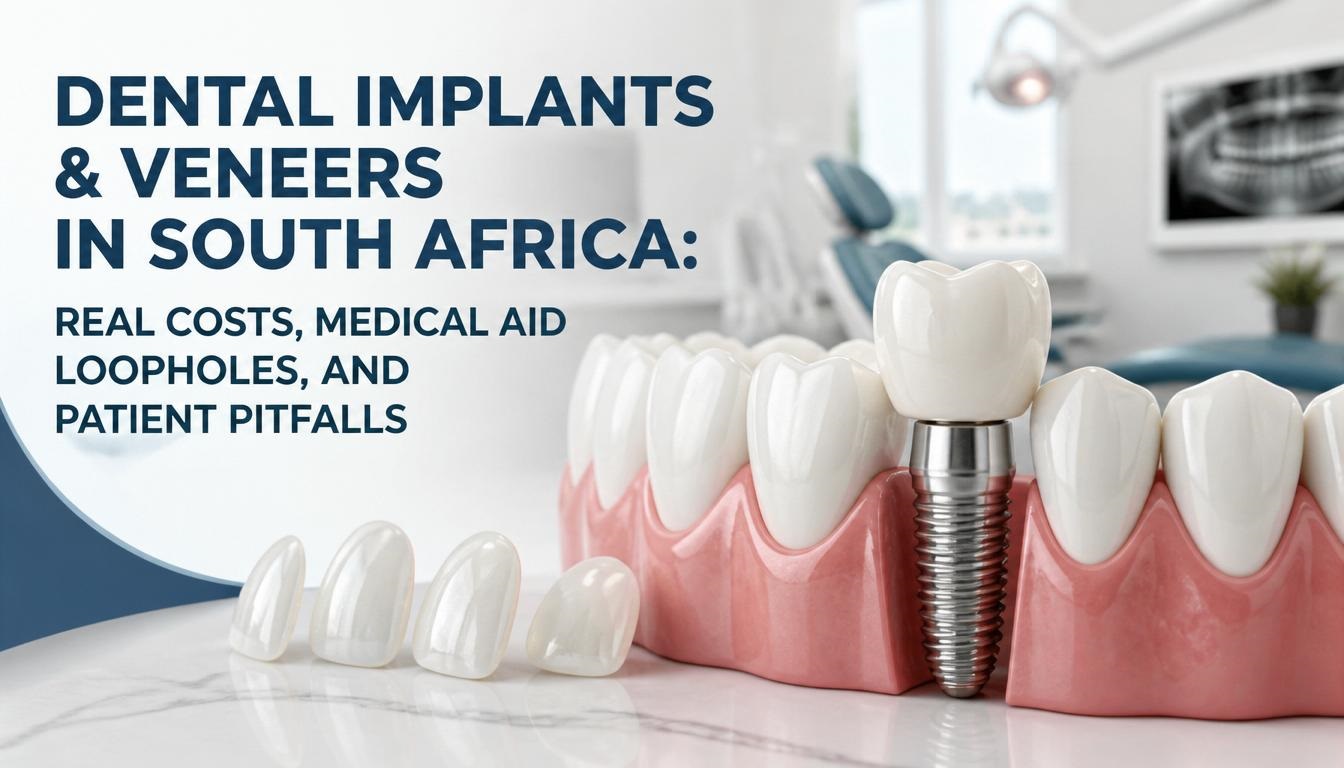
Walking into a high-end cosmetic dental practice in Rosebank, Sandton, or Camps Bay can feel intimidating. The sleek glass finishes, the subtle scent of clinical antiseptic, and the soft humming of 3D intraoral scanners all point to one reality: premium dental restorations are a major financial commitment.
When your smile suffers from deep structural damage, missing teeth, or severe discoloration, the path to recovery almost always leads to a choice between dental implants and porcelain veneers. However, navigating the true out-of-pocket expenses in South Africa is notoriously difficult. Private practice quotes are often fragmented, separating surgeon fees, laboratory charges, and material costs into confusing line items.
This breakdown cuts through the marketing fluff. We examine actual market rates across South Africa, break down line-item invoices, explain how major medical aid schemes interact with cosmetic dentistry, and provide practical advice to help you avoid predatory treatment plans.
The True Cost of Dental Restorations in South Africa
Dental pricing in South Africa operates on a free-market system. While the South African Dental Association (SADA) publishes guidelines, individual private practitioners set their own rates based on geographic location, clinical experience, and the specialized materials they use.
The table below outlines current average fees for standard dental implant and veneer procedures across South African metropolitan areas.
Comprehensive Price Comparison Table
| Restorative Procedure | Average Price Range (ZAR) | Expected Lifespan | Typical Number of Visits | Medical Aid Coverage Likelihood |
| Single Tooth Dental Implant (Titanium Post Only) | R8,000 – R15,000 | 20+ Years / Lifetime | 2 – 3 Surgical Stages | Extremely Low (Cosmetic/Elective) |
| Abutment & Custom Crown (Final Restoration) | R8,000 – R16,000 | 10 – 15 Years | 2 Restorative Stages | Partial (Ex-Seta / Scheme Dependent) |
| Complete Single Tooth Replacement (Post + Abutment + Crown) | R16,000 – R30,000 | 15+ Years | 3 – 5 Total Visits | Very Low (Requires Motivation Letter) |
| Full Arch All-on-4 Implants (Per Arch) | R75,000 – R160,000 | 15 – 25 Years | 4 – 6 Comprehensive Visits | Almost Non-Existent |
| Composite Resin Veneer (Direct Chairside) | R3,500 – R6,500 | 5 – 7 Years | 1 Single Appointment | Zero (Purely Cosmetic) |
| Porcelain Veneer (E.max / Lab-Crafted) | R9,000 – R16,000 | 10 – 15+ Years | 2 – 3 Precise Stages | Zero (Purely Cosmetic) |
| Full Smile Makeover (6 – 8 Upper Porcelain Veneers) | R60,000 – R130,000 | 10 – 15+ Years | 3 Multi-Hour Visits | Zero (Purely Cosmetic) |
Dental Implants vs. Veneers: Which One Do You Actually Need?
A common mistake made by patients seeking a smile transformation is confusing structural reconstruction with aesthetic refinement. Choosing the wrong procedure can cause unnecessary damage to healthy tooth structures or result in premature treatment failure.
1. Dental Implants: Biological Mechanics and Structural Integrity
A dental implant is a complete structural replacement for a missing tooth root.
-
The Mechanism: A biocompatible grade-4 pure titanium or zirconia screw is surgically inserted directly into the alveolar bone. Over 3 to 6 months, a biological process called osseointegration occurs, where bone cells fuse directly to the titanium surface.
-
When It Is Required: Implants are necessary for completely missing teeth, teeth with non-restorable root fractures, or following severe periodontal decay where extraction is unavoidable.
-
Functional Value: Unlike dental bridges, an implant preserves adjacent natural teeth because it does not require grinding down neighboring structures. Furthermore, it stimulates the jawbone through chewing forces, preventing the bone resorption and facial sagging that naturally occur after tooth loss.
2. Porcelain and Composite Veneers: Surface Aesthetics
Veneers are ultra-thin, custom-milled shells designed to bond directly to the front surface of existing natural teeth.
-
The Mechanism: The dentist removes a tiny layer of outer enamel—typically 0.3mm to 0.7mm—to ensure the restoration sits flush with the gum line. A digital impression is taken, and a specialized dental technician crafts the shell using high-strength lithium disilicate (E.max) or feldspathic porcelain.
-
When It Is Required: Veneers are ideal for correcting intrinsic enamel staining that resists chemical whitening, closing mild diastemas (gaps), reshaping peg lateral incisors, or masking minor surface cracks.
-
Functional Value: Veneers are purely surface-level restorations. They cannot replace a missing tooth and rely entirely on the underlying natural tooth structure for strength and support.
The Unseen Extras: Line-Item Cost Breakdown
When evaluating a preliminary estimate for a dental implant, the initial figure quoted by a practice often covers only the physical titanium post. To avoid unexpected out-of-pocket expenses, it is helpful to understand the full breakdown of required clinical line items.
Standard Dental Implant Invoice Structure
-
Initial Diagnostic Protocol (R2,500 – R4,500):
-
High-resolution 3D CBCT (Cone Beam Computed Tomography) scan to assess bone density, height, and nerve proximity.
-
Digital intraoral scanning and diagnostic smile design models.
-
-
Pre-Surgical Preparatory Procedures (Case-Dependent):
-
Bone Grafting (R4,500 – R12,000): Required if the jawbone has thinned due to long-term tooth loss. Bio-compatible synthetic bone matrix or autogenous grafts are placed to build a stable foundation.
-
Sinus Lift / Augmentation (R8,000 – R18,000): Necessary for upper posterior implants when the sinus cavity sits too close to the jawbone ridge.
-
Surgical Extraction (R1,500 – R3,500 per tooth): Removal of broken or diseased roots prior to implant placement.
-
-
Surgical Stage (R8,000 – R15,000):
-
Placement of the titanium implant body under sterile operating conditions.
-
Sterile surgical consumables, local anesthesia, and specialized drills.
-
Conscious sedation fees (if requested or administered by a visiting anesthetist): R4,000 – R8,000.
-
-
Prosthetic Stage (R8,000 – R16,000):
-
Healing abutment placement and subsequent customized titanium or zirconia abutment.
-
High-translucency monolithic zirconia or E.max dental crown, custom-stained by a master dental technician.
-
Medical Aid Realities in South Africa: Discovering Coverage Gaps
A common issue facing South African dental patients is assuming that a “Comprehensive” or “Executive” medical scheme plan will fully cover advanced dental restorations.
Discovery Health, Momentum, and Bonitas Frameworks
-
The “Cosmetic Exclusion” Rule: Almost every medical scheme operating under the Council for Medical Schemes (CMS) guidelines explicitly excludes porcelain veneers and cosmetic dentistry from core benefits. These are categorized as elective procedures and must be funded entirely from your personal Medical Savings Account (MSA) or paid out-of-pocket.
-
Dental Implants and Specialized Dentistry Benefits: Some high-tier medical aid plans offer a designated “Specialized Dentistry” benefit. However, this coverage comes with strict conditions:
-
Pre-Authorization Requirements: Implants are rarely approved for cosmetic reasons. Approval usually requires demonstrating severe functional impairment, such as loss of function following trauma, jaw reconstruction, or medical conditions where partial dentures are clinically unviable.
-
The Scheme Rate Gap: Medical aid plans reimburse procedures based on the National Health Reference Price List (NHRPL) or their own internal scheme rates. Private implant surgeons and prosthodontists typically charge between 200% and 400% of these base scheme rates. As a result, even when an implant placement is approved, the medical aid payment may cover only a fraction of the actual invoice, leaving you responsible for the remaining balance.
-
Sub-Limits and Co-Payments: Specialized dentistry sub-limits are often capped between R15,000 and R30,000 per family per year. This limit is easily used up by a single implant, leaving no remaining benefit for other specialized care later in the year.
-
Material Engineering: E.max Porcelain vs. Composite Resin vs. Zirconia
Understanding the technical differences between dental materials can help you evaluate their relative value and overall cost.
Material Specifications Breakdown
-
Composite Resin (Direct Chairside):
-
Cost: R3,500 – R6,500 per tooth
-
Expected Lifespan: 5 – 7 Years
-
Flexural Strength: Moderate (~120–160 MPa)
-
Aesthetics & Maintenance: Good initial translucency, but prone to micro-fractures, surface wear, and marginal discoloration over time. Requires regular professional polishing every 6 to 12 months.
-
Best Used For: Minor cosmetic adjustments, young patients whose bites are still settling, or budget-conscious smile enhancements.
-
-
Lithium Disilicate (E.max Porcelain):
-
Cost: R9,000 – R16,000 per tooth
-
Expected Lifespan: 10 – 15+ Years
-
Flexural Strength: High (~400–500 MPa)
-
Aesthetics & Maintenance: Exceptional optical characteristics that mimic natural enamel translucency, light reflection, and depth. Completely resistant to surface staining from coffee, red wine, or smoking. Standard home oral hygiene and routine bi-annual cleanings.
-
Best Used For: High-visibility front teeth (porcelain veneers and anterior crowns).
-
-
Monolithic Zirconia:
-
Cost: R10,000 – R18,000 per tooth
-
Expected Lifespan: 15 – 20+ Years
-
Flexural Strength: Ultra-High (1,000+ MPa)
-
Aesthetics & Maintenance: Slightly more opaque than E.max, though modern multi-layered zirconia blocks offer excellent aesthetics. Exceptionally durable with virtually zero risk of chipping.
-
Best Used For: Posterior (molar) implant crowns, full-arch All-on-4 bridges, and patients with severe bruxism (teeth grinding).
-
4 Red Flags to Watch for in Cheap Dental Quotes
While hunting for competitive pricing is understandable, extremely low quotes for implants or veneers often indicate compromises in material quality or surgical precision.
-
Undisclosed Surgical Component Quotes: A quote offering an “Implant for R7,999” often covers only the physical titanium screw placed into the bone. It excludes the surgical placement fee, healing abutment, digital scans, custom connector, and final porcelain crown—which can easily add another R12,000 to R18,000 to the total bill. Always request a comprehensive, written treatment plan that includes all stage codes.
-
Generic, Unbranded Implant Systems: Top-tier implant brands (such as Straumann, Nobel Biocare, or Dentsply Sirona) invest heavily in long-term clinical trials and supply standardized replacement parts globally. Discount clinics may use obscure, unbranded knockoffs. If a component fails or loosens ten years down the line, finding a matching driver or replacement abutment can prove impossible, often requiring complete surgical removal.
-
Over-reduction of Natural Teeth for Veneers: Be cautious of clinics that aggressively shave teeth down to tiny pegs for routine veneers. This removes the strong outer layer of enamel and exposes the sensitive dentin underneath. True veneer preparation should be minimally invasive. Aggressive grinding is actually full-coverage crown preparation, which compromises the long-term health and vitality of the underlying tooth pulp.
-
Skipping Preliminary 3D CBCT Scans: Placing an implant using only 2D panoramic X-rays is a major clinical risk. A 2D image cannot accurately measure 3D bone depth, density, or the precise location of the inferior alveolar nerve. Inserting an implant without a 3D CBCT scan increases the risk of permanent nerve paresthesia (facial numbness) or sinus perforation.
Interactive Patient Assessment: Where Are You on Your Restorative Journey?
To help us tailor further details to your specific situation, tell us a bit more about what you are facing:
Are you currently weighing your options for a single missing tooth, looking into a full-arch transformation, or trying to navigate a medical aid claim rejection?
Drop your questions or experience in the comments section below! Sharing your local city (Johannesburg, Cape Town, Durban, Pretoria) or your current medical aid scheme helps us provide more specific insight into local practice standards and funding options.

Joseph Mathebula is a consumer analyst and market researcher at Prices in South Africa. He specializes in tracking local service costs, retail pricing, and travel budgets, helping everyday shoppers navigate the market to secure the best value.