Quick Overview
Estimated Running Cost Per Cycle: R3.80 to R7.50 (inclusive of electricity, water, detergent, and rinse aid/salt maintenance).
Primary Value/Cost Factor: Choice of detergent (powder vs. premium tablets accounts for up to 65% of the total cycle cost).
Recommended Retailer/Service Option: Bulk purchases via Takealot or Checkers Sixty60 (Look out for 100-pack value tubs and store-brand rinse aids).
Immediate Bottom-Line Verdict: Running a modern dishwasher on an Eco cycle costs significantly less than handwashing under a running tap in South Africa, saving up to 30 liters of heated water per load.
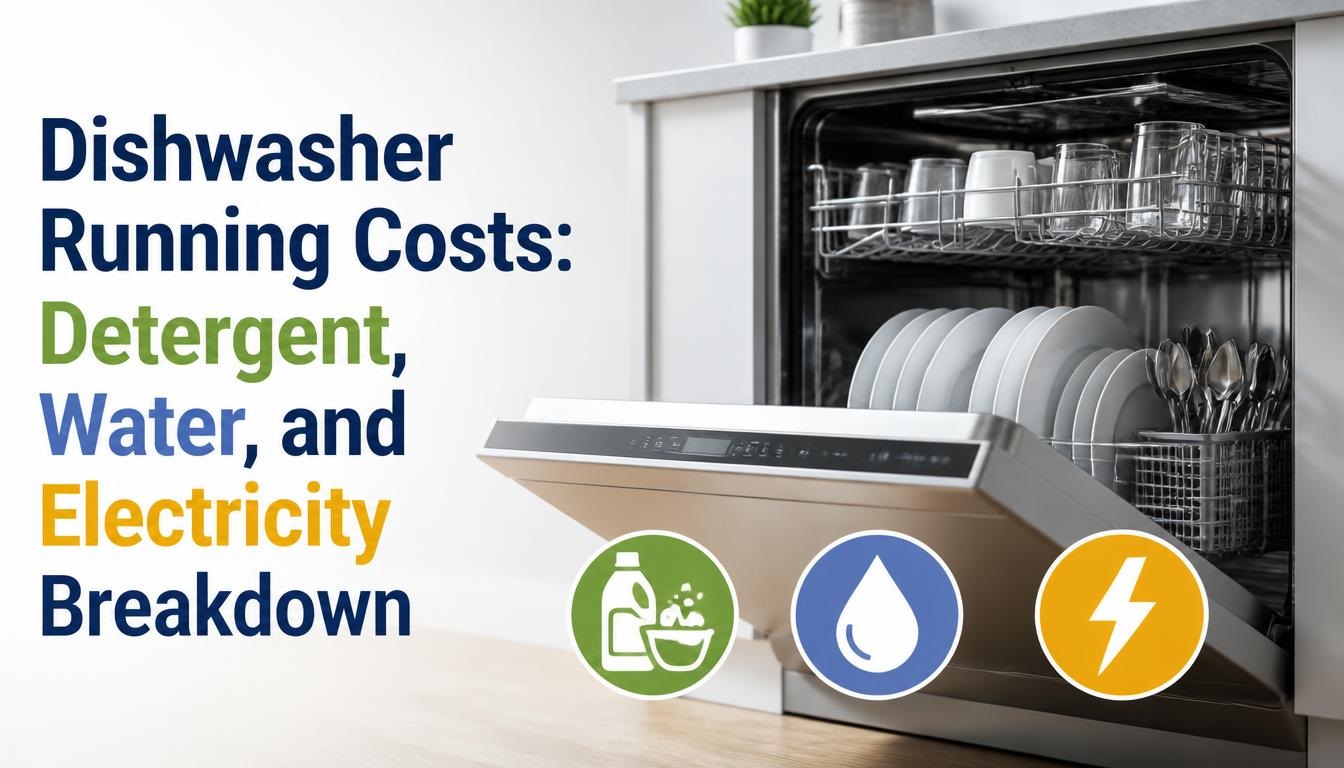
Dishwasher Running Costs: Detergent, Water, and Electricity Breakdown
Many South African households question whether running an automatic dishwasher is a luxury that drives up municipal billing or a smart utility saver. With persistent electricity tariff hikes from Eskom and local municipalities, alongside rising water tariffs across metros like Joburg, Cape Town, and eThekwini, calculating exact appliance running costs is essential for tight household budgets.
The short answer is that running a standard 13-place to 15-place setting dishwasher in South Africa costs between R3.80 and R7.50 per load. However, the exact breakdown depends heavily on whether you load expensive multi-action gel caps or economical bulk powder, and whether your machine relies on peak-rate municipal power. Below is an exhaustive, real-world cost analysis designed to help you optimize every wash.
Market Overview
The shift toward modern dishwashers across South African homes is no longer just about convenience; it is a strategic approach to resource management. Washing dishes by hand in a sink typically consumes between 30 and 50 liters of water per session, warmed continuously by an electric geyser that pulls significant power. By comparison, a modern A+++ rated dishwasher uses between 9.5 and 13 liters of water per cycle.
Because modern dishwashers draw cold water directly from your plumbing feed and heat it internally using high-efficiency heating elements, they bypass geyser heat-loss inefficiencies. However, overall running costs are influenced by external economic factors, including South Africa’s standard 15% Value Added Tax (VAT), municipal electricity step-tariffs, and inflation on imported cleaning chemicals.
Understanding how electricity, water, and detergent contribute to your monthly utility bills provides a clear view of how to maximize appliance efficiency.
Deep-Dive Pricing Breakdown
To understand where your money goes during a 90-to-180-minute cycle, we must isolate the three core variables: power consumption, water usage, and chemical consumables.
-
Detergent & Consumables: Makes up approximately 55% to 70% of the total cycle cost.
-
Electricity Consumption: Accounts for roughly 25% to 35% of the operational expense.
-
Water Consumption: Represents a small fraction, around 5% to 10% of the overall price per load.
1. Electricity Usage Costs (Eskom & Municipal Tariffs)
Most dishwashers draw between 1.0 kWh and 1.5 kWh of electricity per standard 65°C cycle. The vast majority of this energy is expended during the water heating phase, while the motor driving the spray arms uses minimal power.
Assuming an average residential tariff rate of R3.20 to R4.10 per kWh (inclusive of VAT, reflecting standard Step 1/Step 2 municipal tariffs across major SA metros):
-
Eco Cycle (45°C–50°C): Consumes ~0.8 kWh → R2.56 to R3.28 per cycle
-
Standard / Auto Cycle (65°C): Consumes ~1.2 kWh → R3.84 to R4.92 per cycle
-
Intensive / Hygiene Cycle (70°C): Consumes ~1.6 kWh → R5.12 to R6.56 per cycle
2. Water Consumption Costs
Water tariffs vary across South African municipalities and are categorized by usage blocks. On average, domestic water costs approximately R35.00 to R55.00 per kilolitre (kl) including sanitation/sewerage charges.
-
Modern Eco-Rated Dishwasher: Uses 9.5 liters per cycle → R0.33 to R0.52 per cycle
-
Standard / Older Dishwasher: Uses 14 liters per cycle → R0.49 to R0.77 per cycle
3. Detergent & Chemical Consumables
This component accounts for the highest variable expenditure in automatic dishwashing.
-
Premium All-in-1 Quantum Tablets (e.g., Finish Quantum / Somat Gold): R4.00 to R6.50 per tablet.
-
Standard All-in-1 Tablets (e.g., Sunlight 5-in-1 / Finish Powerball): R2.20 to R3.50 per tablet.
-
Auto Dishwashing Powder (e.g., Finish 1kg / Store Brand): R0.80 to R1.40 per wash (based on a 25g dose).
-
Rinse Aid & Dishwasher Salt: Adding dedicated rinse aid and salt (crucial for South Africa’s hard water areas) adds roughly R0.40 to R0.80 per load.
| Cost Component | Low-Cost Setup (Powder + Eco Mode) | Standard Setup (All-in-1 Tablet) | High-Cost Setup (Intensive + Premium Tab) |
| Electricity (per load) | R2.56 (0.8 kWh) | R3.84 (1.2 kWh) | R5.12 (1.6 kWh) |
| Water (per load) | R0.33 (9.5L) | R0.42 (11L) | R0.52 (14L) |
| Detergent / Tablet | R1.10 (Auto Powder) | R2.80 (Standard Tab) | R5.50 (Premium Gel Cap) |
| Rinse Aid & Salt Allocation | R0.50 | Included in tab / R0.30 | R0.60 |
| Total Cost Per Wash | R4.49 | R7.36 | R11.74 |
| Estimated Monthly Cost (30 Loads) | R134.70 | R220.80 | R352.20 |
Practical Field Observations
Living with a dishwasher in South Africa reveals operational quirks that rarely show up in technical brochures. Field feedback from local homeowners and appliance technicians highlights several key practicalities:
-
Hard Water Mineral Buildup: In coastal regions and areas reliant on borehole supply or hard municipal water (such as parts of the Western Cape, West Rand, and Limpopo), limescale accumulates rapidly on heating elements. When heating elements become encrusted with white mineral deposits, they take longer to heat water, pushing electricity consumption up by 15% to 25%. Using dishwashing salt regularly—even if using “All-in-1” tablets—is essential for keeping internal sensors clean.
-
Filter Clogging and Drainage Pumps: A common issue reported to local repair technicians involves dishwashers failing to drain or leaving a gritty residue on glass. In 80% of service calls, the cause is an uncleaned mesh filter at the bottom of the tub. Rinsing the filter weekly under warm tap water prevents the drain pump from laboring and drawing unnecessary current.
-
Bypassing Inverter Generators & Solar Backup: With home solar systems becoming widespread across South Africa, timing your dishwashing routine matters. A dishwasher’s heating element creates a sudden 1,800W to 2,000W spike when heating cold water. Running a cycle at 12:00 PM while your solar panels are generating peak power keeps operating costs close to zero Rand. Conversely, running a hot wash on battery power during an evening load reduction window can drain 1.5 kWh directly from your lithium storage array.
Retailer & Supplier Comparison
Sourcing dishwashing consumables in South Africa requires strategic shopping. Prices for tablets and powders fluctuate significantly between major supermarket chains, bulk wholesalers, and online platforms.
-
Checkers / Checkers Sixty60: Excellent for spot sales and multi-pack promotions. Their house brand options and regular 25% discount promotions on brand-name 56-packs offer solid day-to-day value.
-
Takealot: The go-to retailer for buying 100-tablet value packs in bulk. Purchasing 100-count or 120-count bulk packs drops the unit cost per tablet down to the R3.00–R3.80 range, compared to R5.00+ when buying small 20-pack boxes.
-
Makro & Game: Highly competitive for 2kg or 3kg bulk dishwashing powders and commercial-sized 5-liter rinse aid bottles. Ideal for larger families running one or two loads daily.
-
Clicks & Dis-Chem: Convenient for specialized extras like machine cleaners and water-softening salts, though daily tablet prices tend to sit at standard retail pricing unless linked to loyalty card rewards.
Cost-Saving Strategies
To keep your monthly dishwasher operating expenditure as low as possible without sacrificing hygiene, implement these field-tested practices:
-
Switch from Multi-Tabs to Powder: Unless your cookware is heavily burnt, standard loose auto-dishwashing powder allows you to control the exact dosage. A half-dose for lightly soiled loads drops detergent expenses to under R1.00 per cycle.
-
Always Choose the Eco Program: Eco cycles take longer (often up to 3 hours), leading many to assume they use more power. In reality, they heat water more gradually to a lower maximum temperature (45°C–50°C), reducing energy draw by up to 30-40%.
-
Scrape, Don’t Pre-Rinse: Pre-rinsing dishes under a running warm tap uses up to 20 liters of hot geyser water before the machine even starts—effectively doubling your cost. Modern enzymes in dishwasher detergents require food soil to activate correctly. Simply scrape solid debris into the bin and load.
-
Leverage Solar Production Windows: If you have a grid-tied solar system, schedule your dishwasher using the delay-timer function to run at midday. This ensures water heating relies on solar energy rather than municipal grid power.
-
Run Only Full Loads: Running two half-empty loads consumes twice the water and power of a single well-stacked full load. Ensure spray arms can rotate freely, but maximize rack space before starting a cycle.
Frequently Asked Questions
Is it cheaper to run a dishwasher or wash dishes by hand in South Africa?
Using an energy-efficient dishwasher on an Eco cycle is generally cheaper than washing by hand. Handwashing typically uses between 30 and 50 liters of hot water from your geyser per session, whereas a dishwasher uses only 9.5 to 11 liters and heats water internally.
How much electricity does a dishwasher use per hour?
A standard dishwasher rated at 1,800W uses approximately 1.0 kWh to 1.5 kWh for a complete cycle, rather than drawing continuous peak power for every hour it runs. Peak power draw occurs primarily during the 20-30 minute water-heating phase.
Can I use standard liquid hand dish soap in a dishwasher?
No. Standard hand dishwashing liquids (like Sunlight Dishwashing Liquid) generate excessive foam that will flood your appliance, damage internal electrical components, and trigger drainage fault errors. Only use specialized low-foaming auto-dishwashing powders, gels, or tablets.
Do I really need dishwasher salt in South Africa?
Yes, particularly if you live in regions with hard water or rely on municipal supplies with high mineral content. Dishwasher salt regenerates the built-in ion-exchange softener unit, preventing white limescale spots on glassware and extending the lifespan of the heating element.
Does the short 30-minute quick wash save money?
Not necessarily. Quick wash cycles rapidly heat water to high temperatures in a short window and often run the internal pump at higher speeds, consuming similar or greater amounts of electricity compared to longer, low-temperature Eco programs.
Disclaimer: Prices listed in this guide are estimates based on average South African market rates at the time of publication and are subject to change without notice. Always verify final pricing with official providers or retailers before making purchase decisions.
What has your experience been with running appliance costs in your household? Have you noticed a difference on your municipal bill since switching between tablets and powder, or optimizing your solar generation windows? Drop your thoughts, local detergent finds, or questions in the comments section below—we would love to hear what works for your home!

Joseph Mathebula is a consumer analyst and market researcher at Prices in South Africa. He specializes in tracking local service costs, retail pricing, and travel budgets, helping everyday shoppers navigate the market to secure the best value.