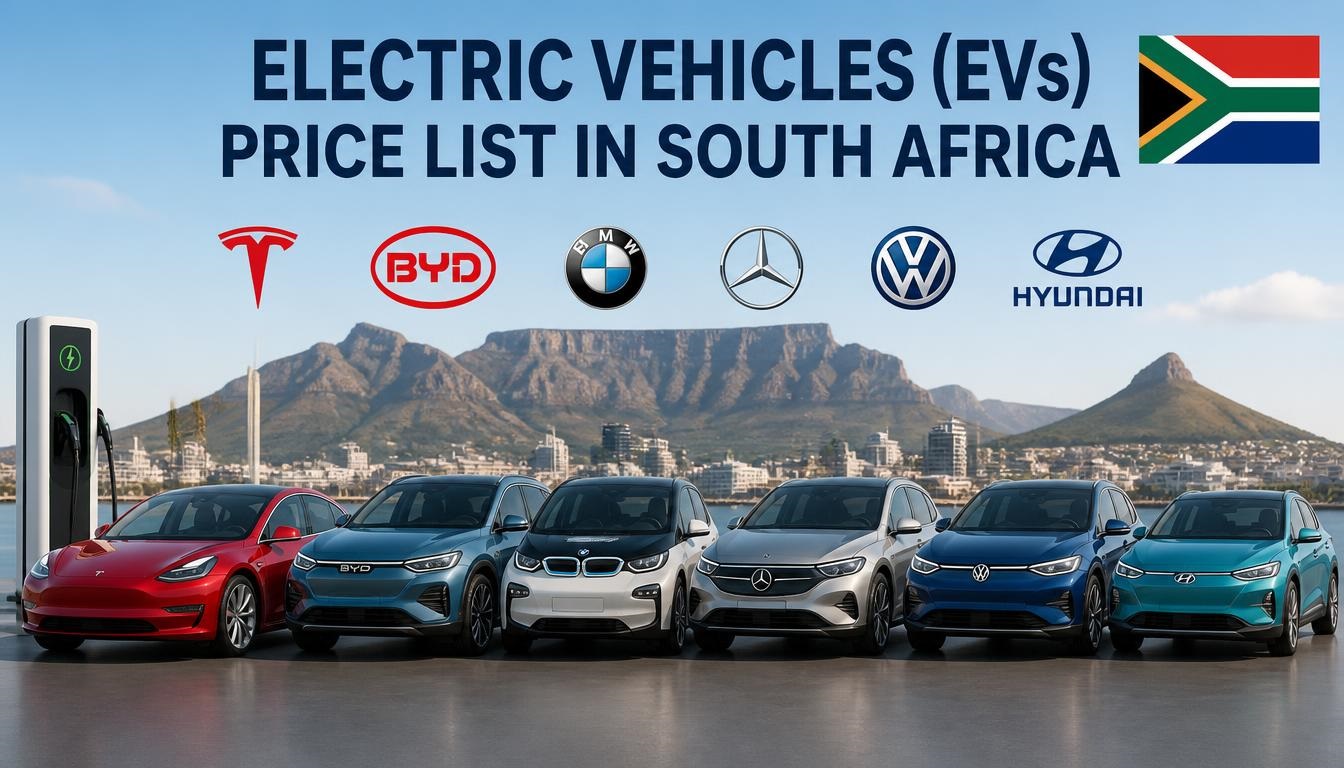
Buying an electric car in South Africa is no longer an exclusive game reserved for Sandton millionaires driving imported European luxury cruisers. Driven by an aggressive wave of Chinese entrants, entry-level battery electric vehicle (BEV) sticker prices have plummeted by over 50%. However, beneath the slick marketing displays and zero-emissions claims lies a complex matrix of 25% import tariffs, Eskom tariff hikes, municipal charging variations, and brutal battery degradation realities caused by high ambient heat in places like the Karoo and Limpopo.
Navigating the Electric Vehicles Price List in South Africa requires looking beyond the showroom window sticker to evaluate the complete total cost of ownership (TCO).
2026 SA Electric Vehicle Market Snapshot
2026 South African EV Market Price Matrix
The dynamic structure below details the current pricing, power outputs, claimed battery ranges, and value tiers across budget, mid-tier, and premium electric vehicles currently on sale in South Africa.
| Model Variant | Base Price (Incl. 15% VAT) | Power / Torque | Battery Capacity | Claimed Range | SA Market Value Rating | Official Reference |
| Geely E2 Aspire | R339,900 | 85 kW / 150 Nm | 39.4 kWh LFP | 325 km | Excellent (Urban) | Check Category Specs |
| BYD Dolphin Surf Comfort | R341,900 | 55 kW / 135 Nm | 30.1 kWh LFP | 300 km | High (City Runabout) | BYD SA – View Details |
| Dongfeng Box E2 430 | R349,000 | 70 kW / 160 Nm | 43.9 kWh LFP | 430 km | Very High (Range/Price) | Dongfeng SA – View Details |
| Chery Q Comfort | R349,900 | 90 kW / 115 Nm | 42.7 kWh LFP | 400 km | High (Compact Crossover) | Chery SA – View Details |
| Dayun Yuehu S5 VIP | R449,900 | 105 kW / 105 Nm | 31.7 kWh NMC | 300 km | Moderate | Enviro Automotive – View Details |
| BYD Dolphin Standard | R539,900 | 70 kW / 180 Nm | 44.9 kWh Blade | 340 km | Balanced Family | BYD SA – View Details |
| GWM Ora 03 300 Super Lux | R686,950 | 126 kW / 250 Nm | 48.0 kWh LFP | 310 km | Premium Lifestyle | GWM SA – View Details |
| Geely E5 Aspire | R699,999 | 160 kW / 310 Nm | 60.2 kWh LFP | 430 km | Exceptional Value SUV | Check Category Specs |
| BYD Atto 3 Extended | R768,000 | 150 kW / 310 Nm | 60.4 kWh Blade | 420 km | Benchmark Crossover | BYD SA – View Details |
| Volvo EX30 Core Single | R835,500 | 200 kW / 343 Nm | 51.0 kWh LFP | 344 km | Premium Compact | Volvo SA – View Details |
| Changan Deepal S07 | R995,900 | 160 kW / 320 Nm | 66.8 kWh NMC | 500 km | Mid-Size Luxury SUV | Changan SA – View Details |
| BYD Seal Performance AWD | R1,200,000 | 390 kW / 670 Nm | 82.5 kWh Blade | 520 km | High Performance | BYD SA – View Details |
| BMW iX1 xDrive30 | R1,210,000 | 230 kW / 494 Nm | 64.7 kWh NMC | 400 km | Executive Compact | BMW SA – View Details |
| Mercedes-Benz EQE 350+ | R1,730,000 | 215 kW / 565 Nm | 89.0 kWh NMC | 500 km | Luxury Sedan | Mercedes-Benz SA – View Details |
| Porsche Taycan Turbo | R4,330,000 | 500 kW / 850 Nm | 93.4 kWh NMC | 507 km | Ultra-Performance | Porsche SA – View Details |
Focusing strictly on the retail purchase price of a vehicle on an Electric Vehicles Price List in South Africa will leave your bank account vulnerable to unexpected post-purchase hits. Operating an EV in South Africa requires managing three distinct cost layers that traditional petrol or diesel ownership never introduces.
Total Cost of Ownership Structure
-
Capital Expenditure (Upfront & Installation)
-
Vehicle Sticker Price (including 15% VAT)
-
Ad Valorem Import Duty (25%)
-
Dedicated Home Wallbox Unit (R15,000 – R28,000 installed)
-
Off-Grid Solar & Inverter System Integration
-
-
Operational Expenses (Ongoing Infrastructure)
-
Standard Residential Grid Power Rates (Eskom & Municipal)
-
Public Fast DC Charging Network Tariffs
-
High-Risk Insurance Premiums & Tracker Contracts
-
Out-of-Warranty Battery Replacement Reserve Fund
-
1. Home Charging Infrastructure & The Solar Reality
Plugging a 60 kWh battery into a standard 3-pin wall socket delivering 2.3 kW will take nearly 26 hours to complete a 0–100% charge. To achieve practical turnaround times, a dedicated 7.4 kW single-phase or 22 kW three-phase AC Wallbox charger is mandatory.
-
Basic Wallbox Unit: R12,500 – R18,000 (depending on smart-app capabilities and load balancing features).
-
Certificate of Compliance (CoC) Installation: R4,500 – R10,000 depending on the distance from your main distribution board and necessary cable trenching.
-
The Load-Shedding Surcharge: If you charge during municipal power interruptions, your battery will rapidly drain a typical 5kW or 8kW home inverter system. Integrating an EV charger into a solar PV setup requires at least an 8kW or 12kW hybrid inverter paired with a dedicated 10kWh to 15kWh stationary storage bank, adding R80,000 – R140,000 to your home energy infrastructure.
2. Public DC Fast-Charging Network Rates
While charging at home on a standard residential municipal tariff costs roughly R2.80 to R3.80 per kWh, relying on public infrastructure (such as GridCars, ChargePoint, or Rubicon networks along the N1, N2, and N3 highways) changes the financial calculation significantly.
-
AC Public Charging (11 kW – 22 kW): R5.50 – R6.50 per kWh
-
DC Fast Charging (50 kW – 150 kW+): R7.50 – R9.80 per kWh
When charging a vehicle like the BYD Atto 3 (60.4 kWh capacity) at a public 150 kW DC fast charger, a 10% to 80% replenishment costs roughly R320 to R415 for approximately 280 km of real-world highway range. While this remains cheaper than petrol per kilometer, the margin narrows substantially during long-distance road trips.
Local insurers classify BEVs in higher risk brackets than equivalent ICE vehicles. This is driven by three main factors:
-
A lack of local structural repair technicians trained in high-voltage aluminum spaceframes.
-
Expensive replacement costs for underbody casing damage caused by severe pothole impacts.
-
Higher write-off ratios when battery pack seals are compromised during accidents.
Expect insurance quotes for a R700,000 EV to land 18% to 30% higher per month than a R700,000 petrol-powered vehicle, often requiring tracking unit installations and certified garage parking.
Local Stress Test: Extreme Heat, Corrugated Roads, and Eskom Realities
South African driving conditions are notoriously harsh on battery-powered drivetrains. A vehicle that achieves 400 km under mild European test cycles will perform differently on a summer road trip through the Karoo or across corrugated gravel tracks in the North West.
Operational Survival Breakdown
-
40°C+ Ambient Heat (Karoo / Limpopo / Kalahari):
-
Impact: Practical range drops by 12% to 18% due to continuous active cabin A/C and liquid battery cooling.
-
Solution: Prioritize LFP (Lithium Iron Phosphate) batteries over NMC chemistries due to superior thermal stability under extreme ambient heat.
-
-
Corrugated Dirt Roads (District & Rural Routes):
-
Impact: Low-slung underbody battery packs are exposed to severe vibration and structural stone strikes.
-
Solution: Require a minimum of 160mm ground clearance, reinforced underbody skid plates, and high-profile tires.
-
-
Eskom Stage 4+ Outages (Grid Reliability & Highway Travel):
-
Impact: Public DC charging stations can go offline if not paired with dedicated local solar/battery storage.
-
Solution: Plan highway routes using multi-network charging apps and install dedicated solar feeds for home charging.
-
Thermal Management Under Summer Sun
Extreme heat accelerates chemical degradation in lithium-ion cells. Vehicles utilizing Lithium Iron Phosphate (LFP) chemistries—such as the BYD Blade Battery, Geely E2, and Dongfeng Box—exhibit significantly higher thermal stability than traditional Nickel Manganese Cobalt (NMC) packs.
Active liquid cooling systems are critical. During 42°C summer days in Upington or Musina, an active cooling pump draws substantial energy directly from the main battery to keep cell temperatures below 35°C, resulting in an automatic 12% to 18% reduction in total driving range before cabin air conditioning is even factored in.
Potholes and Suspension Longevity
EVs carry a massive weight penalty due to their floor-mounted battery packs. A compact hatchback like the GWM Ora 03 weighs over 1,550 kg, while mid-sized SUVs regularly surpass 2,100 kg.
Hitting a deep pothole on the R56 or N14 in a heavy EV exerts immense dynamic loads on suspension arms, wheel bearings, and low-profile rims. When evaluating options on the Electric Vehicles Price List in South Africa, prioritize models equipped with higher-profile sidewall tires (e.g., 215/60 R17) over stylish 20-inch low-profile options. A cracked rim on an imported EV can result in a multi-week wait for replacement parts at an authorized dealership.
Legal & Regulatory Safeguards for South African Buyers
Buying an EV without understanding the local regulatory environment can leave you with an unregistered, uninsurable asset sitting in your driveway.
Before any vehicle on an Electric Vehicles Price List in South Africa can be registered on the eNaTIS system, the importer must obtain a Letter of Authority (LOA) from the National Regulator for Compulsory Specifications (NRCS).
Grey-import EV vehicles or grey-market commercial fleet conversions often lack valid NRCS homologation. Without an official LOA certificate, municipal licensing departments will reject the eNaTIS application, rendering the vehicle illegal for public road use. Always demand proof of NRCS compliance in writing from independent motor importers before paying a deposit.
2. High-Voltage Battery Warranties & Consumer Protection Act (CPA)
Under the South African Consumer Protection Act (CPA) No. 68 of 2008, consumers are protected against latent defects. However, battery degradation terms require close inspection:
-
Industry Standard Warranty: 8 Years / 160,000 km to 200,000 km covering battery health.
-
Degradation Threshold: Warranty claims typically trigger only when the State of Health (SoH) of the pack drops below 70% during the warranty window.
-
CPA Coverage Warning: Fast-charging your EV continuously on high-output DC chargers (over 100 kW) can lead to accelerated wear. Some manufacturer handbooks contain fine print stating that excessive DC fast-charging voids specific warranty claims regarding cell balance.
Frequently Asked Questions
Which model is currently the cheapest EV in South Africa?
The Geely E2 Aspire holds the title as the most affordable fully electric passenger car in South Africa, starting at R339,900. It is closely followed by the BYD Dolphin Surf Comfort at R341,900 and the Dongfeng Box E2 430 at R349,000.
Why are electric vehicles taxed higher than petrol cars in SA?
South African customs duties levy a 25% import tariff on all fully electric vehicles regardless of their country of origin. Petrol and diesel vehicles imported from the European Union carry lower tariffs (down to 18%) due to historical trade agreements. While the SA government’s Electric Vehicle White Paper aims to incentivize local manufacturing, import duties on finished BEVs remain a major driver of elevated local retail pricing.
How long does an electric vehicle battery last under SA conditions?
Modern LFP (Lithium Iron Phosphate) batteries found in the majority of budget-to-mid-tier Chinese EVs are rated for 3,000 to 5,000 charge cycles. For an average driver covering 20,000 km annually, the battery pack is designed to maintain over 75% to 80% capacity for 12 to 15 years, easily outlasting the typical first-owner usage cycle.
Can I charge an electric car during load-shedding?
You can only charge an EV during a grid outage if your home is equipped with a solar-assisted hybrid inverter system that has sufficient spare output capacity. Standard wallboxes will drop offline during power cuts unless powered by a dedicated solar and stationary battery bank capable of handling continuous high-amperage draws (typically requiring an 8 kW to 12 kW inverter setup).
Community Discussion & Real-World Quotes
Are you currently evaluating options on the Electric Vehicles Price List in South Africa, or have you recently received a written quote from a dealer in Gauteng, the Western Cape, or KwaZulu-Natal?
Drop your real-world experience in the comments section below! Share your actual delivery lead times, home Wallbox installation costs, or insurance quotes. If you’ve taken delivery of a budget BEV, let our community know your real-world highway range when driving against South African headwinds!
Disclaimer: Prices fluctuate and reflect independent market research at the time of publication. We may earn a small affiliate commission through qualified links at no extra cost to you.

Joseph Mathebula is a consumer analyst and market researcher at Prices in South Africa. He specializes in tracking local service costs, retail pricing, and travel budgets, helping everyday shoppers navigate the market to secure the best value.